Water Woes: Pakistan's Provincial Divide

Generated from prompt:

Inter-provincial Divergences in Water Distribution: 1. The 1991 Water Apportionment Accord (WAA) - All four provinces accepted the 1991 Accord, allocating Indus waters and leading to the creation of IRSA. It is seen as a historic achievement, comparable to the Indus Waters Treaty. - However, mistrust has grown over its implementation, especially in four key areas. a. Water Distribution Formula - The Accord allocated water based on 114 MAF, but actual distribution is unclear due to reduced availability. - In 2003, a three-tiered formula was agreed, but Sindh insists on adhering to the Accord. - This has caused repeated disputes, particularly between Punjab and Sindh. b. Data and Transparency - Lack of a telemetry system fuels mistrust, making it hard to verify if provinces receive their agreed share. - Without a trusted real-time monitoring system, suspicion remains during water shortfalls. c. Lower Riparian Concerns - Sindh argues it doesn’t consistently receive its full share, particularly during low-flow periods. - Insufficient flows below Kotri cause sea intrusion, delta loss, and damage to mangroves and agriculture. d. Trust Deficit - Punjab argues that river flows have declined, facing shortages but still adhering to the Accord and IRSA rules. - Khyber Pakhtunkhwa and Balochistan raise concerns about infrastructure and delivery of their shares. - This leads to a trust deficit, with provinces viewing shortfalls as unfair. 2. Sindh Concerns over New Canals (GPI) - Sindh expresses concerns about the Green Pakistan Initiative (GPI), especially with water allocation for projects like the Mahfooz Shaheed Canal and the Kachhi Canal. - The province fears that diverting water for these projects will reduce freshwater flow to critical areas, exacerbating seawater intrusion and land degradation in the Indus Delta. - Sindh calls for a balanced approach to water management, ensuring equitable distribution and protecting the environment and agriculture.

Examines inter-provincial tensions over the 1991 Water Apportionment Accord, highlighting disputes on distribution formulas, data transparency, Sindh's riparian concerns, and trust deficits. Also cove

November 26, 202512 slides
Slide 1 of 12

Slide 1 - Inter-provincial Divergences in Water Distribution

The slide's title, "Inter-provincial Divergences in Water Distribution," highlights disparities in how water is allocated across provinces. Its subtitle focuses on the challenges posed by Pakistan's Indus Water Sharing and the 1991 Accord.

Inter-Provincial Divergences in Water Distribution

Challenges in Pakistan's Indus Water Sharing and 1991 Accord
Slide 1 - Inter-provincial Divergences in Water Distribution
Slide 2 of 12

Slide 2 - Presentation Agenda

The presentation agenda outlines the structure of a discussion on the 1991 Water Apportionment Accord, starting with an introduction to the accord itself. It then covers key implementation issues, Sindh's concerns regarding new canals, and concludes with recommendations.

Presentation Agenda

  1. Introduction to 1991 Water Apportionment Accord
  2. Key Implementation Issues
  3. Sindh Concerns over New Canals
  4. Conclusion and Recommendations
Slide 2 - Presentation Agenda
Slide 3 of 12

Slide 3 - The 1991 Water Apportionment Accord (WAA)

The 1991 Water Apportionment Accord (WAA) is the title of this section header slide, marking it as Section 1. It highlights a historic agreement accepted by all four provinces that allocates waters from the Indus River.

The 1991 Water Apportionment Accord (WAA)

1

The 1991 Water Apportionment Accord

Historic agreement accepted by all four provinces allocating Indus waters

Speaker Notes
Historic agreement accepted by all four provinces, allocating Indus waters and creating IRSA, comparable to the Indus Waters Treaty. Context: Inter-provincial Divergences in Water Distribution: 1. The 1991 Water Apportionment Accord (WAA) - All four provinces accepted the 1991 Accord, allocating Indus waters and leading to the creation of IRSA. It is seen as a historic achievement, comparable to the Indus Waters Treaty. - However, mistrust has grown over its implementation, especially in four key areas. a. Water Distribution Formula - The Accord allocated water based on 114 MAF, but actual distribution is unclear due to reduced availability. - In 2003, a three-tiered formula was agreed, but Sindh insists on adhering to the Accord. - This has caused repeated disputes, particularly between Punjab and Sindh. b. Data and Transparency - Lack of a telemetry system fuels mistrust, making it hard to verify if provinces receive their agreed share. - Without a trusted real-time monitoring system, suspicion remains during water shortfalls. c. Lower Riparian Concerns - Sindh argues it doesn’t consistently receive its full share, particularly during low-flow periods. - Insufficient flows below Kotri cause sea intrusion, delta loss, and damage to mangroves and agriculture. d. Trust Deficit - Punjab argues that river flows have declined, facing shortages but still adhering to the Accord and IRSA rules. - Khyber Pakhtunkhwa and Balochistan raise concerns about infrastructure and delivery of their shares. - This leads to a trust deficit, with provinces viewing shortfalls as unfair. 2. Sindh Concerns over New Canals (GPI) - Sindh expresses concerns about the Green Pakistan Initiative (GPI), especially with water allocation for projects like the Mahfooz Shaheed Canal and the Kachhi Canal. - The province fears that diverting water for these projects will reduce freshwater flow to critical areas, exacerbating seawater intrusion and land degradation in the Indus Delta. - Sindh calls for a balanced approach to water management, ensuring equitable distribution and protecting the environment and agriculture.
Slide 3 - The 1991 Water Apportionment Accord (WAA)
Slide 4 of 12

Slide 4 - Growth of Mistrust in Implementation

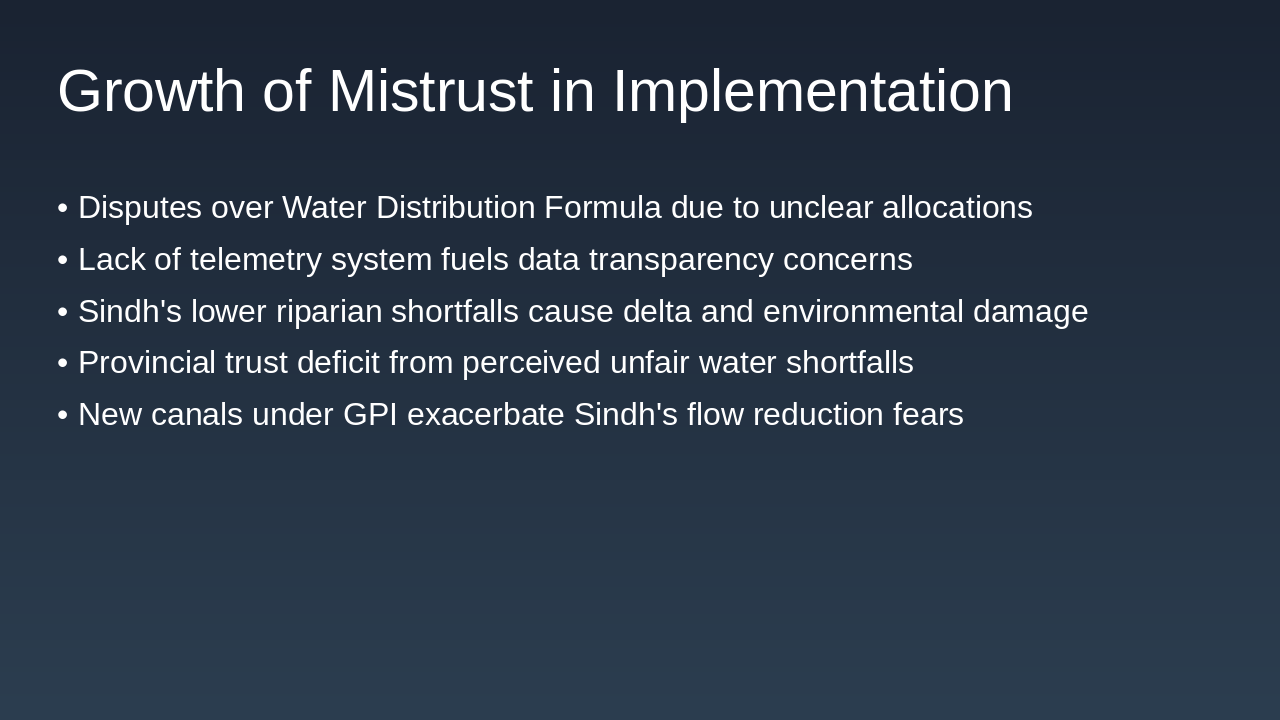
Mistrust in water implementation grows from disputes over unclear distribution formulas, lack of telemetry fueling transparency issues, and Sindh's shortfalls as the lower riparian causing delta and environmental damage. This erodes provincial trust due to perceived unfair shortfalls, worsened by new canals under GPI that heighten fears of further flow reductions to Sindh.

Growth of Mistrust in Implementation

  • Disputes over Water Distribution Formula due to unclear allocations
  • Lack of telemetry system fuels data transparency concerns
  • Sindh's lower riparian shortfalls cause delta and environmental damage
  • Provincial trust deficit from perceived unfair water shortfalls
  • New canals under GPI exacerbate Sindh's flow reduction fears
Slide 4 - Growth of Mistrust in Implementation
Slide 5 of 12

Slide 5 - Water Distribution Formula Disputes

The 1991 Accord allocates Indus waters based on a 114 MAF baseline, but reduced availability has led to implementation uncertainties, prompting a 2003 three-tiered formula to address shortages. Disputes persist between Punjab and Sindh, with Sindh insisting on the original Accord provisions while disagreements over shares continue.

Water Distribution Formula Disputes

  • 1991 Accord allocates Indus waters based on 114 MAF baseline.
  • Reduced availability creates uncertainties in actual distribution implementation.
  • 2003 three-tiered formula agreed to address shortages.
  • Sindh insists on adhering to original Accord provisions.
  • Disputes persist between Punjab and Sindh over shares.
Slide 5 - Water Distribution Formula Disputes
Slide 6 of 12

Slide 6 - Data and Transparency Challenges

The absence of a reliable telemetry system in water distribution prevents accurate data collection, breeding inter-provincial mistrust and disputes, particularly between Punjab and Sindh, over verifying allocated shares under the 1991 Water Apportionment Accord. Without real-time monitoring tools, water shortfalls spark immediate suspicions, hindering timely flow verification and fueling ongoing conflicts, especially during low-flow periods when Sindh's concerns about insufficient shares heighten.

Data and Transparency Challenges

Lack of Telemetry SystemNo Real-time Monitoring
The absence of a reliable telemetry system in water distribution hinders accurate data collection, fueling inter-provincial mistrust. Provinces struggle to verify if they receive their allocated shares under the 1991 Water Apportionment Accord, exacerbating disputes between Punjab and Sindh.Without real-time monitoring tools, water shortfalls trigger immediate suspicion among provinces. This lack of transparency prevents timely verification of flows, leading to ongoing conflicts, especially during low-flow periods when Sindh's concerns about insufficient shares intensify.
Slide 6 - Data and Transparency Challenges
Slide 7 of 12

Slide 7 - Lower Riparian Concerns (Sindh)

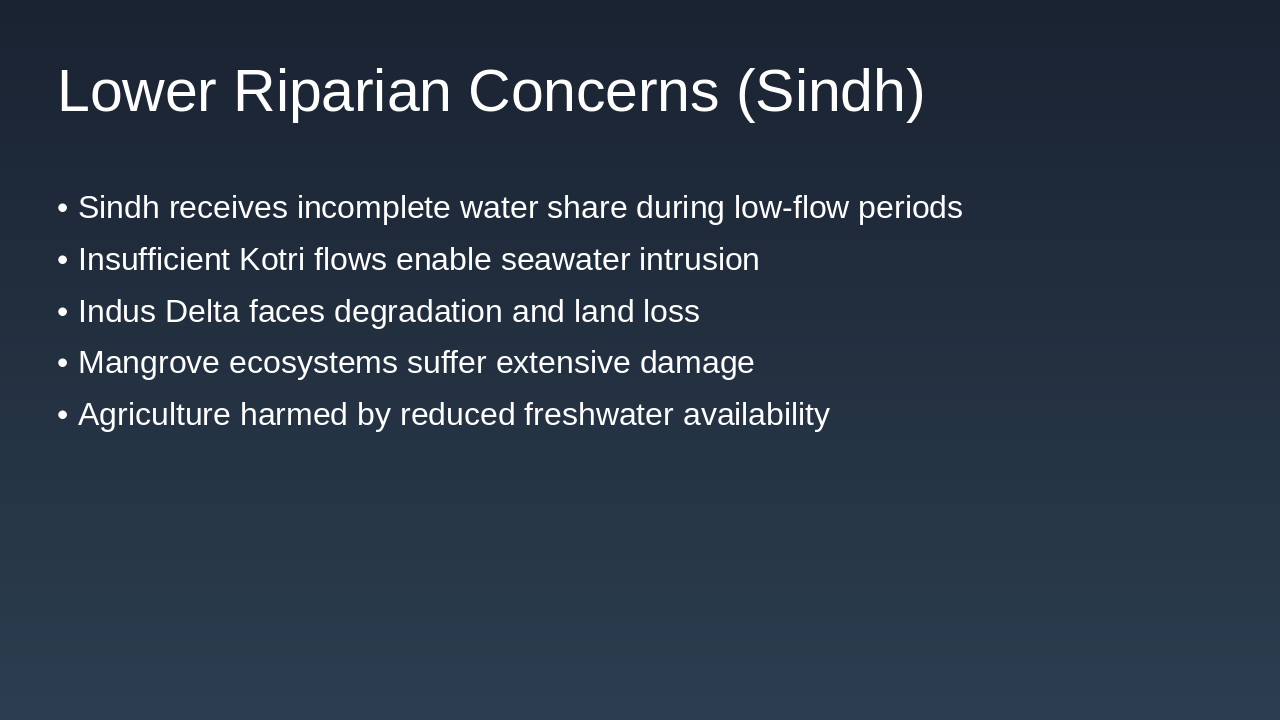
Sindh, as the lower riparian province, experiences incomplete water shares during low-flow periods, leading to insufficient Kotri flows that enable seawater intrusion. This contributes to Indus Delta degradation, land loss, extensive mangrove ecosystem damage, and reduced freshwater availability harming agriculture.

Lower Riparian Concerns (Sindh)

  • Sindh receives incomplete water share during low-flow periods
  • Insufficient Kotri flows enable seawater intrusion
  • Indus Delta faces degradation and land loss
  • Mangrove ecosystems suffer extensive damage
  • Agriculture harmed by reduced freshwater availability
Speaker Notes
Sindh doesn't receive full share in low-flow periods. Insufficient flows below Kotri cause sea intrusion, delta loss, mangrove damage, and agricultural harm.
Slide 7 - Lower Riparian Concerns (Sindh)
Slide 8 of 12

Slide 8 - Trust Deficit Among Provinces

Punjab continues to follow the Accord amid its own water shortages, while Khyber Pakhtunkhwa (KP) and Balochistan express concerns over infrastructure development and equitable water sharing. This leads provinces to view shortfalls as unfair, further eroding trust among them.

Trust Deficit Among Provinces

  • Punjab adheres to Accord despite facing water shortages.
  • KP and Balochistan worry about infrastructure and share delivery.
  • Provinces perceive shortfalls as unfair, deepening mistrust.
Slide 8 - Trust Deficit Among Provinces
Slide 9 of 12

Slide 9 - Sindh Concerns over New Canals (GPI)

This section header slide, titled "Sindh Concerns over New Canals (GPI)" and numbered as section 2, highlights apprehensions in Sindh province related to the Green Pakistan Initiative. The subtitle specifically addresses fears about projects such as the Mahfooz Shaheed and Kachhi Canals.

Sindh Concerns over New Canals (GPI)

2

Sindh Concerns over New Canals (GPI)

Fears regarding Green Pakistan Initiative projects like Mahfooz Shaheed and Kachhi Canals.

Speaker Notes
Highlight Sindh's fears about GPI projects reducing Indus Delta flows, exacerbating environmental issues. Reference Water Apportionment Accord disputes.
Slide 9 - Sindh Concerns over New Canals (GPI)
Slide 10 of 12

Slide 10 - Impacts of Water Diversion

Water diversion significantly reduces freshwater flows to the Indus Delta ecosystems, exacerbating seawater intrusion in coastal areas and leading to land degradation and soil salinization. This process threatens mangrove forests and biodiversity while severely impacting agriculture and local livelihoods in Sindh.

Impacts of Water Diversion

  • Reduces freshwater flows to Indus Delta ecosystems
  • Worsens seawater intrusion in coastal regions
  • Causes land degradation and soil salinization
  • Threatens mangrove forests and biodiversity
  • Impacts agriculture and local livelihoods in Sindh
Speaker Notes
Diversion reduces freshwater to critical areas, worsening seawater intrusion and land degradation in Indus Delta. Threatens environment and agriculture.
Slide 10 - Impacts of Water Diversion
Slide 11 of 12

Slide 11 - Sindh's Call for Balance

The slide, titled "Sindh's Call for Balance," features a quote from Jam Saqi, former Minister of Irrigation for the Government of Sindh. In it, he advocates for a balanced water management strategy that promotes equitable distribution while safeguarding the environment, agriculture, and the Indus Delta against seawater intrusion and degradation.

Sindh's Call for Balance

> Sindh calls for a balanced approach to water management, ensuring equitable distribution while protecting the environment, agriculture, and the Indus Delta from seawater intrusion and degradation.

— Jam Saqi, Former Minister of Irrigation, Government of Sindh

Slide 11 - Sindh's Call for Balance
Slide 12 of 12

Slide 12 - Conclusion: Towards Equitable Solutions

The conclusion slide advocates fostering transparency through telemetry and fair implementation to rebuild trust, while promoting balanced water management that protects all provinces and the Indus ecosystem. It calls for commitment to equitable solutions to ensure sustainable harmony in Pakistan's water future.

Conclusion: Towards Equitable Solutions

Foster transparency with telemetry and fair implementation to rebuild trust. Promote balanced water management protecting all provinces and the Indus ecosystem.

Building Trust for Sustainable Harmony Call to Action: Commit to equitable solutions for Pakistan's water future.

Speaker Notes
Address mistrust through better transparency, telemetry, and fair implementation. Promote balanced water management to protect all provinces and the Indus ecosystem. Context includes inter-provincial divergences in water distribution under the 1991 Water Apportionment Accord, issues with data transparency, lower riparian concerns, trust deficits, and Sindh's concerns over new canals like GPI projects.
Slide 12 - Conclusion: Towards Equitable Solutions

Discover More Presentations

Explore thousands of AI-generated presentations for inspiration

Browse Presentations
Powered by AI

Create Your Own Presentation

Generate professional presentations in seconds with Karaf's AI. Customize this presentation or start from scratch.

Create New Presentation

Powered by Karaf.ai — AI-Powered Presentation Generator