Load-Balancing in Multi-Cell MIMO-NOMA

Generated from prompt:

Create a presentation summarizing the IEEE Transactions on Communications paper titled 'Load-Balancing during Resource Allocation in Multi-Cell MIMO-NOMA'. Include the following sections: 1) Introduction and motivation for load balancing in MIMO-NOMA networks, 2) Problem formulation and system model, 3) Proposed PTLO-based load-balancing algorithms (LB-BB-MIMO-NOMA and LB-M2O-MIMO-NOMA), 4) Simulation results and performance comparison, 5) Key contributions and conclusions.

Presentation summarizes IEEE paper on PTLO-based algorithms (LB-BB-MIMO-NOMA, LB-M2O-MIMO-NOMA) for load balancing in multi-cell MIMO-NOMA networks. Covers motivation, system model, simulations showin

January 21, 202623 slides
Slide 1 of 23

Slide 1 - Load-Balancing in Multi-Cell MIMO-NOMA

The slide presents a title on "Load-Balancing in Multi-Cell MIMO-NOMA," focusing on resource allocation strategies and algorithms. It serves as a title slide introducing the topic.

Load-Balancing in Multi-Cell MIMO-NOMA

Resource Allocation Strategies and Algorithms

Source: IEEE Transactions on Communications Paper Summary

Speaker Notes
Introduction slide for presentation summarizing the paper on load-balancing during resource allocation in multi-cell MIMO-NOMA networks.
Slide 1 - Load-Balancing in Multi-Cell MIMO-NOMA
Slide 2 of 23

Slide 2 - Presentation Agenda

This agenda slide outlines the structure of the presentation, starting with an Introduction & Motivation followed by Problem Formulation. It then covers Proposed Algorithms, Simulation Results, and ends with Contributions & Conclusions.

Presentation Agenda

  1. Introduction & Motivation
  2. Problem Formulation
  3. Proposed Algorithms
  4. Simulation Results
  5. Contributions & Conclusions

Source: IEEE Transactions on Communications: 'Load-Balancing during Resource Allocation in Multi-Cell MIMO-NOMA'

Speaker Notes
Overview of the presentation structure covering key sections from the paper.
Slide 2 - Presentation Agenda
Slide 3 of 23

Slide 3 - Load Balancing in MIMO-NOMA Networks

This section header slide introduces the topic of "Load Balancing in MIMO-NOMA Networks" with the first section titled "1. Introduction and Motivation." It features section number "01" and a subtitle emphasizing the motivation for load balancing in multi-cell MIMO-NOMA networks.

Load Balancing in MIMO-NOMA Networks

01

1. Introduction and Motivation

Motivating Load Balancing in Multi-Cell MIMO-NOMA Networks

Source: IEEE Transactions on Communications: 'Load-Balancing during Resource Allocation in Multi-Cell MIMO-NOMA'

Speaker Notes
Introduce the motivation for load balancing in multi-cell MIMO-NOMA systems as per the paper.
Slide 3 - Load Balancing in MIMO-NOMA Networks
Slide 4 of 23

Slide 4 - Load Balancing in Multi-Cell MIMO-NOMA Networks

  • User distribution across multiple cells
  • Interference management visualization
  • Resource allocation balancing
  • Enhanced network performance
Slide 4 - Load Balancing in Multi-Cell MIMO-NOMA Networks
Slide 5 of 23

Slide 5

Generating slide...

Slide 6 of 23

Slide 6

Generating slide...

Slide 7 of 23

Slide 7

Generating slide...

Slide 8 of 23

Slide 8

Generating slide...

Slide 9 of 23

Slide 9 - Motivation for Load Balancing in MIMO-NOMA

Load balancing in MIMO-NOMA enhances throughput in dense networks, addresses user-cell imbalance issues, and improves overall spectral efficiency. It also effectively manages interference in multi-cell environments.

Motivation for Load Balancing in MIMO-NOMA

  • Enhances throughput in dense networks
  • Addresses user-cell imbalance issues
  • Improves overall spectral efficiency
  • Manages interference in multi-cell MIMO-NOMA

Source: IEEE Trans. Commun. 'Load-Balancing during Resource Allocation in Multi-Cell MIMO-NOMA'

Speaker Notes
Highlights key motivations: throughput gains, imbalance correction, efficiency, and interference management in dense MIMO-NOMA setups.
Slide 9 - Motivation for Load Balancing in MIMO-NOMA
Slide 10 of 23

Slide 10

Generating slide...

Slide 11 of 23

Slide 11

Generating slide...

Slide 12 of 23

Slide 12

Generating slide...

Slide 13 of 23

Slide 13

Generating slide...

Slide 14 of 23

Slide 14 - 2. Problem Formulation and System Model

This section header slide introduces Section 2: Problem Formulation and System Model. It features a subtitle on the mathematical modeling of resource allocation in multi-cell MIMO-NOMA networks.

2. Problem Formulation and System Model

2

Problem Formulation and System Model

Mathematical modeling of resource allocation in multi-cell MIMO-NOMA networks

Source: IEEE Transactions on Communications: 'Load-Balancing during Resource Allocation in Multi-Cell MIMO-NOMA'

Speaker Notes
This section covers the mathematical modeling of resource allocation in multi-cell MIMO-NOMA networks.
Slide 14 - 2. Problem Formulation and System Model
Slide 15 of 23

Slide 15

Generating slide...

Slide 16 of 23

Slide 16 - Diagram of multi-cell MIMO-NOMA system model with BSs, users, MIMO beams, and NOMA power allocation

  • Multiple base stations (BSs) serving users.
  • MIMO beams for spatial multiplexing.
  • NOMA power allocation across users.
  • Load-balancing in resource allocation.
Slide 16 - Diagram of multi-cell MIMO-NOMA system model with BSs, users, MIMO beams, and NOMA power allocation
Slide 17 of 23

Slide 17 - System Model Overview

The slide provides an overview of a multi-cell MIMO-NOMA system where multiple base stations use multiple antennas for spatial multiplexing and NOMA for power-domain superposition coding to serve user clusters simultaneously. It also describes sum-rate optimization that jointly handles user-BS association, power allocation, and beamforming under per-BS load constraints to boost spectral efficiency.

System Model Overview

Multi-cell MIMO-NOMA SetupSum-Rate Optimization
Multiple base stations (BSs) serve clusters of users via MIMO-NOMA. BSs employ multiple antennas for spatial multiplexing, while NOMA enables power-domain superposition coding for simultaneous user transmission within cells.Maximizes network sum-rate under per-BS load constraints. Jointly optimizes user-BS association, power allocation, and beamforming to balance computational loads while enhancing spectral efficiency.

Source: IEEE Transactions on Communications: 'Load-Balancing during Resource Allocation in Multi-Cell MIMO-NOMA'

Speaker Notes
This slide overviews the multi-cell MIMO-NOMA system model, highlighting the network setup and core optimization objective with load constraints.
Slide 17 - System Model Overview
Slide 18 of 23

Slide 18 - 3. Proposed PTLO-based Algorithms

This slide introduces Section 3 on Proposed PTLO-based Algorithms. It highlights the specific algorithms LB-BB-MIMO-NOMA and LB-M2O-MIMO-NOMA.

3. Proposed PTLO-based Algorithms

03

Proposed PTLO-based Algorithms

LB-BB-MIMO-NOMA and LB-M2O-MIMO-NOMA

Source: IEEE Transactions on Communications: 'Load-Balancing during Resource Allocation in Multi-Cell MIMO-NOMA'

Slide 18 - 3. Proposed PTLO-based Algorithms
Slide 19 of 23

Slide 19 - Algorithm Comparison

The "Algorithm Comparison" slide presents key features of advanced load balancing algorithms like LB-BB (block-based partitioning for balanced resources), LB-M2O (multi-to-one mapping for consolidation), and PTLO (particle swarm for rapid convergence). It highlights superior performance in fairness, throughput, sum rates, latency reduction in MIMO-NOMA networks, and scalable design for large-scale scenarios.

Algorithm Comparison

Source: IEEE Trans. Commun. 'Load-Balancing in Multi-Cell MIMO-NOMA'

Slide 19 - Algorithm Comparison
Slide 20 of 23

Slide 20 - 4. Simulation Results

The simulation results demonstrate superior throughput, faster convergence to optimal load balance, and reduced load variance across cells compared to baseline algorithms. The proposed approach outperforms traditional MIMO-NOMA schemes and enhances system performance in multi-cell setups.

4. Simulation Results

  • Superior throughput compared to baseline algorithms
  • Faster convergence to optimal load balance
  • Reduced load variance across cells
  • Outperforms traditional MIMO-NOMA schemes
  • Enhanced system performance in multi-cell setups

Source: IEEE Transactions on Communications: 'Load-Balancing during Resource Allocation in Multi-Cell MIMO-NOMA'

Slide 20 - 4. Simulation Results
Slide 21 of 23

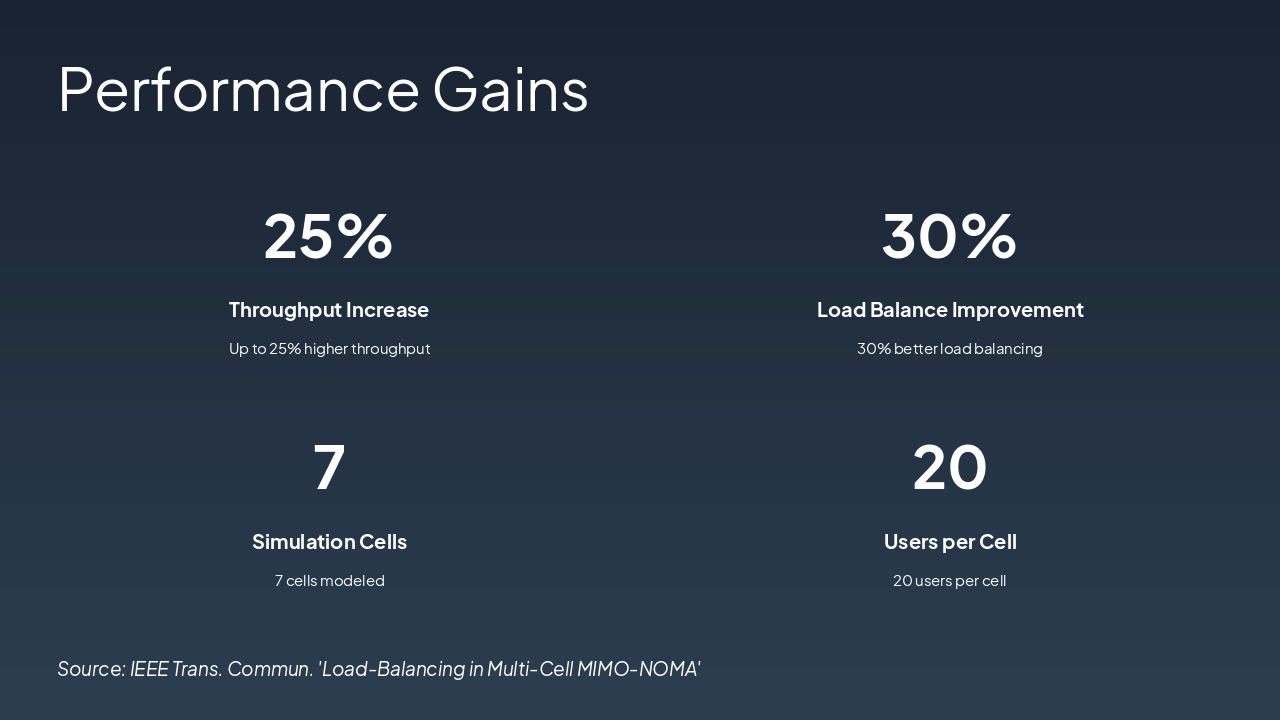
Slide 21 - Performance Gains

  • 25%: Throughput Increase
  • Up to 25% higher throughput

  • 30%: Load Balance Improvement
  • 30% better load balancing

  • 7: Simulation Cells
  • 7 cells modeled

  • 20: Users per Cell
  • 20 users per cell

Slide 21 - Performance Gains
Slide 22 of 23

Slide 22 - 5. Key Contributions and Conclusions

This slide introduces Section 5, titled "Key Contributions and Conclusions." It highlights innovative load-balancing solutions for multi-cell MIMO-NOMA networks.
5. Key Contributions and Conclusions

05

Key Contributions and Conclusions

Innovative load-balancing solutions for multi-cell MIMO-NOMA networks

Source: IEEE Transactions on Communications: 'Load-Balancing during Resource Allocation in Multi-Cell MIMO-NOMA'

Speaker Notes
Summarize innovative load-balancing solutions from the paper.
Slide 22 - 5. Key Contributions and Conclusions
Slide 23 of 23

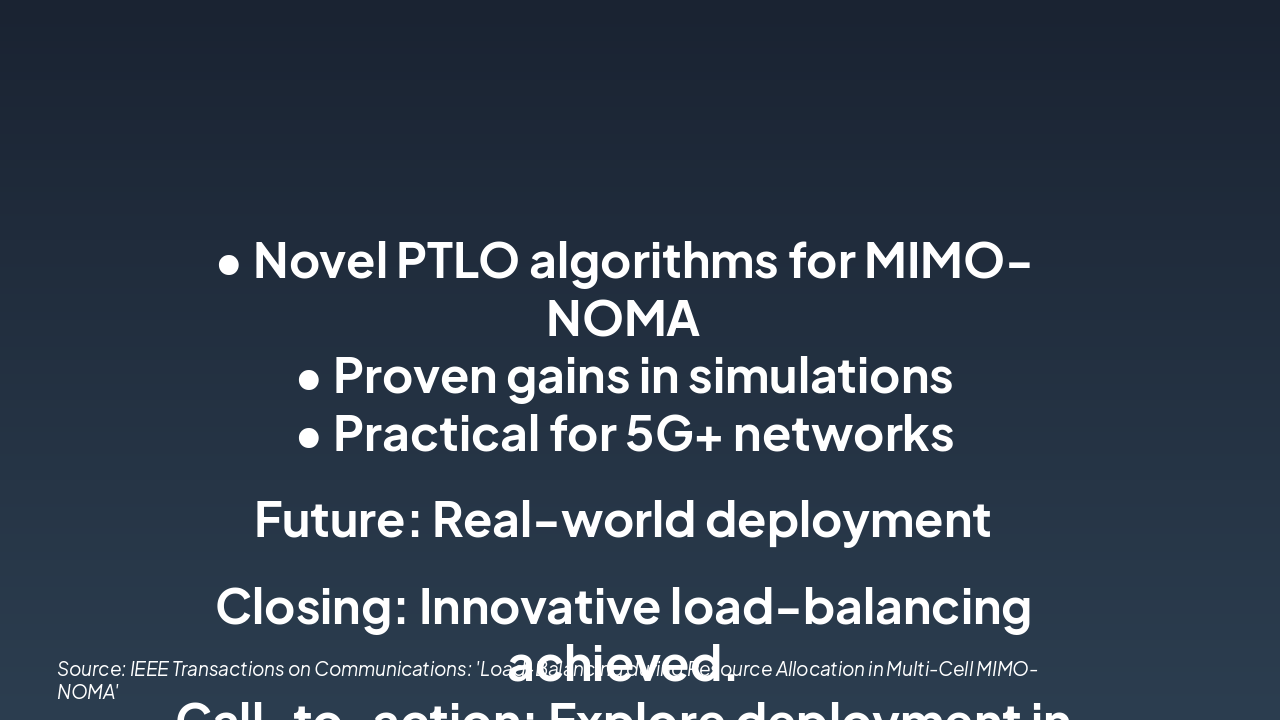
Slide 23 - Key Contributions & Conclusions

This conclusion slide highlights novel PTLO algorithms for MIMO-NOMA, with proven simulation gains and practicality for 5G+ networks. It proposes future real-world deployment and closes with innovative load-balancing achieved, urging exploration in 5G+ networks.

Key Contributions & Conclusions

• Novel PTLO algorithms for MIMO-NOMA

  • Proven gains in simulations
  • Practical for 5G+ networks

Future: Real-world deployment

Closing: Innovative load-balancing achieved. Call-to-action: Explore deployment in 5G+ networks.

Source: IEEE Transactions on Communications: 'Load-Balancing during Resource Allocation in Multi-Cell MIMO-NOMA'

Speaker Notes
Summarize novel PTLO algorithms, proven gains, practicality for 5G+, and future deployment.
Slide 23 - Key Contributions & Conclusions

Discover More Presentations

Explore thousands of AI-generated presentations for inspiration

Browse Presentations
Powered by AI

Create Your Own Presentation

Generate professional presentations in seconds with Karaf's AI. Customize this presentation or start from scratch.

Create New Presentation

Powered by Karaf.ai — AI-Powered Presentation Generator