The Evolution of PDF

Generated from prompt:

Create a presentation about the document I uploaded

This presentation explores the Portable Document Format (PDF), covering its origins in PostScript, key technical features like self-contained structure and imaging models, standardization history, and

November 10, 202512 slides
Slide 1 of 12

Slide 1 - Portable Document Format (PDF)

The slide's title is "Portable Document Format (PDF)", serving as an introduction to this file format. The subtitle highlights PDF's widespread use for document sharing.

Portable Document Format (PDF)

Introduction to PDF: Widely Used for Document Sharing

--- Speaker Notes: Introduction to PDF, a widely used file format for document sharing.
Slide 1
Slide 2 of 12

Slide 2 - Presentation Agenda

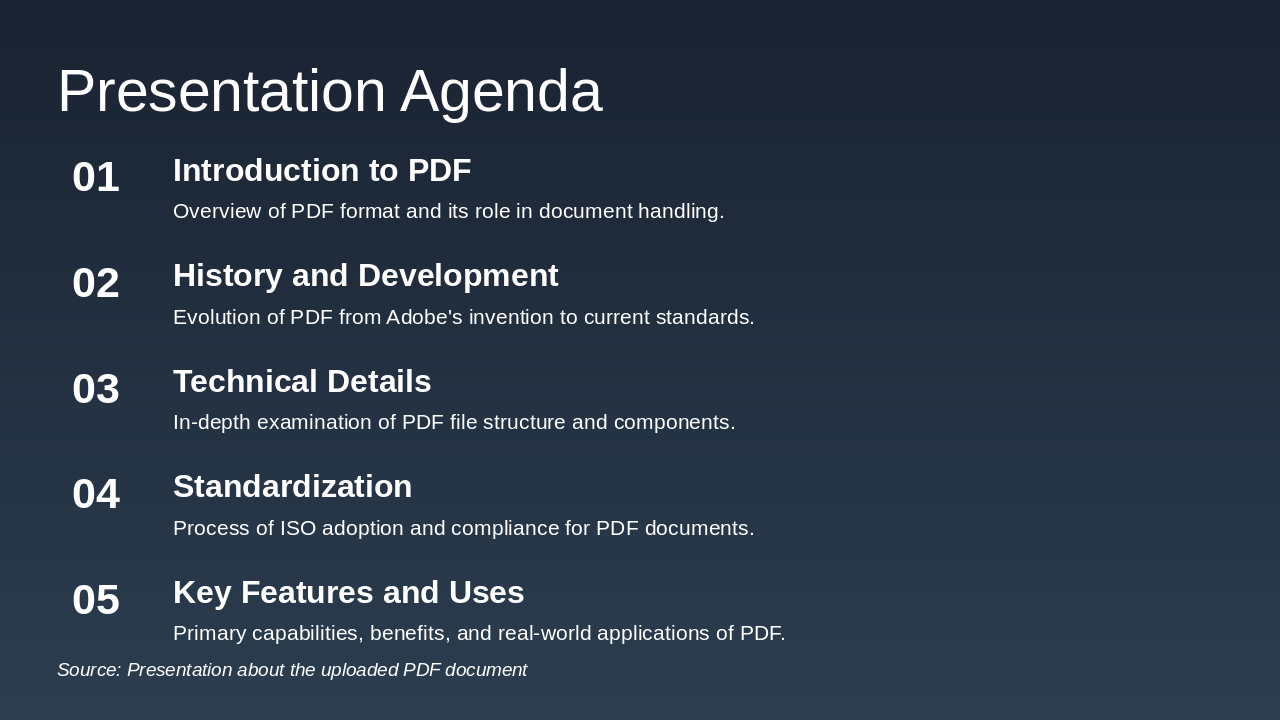
The presentation agenda outlines key topics on PDF, starting with an introduction to its format and role in document handling. It then covers the history and development, technical details of file structure, standardization through ISO adoption, and key features with real-world applications.

Presentation Agenda

  1. Introduction to PDF

Overview of PDF format and its role in document handling.

  1. History and Development

Evolution of PDF from Adobe's invention to current standards.

  1. Technical Details

In-depth examination of PDF file structure and components.

  1. Standardization

Process of ISO adoption and compliance for PDF documents.

  1. Key Features and Uses

Primary capabilities, benefits, and real-world applications of PDF.

Source: Presentation about the uploaded PDF document

Slide 2
Slide 3 of 12

Slide 3 - History and Development

This section header slide introduces the topic of "History and Development" in the context of PDF technology. It highlights the origins of PDF as stemming from Adobe's Camelot Project launched in 1991.

History and Development

Origins of PDF from Adobe's Camelot Project in 1991.

Slide 3
Slide 4 of 12

Slide 4 - PDF Timeline

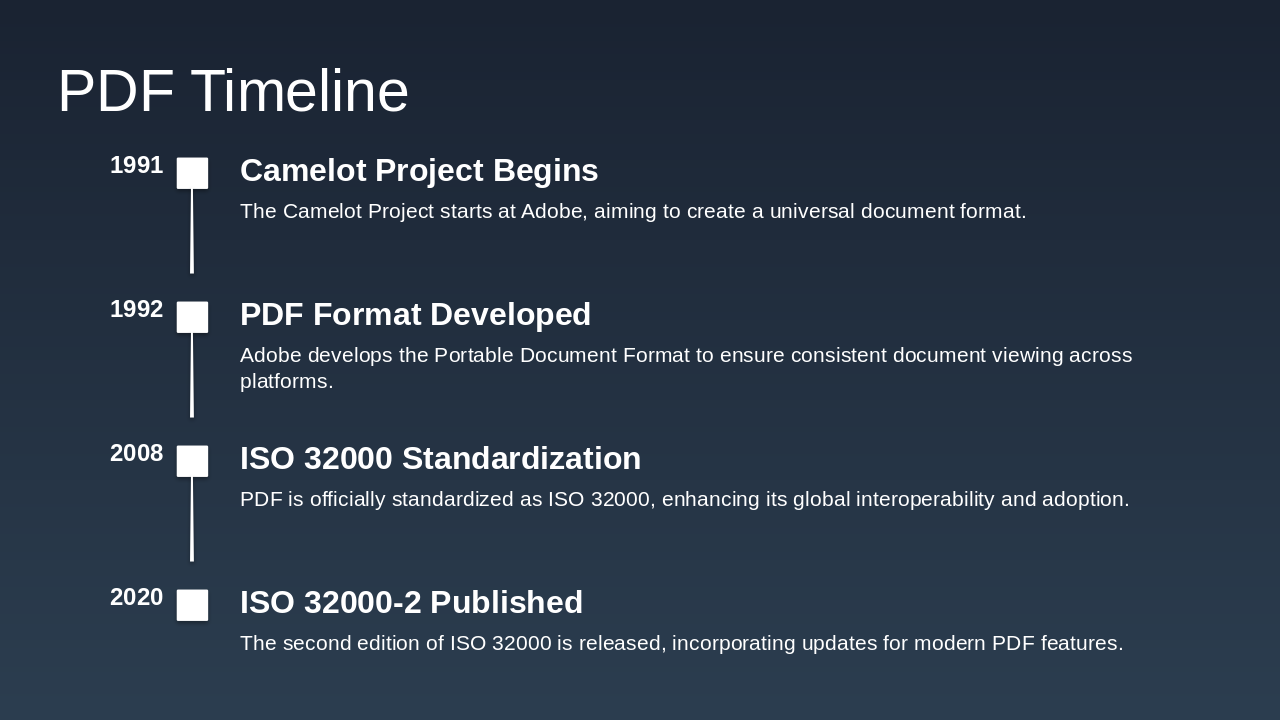
The PDF Timeline slide outlines the evolution of the Portable Document Format, beginning with the 1991 launch of Adobe's Camelot Project to develop a universal document standard. It highlights key milestones, including the 1992 creation of the PDF format for cross-platform consistency, its 2008 standardization as ISO 32000 for global interoperability, and the 2020 release of ISO 32000-2 with modern feature updates.

PDF Timeline

1991: Camelot Project Begins The Camelot Project starts at Adobe, aiming to create a universal document format. 1992: PDF Format Developed Adobe develops the Portable Document Format to ensure consistent document viewing across platforms. 2008: ISO 32000 Standardization PDF is officially standardized as ISO 32000, enhancing its global interoperability and adoption. 2020: ISO 32000-2 Published The second edition of ISO 32000 is released, incorporating updates for modern PDF features.

Slide 4
Slide 5 of 12

Slide 5 - Roots in PostScript

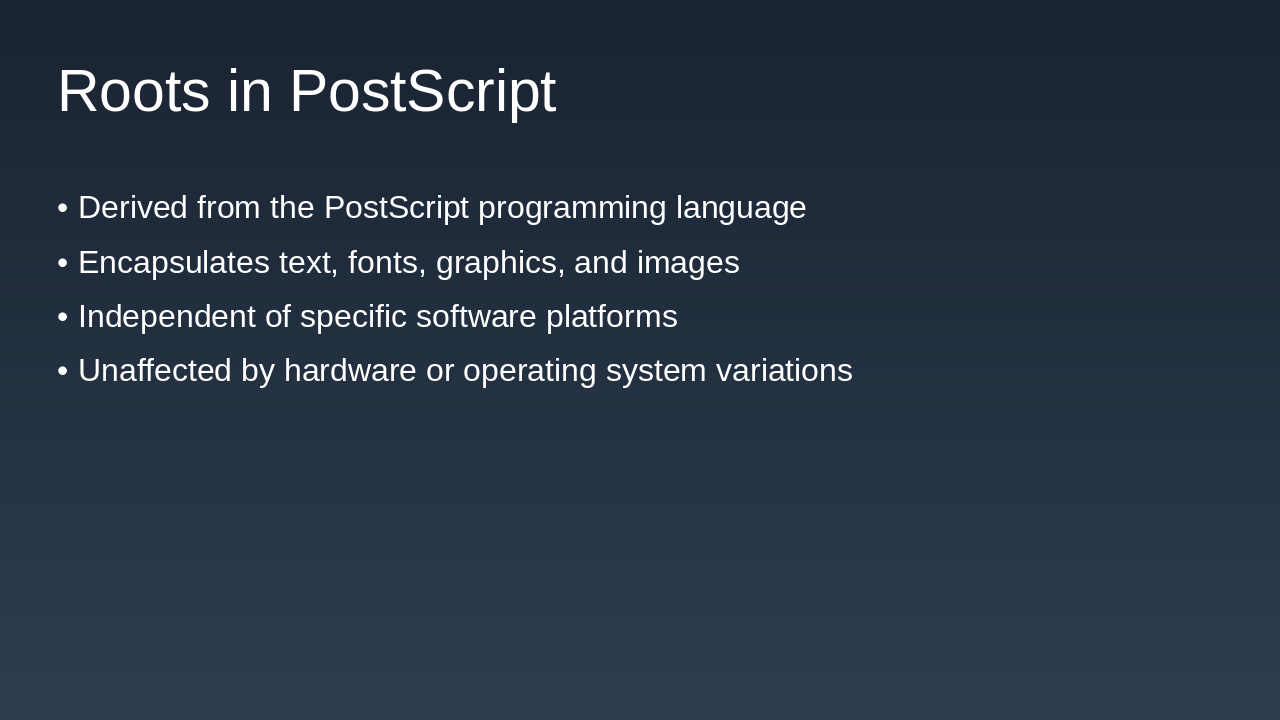
PDF, rooted in the PostScript programming language, encapsulates text, fonts, graphics, and images into a unified format. It remains independent of specific software platforms and unaffected by hardware or operating system variations.

Roots in PostScript

  • Derived from the PostScript programming language
  • Encapsulates text, fonts, graphics, and images
  • Independent of specific software platforms
  • Unaffected by hardware or operating system variations
Slide 5
Slide 6 of 12

Slide 6 - Technical Details

This section header slide, titled "Technical Details" and numbered as 5, introduces a focused discussion on the core elements of PDF files. Its subtitle specifies coverage of the fundamental structure and imaging model used in PDFs.

Technical Details

5

Technical Details

Core structure and imaging model of PDF files.

--- Speaker Notes: Core structure and imaging model of PDF files.

Slide 6
Slide 7 of 12

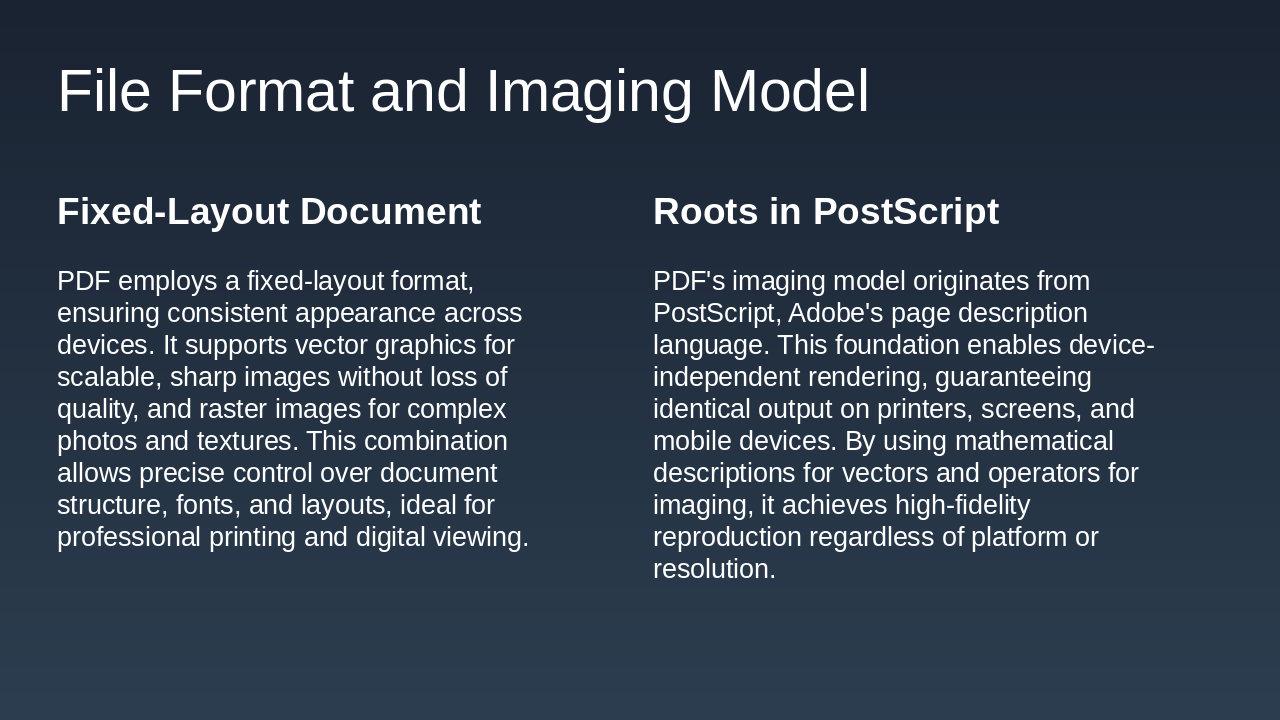
Slide 7 - File Format and Imaging Model

PDF uses a fixed-layout format to ensure consistent document appearance across devices, combining vector graphics for scalable sharpness and raster images for complex visuals, which provides precise control over structure, fonts, and layouts ideal for printing and viewing. Its imaging model stems from Adobe's PostScript language, enabling device-independent rendering through mathematical vector descriptions and imaging operators for high-fidelity reproduction on any platform or resolution.

File Format and Imaging Model

Fixed-Layout DocumentRoots in PostScript
PDF employs a fixed-layout format, ensuring consistent appearance across devices. It supports vector graphics for scalable, sharp images without loss of quality, and raster images for complex photos and textures. This combination allows precise control over document structure, fonts, and layouts, ideal for professional printing and digital viewing.PDF's imaging model originates from PostScript, Adobe's page description language. This foundation enables device-independent rendering, guaranteeing identical output on printers, screens, and mobile devices. By using mathematical descriptions for vectors and operators for imaging, it achieves high-fidelity reproduction regardless of platform or resolution.
Slide 7
Slide 8 of 12

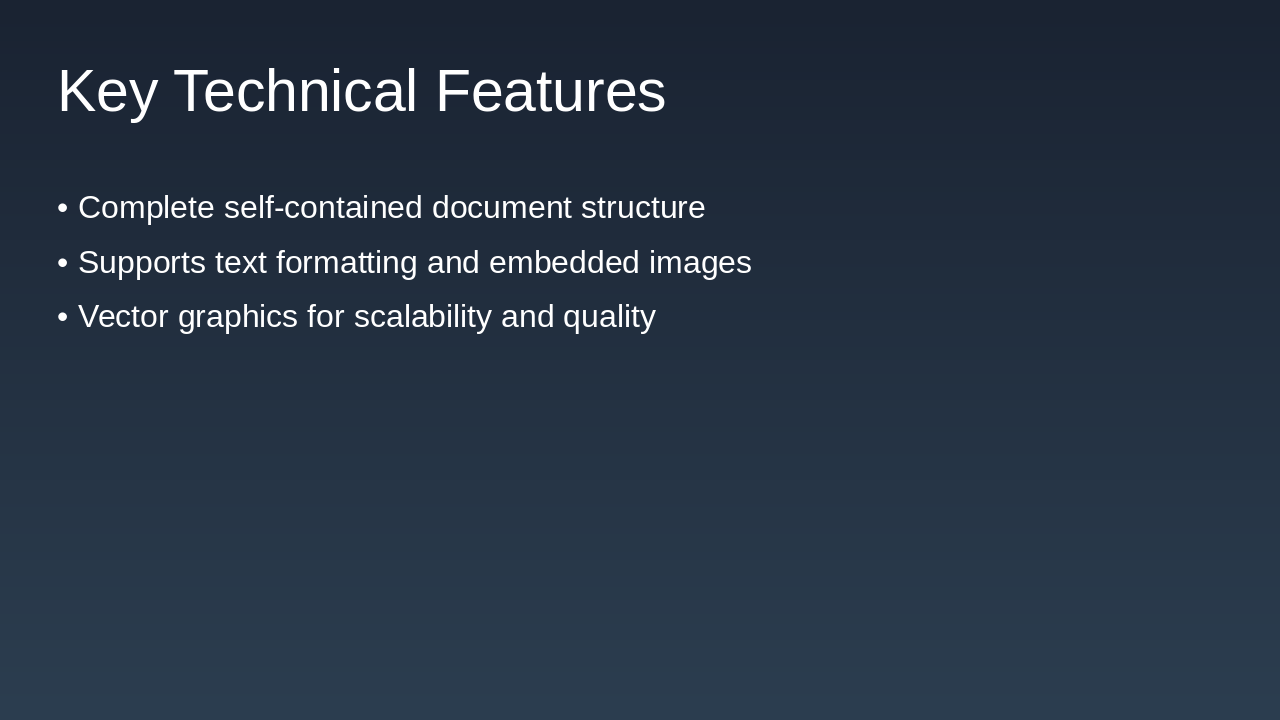
Slide 8 - Key Technical Features

The slide titled "Key Technical Features" highlights a complete, self-contained document structure that supports text formatting and embedded images for versatile content handling. It also emphasizes vector graphics, ensuring scalability and high quality across different uses.

Key Technical Features

  • Complete self-contained document structure
  • Supports text formatting and embedded images
  • Vector graphics for scalability and quality
Slide 8
Slide 9 of 12

Slide 9 - Standardization and Maintenance

This section header slide is titled "Standardization and Maintenance," focusing on the ongoing processes to establish and uphold consistent standards. Its subtitle highlights the evolution of these efforts into an international standard.

Standardization and Maintenance

Standardization and Maintenance

Evolution into an international standard

Slide 9
Slide 10 of 12

Slide 10 - PDF Standards Timeline

The PDF Standards Timeline slide outlines the key milestones in PDF standardization, beginning with the initial ISO 32000-1 release in 2008. It highlights the latest update in ISO 32000-2 published in 2020, marking 12 years of development from the first to the most recent version.

PDF Standards Timeline

  • 2008: Initial PDF Standard

ISO 32000-1 released

  • 2020: Latest PDF Standard

ISO 32000-2 published

  • 12: Years of Development

From first to latest version

Source: ISO Standards

Slide 10
Slide 11 of 12

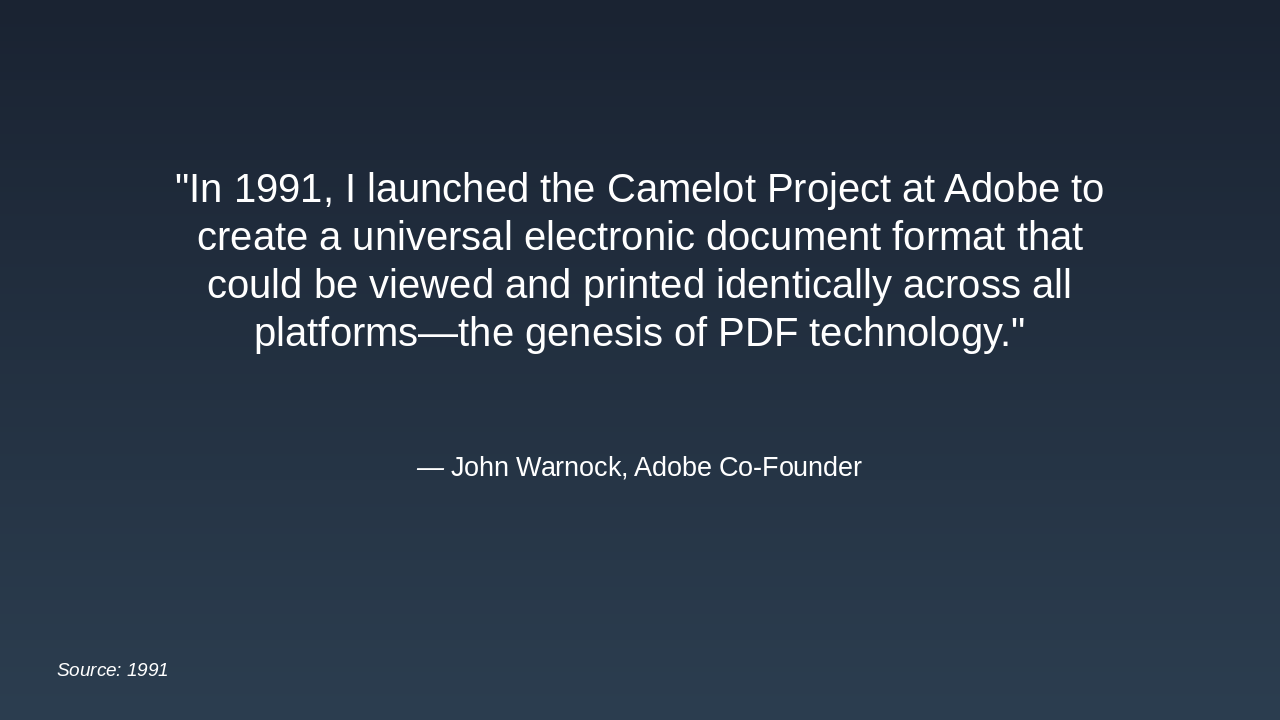
Slide 11 - John Warnock on PDF

In 1991, Adobe co-founder John Warnock initiated the Camelot Project to develop a universal electronic document format that would display and print consistently across all platforms, marking the origin of PDF technology. This quote slide highlights Warnock's pivotal role in creating what became a cornerstone of digital documentation.

John Warnock on PDF

> In 1991, I launched the Camelot Project at Adobe to create a universal electronic document format that could be viewed and printed identically across all platforms—the genesis of PDF technology.

— John Warnock, Adobe Co-Founder

Source: 1991

--- Speaker Notes: The Camelot Project laid the foundation for PDF as a universal document format.

Slide 11
Slide 12 of 12

Slide 12 - Conclusion

The conclusion slide emphasizes that PDF is essential for reliable document exchange and should be future-proofed through ongoing ISO updates. It ends with a simple "Thank you!" subtitle.

Conclusion

PDF remains essential for reliable document exchange. Future-proof with ongoing ISO updates.

Thank you!

Source: PDF Presentation

--- Speaker Notes: Closing message: Thank you for your attention. Call-to-action: Adopt PDF for secure document sharing.

Slide 12
Powered by AI

Create Your Own Presentation

Generate professional presentations in seconds with Karaf's AI. Customize this presentation or start from scratch.

Create New Presentation

Powered by Karaf.ai — AI-Powered Presentation Generator