Pancreatic Head Lesions in Children: Diagnosis and Surgical 

Generated from prompt:

Pancreatic Head Lesions in Children: Diagnosis and Management. Professional medical conference slides. Include structured slides: Title, Introduction, Epidemiology, Types of tumors, MDT approach, Aim, Methods (7 cases), Surgical options (Whipple, bypass, Frey), Case summaries, Investigations, Management, Outcomes, Conclusion. Clean modern design.

This medical conference presentation reviews rare pancreatic head lesions in pediatric patients, covering epidemiology, tumor types, diagnostic imaging, multidisciplinary team approaches, surgical options like Whipple and Frey procedures, a 7-case 

April 6, 202614 slides
Slide 1 of 14

Slide 1 - Medical Conference Presentation

Pancreatic Head Lesions in Children: Diagnosis and Management

Diagnostic Challenges and Surgical Management Strategies in Pediatric Patients

---

Photo by Logan Gutierrez on Unsplash

Slide 1 - Medical Conference Presentation
Slide 2 of 14

Slide 2 - Presentation Overview

  • Introduction and Epidemiology
  • Tumor Types and Classification
  • Diagnostic Investigations
  • Multidisciplinary Team (MDT) Approach
  • Surgical Management Options
  • Case Series Analysis (7 Cases)
  • Outcomes and Conclusion

---

Photo by Abdulai Sayni on Unsplash

Slide 2 - Presentation Overview
Slide 3 of 14

Slide 3 - Clinical Context

1

Introduction and Epidemiology

Understanding pancreatic pathology in the pediatric population

---

Photo by Accuray on Unsplash

Slide 3 - Clinical Context
Slide 4 of 14

Slide 4 - Introduction to Pediatric Pancreatic Lesions

  • Pancreatic tumors are extremely rare in the pediatric population.
  • Differential diagnosis significantly differs from adult pancreatic pathology.
  • Clinical presentation often presents as vague abdominal symptoms.
  • Early recognition is crucial due to the rarity of these lesions.

---

Photo by Louis Reed on Unsplash

Slide 4 - Introduction to Pediatric Pancreatic Lesions
Slide 5 of 14

Slide 5 - Epidemiology and Tumor Types

  • Primary pancreatic tumors account for less than 1% of all pediatric neoplasms.
  • Most common lesions in children include pancreatoblastoma, solid pseudopapillary neoplasms (SPN), and neuroendocrine tumors (NET).
  • Pancreatic adenocarcinoma, highly prevalent in adults, is exceptionally rare in children.
  • Benign cystic lesions and developmental anomalies must be considered in the differential.

---

Photo by Louis Reed on Unsplash

Slide 5 - Epidemiology and Tumor Types
Slide 6 of 14

Slide 6 - Diagnostic Strategy

2

Diagnosis and MDT Approach

The role of imaging and collaborative care

---

Photo by Accuray on Unsplash

Slide 6 - Diagnostic Strategy
Slide 7 of 14

Slide 7 - Diagnostic Investigations

  • Imaging: Contrast-enhanced MRI/MRCP is the gold standard for defining anatomy.
  • CT scans are useful for surgical planning but involve radiation exposure.
  • Biopsy: Generally reserved for suspected malignancy; fine-needle aspiration (FNA) guided by EUS is preferred.
  • Biochemical: Assessment of serum tumor markers and hormonal profiles.

---

Photo by Louis Reed on Unsplash

Slide 7 - Diagnostic Investigations
Slide 8 of 14

Slide 8 - MDT Approach to Management

  • Expert panel comprising pediatric surgeons, oncologists, radiologists, and pathologists.
  • Pre-operative planning is essential to minimize morbidity.
  • Consensus on surgical vs. conservative management for specific histologies.
  • Coordination of long-term follow-up and surveillance.

---

Photo by Louis Reed on Unsplash

Slide 8 - MDT Approach to Management
Slide 9 of 14

Slide 9 - Surgical Management

3

Methods and Surgical Options

Reviewing 7 surgical case interventions

---

Photo by freestocks on Unsplash

Slide 9 - Surgical Management
Slide 10 of 14

Slide 10 - Study Methods: Cohort Summary

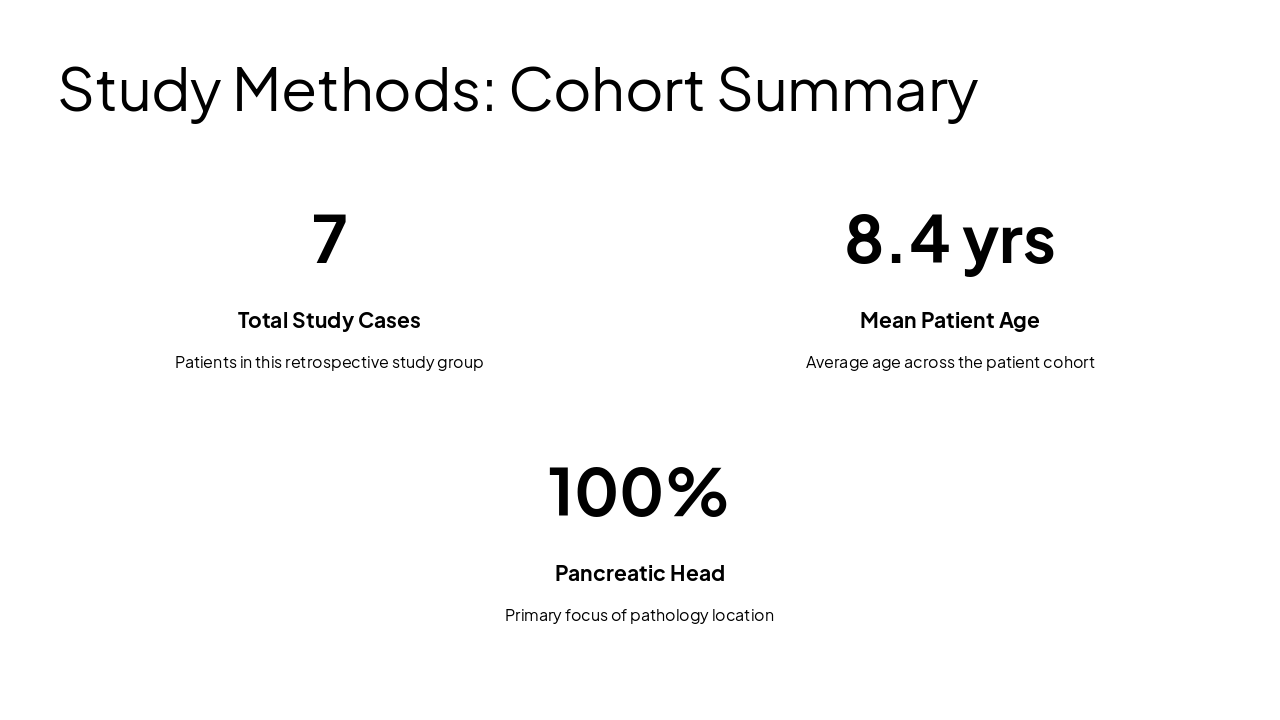
  • 7: Total Study Cases
  • 8.4 yrs: Mean Patient Age
  • 100%: Pancreatic Head
Slide 10 - Study Methods: Cohort Summary
Slide 11 of 14

Slide 11 - Surgical Management Options

  • Whipple Procedure (Pancreaticoduodenectomy): Indicated for aggressive or large lesions involving the pancreatic head.
  • Bypass Surgery: Used in non-resectable or palliative scenarios to relieve biliary or gastric obstruction.
  • Frey Procedure: A lateral pancreaticojejunostomy combined with central coring for chronic inflammatory lesions.

---

Photo by Louis Reed on Unsplash

Slide 11 - Surgical Management Options
Slide 12 of 14

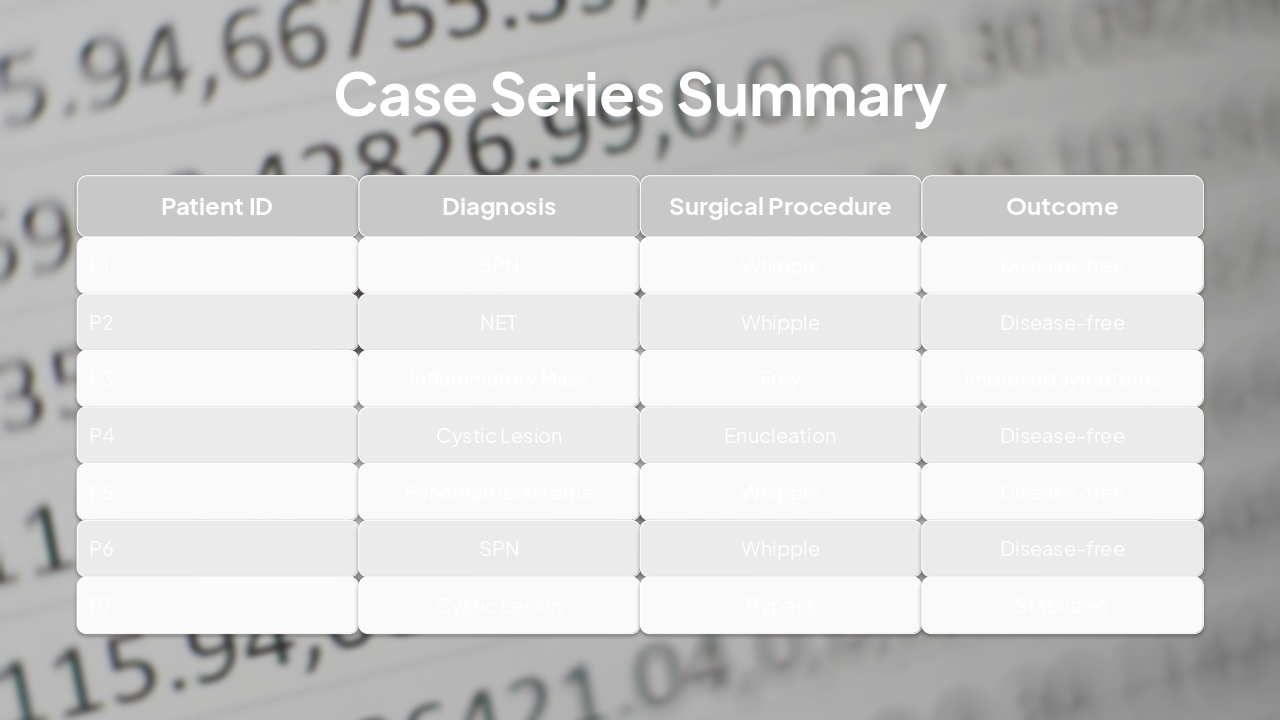
Slide 12 - Case Series Summary

Patient IDDiagnosisSurgical ProcedureOutcome
P1SPNWhippleDisease-free
P2NETWhippleDisease-free
P3Inflammatory MassFreyImproved symptoms
P4Cystic LesionEnucleationDisease-free
P5PancreatoblastomaWhippleDisease-free
P6SPNWhippleDisease-free
P7Cystic LesionBypassStabilized

---

Photo by Mika Baumeister on Unsplash
Slide 12 - Case Series Summary
Slide 13 of 14

Slide 13 - Outcomes and Management Takeaways

  • High success rates in complete tumor resection for benign/low-grade lesions.
  • Minimal perioperative complications observed.
  • Need for specialized pediatric hepatobiliary and pancreatic surgical expertise.
  • Long-term follow-up essential for recurrence monitoring.

---

Photo by Louis Reed on Unsplash

Slide 13 - Outcomes and Management Takeaways
Slide 14 of 14

Slide 14 - Conclusion

Summary: Pediatric pancreatic head lesions, while rare, require specialized MDT management to ensure optimal patient outcomes and functional preservation.

Early diagnosis and multidisciplinary care are key to successful management.

---

Photo by Testalize.me on Unsplash

Slide 14 - Conclusion

Discover More Presentations

Explore thousands of AI-generated presentations for inspiration

Browse Presentations
Powered by AI

Create Your Own Presentation

Generate professional presentations in seconds with Karaf's AI. Customize this presentation or start from scratch.

Create New Presentation

Powered by Karaf.ai — AI-Powered Presentation Generator