SatCom: Revolutionizing Global Connectivity (39 chars)

Generated from prompt:

Create a presentation on 'Satellite Communication and its Applications' for an awareness session. Include slides on: 1) Introduction to satellite communication, 2) How satellites work, 3) Types of satellites, 4) Communication process, 5) Applications in telecommunication, broadcasting, navigation, defense, and remote sensing, 6) Benefits and limitations, 7) Future trends, 8) Conclusion.

Covers intro to satellite comm, workings, types, process, apps in telecom/broadcasting/navigation/defense/remote sensing, benefits/limits, future trends, concluding its transformative role in connecti

December 16, 202510 slides
Slide 1 of 10

Slide 1 - Satellite Communication and its Applications

This title slide presents the main topic "Satellite Communication and its Applications." The subtitle indicates it provides an "Awareness Session Overview."

Satellite Communication and its Applications

Awareness Session Overview

Source: Awareness Session Overview

Slide 1 - Satellite Communication and its Applications
Slide 2 of 10

Slide 2 - Presentation Agenda

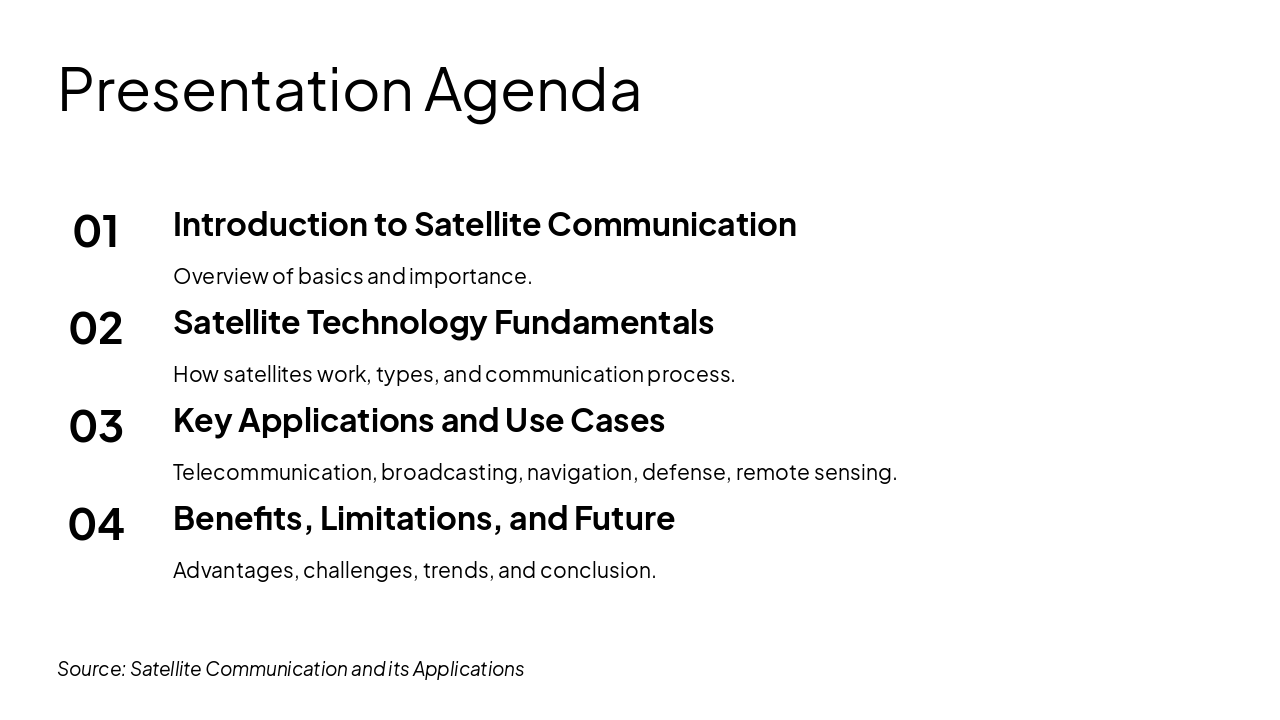
This agenda slide outlines a presentation on satellite communication, beginning with an introduction to its basics and importance, followed by satellite technology fundamentals including how they work, types, and processes. It then covers key applications like telecommunication, broadcasting, navigation, defense, and remote sensing, ending with benefits, limitations, trends, and a conclusion.

Presentation Agenda

  1. Introduction to Satellite Communication
  2. Overview of basics and importance.

  3. Satellite Technology Fundamentals
  4. How satellites work, types, and communication process.

  5. Key Applications and Use Cases
  6. Telecommunication, broadcasting, navigation, defense, remote sensing.

  7. Benefits, Limitations, and Future

Advantages, challenges, trends, and conclusion. Source: Satellite Communication and its Applications

Slide 2 - Presentation Agenda
Slide 3 of 10

Slide 3 - Introduction to Satellite Communication

Satellite communication is wireless communication using orbiting satellites, with a history from Sputnik in 1957 to modern constellations and key orbits including GEO, MEO, and LEO. It enables global connectivity, especially in remote areas.

Introduction to Satellite Communication

  • Wireless communication using orbiting satellites
  • History: Sputnik 1957 to modern constellations
  • Orbits: GEO, MEO, LEO
  • Enables global connectivity in remote areas

Source: User request: Definition, history, orbits, key enabler

Speaker Notes
Highlight fundamentals; transition to how satellites work.
Slide 3 - Introduction to Satellite Communication
Slide 4 of 10

Slide 4 - How Satellites Work

The slide "How Satellites Work" depicts the satellite communication process. A ground station uplinks a signal to the satellite, where transponders amplify and shift its frequency before downlinking it to Earth receivers.

How Satellites Work

!Image

  • Uplink: Ground station transmits signal to satellite.
  • Transponders amplify and shift frequency of signal.
  • Downlink: Satellite relays signal to Earth receivers.

Source: Wikipedia

Speaker Notes
Visual: Satellite in orbit receiving/transmitting signals. Uplink from ground station, amplification, downlink to receivers. Covers transponders and signal relay.
Slide 4 - How Satellites Work
Slide 5 of 10

Slide 5 - Types of Satellites

The slide "Types of Satellites" features a table outlining three satellite types by orbit altitude and primary uses. GEO orbits at 36,000 km for TV and communications, MEO at 8,000-20,000 km for navigation, and LEO below 2,000 km for internet and imaging.

Types of Satellites

{ "headers": [ "Type", "Orbit", "Use" ], "rows": [ [ "GEO", "36,000 km", "TV, comm" ], [ "MEO", "8,000-20,000 km", "Navigation" ], [ "LEO", "<2,000 km", "Internet, imaging" ] ] }

Slide 5 - Types of Satellites
Slide 6 of 10

Slide 6 - Satellite Communication Process

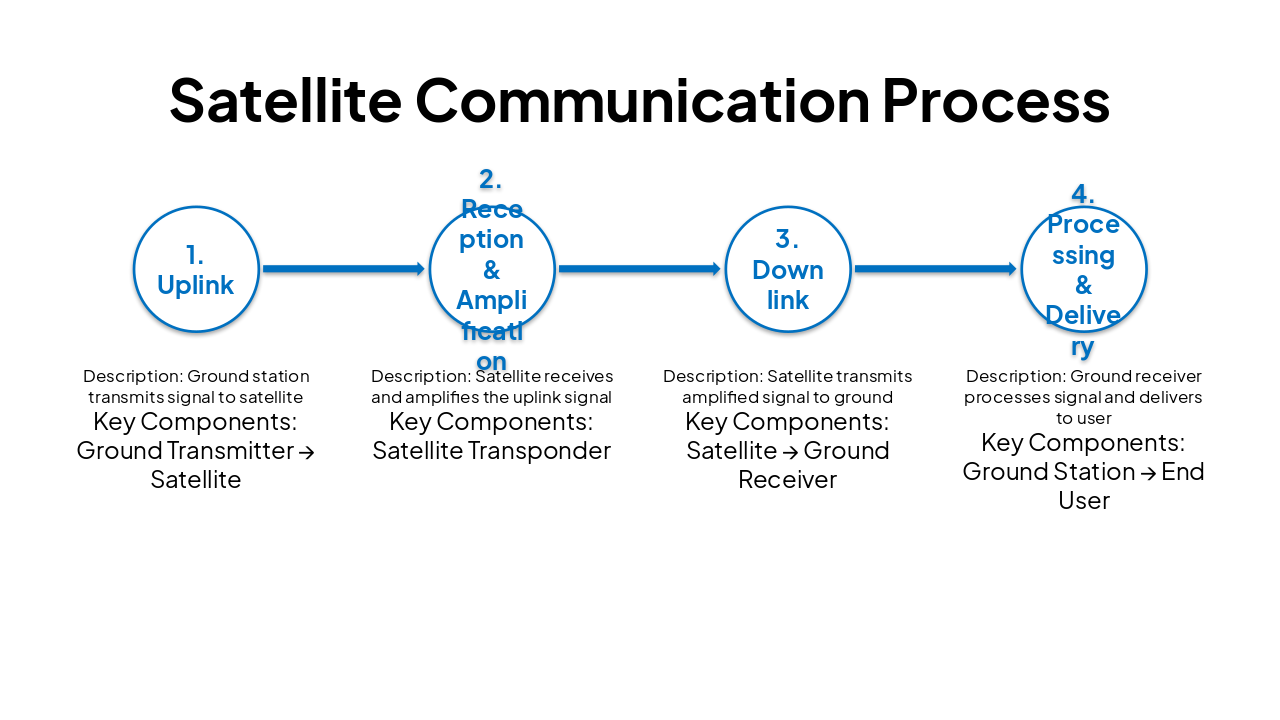
The Satellite Communication Process workflow outlines four phases: Uplink (ground transmitter to satellite), Reception & Amplification (via satellite transponder), Downlink (satellite to ground receiver), and Processing & Delivery (to end user). This depicts the full signal path from transmission to user delivery.

Satellite Communication Process

{ "headers": [ "Phase", "Description", "Key Components" ], "rows": [ [ "1. Uplink", "Ground station transmits signal to satellite", "Ground Transmitter β†’ Satellite" ], [ "2. Reception & Amplification", "Satellite receives and amplifies the uplink signal", "Satellite Transponder" ], [ "3. Downlink", "Satellite transmits amplified signal to ground", "Satellite β†’ Ground Receiver" ], [ "4. Processing & Delivery", "Ground receiver processes signal and delivers to user", "Ground Station β†’ End User" ] ] }

Slide 6 - Satellite Communication Process
Slide 7 of 10

Slide 7 - Key Applications

The "Key Applications" slide features a grid of five satellite-based services. These include Global Calls for worldwide voice/data, TV/Radio Broadcasting, GPS Navigation, Secure Defense Links, and Earth Observation for monitoring.

Key Applications

{ "features": [ { "icon": "πŸ“ž", "heading": "Global Calls", "description": "Worldwide voice and data communication via satellites." }, { "icon": "πŸ“Ί", "heading": "TV/Radio Broadcasting", "description": "Global distribution of television and radio signals." }, { "icon": "πŸ—ΊοΈ", "heading": "GPS Navigation", "description": "Precise global positioning and timing services." }, { "icon": "πŸ›‘οΈ", "heading": "Secure Defense Links", "description": "Encrypted communications for military operations." }, { "icon": "πŸ›°οΈ", "heading": "Earth Observation", "description": "Remote sensing for weather and environmental monitoring." } ] }

Slide 7 - Key Applications
Slide 8 of 10

Slide 8 - Benefits and Limitations

The slide highlights satellite benefits, including global coverage, reliability in remote areas, and high bandwidth. It also lists limitations such as high latency (GEO), costly launches, and space debris.

Benefits and Limitations

BenefitsLimitations

| β€’ Global coverage

  • Reliable in remote areas
  • High bandwidth | β€’ High latency (GEO)
  • Costly launch
  • Space debris |
Slide 8 - Benefits and Limitations
Slide 9 of 10

Slide 9 - Future Trends

The "Future Trends" timeline slide outlines satellite advancements: LEO mega-constellations in the 2020s for global broadband, quantum communication by 2030 for secure data, and interplanetary laser links to Mars in 2040. Ongoing AI integration optimizes routing, predicts failures, and boosts network performance.

Future Trends

2020s: LEO Mega-Constellations Launch Starlink and rivals deliver global broadband via thousands of low-Earth orbit satellites. 2030: Quantum Communication Deployment Satellites enable quantum key distribution for ultra-secure global data transmission. 2040: Interplanetary Networks Emerge Laser links connect Earth to Mars, enabling real-time deep space communication. Ongoing: AI Integration for Efficiency Artificial intelligence optimizes satellite routing, predicts failures, and enhances network performance.

Slide 9 - Future Trends
Slide 10 of 10

Slide 10 - Conclusion

The conclusion slide highlights that satellite communications revolutionize connectivity and calls to embrace future innovations for global access. It includes a "Q&A?" subtitle.

Conclusion

Sat comm revolutionizes connectivity. Embrace future innovations for global access.

Q&A?

Slide 10 - Conclusion

Discover More Presentations

Explore thousands of AI-generated presentations for inspiration

Browse Presentations
Powered by AI

Create Your Own Presentation

Generate professional presentations in seconds with Karaf's AI. Customize this presentation or start from scratch.

Create New Presentation

Powered by Karaf.ai β€” AI-Powered Presentation Generator