AI Stock Market Bubble: Hype vs. Reality

Generated from prompt:

Create a professional PowerPoint presentation on the topic "The AI Stock Market Bubble". Include ~12-15 slides with clear structure: 1. Title Slide: The AI Stock Market Bubble (subtitle: hype vs reality) 2. Agenda 3. What is a Stock Market Bubble? (definition + examples like dot-com) 4. Overview of AI Boom (2020s surge, key drivers) 5. Key Companies Leading AI Rally (NVIDIA, Microsoft, Google, etc.) 6. Why Investors are Bullish on AI (growth potential, productivity gains) 7. Signs of a Bubble (overvaluation, hype cycles, speculation) 8. Valuation Metrics (P/E ratios, comparisons) 9. Comparison to Dot-Com Bubble (similarities & differences) 10. Risks and Concerns (regulation, overhype, profitability) 11. Counterarguments: Why This Might NOT Be a Bubble 12. Expert Opinions / Market Sentiment 13. Possible Scenarios (bubble burst vs sustained growth) 14. Investment Strategies (diversification, risk management) 15. Conclusion & Key Takeaways Style: modern, clean, tech-themed visuals (blue/purple gradients), minimal text per slide, include icons and charts suggestions. Tone: informative and balanced. Add speaker notes for each slide.

This deck analyzes the 2020s AI stock boom, exploring if it's a bubble like the dot-com era. It covers bubble definitions, key players (NVIDIA, Microsoft), bullish drivers, valuation red flags, risks, counterarguments, expert views, scenarios, and投资与

March 19, 202615 slides
Slide 1 of 15

Slide 1 - The AI Stock Market Bubble

The AI Stock Market Bubble

Hype vs. Reality

Slide 1 - The AI Stock Market Bubble
Slide 2 of 15

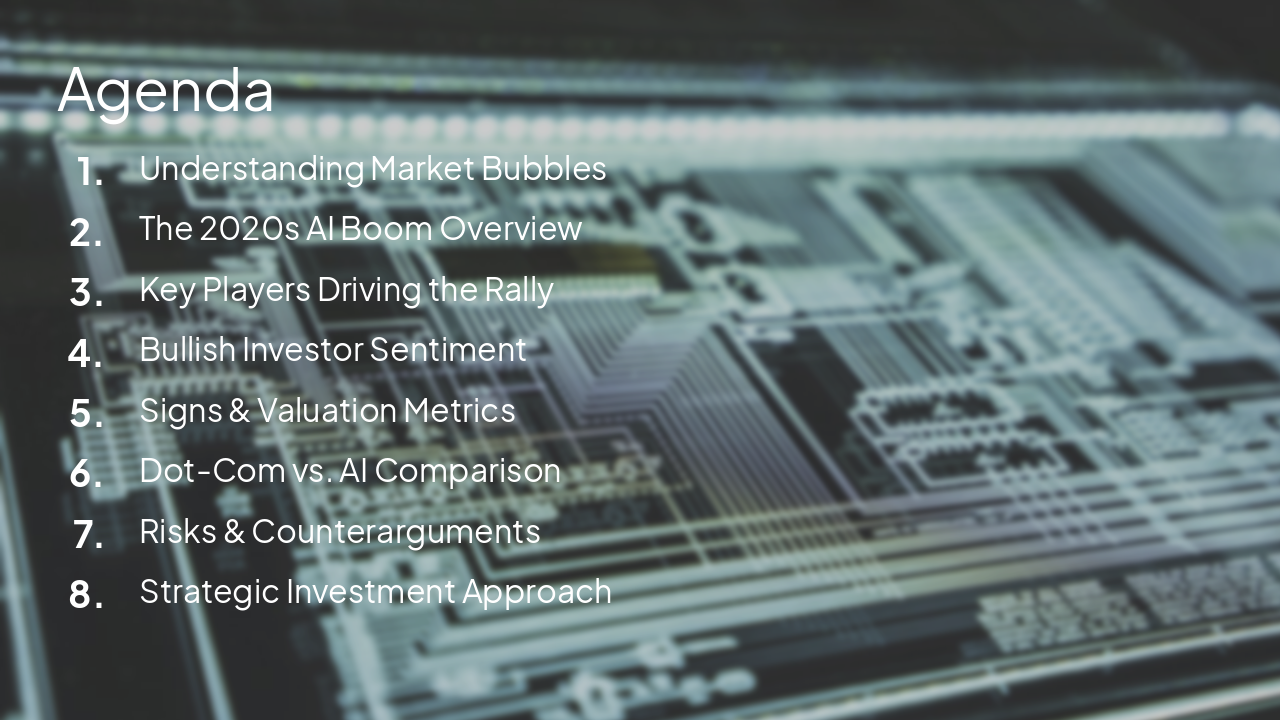
Slide 2 - Agenda

  • Understanding Market Bubbles
  • The 2020s AI Boom Overview
  • Key Players Driving the Rally
  • Bullish Investor Sentiment
  • Signs & Valuation Metrics
  • Dot-Com vs. AI Comparison
  • Risks & Counterarguments
  • Strategic Investment Approach
Slide 2 - Agenda
Slide 3 of 15

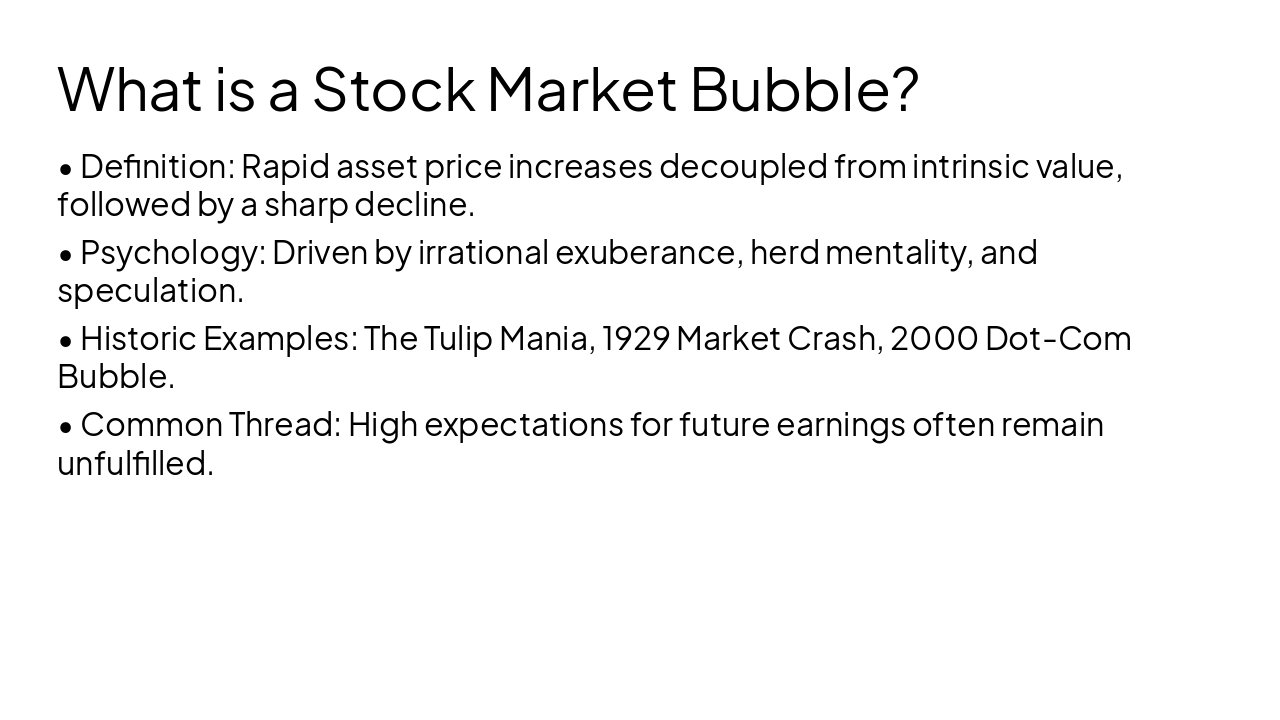
Slide 3 - What is a Stock Market Bubble?

  • Definition: Rapid asset price increases decoupled from intrinsic value, followed by a sharp decline.
  • Psychology: Driven by irrational exuberance, herd mentality, and speculation.
  • Historic Examples: The Tulip Mania, 1929 Market Crash, 2000 Dot-Com Bubble.
  • Common Thread: High expectations for future earnings often remain unfulfilled.
Slide 3 - What is a Stock Market Bubble?
Slide 4 of 15

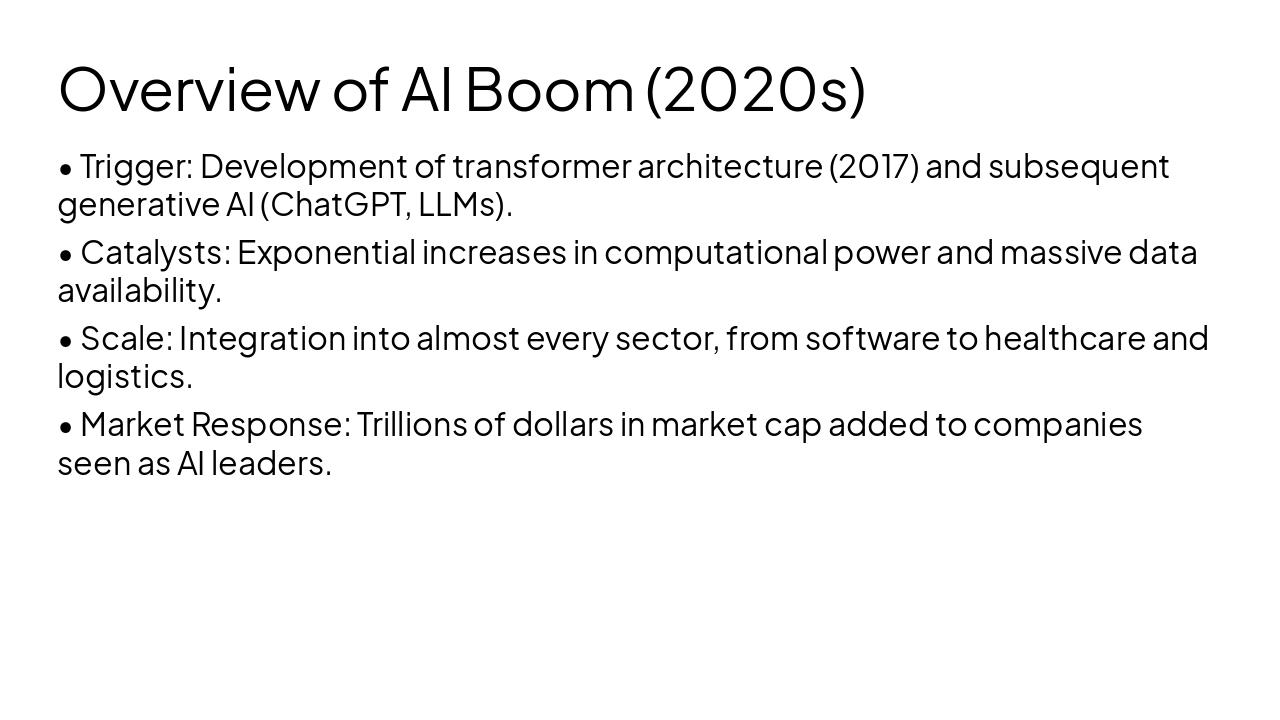
Slide 4 - Overview of AI Boom (2020s)

  • Trigger: Development of transformer architecture (2017) and subsequent generative AI (ChatGPT, LLMs).
  • Catalysts: Exponential increases in computational power and massive data availability.
  • Scale: Integration into almost every sector, from software to healthcare and logistics.
  • Market Response: Trillions of dollars in market cap added to companies seen as AI leaders.
Slide 4 - Overview of AI Boom (2020s)
Slide 5 of 15

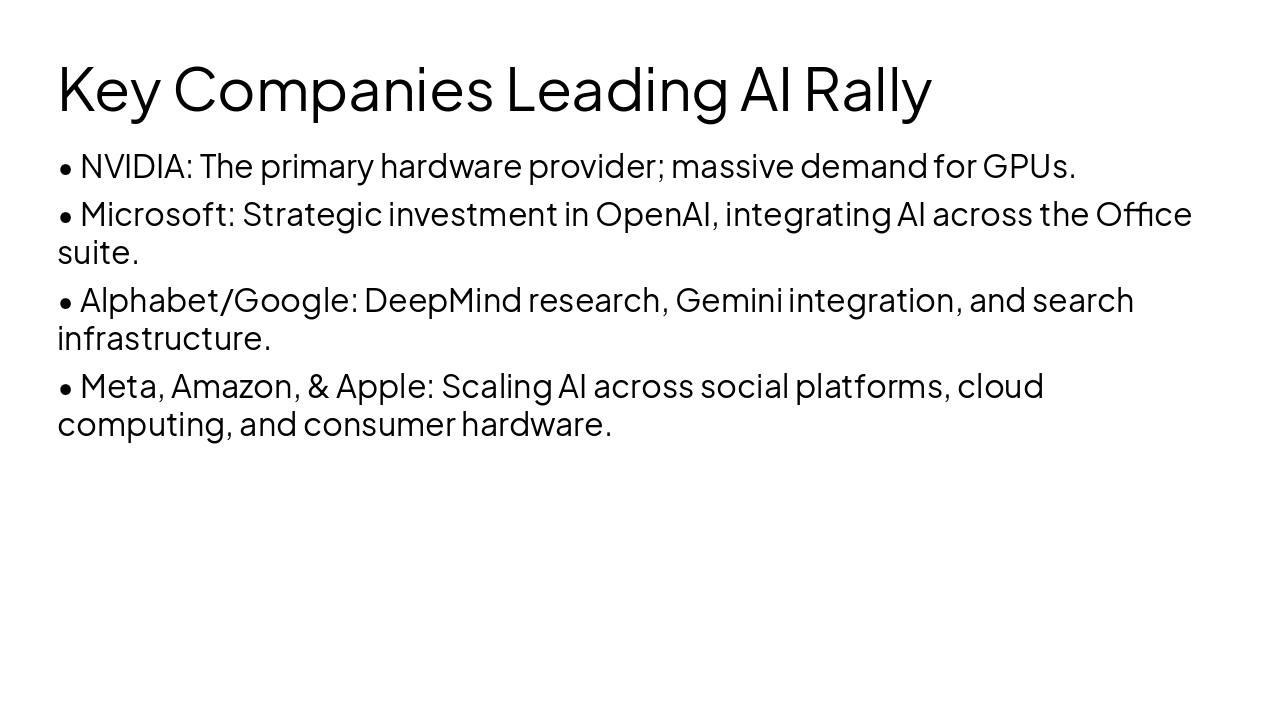
Slide 5 - Key Companies Leading AI Rally

  • NVIDIA: The primary hardware provider; massive demand for GPUs.
  • Microsoft: Strategic investment in OpenAI, integrating AI across the Office suite.
  • Alphabet/Google: DeepMind research, Gemini integration, and search infrastructure.
  • Meta, Amazon, & Apple: Scaling AI across social platforms, cloud computing, and consumer hardware.
Slide 5 - Key Companies Leading AI Rally
Slide 6 of 15

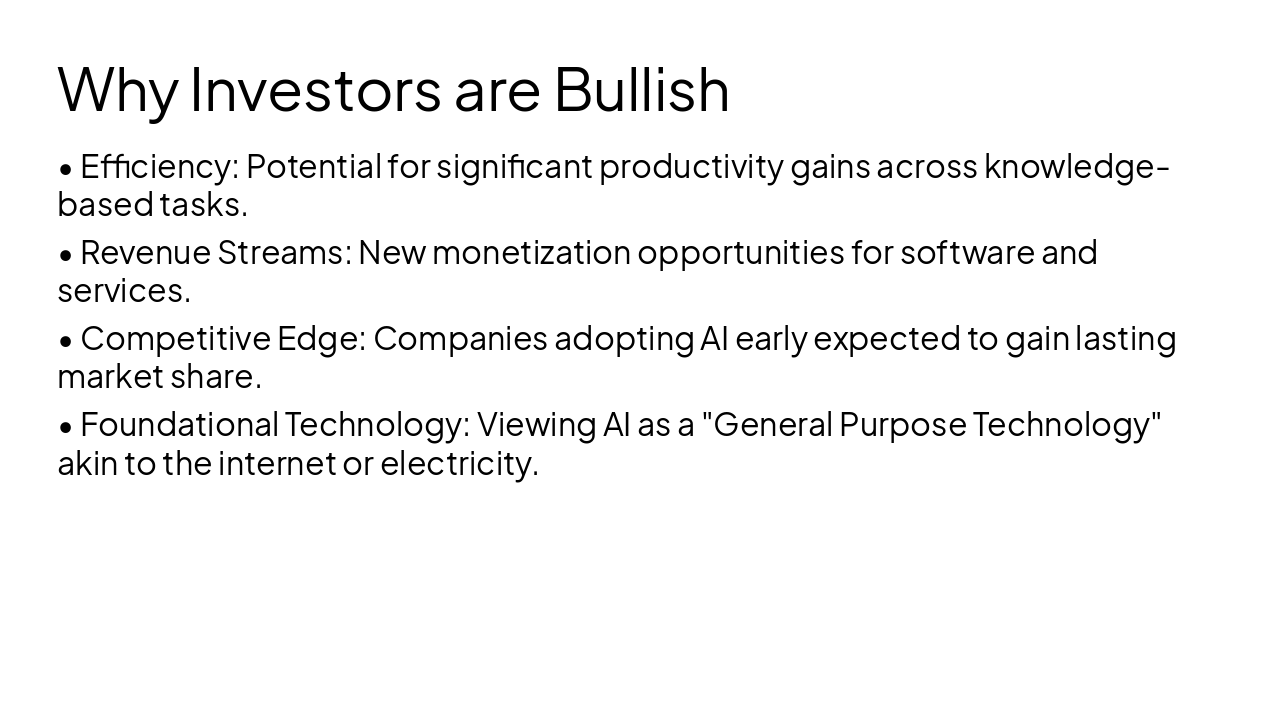
Slide 6 - Why Investors are Bullish

  • Efficiency: Potential for significant productivity gains across knowledge-based tasks.
  • Revenue Streams: New monetization opportunities for software and services.
  • Competitive Edge: Companies adopting AI early expected to gain lasting market share.
  • Foundational Technology: Viewing AI as a "General Purpose Technology" akin to the internet or electricity.
Slide 6 - Why Investors are Bullish
Slide 7 of 15

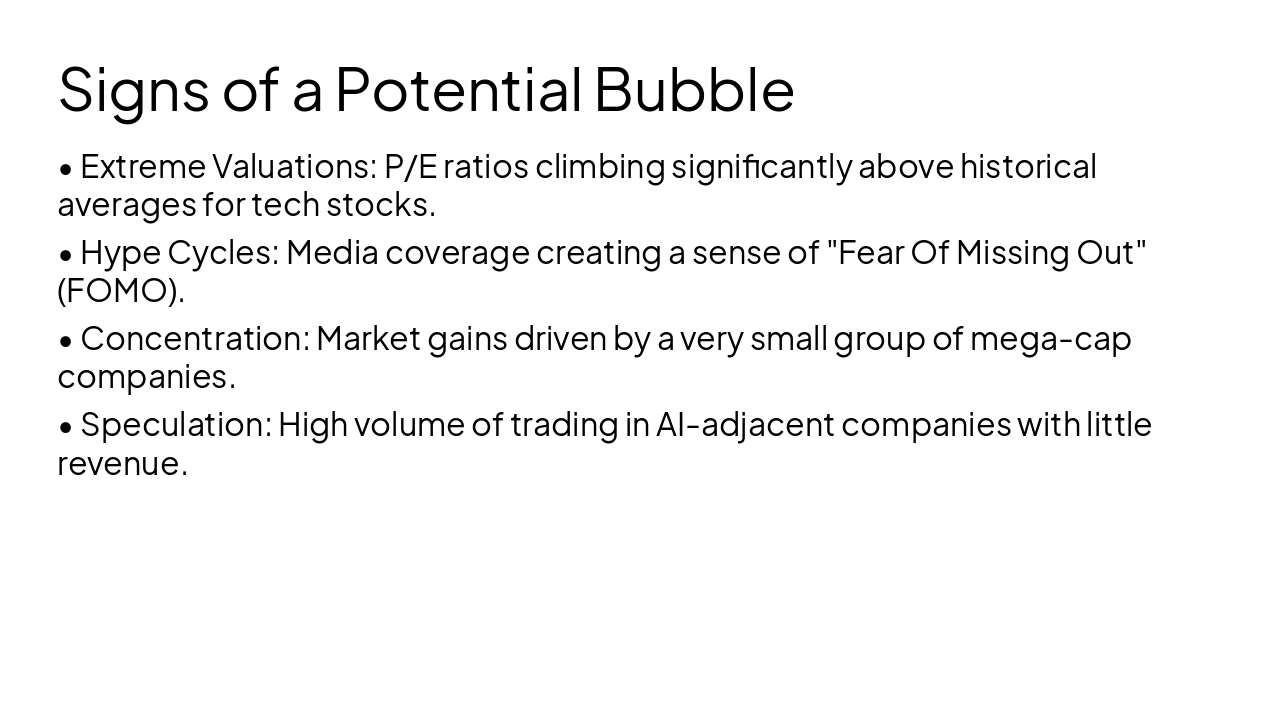
Slide 7 - Signs of a Potential Bubble

  • Extreme Valuations: P/E ratios climbing significantly above historical averages for tech stocks.
  • Hype Cycles: Media coverage creating a sense of "Fear Of Missing Out" (FOMO).
  • Concentration: Market gains driven by a very small group of mega-cap companies.
  • Speculation: High volume of trading in AI-adjacent companies with little revenue.
Slide 7 - Signs of a Potential Bubble
Slide 8 of 15

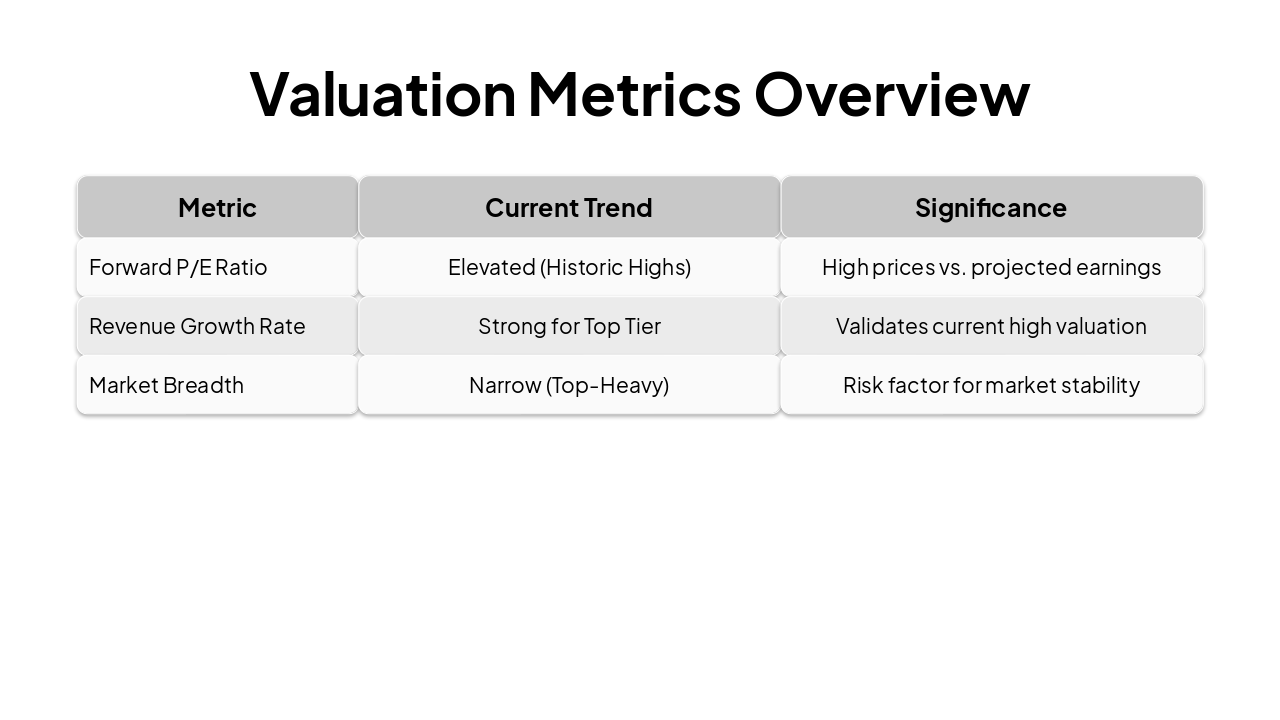
Slide 8 - Valuation Metrics Overview

MetricCurrent TrendSignificance
Forward P/E RatioElevated (Historic Highs)High prices vs. projected earnings
Revenue Growth RateStrong for Top TierValidates current high valuation
Market BreadthNarrow (Top-Heavy)Risk factor for market stability
Slide 8 - Valuation Metrics Overview
Slide 9 of 15

Slide 9 - Comparison to Dot-Com Bubble

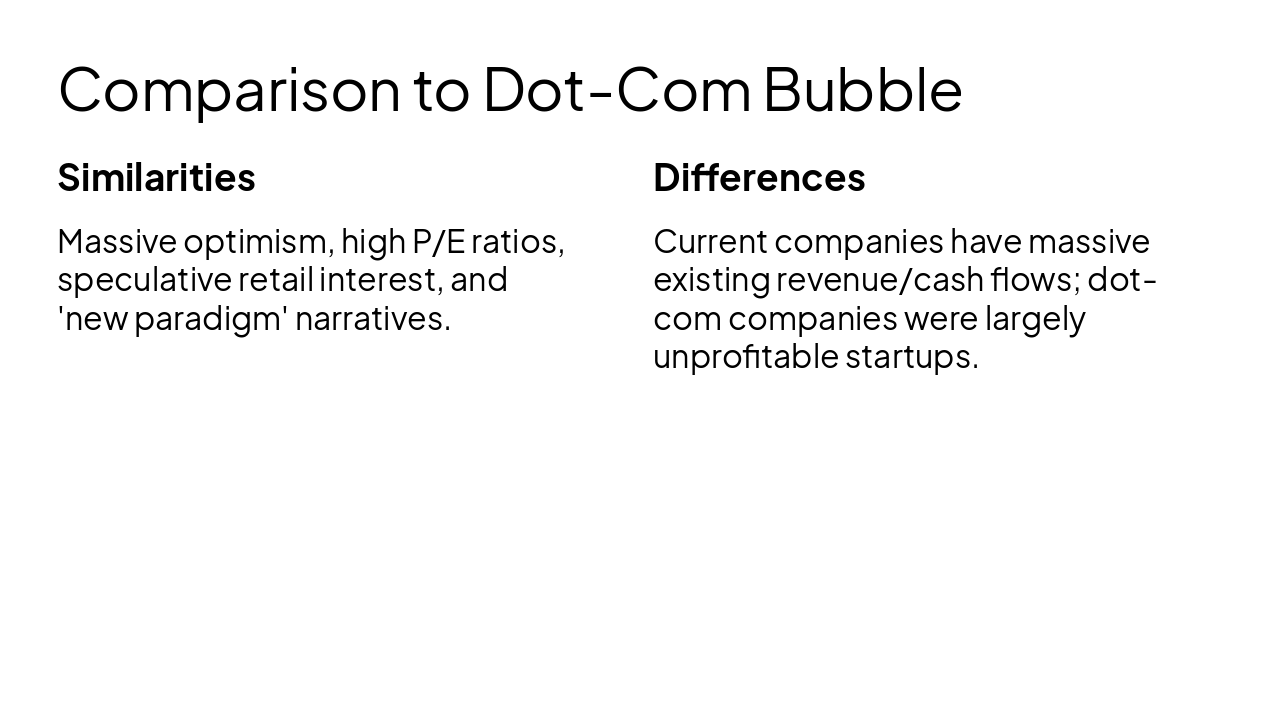
Similarities Massive optimism, high P/E ratios, speculative retail interest, and 'new paradigm' narratives.

Differences Current companies have massive existing revenue/cash flows; dot-com companies were largely unprofitable startups.
Slide 9 - Comparison to Dot-Com Bubble
Slide 10 of 15

Slide 10 - Risks and Concerns

  • Regulation: Increasing scrutiny from governments on data, safety, and competition.
  • Return on Investment: Difficulty in translating AI experimentation into immediate bottom-line profits.
  • Infrastructure Costs: Immense capital expenditure required for data centers/hardware.
  • Societal Impact: Risks related to automation, labor displacement, and deepfakes.
Slide 10 - Risks and Concerns
Slide 11 of 15

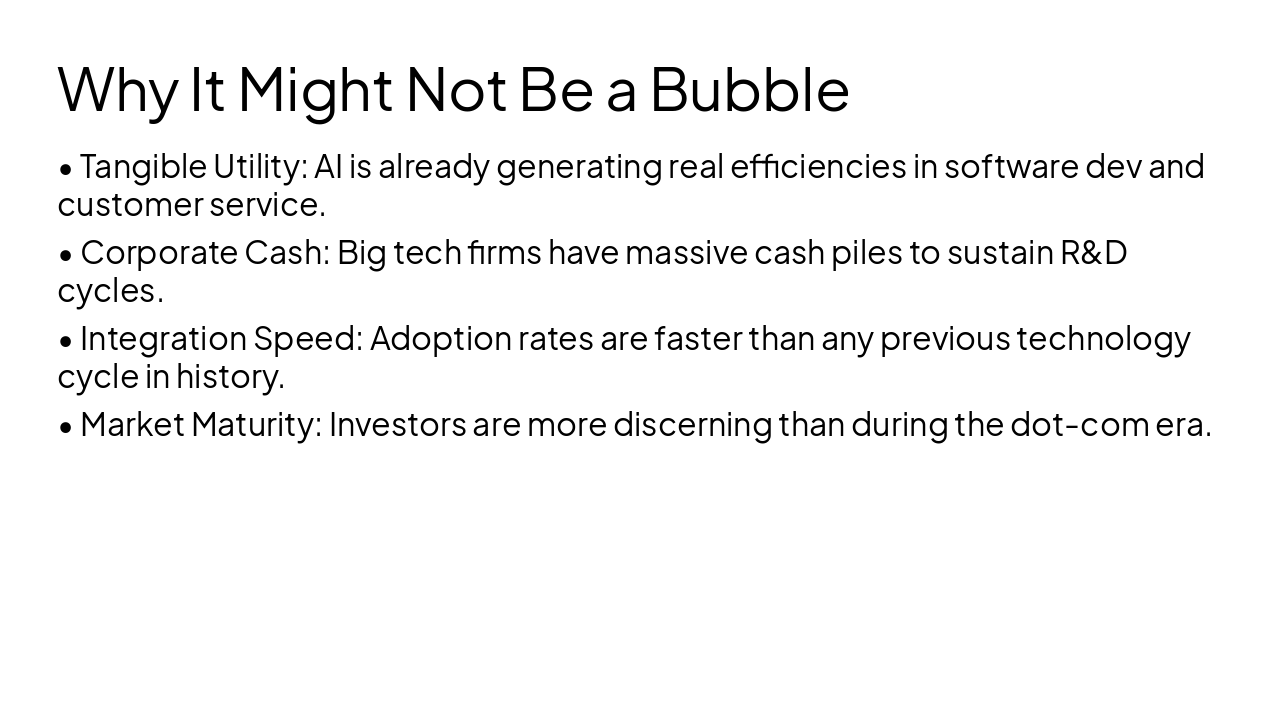
Slide 11 - Why It Might Not Be a Bubble

  • Tangible Utility: AI is already generating real efficiencies in software dev and customer service.
  • Corporate Cash: Big tech firms have massive cash piles to sustain R&D cycles.
  • Integration Speed: Adoption rates are faster than any previous technology cycle in history.
  • Market Maturity: Investors are more discerning than during the dot-com era.
Slide 11 - Why It Might Not Be a Bubble
Slide 12 of 15

Slide 12 - Expert Opinions & Sentiment

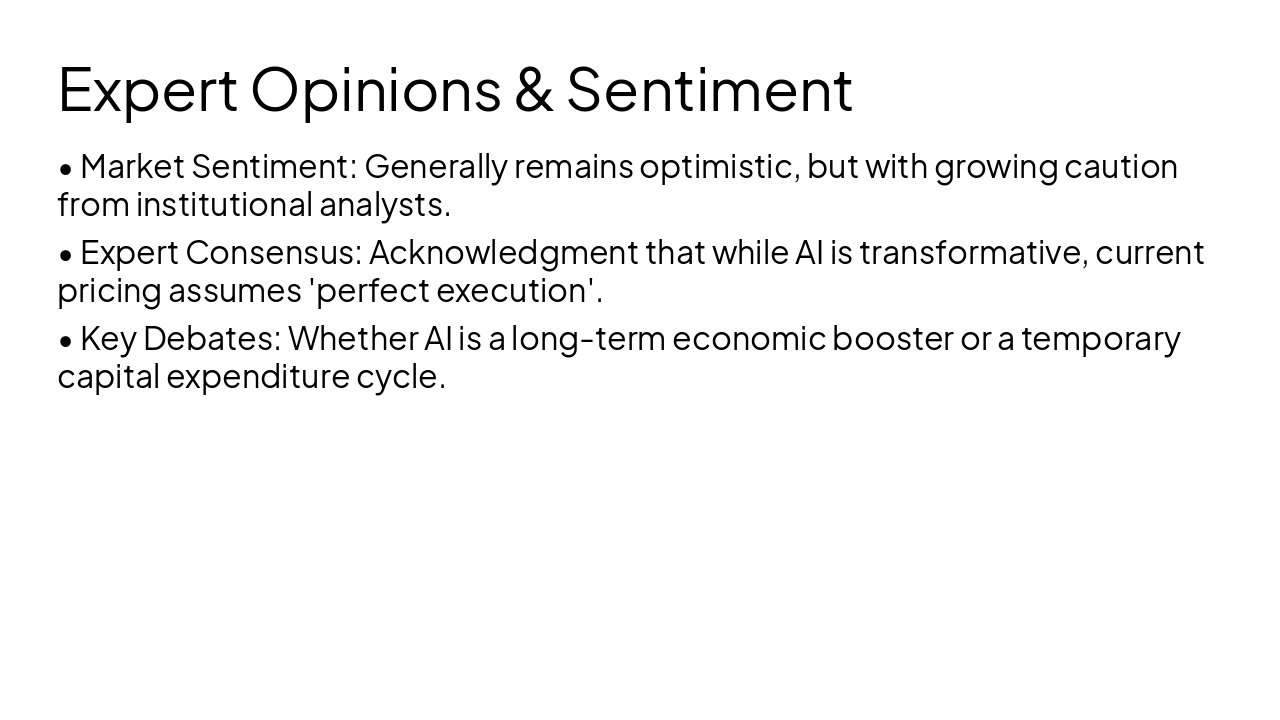
  • Market Sentiment: Generally remains optimistic, but with growing caution from institutional analysts.
  • Expert Consensus: Acknowledgment that while AI is transformative, current pricing assumes 'perfect execution'.
  • Key Debates: Whether AI is a long-term economic booster or a temporary capital expenditure cycle.
Slide 12 - Expert Opinions & Sentiment
Slide 13 of 15

Slide 13 - Possible Market Scenarios

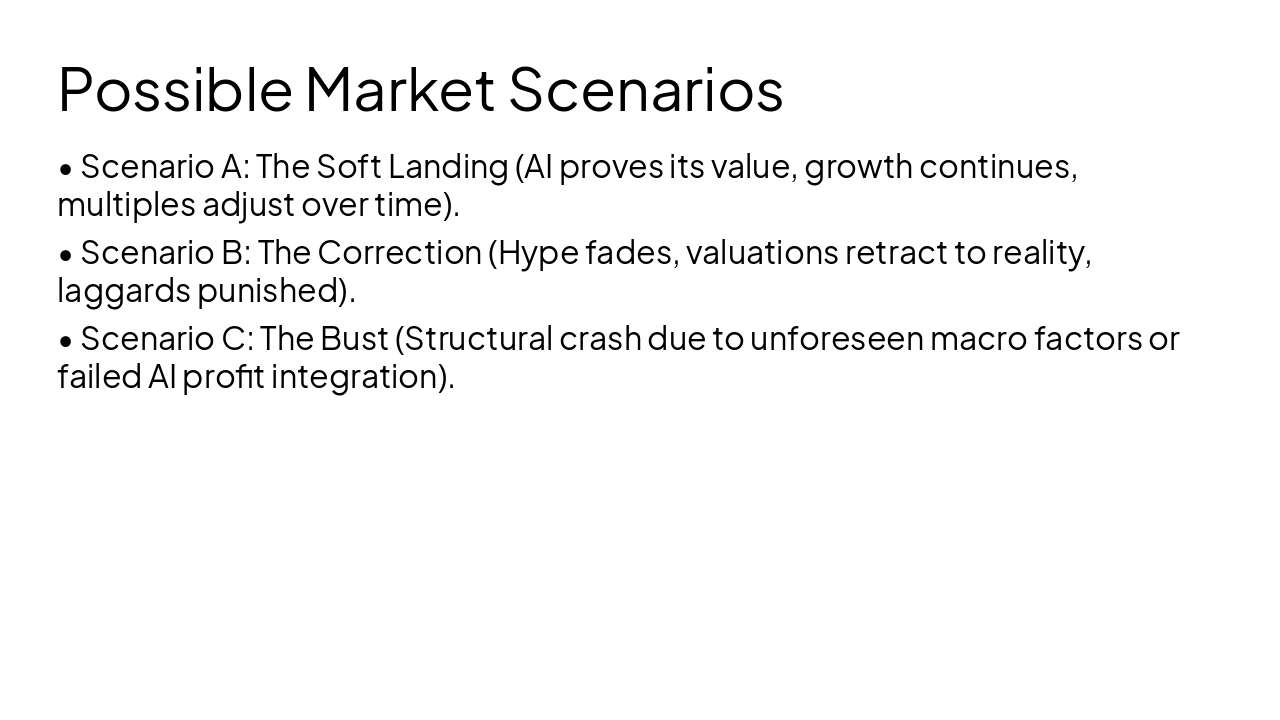
  • Scenario A: The Soft Landing (AI proves its value, growth continues, multiples adjust over time).
  • Scenario B: The Correction (Hype fades, valuations retract to reality, laggards punished).
  • Scenario C: The Bust (Structural crash due to unforeseen macro factors or failed AI profit integration).
Slide 13 - Possible Market Scenarios
Slide 14 of 15

Slide 14 - Investment Strategies

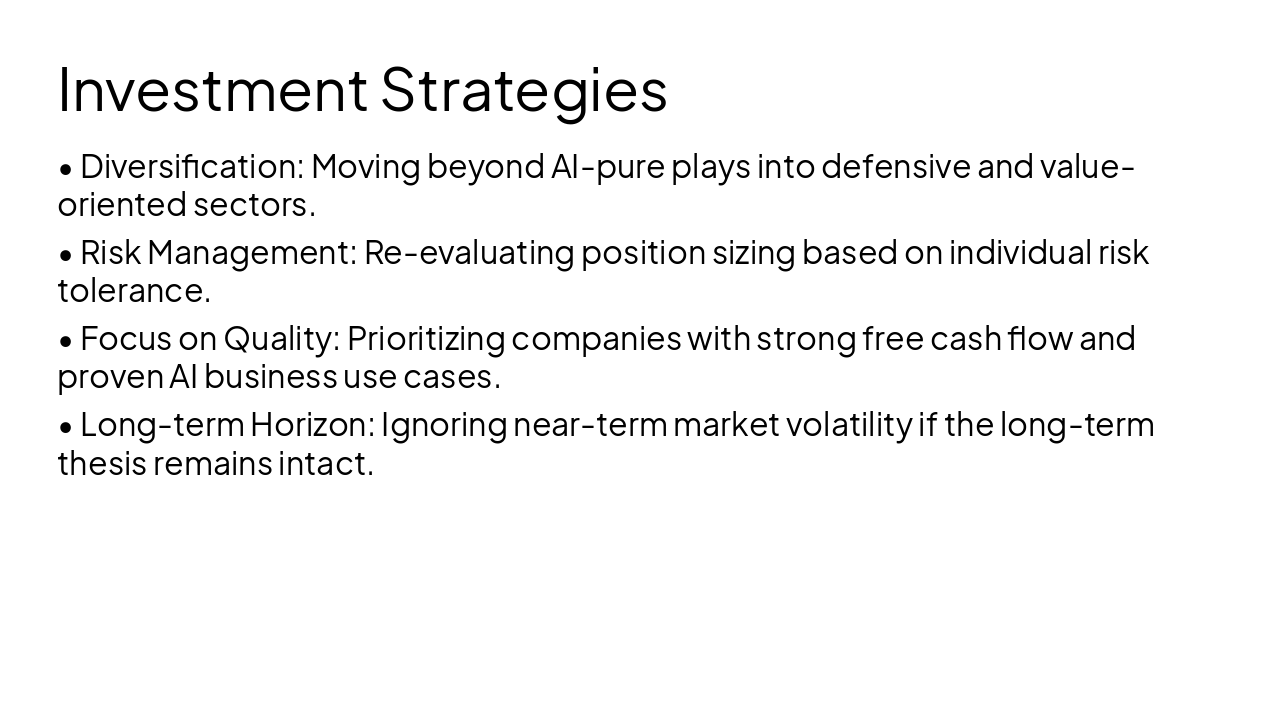
  • Diversification: Moving beyond AI-pure plays into defensive and value-oriented sectors.
  • Risk Management: Re-evaluating position sizing based on individual risk tolerance.
  • Focus on Quality: Prioritizing companies with strong free cash flow and proven AI business use cases.
  • Long-term Horizon: Ignoring near-term market volatility if the long-term thesis remains intact.
Slide 14 - Investment Strategies
Slide 15 of 15

Slide 15 - Summary & Key Takeaways

Conclusion: Balancing Innovation and Prudence

AI is transformative, but disciplined investing is critical in times of hyper-growth.
Slide 15 - Summary & Key Takeaways

Discover More Presentations

Explore thousands of AI-generated presentations for inspiration

Browse Presentations
Powered by AI

Create Your Own Presentation

Generate professional presentations in seconds with Karaf's AI. Customize this presentation or start from scratch.

Create New Presentation

Powered by Karaf.ai — AI-Powered Presentation Generator