Solar Revolution: Boom & Bottlenecks (35 chars)

Generated from prompt:

Slide 1: Title Slide Title: The Global Solar Energy Revolution: Scale, Economics, and Systemic Challenges • Key Theme: Exponential growth of Solar PV alongside critical infrastructure and financial bottlenecks in emerging markets. • Source Material Focus: Global Market Outlook, Financial De-risking, O&M Performance, and Grid Stability. -------------------------------------------------------------------------------- Slide 2: Global Solar Market Milestones & Economics Title: Solar PV Dominance: Record Growth and Cost Competitiveness • Global Capacity Milestone: Cumulative solar PV installations surpassed 2 Terawatts (TW) by the end of 2024. • Speed of Growth: The industry achieved the 2 TW milestone just two years after reaching 1 TW. • New Power Generation: Solar PV accounts for 71% of total new annual generation capacity additions globally. • Record Low Costs (2023): ◦ Global weighted average Levelized Cost of Electricity (LCOE) for utility-scale PV reached a record low of $0.044 per kWh. ◦ This LCOE is 56% lower than the lowest-cost thermal power option. ◦ Total global installation cost for PV dropped to $758 USD/kW in 2023, representing an 86% decrease compared to 2010. -------------------------------------------------------------------------------- Slide 3: Critical Bottlenecks: Grid Infrastructure and Storage Gap Title: Grid and Storage Deficits Threaten Transition Pace • Primary Bottleneck: Outdated grids are the main obstacle causing project delays due to curtailment, congestion, and long connection queues. • Required Grid Investment: Grid investment must nearly double to over $600 billion annually by 2030 to meet climate targets. • Storage Deployment Gap: Current short and long duration storage deployment falls significantly short of the estimated 1,500 GW of capacity required globally to triple renewable energy by 2030. • Storage Cost Reduction: Energy storage technology costs have dropped dramatically, plummeting 85% over the last 10 years. • Policy Focus: The Global Solar Council (GSC) expanded its mandate to represent the solar plus storage ecosystem to lead the required system transformation. -------------------------------------------------------------------------------- Slide 4: Financial Barriers in Emerging Markets (Pakistan Case) Title: High Risk and Legacy Costs Cripple Renewables Investment • High Capital Costs: High interest rates and risk premiums in emerging markets double their capital costs compared to advanced economies. • Core Problem: Circular Debt: Pakistan’s power sector circular debt reached PKR 2.4 Trillion (T) in FY24. • Rising Fixed Costs: Capacity Purchase Price (CPP) surged to PKR 1.9 T in FY24, reflecting a 46% Year-on-Year (YoY) increase. • Fossil Fuel Strandings: Chinese-financed coal-fired power plants (CFPPs) relying on imported coal operated at a catastrophic average utilization rate of only 11% capacity factor in FY24. • Solar Contradiction: This underutilization is exacerbated by the influx of cheap solar, creating inadvertent competition between legacy coal investments and Chinese solar panels. -------------------------------------------------------------------------------- Slide 5: Pakistan's Solar Rush Title: Consumer-Led Transition Outpaces Planning • Massive Imports: Total Chinese solar PV imports reached 39 GW by March 2025 over five years. • Scale Comparison: This imported capacity is more than three-fourths of Pakistan’s total national generation capacity. • Recent Surge: Solar panel imports jumped by 227% YoY in FY24 to 16 GW. • Distributed Growth: Net metering capacity reached 4.9 GW by 9M FY25, having nearly doubled from 2.5 GW in FY24. • Economic Driver: Consumer tariffs surged 155% over three years, driving households and businesses to seek alternatives. • Financial Incentive: The average payback period for residential solar systems is as low as 2 years. -------------------------------------------------------------------------------- Slide 6: Operational Performance Challenges: Rising Power Loss Title: Underperformance and Labor Shortfalls in Maturing Solar Fleets • Underperformance Trend: Equipment-driven power loss has tripled (3.1x) over the last five years. • Annual Financial Loss: The average solar asset incurred a potential revenue loss of $5,720 per MWdc annually from unresolved equipment issues in 2024. • Global Revenue Risk: This indicates an annualized potential revenue loss of $10.0 billion across the global solar industry fleet. • O&M Labor Gap (US): Over the last five years (2019-2023), solar capacity grew by 182%, while the O&M operational labor force grew by only 91%. • Inspection Frequency: Asset owners increased the inspection rate of the same sites by 70% from 2023 to 2024. -------------------------------------------------------------------------------- Slide 7: Optimizing Operations: The 90% Revenue Loss Rule Title: Prioritizing High-Impact Defects with Intelligence and Automation • Concentrated Loss: High-priority equipment failures (inverters, strings, combiners, trackers) accounted for 90% of the observed revenue loss in 2024. • Issue Frequency vs. Impact: These critical issues represented only 32% of the total identified defects. • Top Equipment Failure: Inverter faults remained the single largest driver of observed power loss at 37% in 2024. • Mitigation Strategy: Successful operators are rapidly adopting automation, remote diagnostics, and aerial inspections to efficiently identify, prioritize, and remediate the highest-impact issues. -------------------------------------------------------------------------------- Slide 8: Technical Integration and Stability Title: Managing Low Inertia and Grid Constraints • Grid Stability Impact: Integrating large-scale solar PV reduces rotational inertia, causing faster frequency dynamics and making power system operation challenging. • Injection Limit (Zambia Case): Simulation found that integrating PV resulted in system collapse during uncontrolled loss of generation (a common fault scenario). • Autonomy Threshold: On the Zambian grid (Leopards Hill/Lusaka West), the system could only autonomously retain stability following a complete loss of generation of 43.6 MW. • Need for Reform: Legislations, regulations, and grid codes—originally developed for conventional generation—must be modified to enable flexibility in the design and operation of future power infrastructure incorporating low-inertia, variable resources.

Solar PV hits 2TW, 71% new capacity, $0.044/kWh LCOE amid grid/storage gaps, EM finance woes (Pakistan debt/solar rush), O&M losses (3x to $5.7k/MW), and stability reforms needed. (174 chars)

December 18, 20255 slides
Slide 1 of 5

Slide 1 - The Global Solar Energy Revolution: Scale, Economics, and Systemic Challenges

This title slide features "The Global Solar Energy Revolution" as the main heading. The subtitle focuses on scale, economics, and systemic challenges in emerging markets.

The Global Solar Energy Revolution

Scale, Economics, and Systemic Challenges in Emerging Markets

Speaker Notes
Key Theme: Exponential growth of Solar PV alongside infrastructure & financial bottlenecks in emerging markets. Focus: Global Outlook, De-risking, O&M, Grid Stability.
Slide 1 - The Global Solar Energy Revolution: Scale, Economics, and Systemic Challenges
Slide 2 of 5

Slide 2 - Solar PV Dominance: Record Growth & Cost Competitiveness

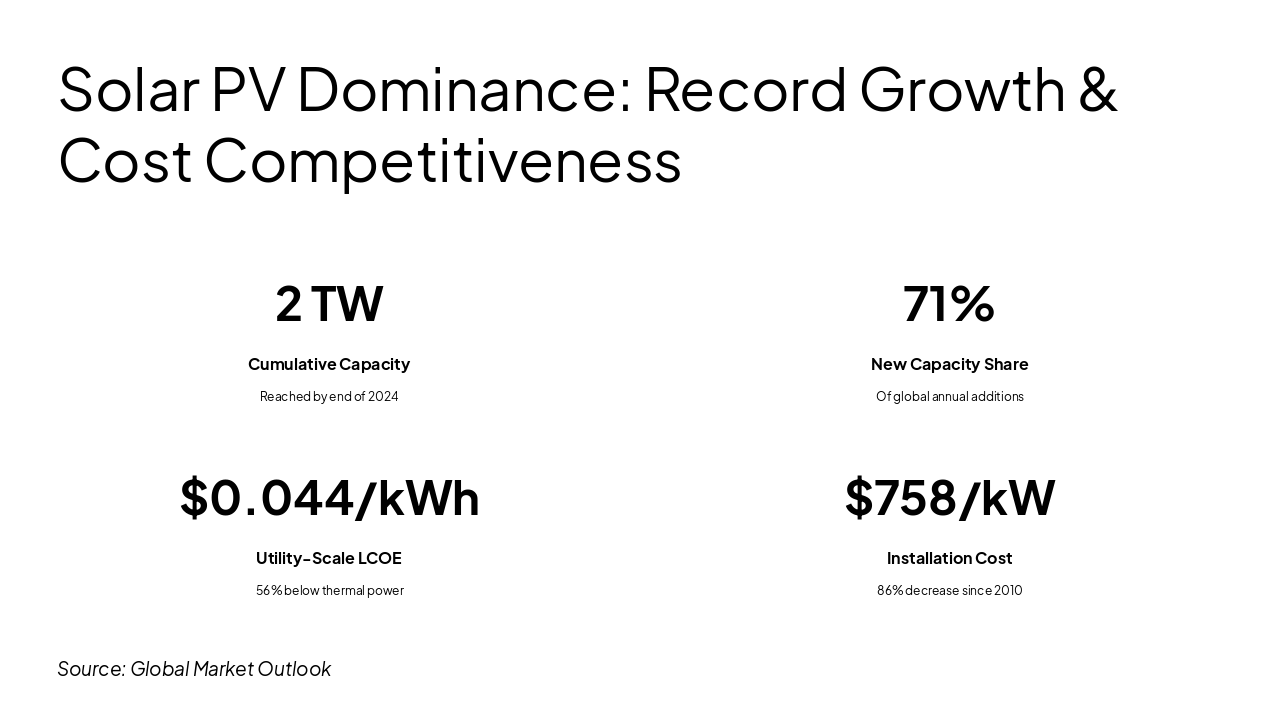
Solar PV cumulative capacity hit 2 TW by end of 2024, capturing 71% of global annual new capacity additions. Utility-scale LCOE stands at $0.044/kWh—56% below thermal power—with installation costs down 86% since 2010 to $758/kW.

Solar PV Dominance: Record Growth & Cost Competitiveness

  • 2 TW: Cumulative Capacity
  • Reached by end of 2024

  • 71%: New Capacity Share
  • Of global annual additions

  • $0.044/kWh: Utility-Scale LCOE
  • 56% below thermal power

  • $758/kW: Installation Cost

86% decrease since 2010 Source: Global Market Outlook

Slide 2 - Solar PV Dominance: Record Growth & Cost Competitiveness
Slide 3 of 5

Slide 3 - Grid & Storage Deficits Threaten Transition

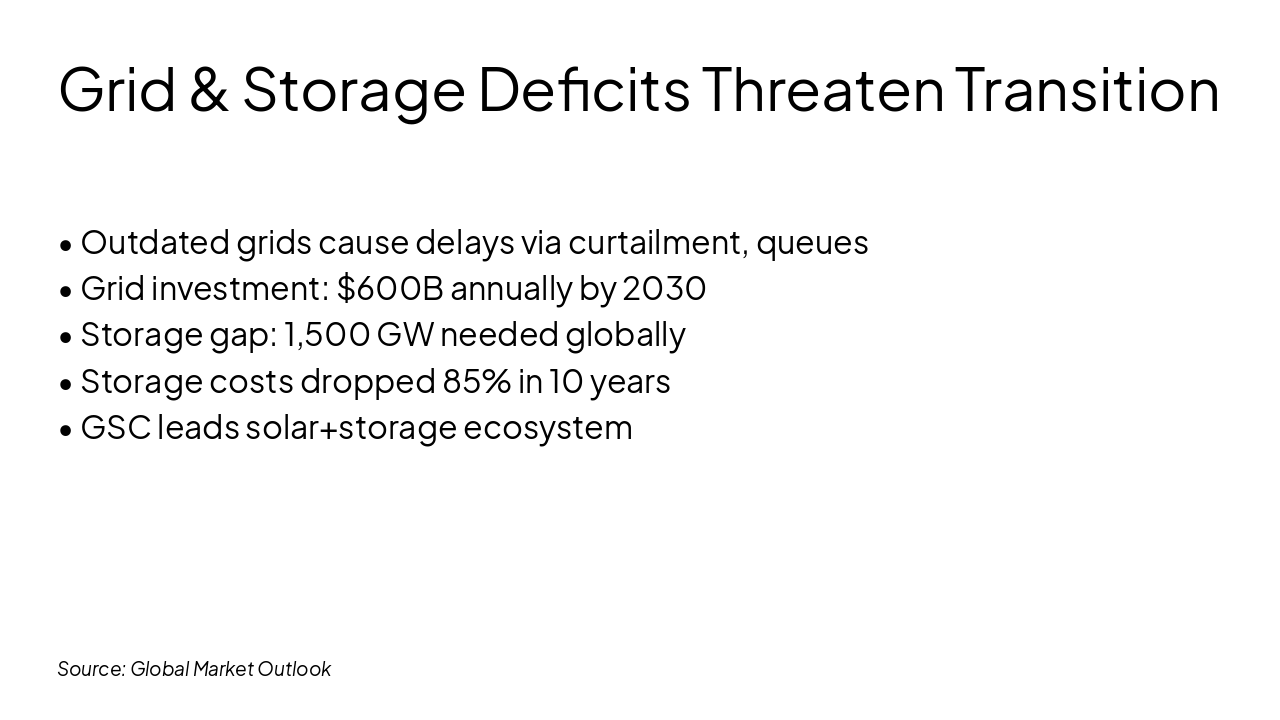
Outdated grids cause delays through curtailment and queues, needing $600B annual investment by 2030, while a 1,500 GW global storage gap persists despite 85% cost drops in 10 years. GSC leads the solar+storage ecosystem to counter these transition threats.

Grid & Storage Deficits Threaten Transition

  • Outdated grids cause delays via curtailment, queues
  • Grid investment: $600B annually by 2030
  • Storage gap: 1,500 GW needed globally
  • Storage costs dropped 85% in 10 years
  • GSC leads solar+storage ecosystem

Source: Global Market Outlook

Slide 3 - Grid & Storage Deficits Threaten Transition
Slide 4 of 5

Slide 4 - Pakistan: Financial Barriers vs Solar Rush

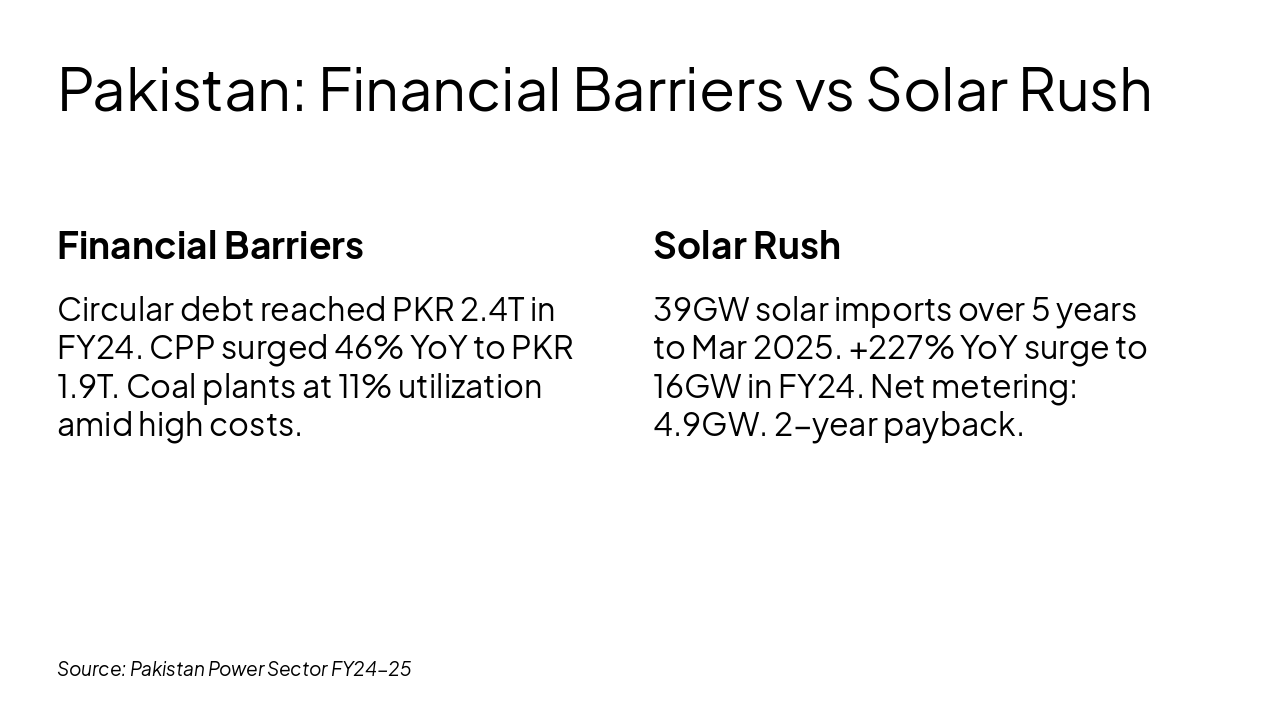
Pakistan faces severe financial barriers in energy, with circular debt at PKR 2.4T in FY24, CPP up 46% YoY to PKR 1.9T, and coal plants at just 11% utilization due to high costs. Meanwhile, a solar rush features 39GW imports over 5 years to Mar 2025, +227% YoY to 16GW in FY24, 4.9GW net metering, and 2-year payback.

Pakistan: Financial Barriers vs Solar Rush

Financial BarriersSolar Rush
Circular debt reached PKR 2.4T in FY24. CPP surged 46% YoY to PKR 1.9T. Coal plants at 11% utilization amid high costs.39GW solar imports over 5 years to Mar 2025. +227% YoY surge to 16GW in FY24. Net metering: 4.9GW. 2-year payback.

Source: Pakistan Power Sector FY24-25

Slide 4 - Pakistan: Financial Barriers vs Solar Rush
Slide 5 of 5

Slide 5 - O&M Challenges & Optimization for Stability

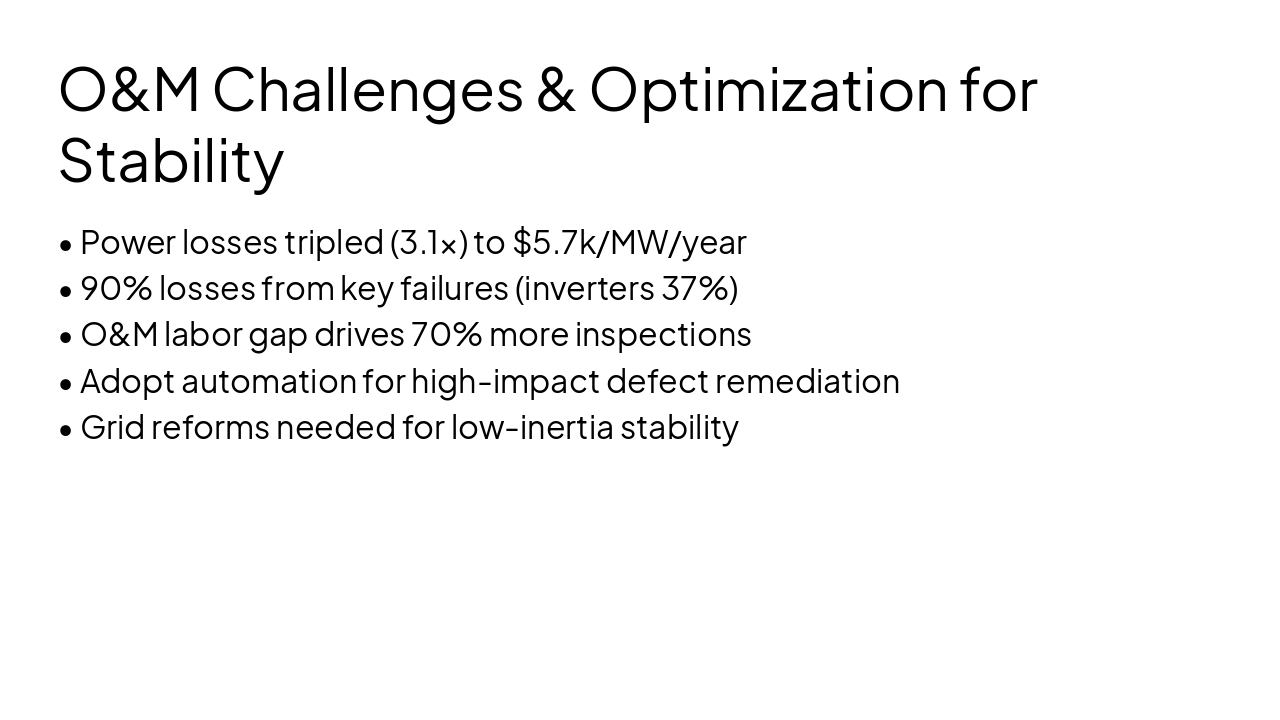
Power losses have tripled to $5.7k/MW/year, with 90% from key failures like inverters (37%), and O&M labor gaps driving 70% more inspections. Optimization requires adopting automation for high-impact defect remediation and grid reforms for low-inertia stability.

O&M Challenges & Optimization for Stability

  • Power losses tripled (3.1x) to $5.7k/MW/year
  • 90% losses from key failures (inverters 37%)
  • O&M labor gap drives 70% more inspections
  • Adopt automation for high-impact defect remediation
  • Grid reforms needed for low-inertia stability
Slide 5 - O&M Challenges & Optimization for Stability
Powered by AI

Create Your Own Presentation

Generate professional presentations in seconds with Karaf's AI. Customize this presentation or start from scratch.

Create New Presentation

Powered by Karaf.ai — AI-Powered Presentation Generator