Marcel Duchamp: Revolutionary Life, Works, and Enduring Legacy

Generated from prompt:

Task Create a creative output about the life and works of Marcel Duchamp. Your work should explain: Who Marcel Duchamp was His artistic journey His major artworks His influence on modern and contemporary art Explain: What made Duchamp different from traditional artists His concept of “readymades” His challenge to traditional definitions of art His influence on conceptual thinking in art Discuss How Duchamp influenced modern and contemporary art His impact on conceptual art and installation art Why he remains important in today’s art world Do you consider his works “art”? Why or why not? Which artwork interested you the most?

This presentation delves into the life and artistic journey of Marcel Duchamp (1887-1968), a painter, sculptor, and chess master who revolutionized art. It covers his early career, major artworks like Nude Descending a Staircase No. 2 and Fountain, the innovative readymades that prioritized concept over craft, challenges to traditional art definitions, profound influence on Dada, conceptual art, Pop Art, and contemporary practices, plus personal reflections on his provocative legacy.

May 12, 202616 slides
Slide 1 of 16

Slide 1 - Marcel Duchamp Revolutionary Life and Works

Marcel Duchamp Revolutionary Life and Works

Challenging Art's Boundaries and Enduring Legacy
Slide 1 - Marcel Duchamp
Revolutionary Life and Works
Slide 2 of 16

Slide 2 - Presentation Agenda

  • Who Was Marcel Duchamp?
  • Artistic Journey
  • Major Artworks
  • What Made Him Different: Readymades
  • Challenge to Art Definitions
  • Influence on Modern Art
  • Personal Reflections

---

Photo by Kelly Sikkema on Unsplash
Slide 2 - Presentation Agenda
Slide 3 of 16

Slide 3 - Section 1

1

Who Was Marcel Duchamp?

Painter, sculptor, and chess master (1887-1968)

---

Photo by Alex Dard on Unsplash

Slide 3 - Section 1
Slide 4 of 16

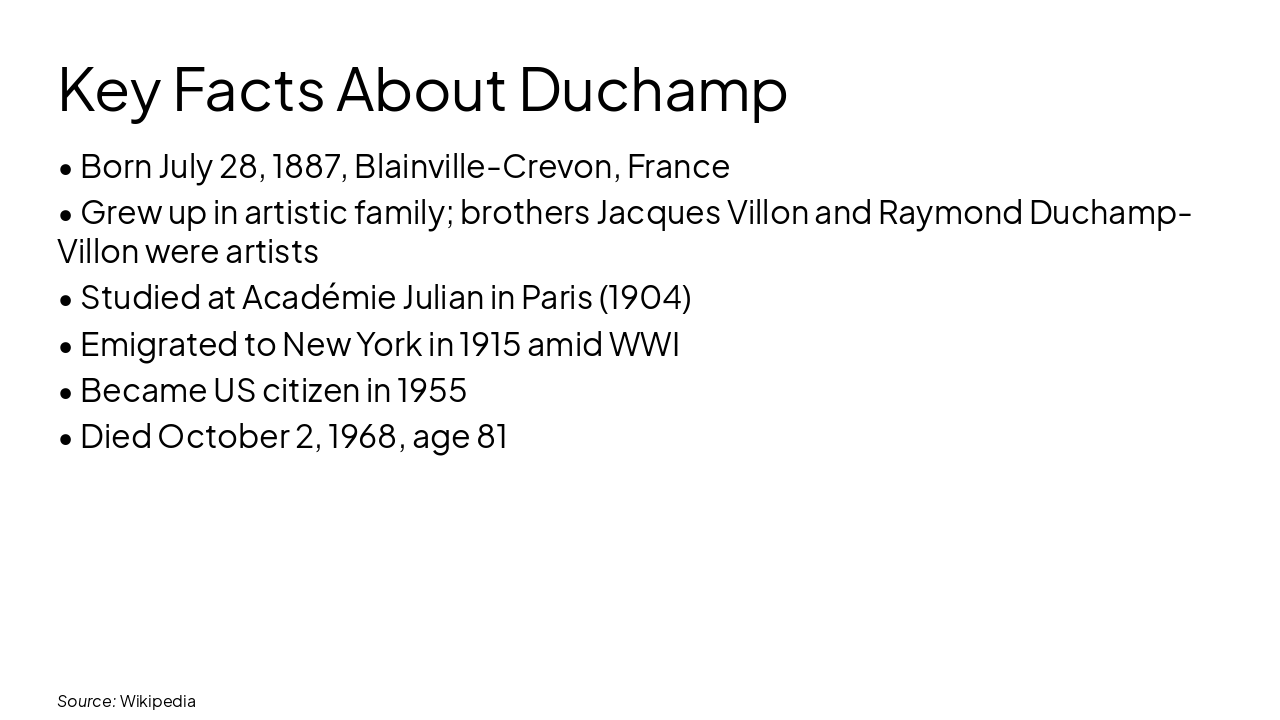
Slide 4 - Key Facts About Duchamp

  • Born July 28, 1887, Blainville-Crevon, France
  • Grew up in artistic family; brothers Jacques Villon and Raymond Duchamp-Villon were artists
  • Studied at Académie Julian in Paris (1904)
  • Emigrated to New York in 1915 amid WWI
  • Became US citizen in 1955
  • Died October 2, 1968, age 81

Source: Wikipedia

Slide 4 - Key Facts About Duchamp
Slide 5 of 16

Slide 5 - Artistic Journey Timeline

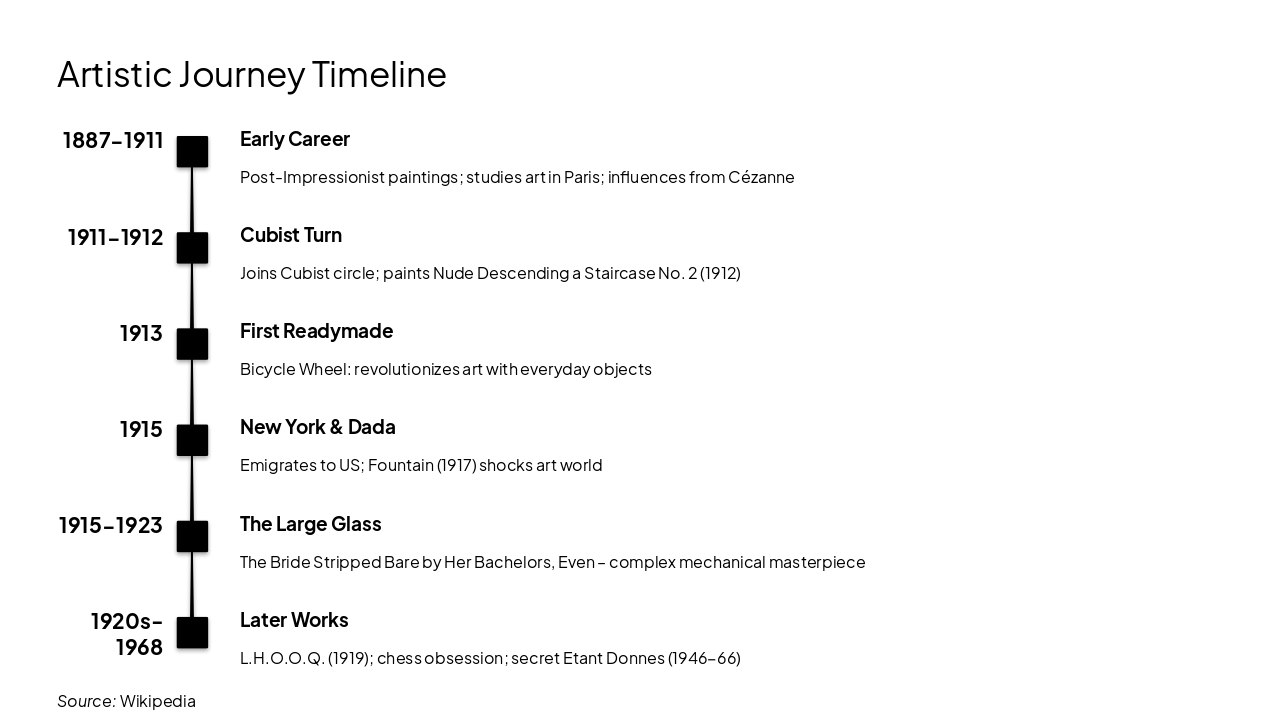
1887-1911: Early Career Post-Impressionist paintings; studies art in Paris; influences from Cézanne 1911-1912: Cubist Turn Joins Cubist circle; paints Nude Descending a Staircase No. 2 (1912) 1913: First Readymade Bicycle Wheel: revolutionizes art with everyday objects 1915: New York & Dada Emigrates to US; Fountain (1917) shocks art world 1915-1923: The Large Glass The Bride Stripped Bare by Her Bachelors, Even – complex mechanical masterpiece 1920s-1968: Later Works L.H.O.O.Q. (1919); chess obsession; secret Etant Donnes (1946-66)

Source: Wikipedia
Slide 5 - Artistic Journey Timeline
Slide 7 of 16

Slide 7 - Nude Descending a Staircase No. 2 (1912)

  • Oil on canvas, 152 x 152 cm
  • Fuses Cubist fragmentation with Futurist motion
  • Scandalized 1913 Armory Show in New York
  • Represents a nude in dynamic descent
  • Bridged European modernism to American audience

---

Photo by Trnava University on Unsplash

Source: Wikipedia
Slide 7 - Nude Descending a Staircase No. 2 (1912)
Slide 8 of 16

Slide 8 - Fountain (1917)

  • Porcelain urinal signed 'R. Mutt 1917'
  • Submitted to 1917 Independents exhibition, rejected
  • Iconic readymade challenging art definitions
  • Original lost; authorized replicas from 1960s
  • Provoked debate: context creates art

---

Photo by Oliver Hale on Unsplash

Source: Wikipedia
Slide 8 - Fountain (1917)
Slide 9 of 16

Slide 9 - Section 3

3

What Made Duchamp Different

Readymades and Anti-Art Philosophy

---

Photo by Zoshua Colah on Unsplash

Slide 9 - Section 3
Slide 10 of 16

Slide 10 - Defining the Readymade

> Whether Mr. Mutt made the fountain with his own hands or not has no importance. He CHOSE it. He took an ordinary article of life, placed it so that its useful significance disappeared under a new title and point of view.

— Marcel Duchamp

---

Photo by Peter Herrmann on Unsplash

Source: Wikipedia, The Blind Man No. 2 (1917)
Slide 10 - Defining the Readymade
Slide 11 of 16

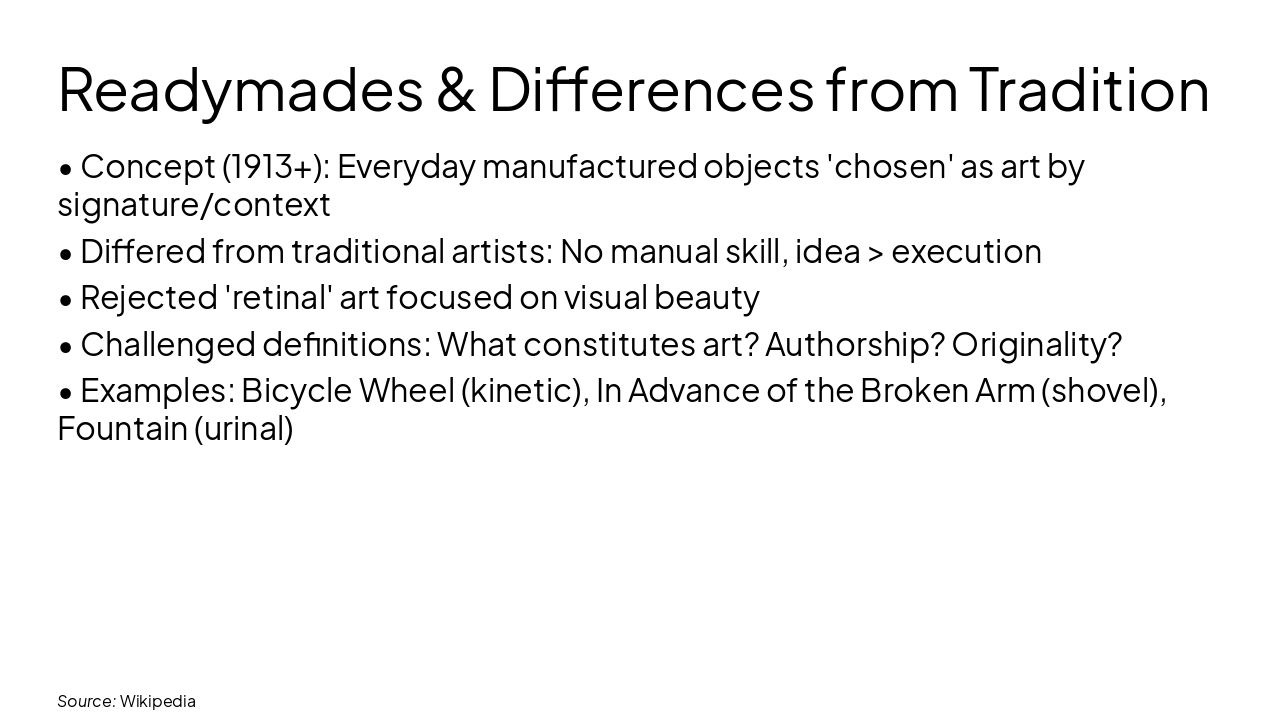
Slide 11 - Readymades & Differences from Tradition

  • Concept (1913+): Everyday manufactured objects 'chosen' as art by signature/context
  • Differed from traditional artists: No manual skill, idea > execution
  • Rejected 'retinal' art focused on visual beauty
  • Challenged definitions: What constitutes art? Authorship? Originality?
  • Examples: Bicycle Wheel (kinetic), In Advance of the Broken Arm (shovel), Fountain (urinal)

Source: Wikipedia

Slide 11 - Readymades & Differences from Tradition
Slide 12 of 16

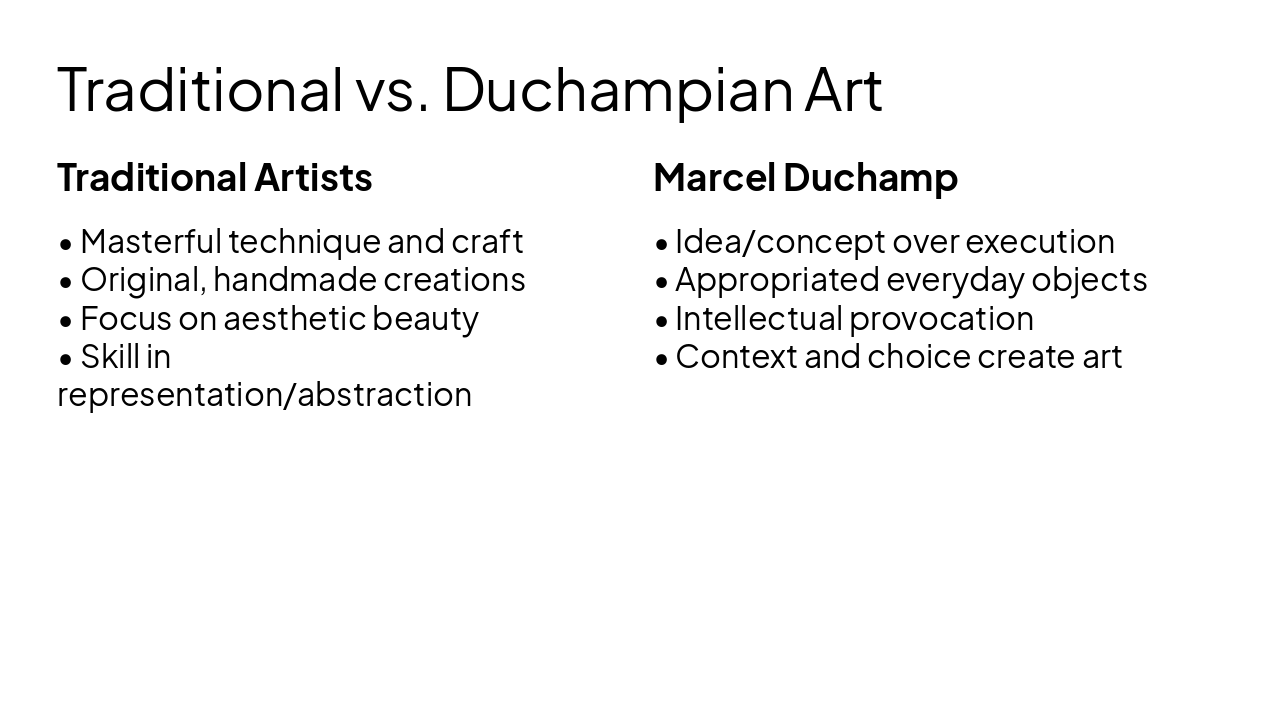
Slide 12 - Traditional vs. Duchampian Art

Traditional Artists

  • Masterful technique and craft
  • Original, handmade creations
  • Focus on aesthetic beauty
  • Skill in representation/abstraction

Marcel Duchamp

  • Idea/concept over execution
  • Appropriated everyday objects
  • Intellectual provocation
  • Context and choice create art
Slide 12 - Traditional vs. Duchampian Art
Slide 13 of 16

Slide 13 - Section 4

4

Duchamp's Lasting Influence

Shaping Conceptual and Installation Art

---

Photo by Maria Ivanova on Unsplash
Slide 13 - Section 4
Slide 14 of 16

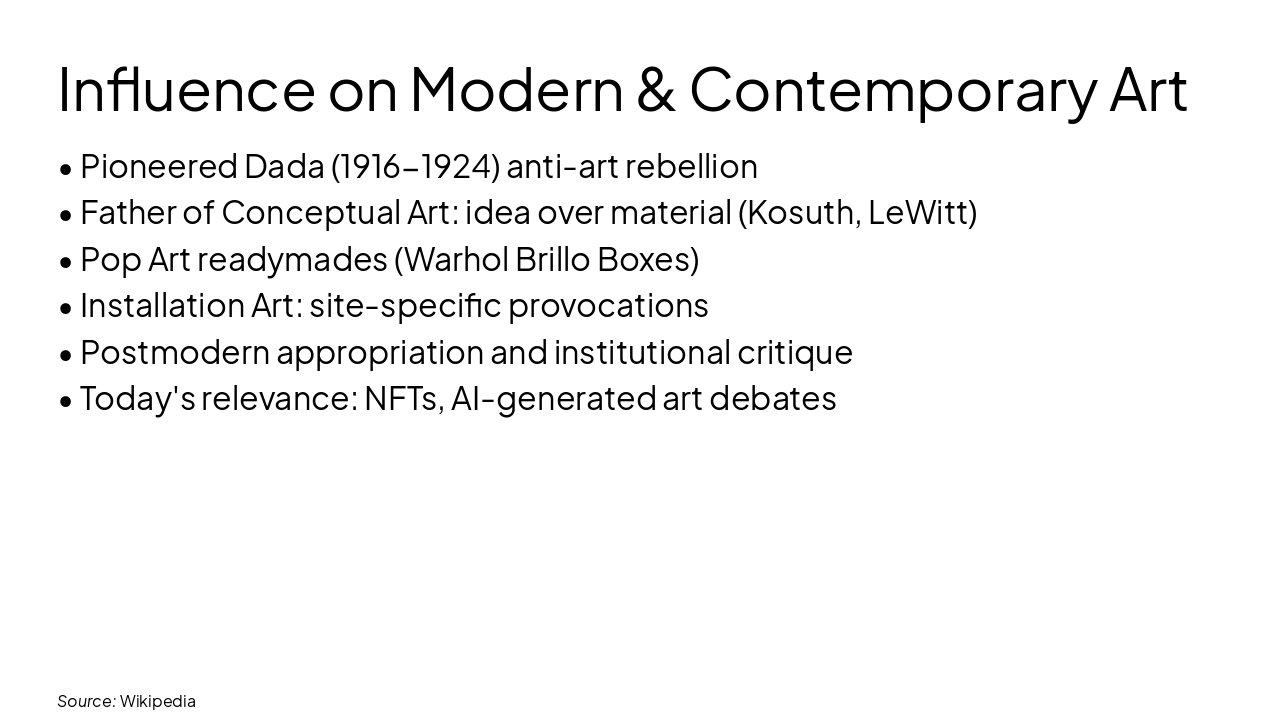
Slide 14 - Influence on Modern & Contemporary Art

  • Pioneered Dada (1916-1924) anti-art rebellion
  • Father of Conceptual Art: idea over material (Kosuth, LeWitt)
  • Pop Art readymades (Warhol Brillo Boxes)
  • Installation Art: site-specific provocations
  • Postmodern appropriation and institutional critique
  • Today's relevance: NFTs, AI-generated art debates

Source: Wikipedia

Slide 14 - Influence on Modern & Contemporary Art
Slide 15 of 16

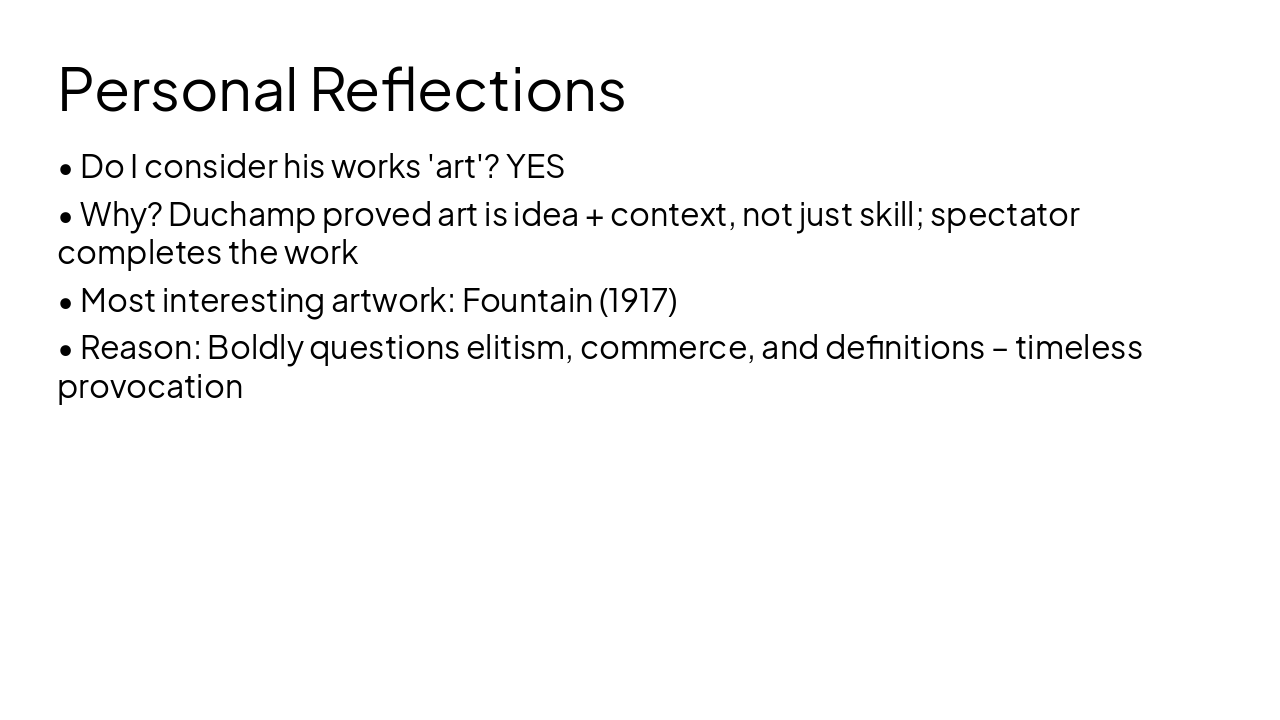
Slide 15 - Personal Reflections

  • Do I consider his works 'art'? YES
  • Why? Duchamp proved art is idea + context, not just skill; spectator completes the work
  • Most interesting artwork: Fountain (1917)
  • Reason: Boldly questions elitism, commerce, and definitions – timeless provocation
Slide 15 - Personal Reflections
Slide 16 of 16

Slide 16 - Thank You

Duchamp: Redefining Art as Idea Legacy in Conceptualism, Installations & Beyond

Questions remain: What is art? His influence endures.

---

Photo by R INVSCIMENTO on Unsplash
Slide 16 - Thank You

Discover More Presentations

Explore thousands of AI-generated presentations for inspiration

Browse Presentations
Powered by AI

Create Your Own Presentation

Generate professional presentations in seconds with Karaf's AI. Customize this presentation or start from scratch.

Create New Presentation

Powered by Karaf.ai — AI-Powered Presentation Generator