Attention Is All You Need: The Transformer Revolution

Generated from prompt:

Please make a presentation from the attached paper

This presentation dives into the Transformer model from the landmark paper 'Attention Is All You Need'. It covers background on RNN/CNN limitations, the encoder-decoder architecture with self-attention, multi-head attention, positional encoding,训练细节,

March 2, 202617 slides
Slide 1 of 17

Slide 1 - Attention Is All You Need

Attention Is All You Need

Introducing the Transformer: A Novel Neural Network Architecture for Sequence Transduction

---

Photo by Mirella Callage on Unsplash
Slide 1 - Attention Is All You Need
Slide 2 of 17

Slide 2 - Presentation Agenda

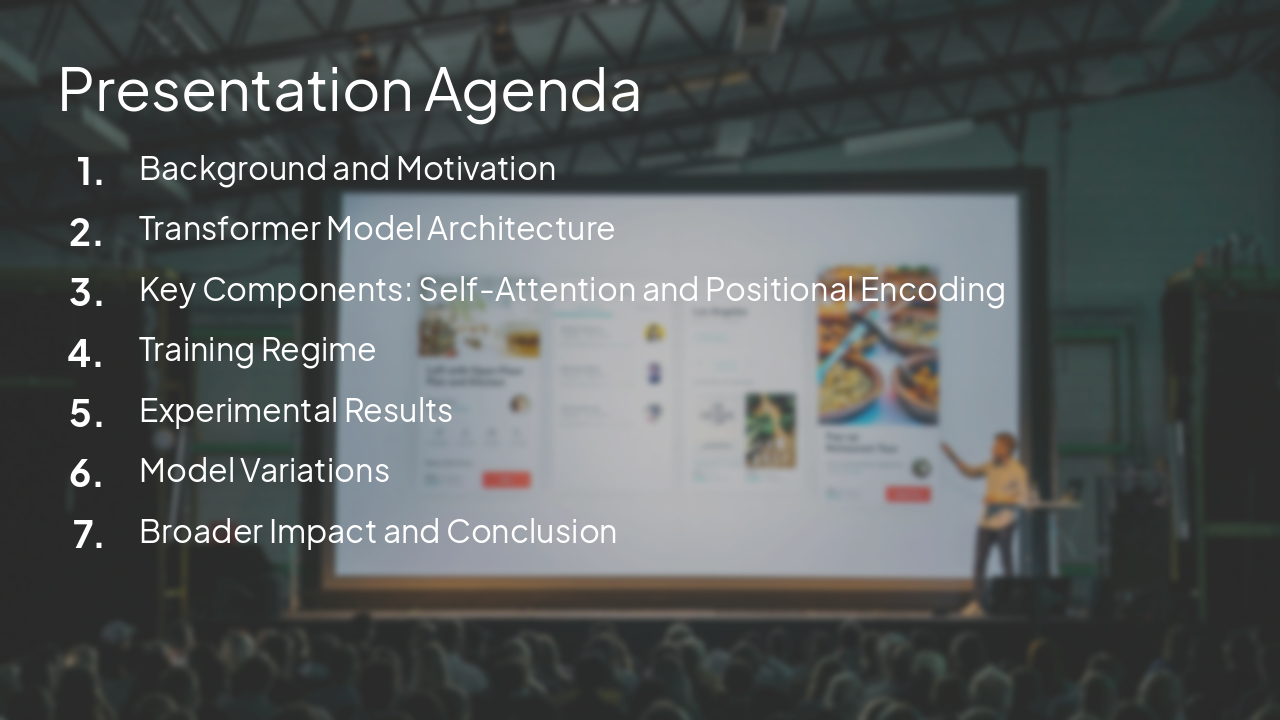
  • Background and Motivation
  • Transformer Model Architecture
  • Key Components: Self-Attention and Positional Encoding
  • Training Regime
  • Experimental Results
  • Model Variations
  • Broader Impact and Conclusion

---

Photo by Teemu Paananen on Unsplash
Slide 2 - Presentation Agenda
Slide 3 of 17

Slide 3 - Background and Motivation

1

Background and Motivation

Limitations of Recurrent and Convolutional Models in Sequence Transduction

---

Photo by Conny Schneider on Unsplash
Slide 3 - Background and Motivation
Slide 4 of 17

Slide 4 - Challenges with Traditional Models

  • Recurrent models (RNN/LSTM/GRU): Sequential nature precludes parallelization within training examples, especially for long sequences
  • Convolutional models: Operations grow linearly or logarithmically with distance between positions, difficult to learn long-range dependencies
  • Previous attention mechanisms used in conjunction with recurrent networks
Slide 4 - Challenges with Traditional Models
Slide 5 of 17

Slide 5 - Transformer Model Architecture

2

Transformer Model Architecture

Encoder-Decoder Structure Based Solely on Attention Mechanisms

---

Photo by Umberto on Unsplash

Slide 5 - Transformer Model Architecture
Slide 6 of 17

Slide 6 - Overall Transformer Architecture

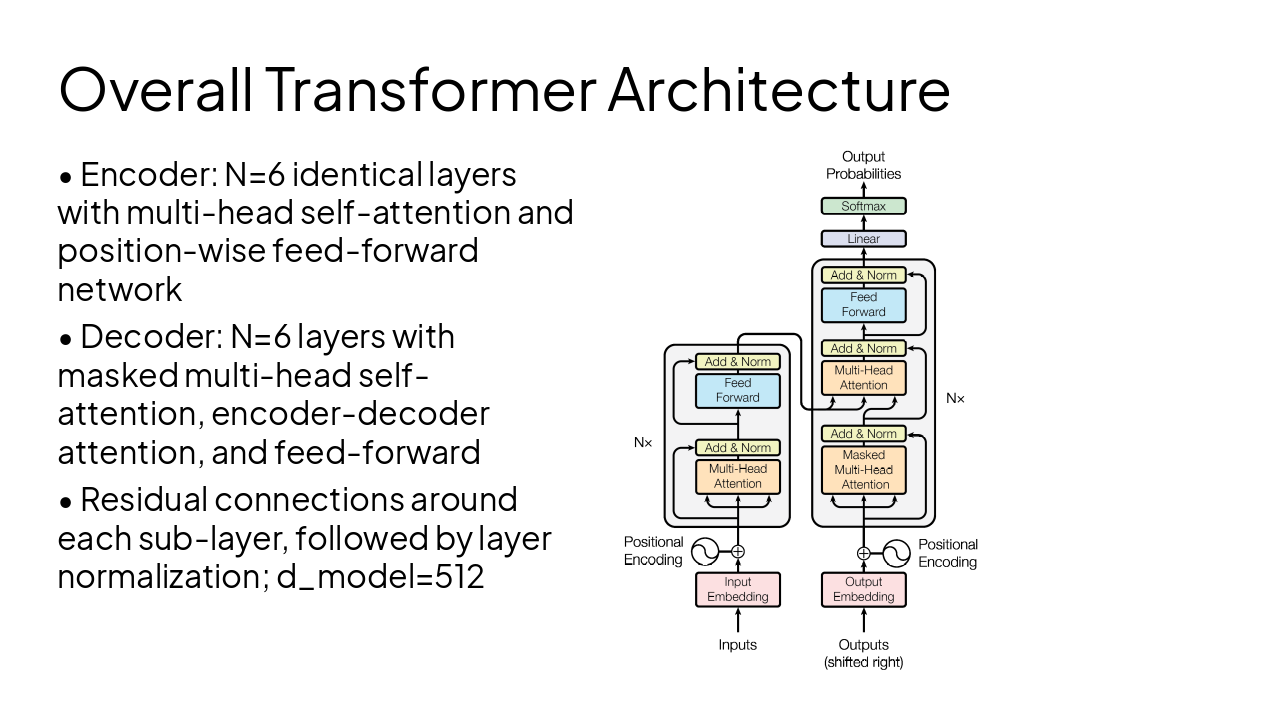
  • Encoder: N=6 identical layers with multi-head self-attention and position-wise feed-forward network
  • Decoder: N=6 layers with masked multi-head self-attention, encoder-decoder attention, and feed-forward
  • Residual connections around each sub-layer, followed by layer normalization; d_model=512
Slide 6 - Overall Transformer Architecture
Slide 7 of 17

Slide 7 - Encoder and Decoder Stacks

  • Each encoder layer: Multi-head self-attention sub-layer + Position-wise fully connected feed-forward network
  • Decoder adds: Encoder-decoder attention sub-layer (queries from decoder, keys/values from encoder)
  • Masked self-attention in decoder prevents attending to future positions
  • All sub-layers produce d_model=512 outputs, with residual connections: LayerNorm(x + Sublayer(x))
Slide 7 - Encoder and Decoder Stacks
Slide 8 of 17

Slide 8 - Attention Mechanisms

3

Attention Mechanisms

Scaled Dot-Product and Multi-Head Attention

---

Photo by Shane Rounce on Unsplash
Slide 8 - Attention Mechanisms
Slide 9 of 17

Slide 9 - Scaled Dot-Product Attention

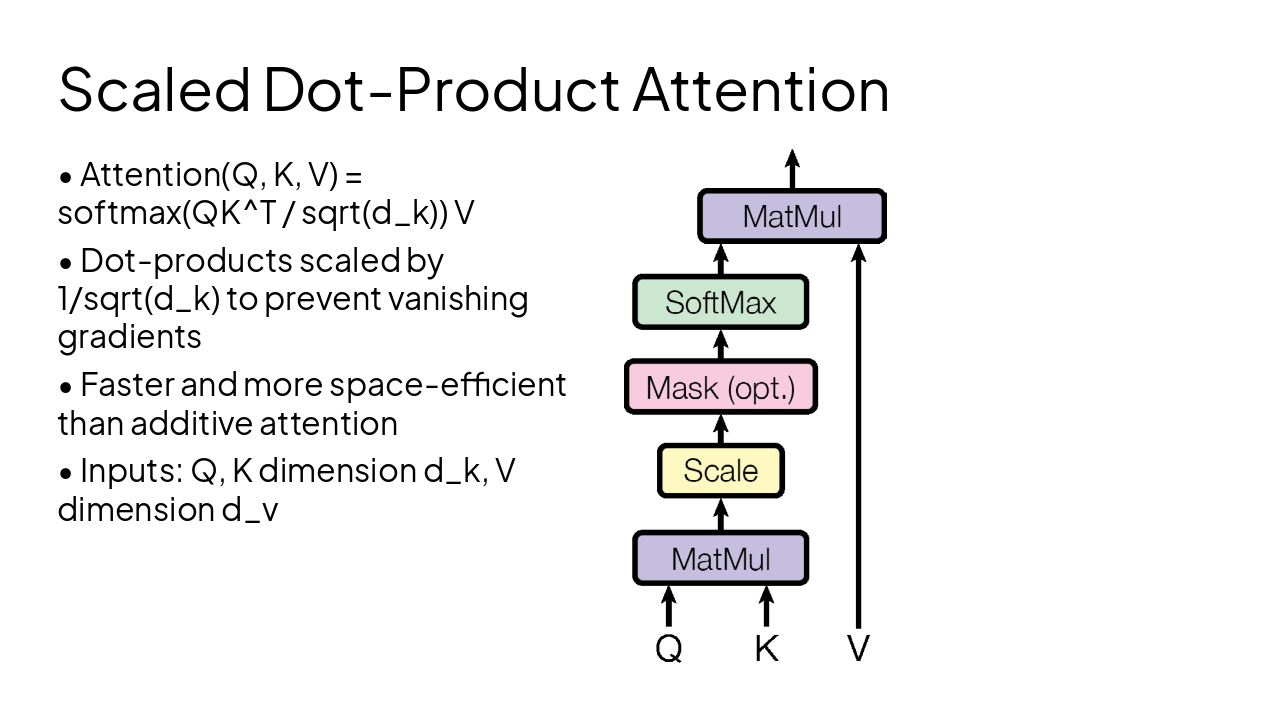
  • Attention(Q, K, V) = softmax(QK^T / sqrt(dk)) V
  • Dot-products scaled by 1/sqrt(dk) to prevent vanishing gradients
  • Faster and more space-efficient than additive attention
  • Inputs: Q, K dimension dk, V dimension dv
Slide 9 - Scaled Dot-Product Attention
Slide 10 of 17

Slide 10 - Multi-Head Attention

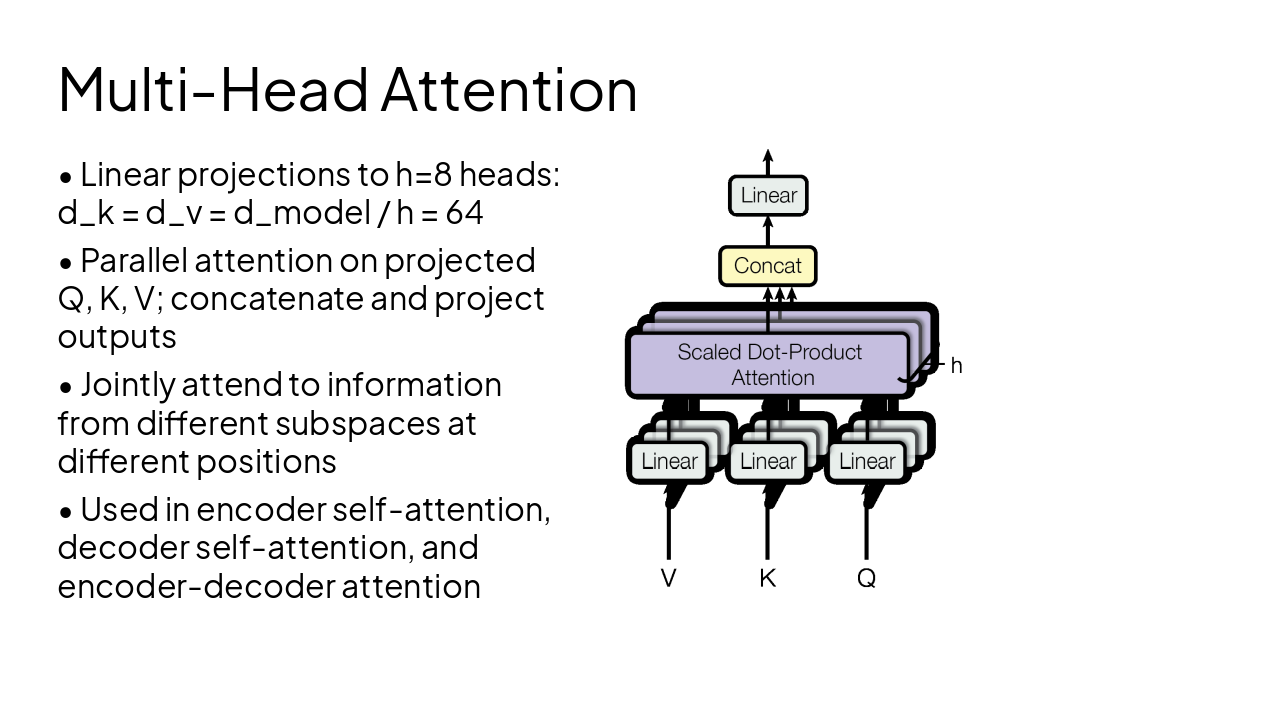
  • Linear projections to h=8 heads: dk = dv = d_model / h = 64
  • Parallel attention on projected Q, K, V; concatenate and project outputs
  • Jointly attend to information from different subspaces at different positions
  • Used in encoder self-attention, decoder self-attention, and encoder-decoder attention
Slide 10 - Multi-Head Attention
Slide 11 of 17

Slide 11 - Position-wise Feed-Forward and Positional Encoding

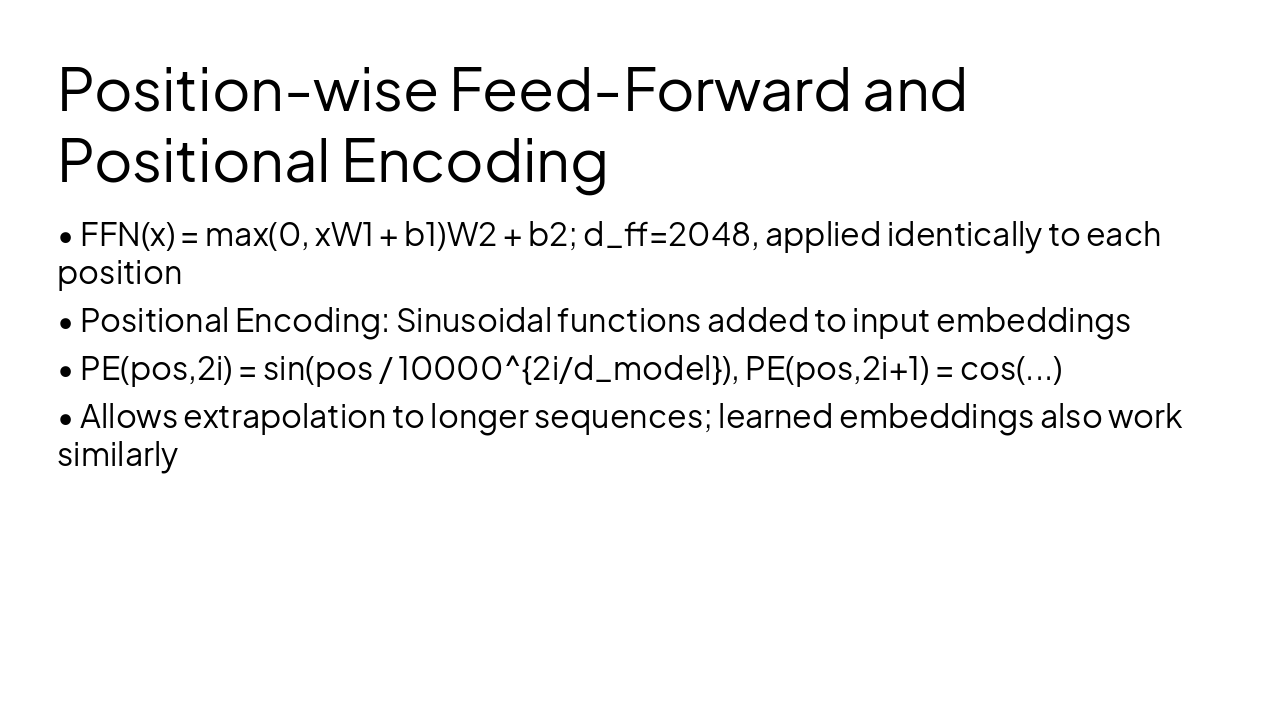
  • FFN(x) = max(0, xW1 + b1)W2 + b2; dff=2048, applied identically to each position
  • Positional Encoding: Sinusoidal functions added to input embeddings
  • PE(pos,2i) = sin(pos / 10000^{2i/dmodel}), PE(pos,2i+1) = cos(...)
  • Allows extrapolation to longer sequences; learned embeddings also work similarly
Slide 11 - Position-wise Feed-Forward and Positional Encoding
Slide 12 of 17

Slide 12 - Training and Results

4

Training and Results

State-of-the-Art Performance on Machine Translation

---

Photo by Deng Xiang on Unsplash

Slide 12 - Training and Results
Slide 13 of 17

Slide 13 - Machine Translation Results (WMT 2014 newstest2014)

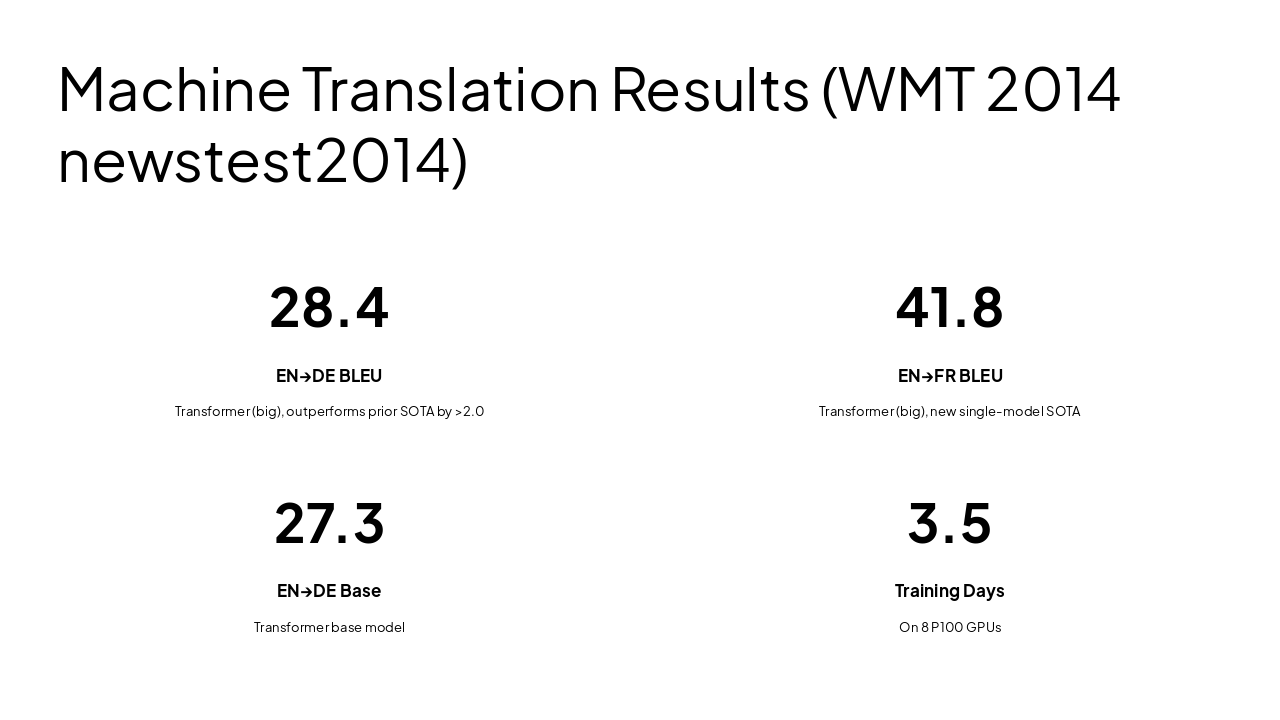
  • 28.4: EN→DE BLEU
  • 41.8: EN→FR BLEU
  • 27.3: EN→DE Base
  • 3.5: Training Days
Slide 13 - Machine Translation Results (WMT 2014 newstest2014)
Slide 14 of 17

Slide 14 - Comparison with Prior Work

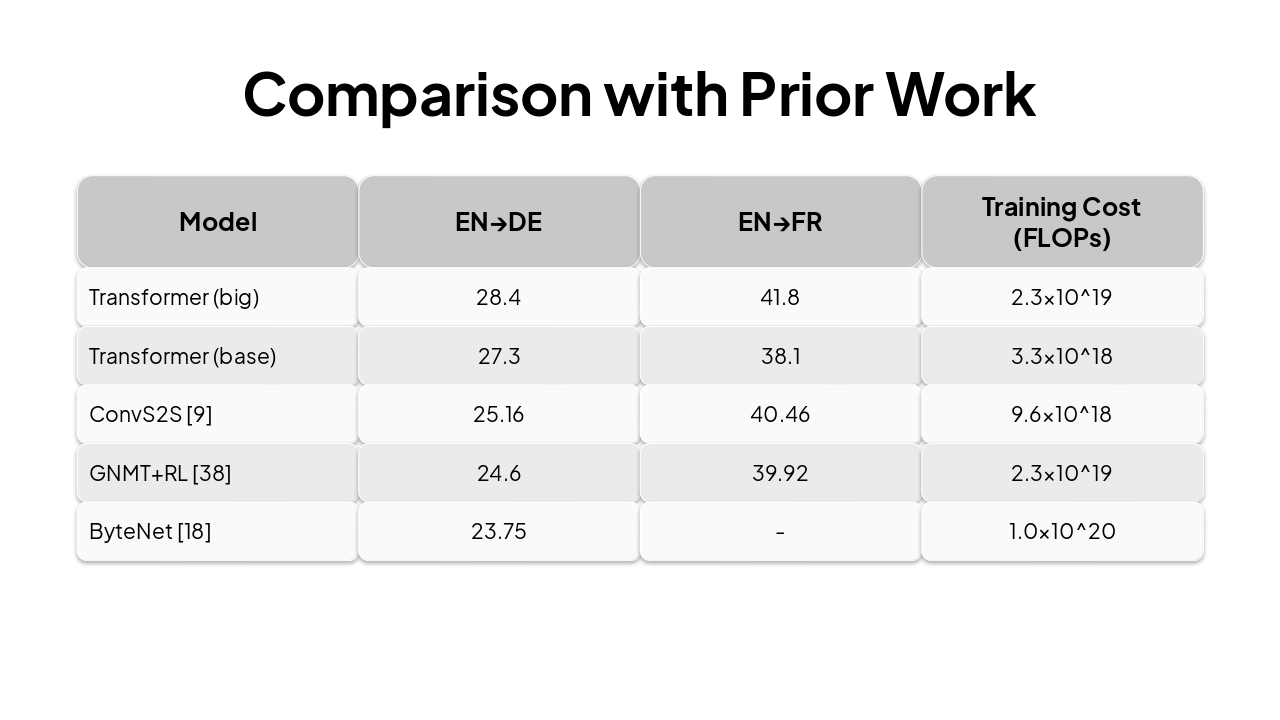
ModelEN→DEEN→FRTraining Cost (FLOPs)
Transformer (big)28.441.82.3×10^19
Transformer (base)27.338.13.3×10^18
ConvS2S [9]25.1640.469.6×10^18
GNMT+RL [38]24.639.922.3×10^19
ByteNet [18]23.75-1.0×10^20
Slide 14 - Comparison with Prior Work
Slide 15 of 17

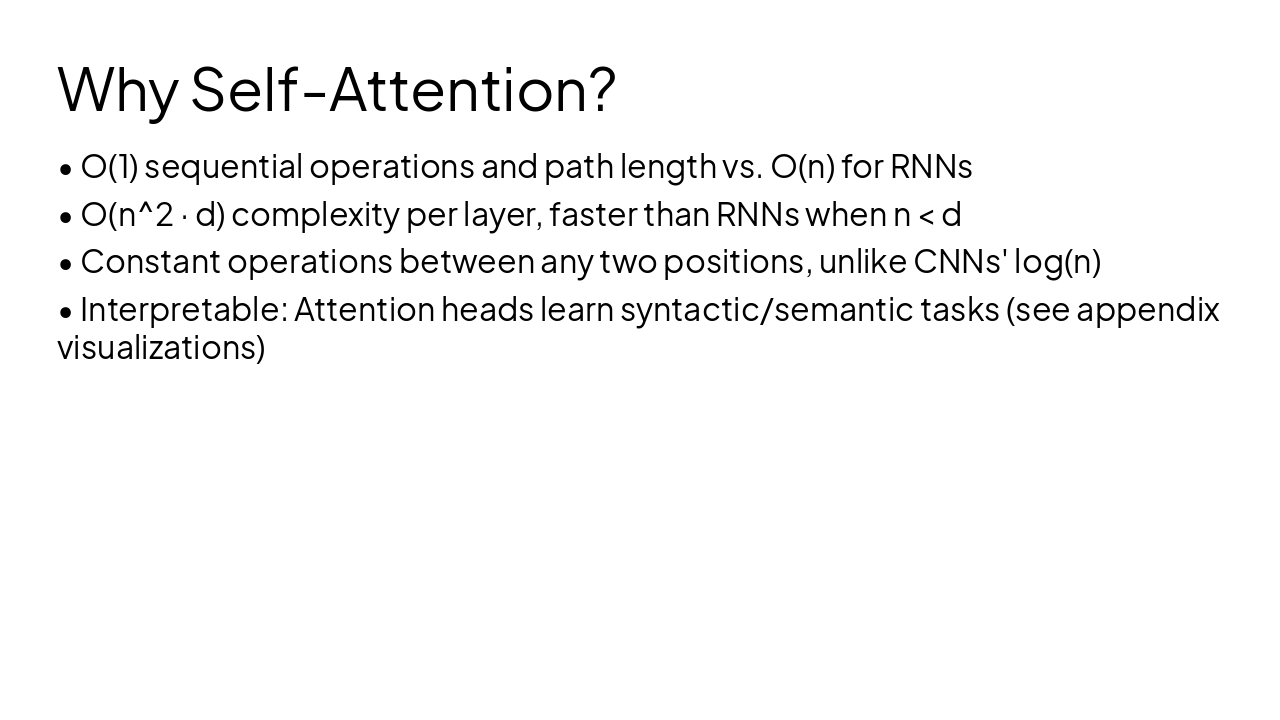
Slide 15 - Why Self-Attention?

  • O(1) sequential operations and path length vs. O(n) for RNNs
  • O(n^2 · d) complexity per layer, faster than RNNs when n < d
  • Constant operations between any two positions, unlike CNNs' log(n)
  • Interpretable: Attention heads learn syntactic/semantic tasks (see appendix visualizations)
Slide 15 - Why Self-Attention?
Slide 16 of 17

Slide 16 - Key Insight from the Paper

> We propose a new simple network architecture, the Transformer, based solely on attention mechanisms, dispensing with recurrence and convolutions entirely.

— Vaswani et al., 2017
Slide 16 - Key Insight from the Paper
Slide 17 of 17

Slide 17 - Conclusion

Transformer: First transduction model relying entirely on self-attention Achieves new SOTA on translation tasks with faster training Generalizes to parsing; foundation for modern LLMs, ViTs, and more

Future: Extend to images, audio, video; less sequential generation https://github.com/tensorflow/tensor2tensor

---

Photo by Vinh Nguyen on Unsplash
Slide 17 - Conclusion

Discover More Presentations

Explore thousands of AI-generated presentations for inspiration

Browse Presentations
Powered by AI

Create Your Own Presentation

Generate professional presentations in seconds with Karaf's AI. Customize this presentation or start from scratch.

Create New Presentation

Powered by Karaf.ai — AI-Powered Presentation Generator