Comprehensive Risk Management: Analysis and Response

Generated from prompt:

Prepare 15 slides contain best explanation of qualitative Risk analysis evaluation and analysis, quantitative Risk analysis evaluation and analysis and risk response planning evaluation and analysis used for presentation

This presentation provides a comprehensive overview of risk management, covering its fundamental principles, the methodology of qualitative and quantitative risk analysis, and effective strategies for risk response planning, including both threats and opportunities. It outlines how to identify, evaluate, and prioritize risks to optimize project and business outcomes.

May 16, 202616 slides
Slide 1 of 16

Slide 1 - Comprehensive Risk Management: Analysis & Response

Comprehensive Risk Management: Analysis & Response

Qualitative, Quantitative, and Response Planning

---

Photo by Martin Martz on Unsplash
Slide 1 - Comprehensive Risk Management: Analysis & Response
Slide 2 of 16

Slide 2 - Presentation Agenda

  • Introduction to Risk Management
  • Qualitative Risk Analysis
  • Quantitative Risk Analysis
  • Risk Response Planning
  • Conclusion

---

Photo by GeoJango Maps on Unsplash
Slide 2 - Presentation Agenda
Slide 3 of 16

Slide 3

1

Introduction to Risk Management

Understanding the Fundamentals

---

Photo by Carlos Muza on Unsplash
Slide 3
Slide 4 of 16

Slide 4 - What is Risk Management?

  • Identification, evaluation, and prioritization of risks.
  • Minimizing, monitoring, and controlling the impact or probability of risks.
  • Risks can arise from international markets, political instability, project failures, legal liabilities, and more.
  • Includes analysis of both negative events (risks) and positive events (opportunities).

Source: Wikipedia Research: Risk management
Slide 4 - What is Risk Management?
Slide 5 of 16

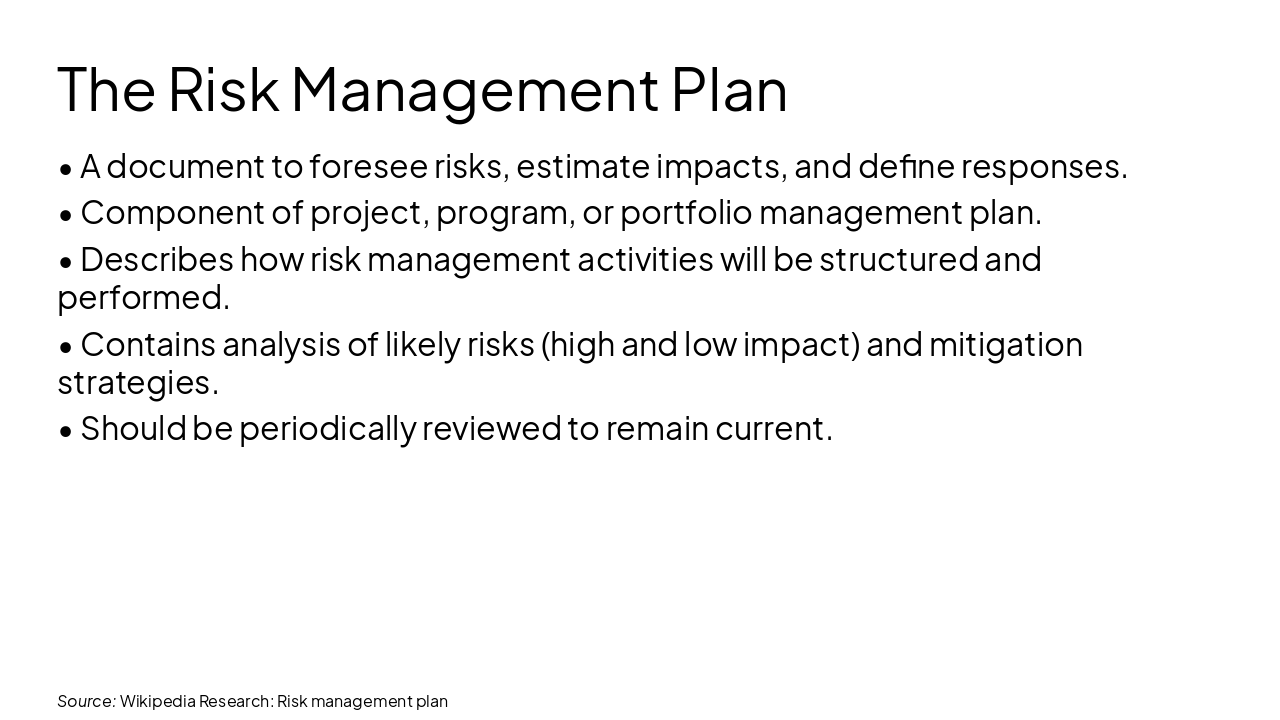
Slide 5 - The Risk Management Plan

  • A document to foresee risks, estimate impacts, and define responses.
  • Component of project, program, or portfolio management plan.
  • Describes how risk management activities will be structured and performed.
  • Contains analysis of likely risks (high and low impact) and mitigation strategies.
  • Should be periodically reviewed to remain current.

Source: Wikipedia Research: Risk management plan
Slide 5 - The Risk Management Plan
Slide 6 of 16

Slide 6

2

Qualitative Risk Analysis

Understanding and Prioritizing Risks

---

Photo by Milad Fakurian on Unsplash
Slide 6
Slide 7 of 16

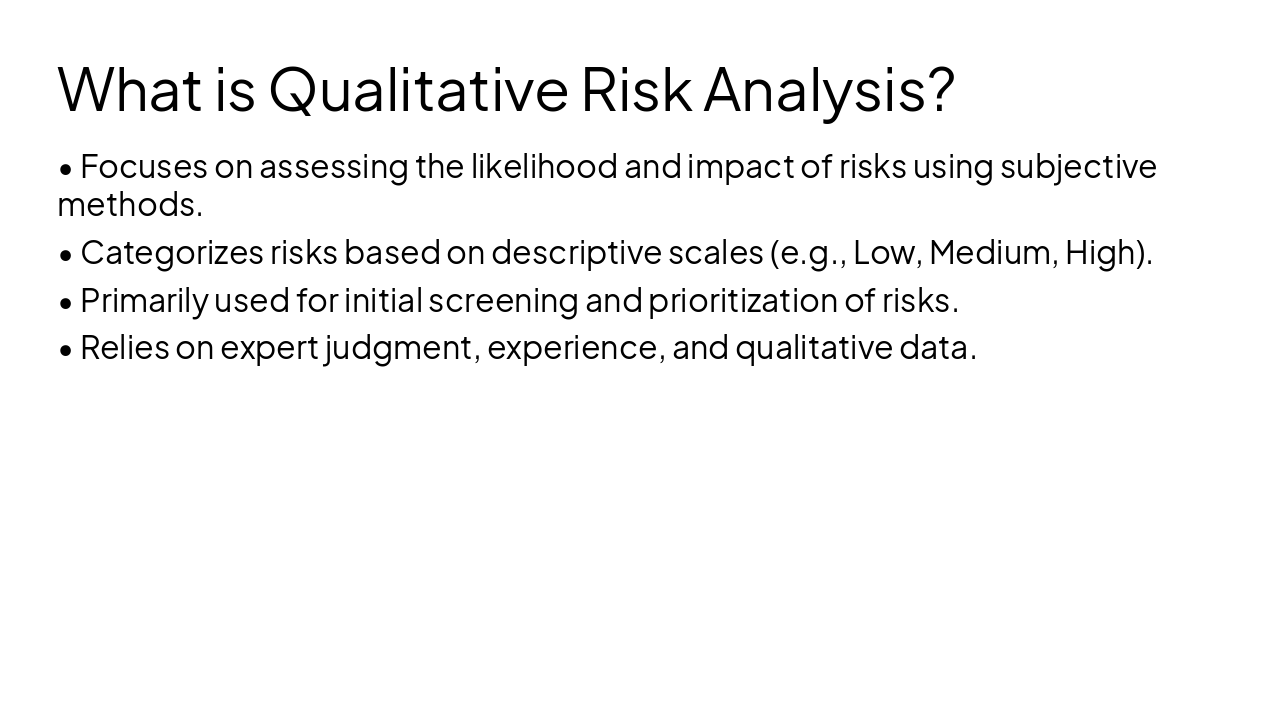
Slide 7 - What is Qualitative Risk Analysis?

  • Focuses on assessing the likelihood and impact of risks using subjective methods.
  • Categorizes risks based on descriptive scales (e.g., Low, Medium, High).
  • Primarily used for initial screening and prioritization of risks.
  • Relies on expert judgment, experience, and qualitative data.
Slide 7 - What is Qualitative Risk Analysis?
Slide 8 of 16

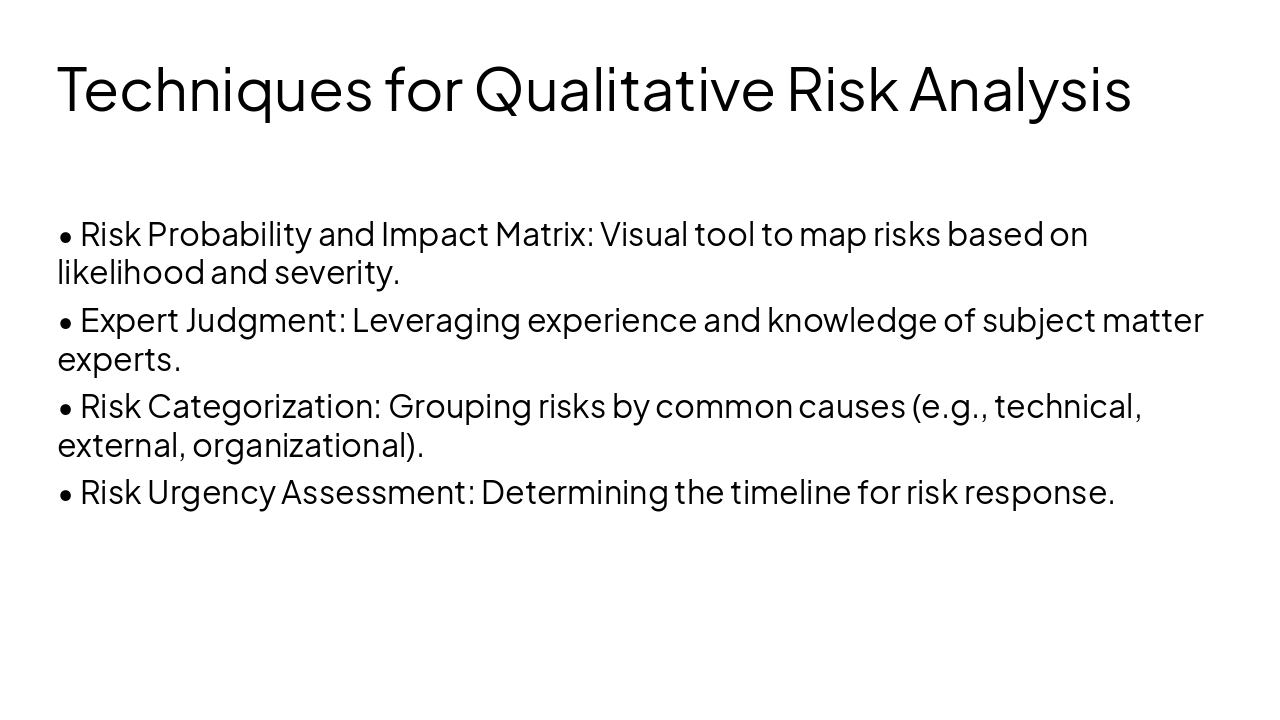
Slide 8 - Techniques for Qualitative Risk Analysis

  • Risk Probability and Impact Matrix: Visual tool to map risks based on likelihood and severity.
  • Expert Judgment: Leveraging experience and knowledge of subject matter experts.
  • Risk Categorization: Grouping risks by common causes (e.g., technical, external, organizational).
  • Risk Urgency Assessment: Determining the timeline for risk response.
Slide 8 - Techniques for Qualitative Risk Analysis
Slide 9 of 16

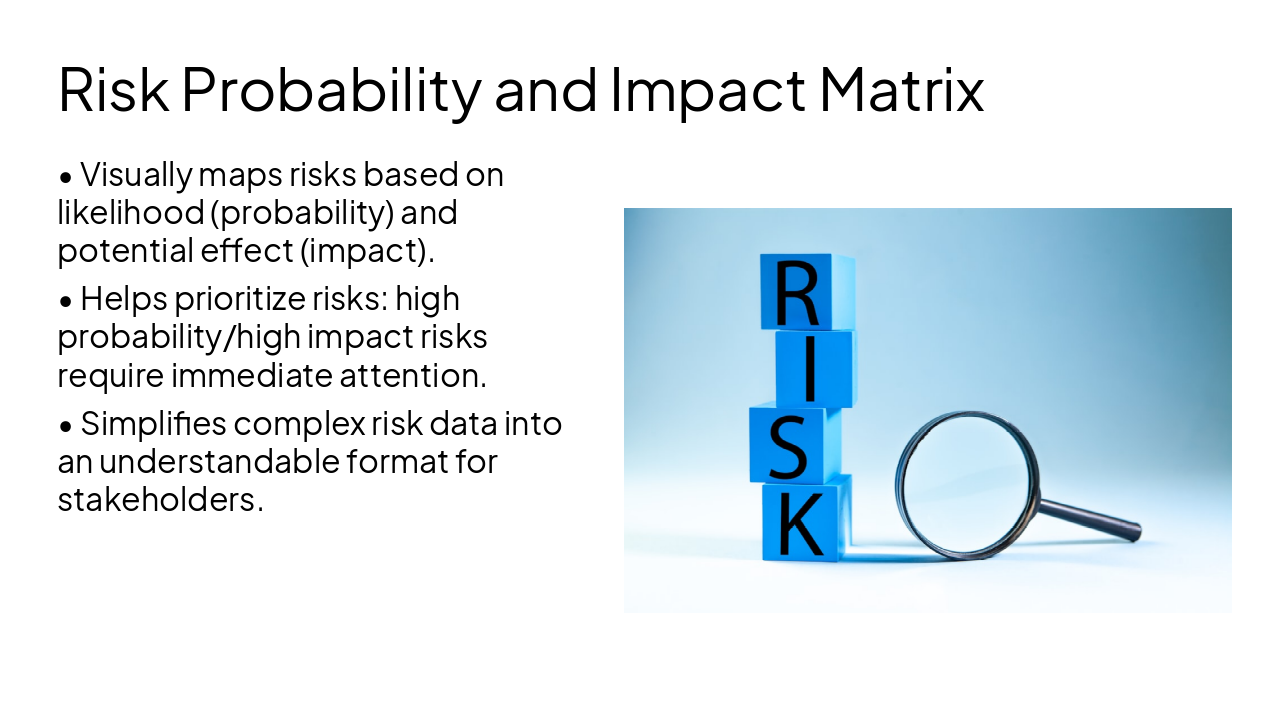
Slide 9 - Risk Probability and Impact Matrix

  • Visually maps risks based on likelihood (probability) and potential effect (impact).
  • Helps prioritize risks: high probability/high impact risks require immediate attention.
  • Simplifies complex risk data into an understandable format for stakeholders.

---

Photo by Sasun Bughdaryan on Unsplash
Slide 9 - Risk Probability and Impact Matrix
Slide 10 of 16

Slide 10

3

Quantitative Risk Analysis

Measuring the Unmeasurable

---

Photo by Conny Schneider on Unsplash
Slide 10
Slide 11 of 16

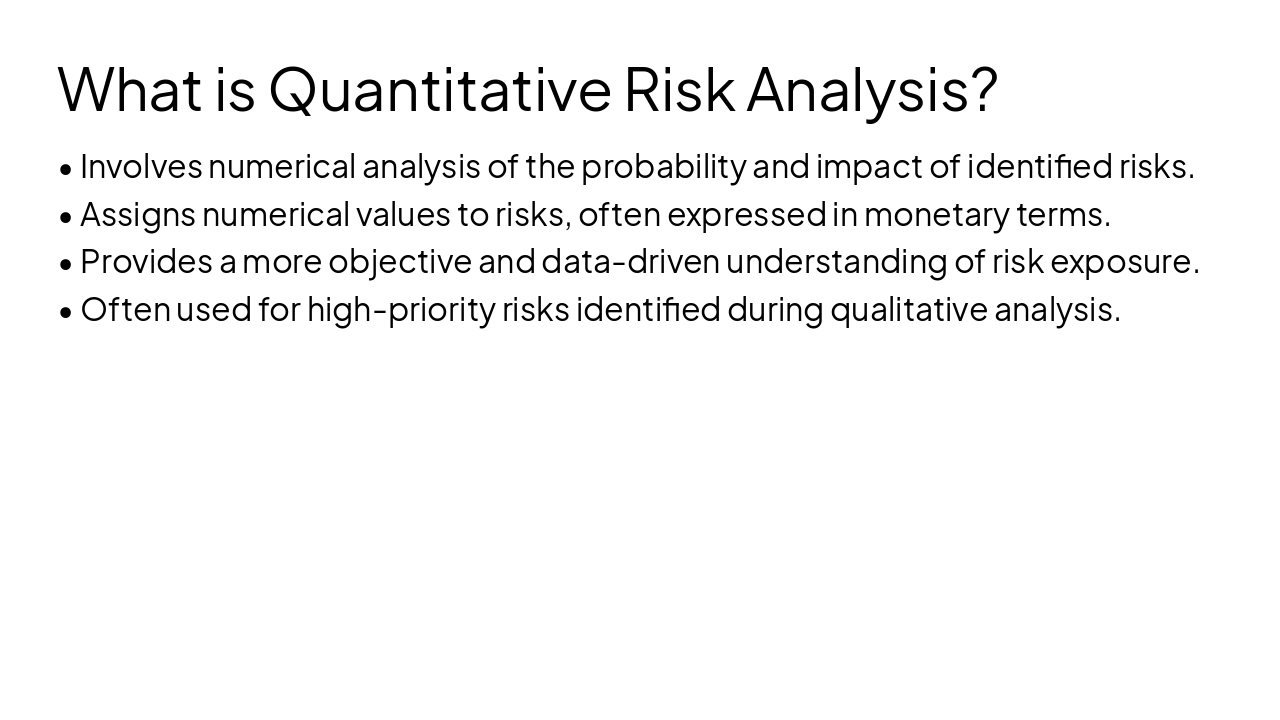
Slide 11 - What is Quantitative Risk Analysis?

  • Involves numerical analysis of the probability and impact of identified risks.
  • Assigns numerical values to risks, often expressed in monetary terms.
  • Provides a more objective and data-driven understanding of risk exposure.
  • Often used for high-priority risks identified during qualitative analysis.
Slide 11 - What is Quantitative Risk Analysis?
Slide 12 of 16

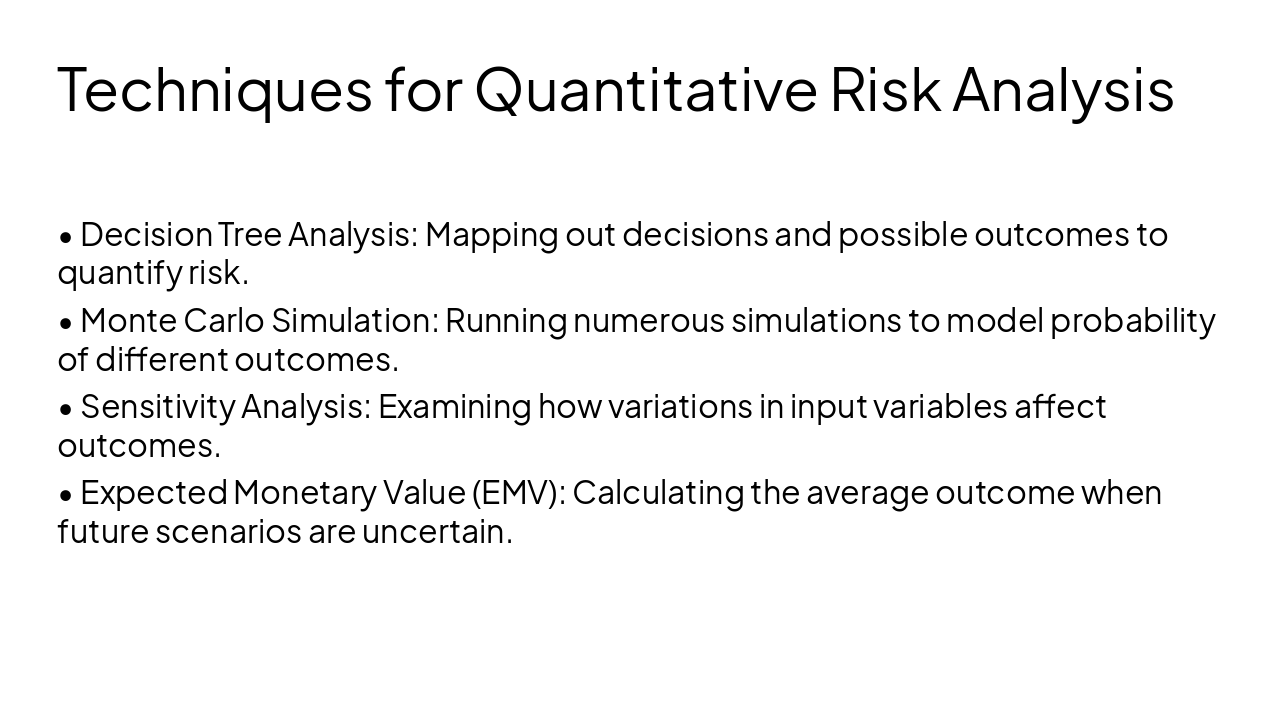
Slide 12 - Techniques for Quantitative Risk Analysis

  • Decision Tree Analysis: Mapping out decisions and possible outcomes to quantify risk.
  • Monte Carlo Simulation: Running numerous simulations to model probability of different outcomes.
  • Sensitivity Analysis: Examining how variations in input variables affect outcomes.
  • Expected Monetary Value (EMV): Calculating the average outcome when future scenarios are uncertain.
Slide 12 - Techniques for Quantitative Risk Analysis
Slide 13 of 16

Slide 13

4

Risk Response Planning

Strategies for Managing Risks

---

Photo by Tim Mossholder on Unsplash
Slide 13
Slide 14 of 16

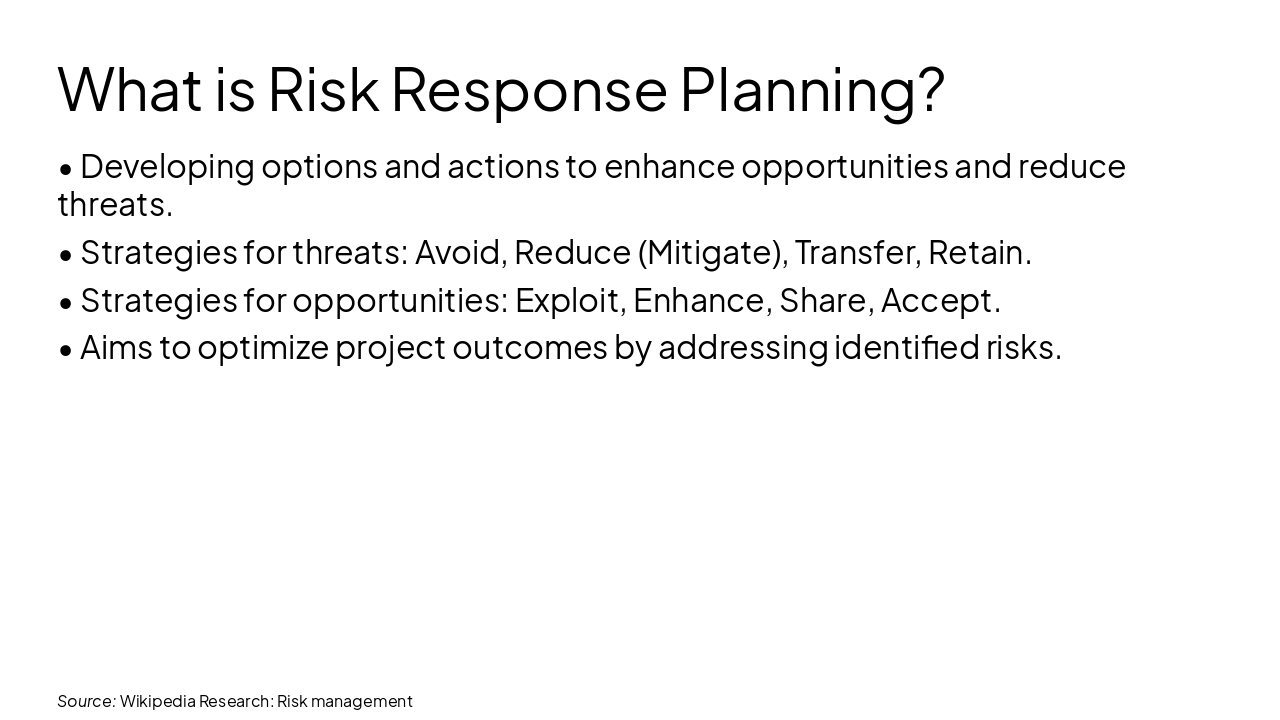
Slide 14 - What is Risk Response Planning?

  • Developing options and actions to enhance opportunities and reduce threats.
  • Strategies for threats: Avoid, Reduce (Mitigate), Transfer, Retain.
  • Strategies for opportunities: Exploit, Enhance, Share, Accept.
  • Aims to optimize project outcomes by addressing identified risks.

Source: Wikipedia Research: Risk management
Slide 14 - What is Risk Response Planning?
Slide 15 of 16

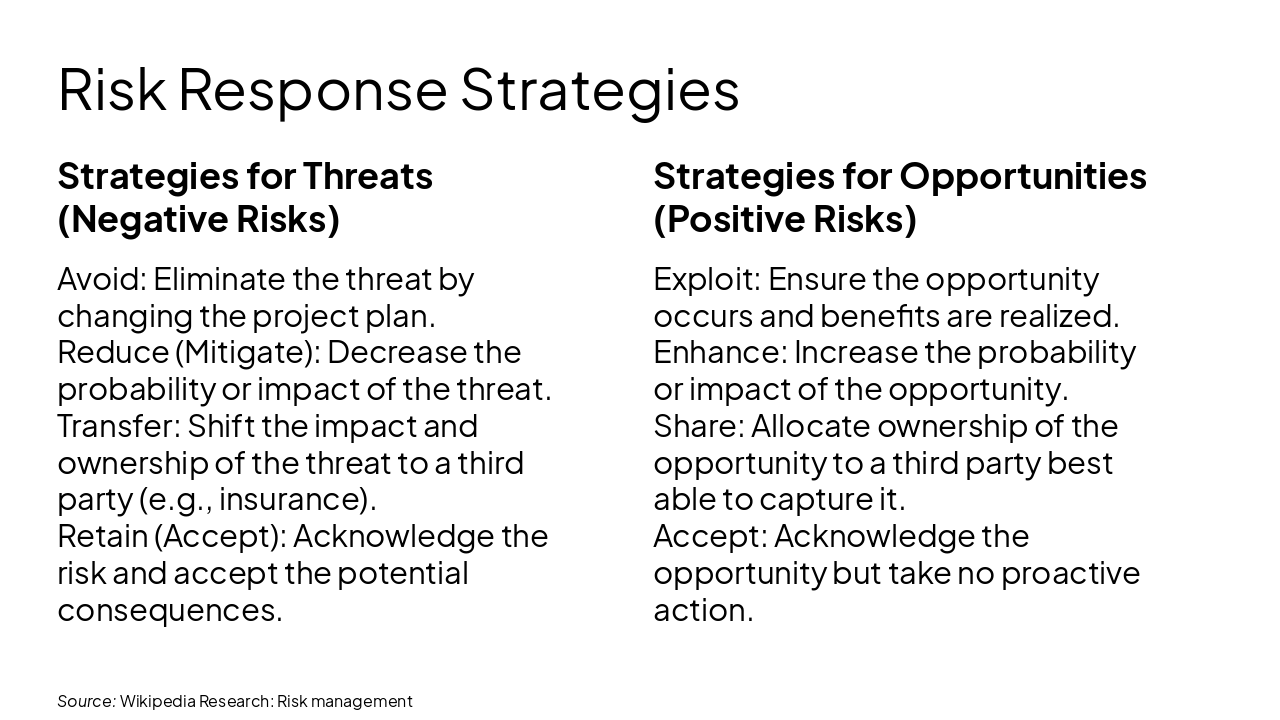
Slide 15 - Risk Response Strategies

Strategies for Threats (Negative Risks) Avoid: Eliminate the threat by changing the project plan. Reduce (Mitigate): Decrease the probability or impact of the threat. Transfer: Shift the impact and ownership of the threat to a third party (e.g., insurance). Retain (Accept): Acknowledge the risk and accept the potential consequences.

Strategies for Opportunities (Positive Risks) Exploit: Ensure the opportunity occurs and benefits are realized. Enhance: Increase the probability or impact of the opportunity. Share: Allocate ownership of the opportunity to a third party best able to capture it. Accept: Acknowledge the opportunity but take no proactive action.

Source: Wikipedia Research: Risk management
Slide 15 - Risk Response Strategies
Slide 16 of 16

Slide 16 - Conclusion

Effective risk management integrates qualitative, quantitative, and response planning for robust decision-making.

Strategic Risk Management for Project Success

---

Photo by Logan Voss on Unsplash
Slide 16 - Conclusion

Discover More Presentations

Explore thousands of AI-generated presentations for inspiration

Browse Presentations
Powered by AI

Create Your Own Presentation

Generate professional presentations in seconds with Karaf's AI. Customize this presentation or start from scratch.

Create New Presentation

Powered by Karaf.ai — AI-Powered Presentation Generator