AGRHYMET's Drought EWS & IbF Roadmap (35 chars)

Generated from prompt:

Create a 6–8 slide presentation titled 'AGRHYMET’s Current Drought Early Warning System and Future Plans for Drought Impact-Based Forecasting (IbF)'. Include: 1) Introduction to AGRHYMET, 2) Drought context in the Sahel, 3) Overview of current drought early warning system, 4) Data sources and technologies used, 5) Current system limitations, 6) Concept of Impact-Based Forecasting (IbF), 7) AGRHYMET’s roadmap for IbF implementation, and 8) Expected benefits and conclusion.

Overview of AGRHYMET's Sahel drought early warning system, data/tech used, limitations (hazard-focused), IbF concept, implementation timeline, and benefits like better decisions & resilience. (162 cha

December 12, 202510 slides
Slide 1 of 10

Slide 1 - AGRHYMET’s Current Drought Early Warning System and Future Plans for Drought Impact-Based Forecasting (IbF)

This title slide presents AGRHYMET's current Drought Early Warning System and future plans for Impact-Based Forecasting (IbF). The subtitle welcomes viewers to the presentation on AGRHYMET's drought monitoring and enhancements.

AGRHYMET Drought Early Warning & IbF Plans

Welcome to the presentation on AGRHYMET's drought monitoring and future enhancements.
Slide 1 - AGRHYMET’s Current Drought Early Warning System and Future Plans for Drought Impact-Based Forecasting (IbF)
Slide 2 of 10

Slide 2 - Presentation Agenda

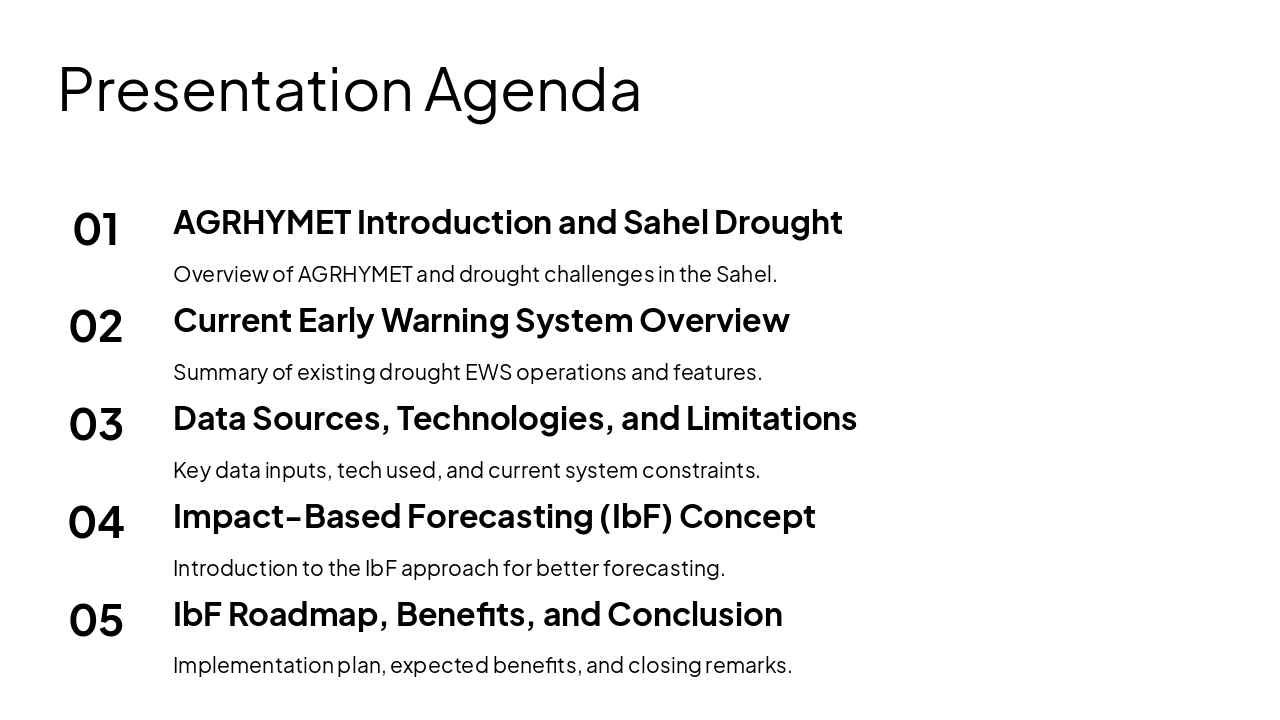
This agenda slide outlines a presentation on drought early warning in the Sahel, starting with AGRHYMET introduction and regional challenges. It covers the current early warning system overview, data sources and limitations, Impact-Based Forecasting concept, and implementation roadmap with benefits and conclusion.

Presentation Agenda

  1. AGRHYMET Introduction and Sahel Drought
  2. Overview of AGRHYMET and drought challenges in the Sahel.

  3. Current Early Warning System Overview
  4. Summary of existing drought EWS operations and features.

  5. Data Sources, Technologies, and Limitations
  6. Key data inputs, tech used, and current system constraints.

  7. Impact-Based Forecasting (IbF) Concept
  8. Introduction to the IbF approach for better forecasting.

  9. IbF Roadmap, Benefits, and Conclusion
  10. Implementation plan, expected benefits, and closing remarks.

Slide 2 - Presentation Agenda
Slide 3 of 10

Slide 3 - Introduction to AGRHYMET

AGRHYMET is the Regional Centre for Agrometeorology & Water Management (CILSS), based in Niamey, Niger. It serves 9 Sahel countries, focusing on food security and drought early warning since 1974.

Introduction to AGRHYMET

  • Regional Centre for Agrometeorology & Water Management (CILSS)
  • Based in Niamey, Niger
  • Serves 9 Sahel countries
  • Focus: Food security, drought early warning since 1974
Slide 3 - Introduction to AGRHYMET
Slide 4 of 10

Slide 4 - Drought Context in the Sahel

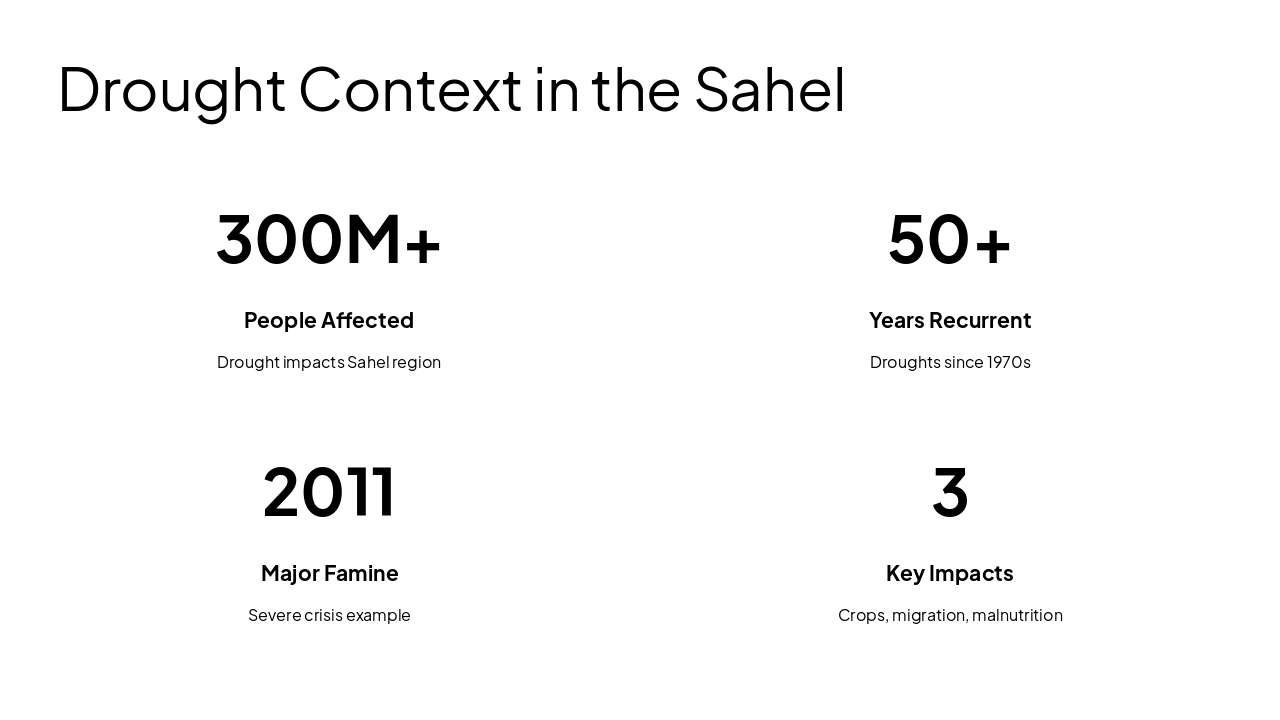
The Drought Context in the Sahel slide states that over 300 million people are affected by drought in the region. It highlights more than 50 years of recurrent droughts since the 1970s, a major 2011 famine, and three key impacts: crops, migration, and malnutrition.

Drought Context in the Sahel

  • 300M+: People Affected
  • Drought impacts Sahel region

  • 50+: Years Recurrent
  • Droughts since 1970s

  • 2011: Major Famine
  • Severe crisis example

  • 3: Key Impacts
  • Crops, migration, malnutrition

Slide 4 - Drought Context in the Sahel
Slide 5 of 10

Slide 5 - Current Drought Early Warning System (EWS)

The Current Drought Early Warning System (EWS) monitors rainfall, NDVI vegetation, and soil moisture while providing seasonal forecasts and 10-day bulletins. It issues threshold-based alerts for meteorological and agricultural droughts, disseminated via radio, web, and stakeholders.

Current Drought Early Warning System (EWS)

  • Monitors rainfall, NDVI vegetation, and soil moisture
  • Provides seasonal forecasts and 10-day bulletins
  • Issues threshold-based alerts for meteorological and agricultural droughts
  • Disseminates via radio, web, and stakeholders
Slide 5 - Current Drought Early Warning System (EWS)
Slide 6 of 10

Slide 6 - Data Sources & Technologies

The slide features a table titled "Data Sources & Technologies" listing key sources and their associated technologies. It includes satellites (e.g., MSG) for rainfall estimates and NDVI, models (CHIRPS, ECMWF) for forecasts, ground stations for validation, and GIS tools for mapping.

Data Sources & Technologies

{ "headers": [ "Source", "Tech" ], "rows": [ [ "Satellites (e.g., MSG)", "Rainfall est., NDVI" ], [ "Models (CHIRPS, ECMWF)", "Forecasts" ], [ "Ground stations", "Validation" ], [ "GIS tools", "Mapping" ] ] }

Slide 6 - Data Sources & Technologies
Slide 7 of 10

Slide 7 - Current System Limitations

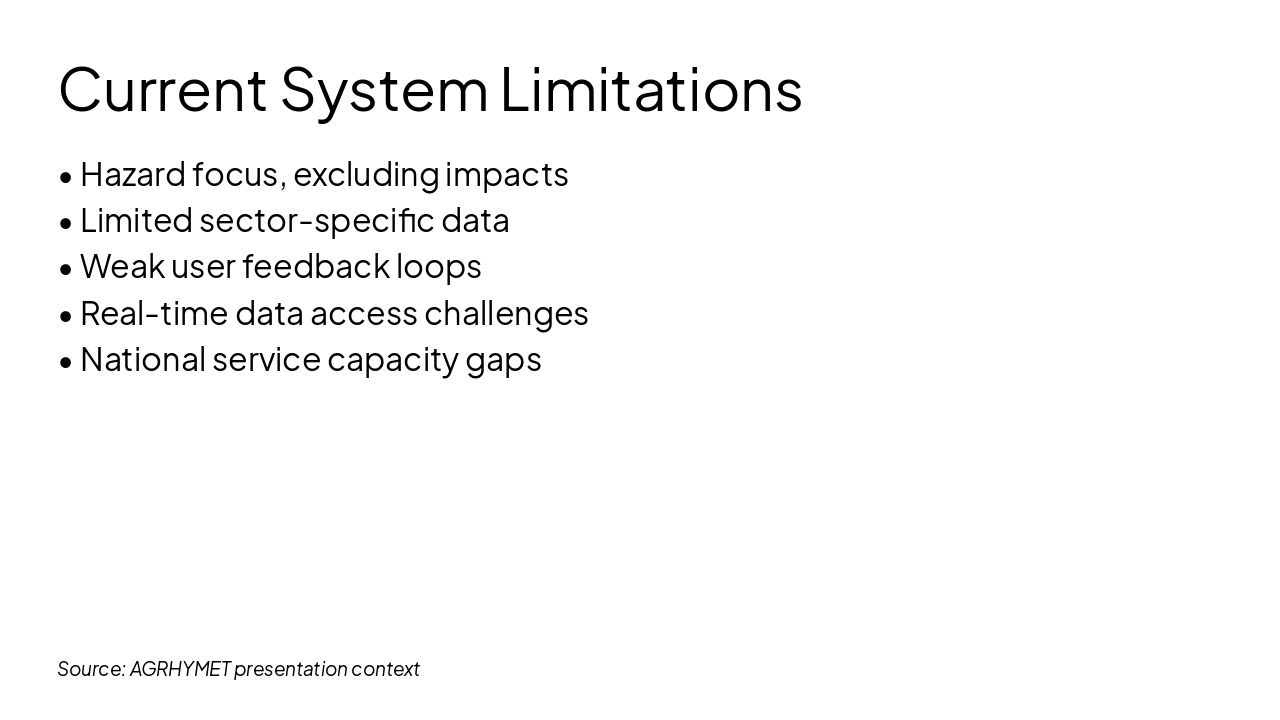
The "Current System Limitations" slide lists key challenges, including a hazard-focused approach that excludes impacts and limited sector-specific data. It also notes weak user feedback loops, real-time data access issues, and national service capacity gaps.

Current System Limitations

  • Hazard focus, excluding impacts
  • Limited sector-specific data
  • Weak user feedback loops
  • Real-time data access challenges
  • National service capacity gaps

Source: AGRHYMET presentation context

Slide 7 - Current System Limitations
Slide 8 of 10

Slide 8 - Concept of Impact-Based Forecasting (IbF)

Impact-Based Forecasting (IbF) is based on the equation Hazard → Exposure → Vulnerability = Impact, quantifying risks from weather events, affected populations/assets, and susceptibility. It shifts from meteorological predictions to multi-hazard, user-driven forecasts of impacts on agriculture, water, and health for actionable decisions.

Concept of Impact-Based Forecasting (IbF)

Impact EquationKey Shift in Forecasting
Hazard → Exposure → Vulnerability = Impact. This core formula underpins IbF by quantifying risks through interaction of weather events, affected populations/assets, and susceptibility factors.IbF forecasts impacts on agriculture, water, and health for actionable decisions. Moves from meteorological predictions to multi-hazard, user-driven approaches tailored to stakeholder needs.
Slide 8 - Concept of Impact-Based Forecasting (IbF)
Slide 9 of 10

Slide 9 - AGRHYMET’s IbF Implementation Roadmap

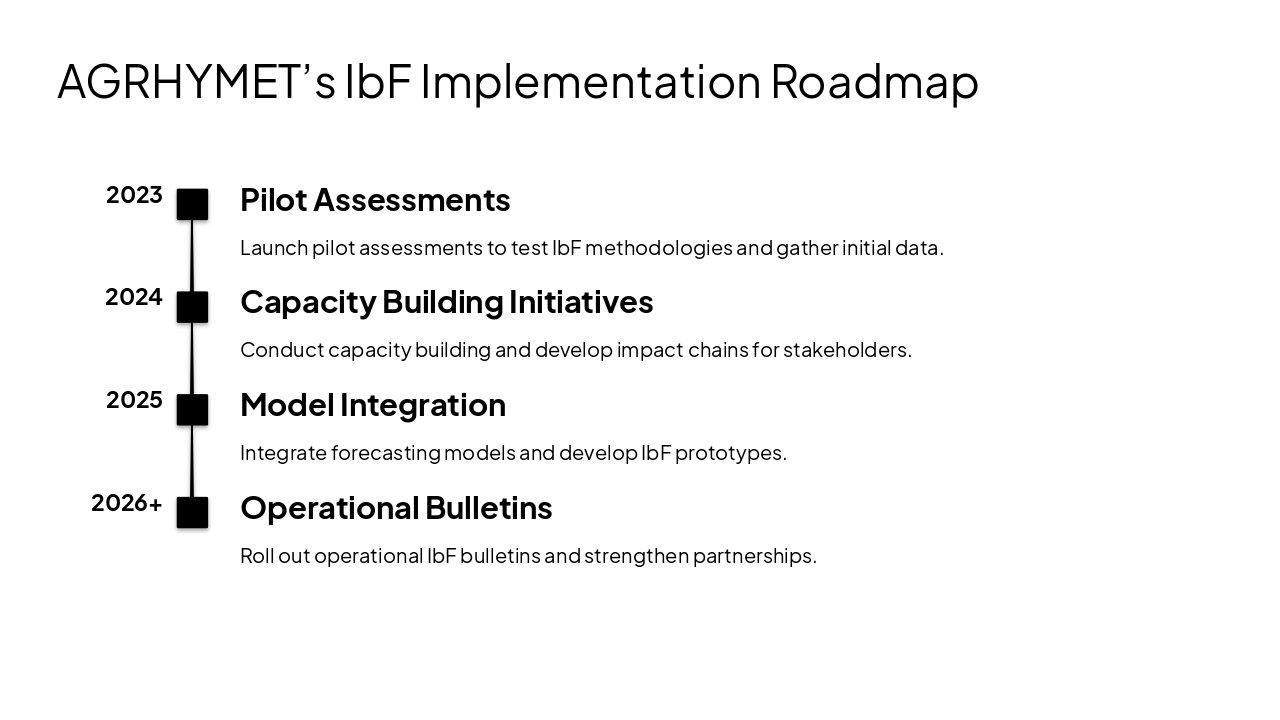
AGRHYMET’s IbF Implementation Roadmap is a timeline outlining key phases from 2023 to 2026+. It begins with pilot assessments in 2023, capacity building in 2024, model integration in 2025, and culminates in operational bulletins and partnerships in 2026+.

AGRHYMET’s IbF Implementation Roadmap

2023: Pilot Assessments Launch pilot assessments to test IbF methodologies and gather initial data. 2024: Capacity Building Initiatives Conduct capacity building and develop impact chains for stakeholders. 2025: Model Integration Integrate forecasting models and develop IbF prototypes. 2026+: Operational Bulletins Roll out operational IbF bulletins and strengthen partnerships.

Slide 9 - AGRHYMET’s IbF Implementation Roadmap
Slide 10 of 10

Slide 10 - Expected Benefits & Conclusion

The slide outlines expected benefits such as better decisions and reduced losses, enhanced resilience in the Sahel, and stronger partnerships. It closes with thanks for attention and an invitation for Q&A.

Expected Benefits & Conclusion

- Better decisions, reduced losses

  • Enhanced resilience in Sahel
  • Stronger partnerships

Thank you for your attention!

Q&A?

Slide 10 - Expected Benefits & Conclusion

Discover More Presentations

Explore thousands of AI-generated presentations for inspiration

Browse Presentations
Powered by AI

Create Your Own Presentation

Generate professional presentations in seconds with Karaf's AI. Customize this presentation or start from scratch.

Create New Presentation

Powered by Karaf.ai — AI-Powered Presentation Generator