Semiconductors: Building Blocks of Electronics (45 chars)

Generated from prompt:

make a presentation about semiconductors

Explores semiconductors' role in electronics, key properties (N/P doping, bandgap), history (Fairchild pioneers 1957), industry stats, and future in AI chips. (148 chars)

December 11, 20259 slides
Slide 1 of 9

Slide 1 - Semiconductors: The Building Blocks of Electronics

This title slide features the heading "Semiconductors: The Building Blocks of Electronics." Its subtitle welcomes viewers to an overview of semiconductors, covering their history, key players like Fairchild, and future impact.

Semiconductors: The Building Blocks of Electronics

Welcome to an overview of semiconductors, their history, key players like Fairchild, and future impact.
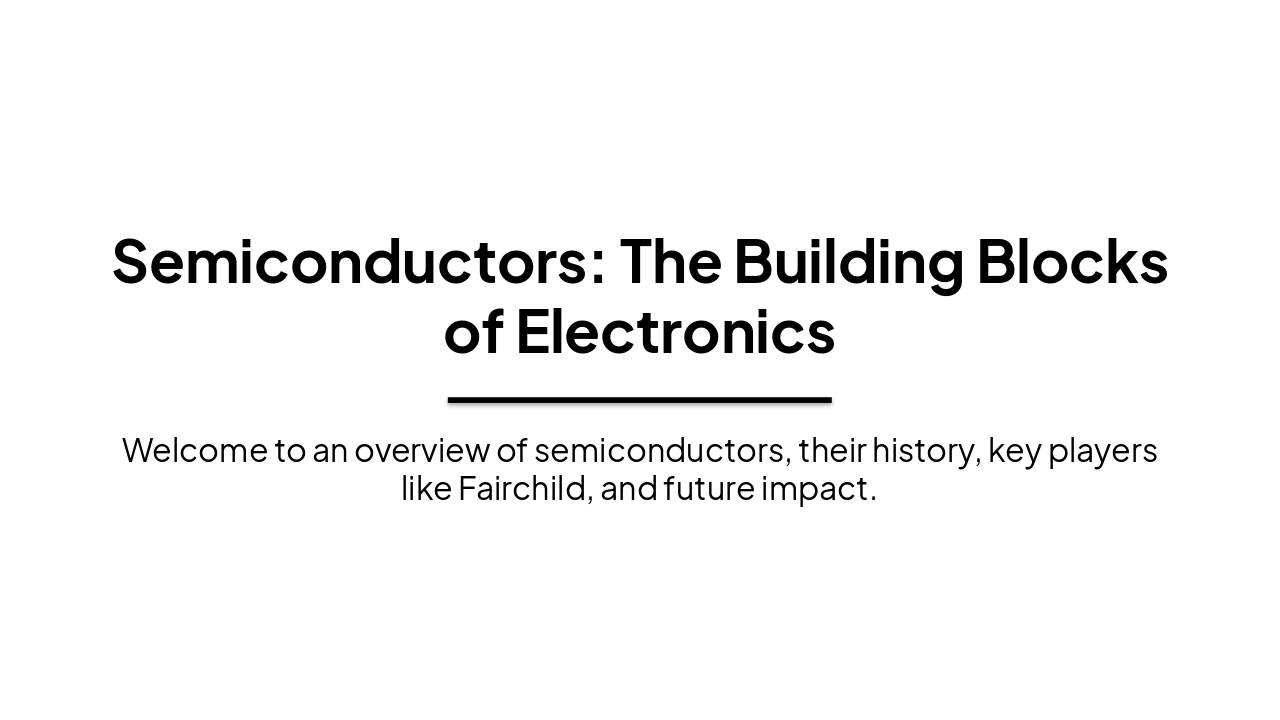
Slide 1 - Semiconductors: The Building Blocks of Electronics
Slide 2 of 9

Slide 2 - Presentation Agenda

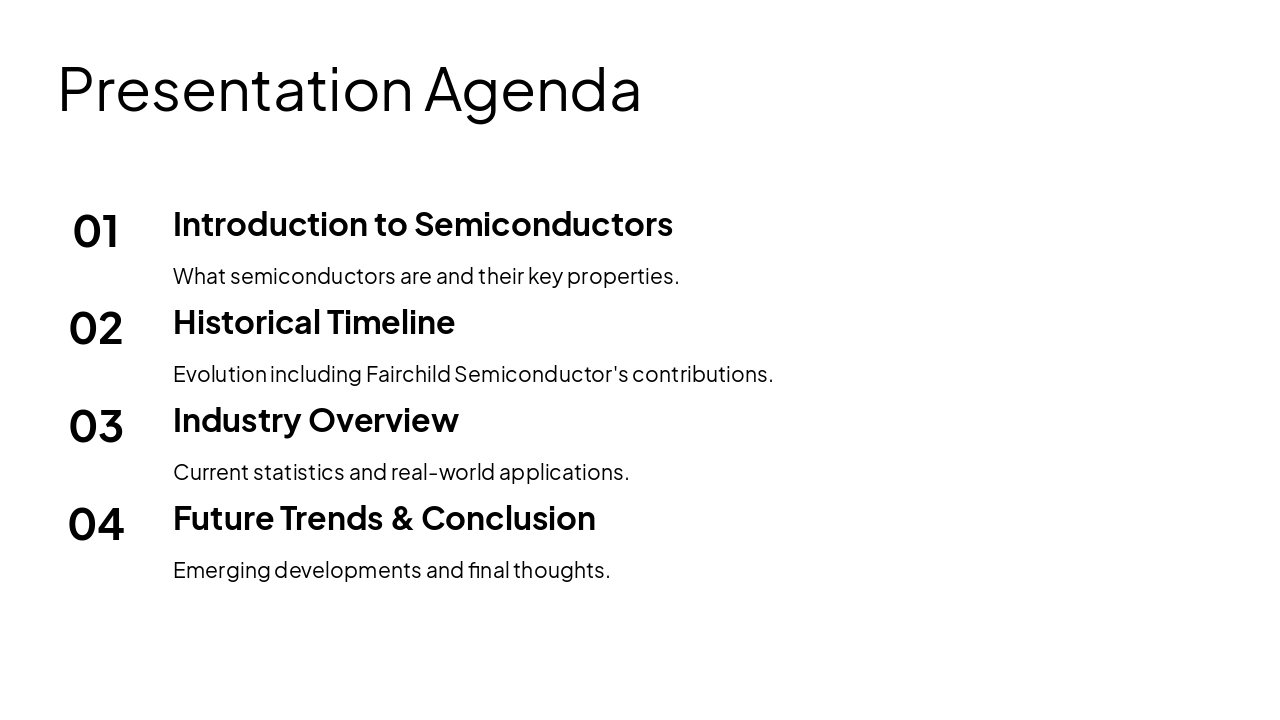
This agenda slide outlines a presentation on semiconductors with four main sections. It starts with an introduction to their properties, followed by a historical timeline featuring Fairchild Semiconductor, an industry overview with statistics and applications, and future trends plus conclusions.

Presentation Agenda

  1. Introduction to Semiconductors
  2. What semiconductors are and their key properties.

  3. Historical Timeline
  4. Evolution including Fairchild Semiconductor's contributions.

  5. Industry Overview
  6. Current statistics and real-world applications.

  7. Future Trends & Conclusion
  8. Emerging developments and final thoughts.

Slide 2 - Presentation Agenda
Slide 3 of 9

Slide 3 - What are Semiconductors?

This slide serves as the section header for "What are Semiconductors?" (Section 01). It describes semiconductors as materials like silicon with conductivity between conductors and insulators, essential for transistors and ICs.

What are Semiconductors?

01

What are Semiconductors?

Materials like silicon with conductivity between conductors and insulators, essential for transistors and ICs.

Source: Semiconductors Presentation

Speaker Notes
Materials like silicon with conductivity between conductors and insulators. Essential for transistors and ICs.
Slide 3 - What are Semiconductors?
Slide 4 of 9

Slide 4 - Key Properties & Types

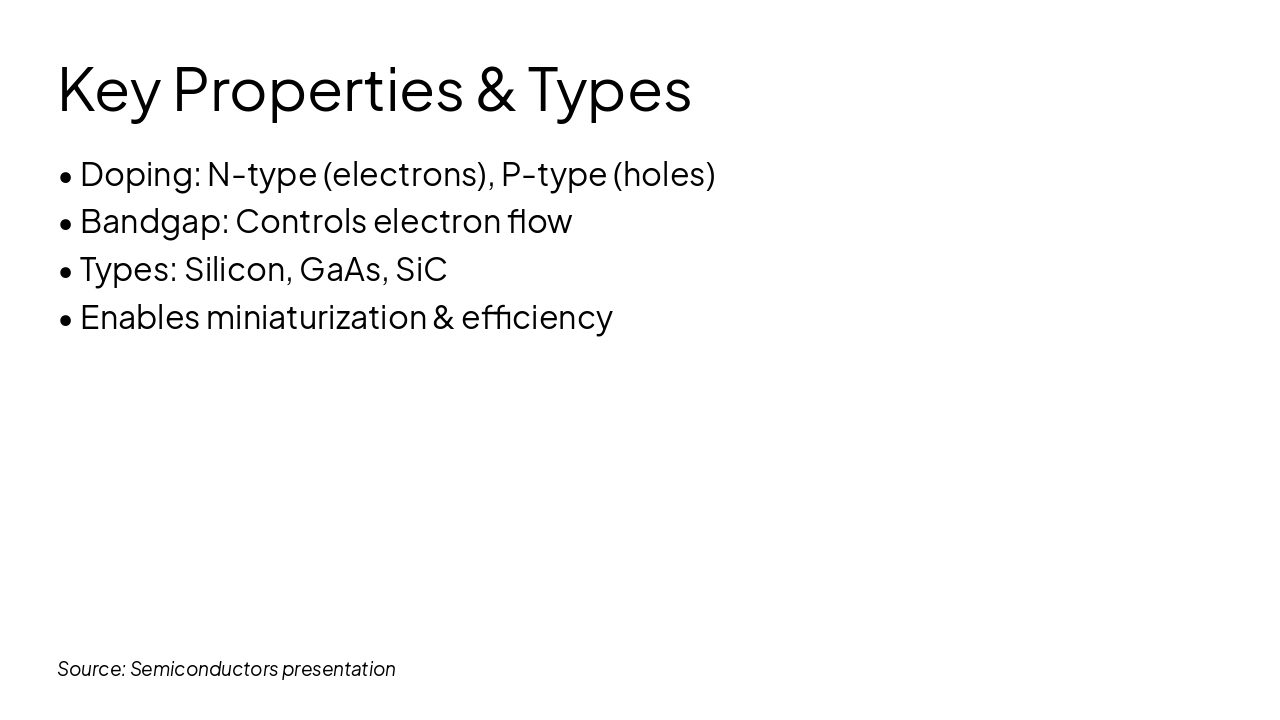
The slide highlights key semiconductor properties like N-type doping (electrons), P-type doping (holes), and bandgap that controls electron flow. It lists types including Silicon, GaAs, and SiC, which enable miniaturization and efficiency.

Key Properties & Types

  • Doping: N-type (electrons), P-type (holes)
  • Bandgap: Controls electron flow
  • Types: Silicon, GaAs, SiC
  • Enables miniaturization & efficiency

Source: Semiconductors presentation

Speaker Notes
Highlight doping types, bandgap role, common materials, and benefits for semiconductor devices.
Slide 4 - Key Properties & Types
Slide 5 of 9

Slide 5 - History of Semiconductors

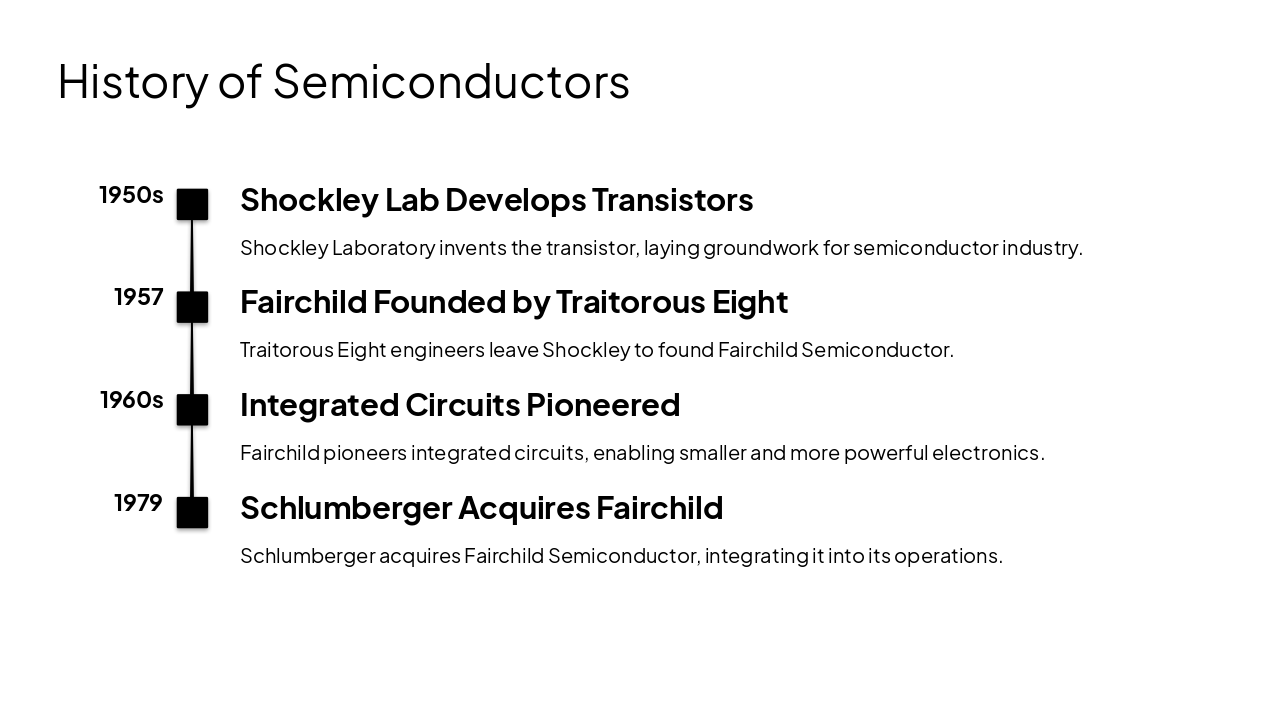
The timeline outlines the semiconductor industry's history, starting with Shockley Laboratory's transistor invention in the 1950s and the Traitorous Eight founding Fairchild Semiconductor in 1957. It continues with Fairchild pioneering integrated circuits in the 1960s and concludes with Schlumberger acquiring Fairchild in 1979.

History of Semiconductors

1950s: Shockley Lab Develops Transistors Shockley Laboratory invents the transistor, laying groundwork for semiconductor industry. 1957: Fairchild Founded by Traitorous Eight Traitorous Eight engineers leave Shockley to found Fairchild Semiconductor. 1960s: Integrated Circuits Pioneered Fairchild pioneers integrated circuits, enabling smaller and more powerful electronics. 1979: Schlumberger Acquires Fairchild Schlumberger acquires Fairchild Semiconductor, integrating it into its operations.

Slide 5 - History of Semiconductors
Slide 6 of 9

Slide 6 - Fairchild Semiconductor Pioneers

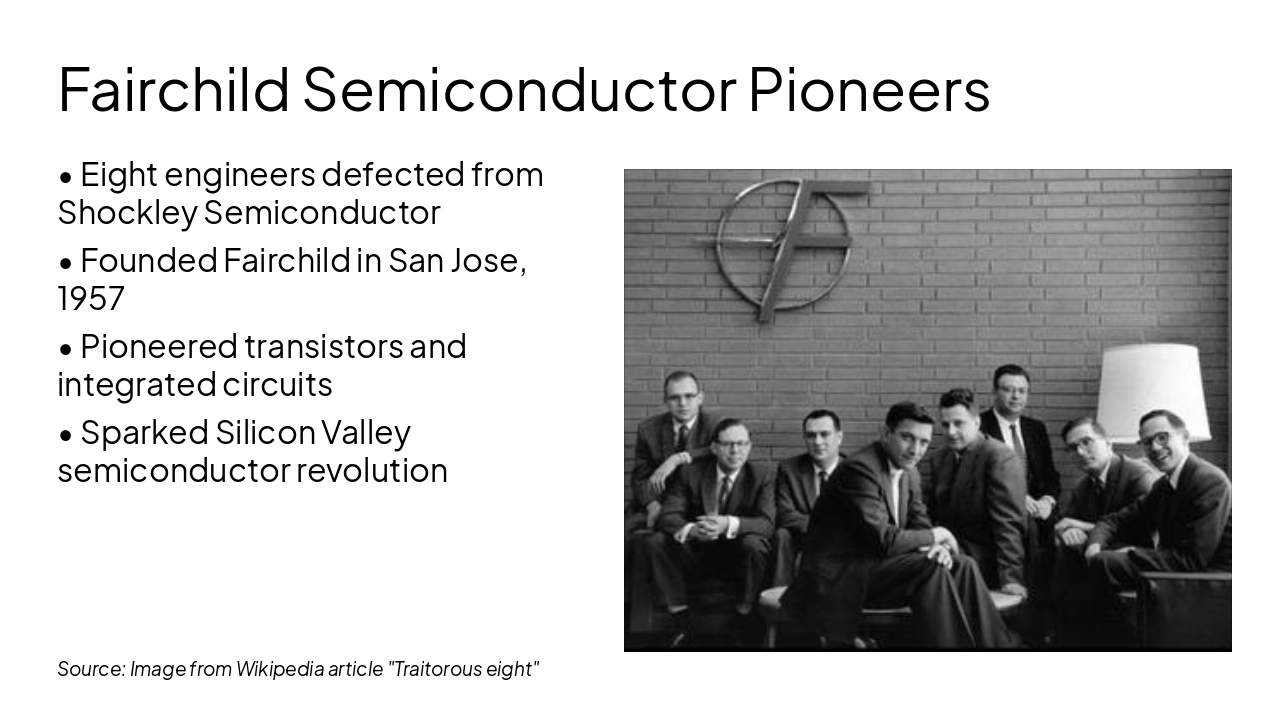
In 1957, eight engineers defected from Shockley Semiconductor to found Fairchild Semiconductor in San Jose. They pioneered transistors and integrated circuits, igniting the Silicon Valley semiconductor revolution.

Fairchild Semiconductor Pioneers

!Image

  • Eight engineers defected from Shockley Semiconductor
  • Founded Fairchild in San Jose, 1957
  • Pioneered transistors and integrated circuits
  • Sparked Silicon Valley semiconductor revolution

Source: Image from Wikipedia article "Traitorous eight"

Slide 6 - Fairchild Semiconductor Pioneers
Slide 7 of 9

Slide 7 - Semiconductor Industry Stats

The Semiconductor Industry Stats slide highlights a global market size exceeding $500B in 2023 and a projected 8-10% annual growth CAGR. It also notes that modern processors contain billions of transistors per chip.

Semiconductor Industry Stats

  • $500B+: Global Market Size
  • 2023 industry value

  • Billions: Transistors per Chip
  • In modern processors

  • 8-10%: Annual Growth CAGR
  • Projected expansion rate

Slide 7 - Semiconductor Industry Stats
Slide 8 of 9

Slide 8 - Conclusion: The Future is Semiconductor-Driven

The conclusion slide, titled "Conclusion: The Future is Semiconductor-Driven," states that semiconductors have fueled the tech revolution from Fairchild's innovations to AI chips. It ends with a subtitle prompting "Questions?"

Conclusion: The Future is Semiconductor-Driven

From Fairchild's innovations to AI chips, semiconductors fuel tech revolution.

Questions?

Source: Semiconductors presentation

Speaker Notes
Closing message: Semiconductors power tomorrow. (3 words) Call-to-action: Thank you! Questions? Let's innovate together. (6 words)
Slide 8 - Conclusion: The Future is Semiconductor-Driven
Slide 9 of 9

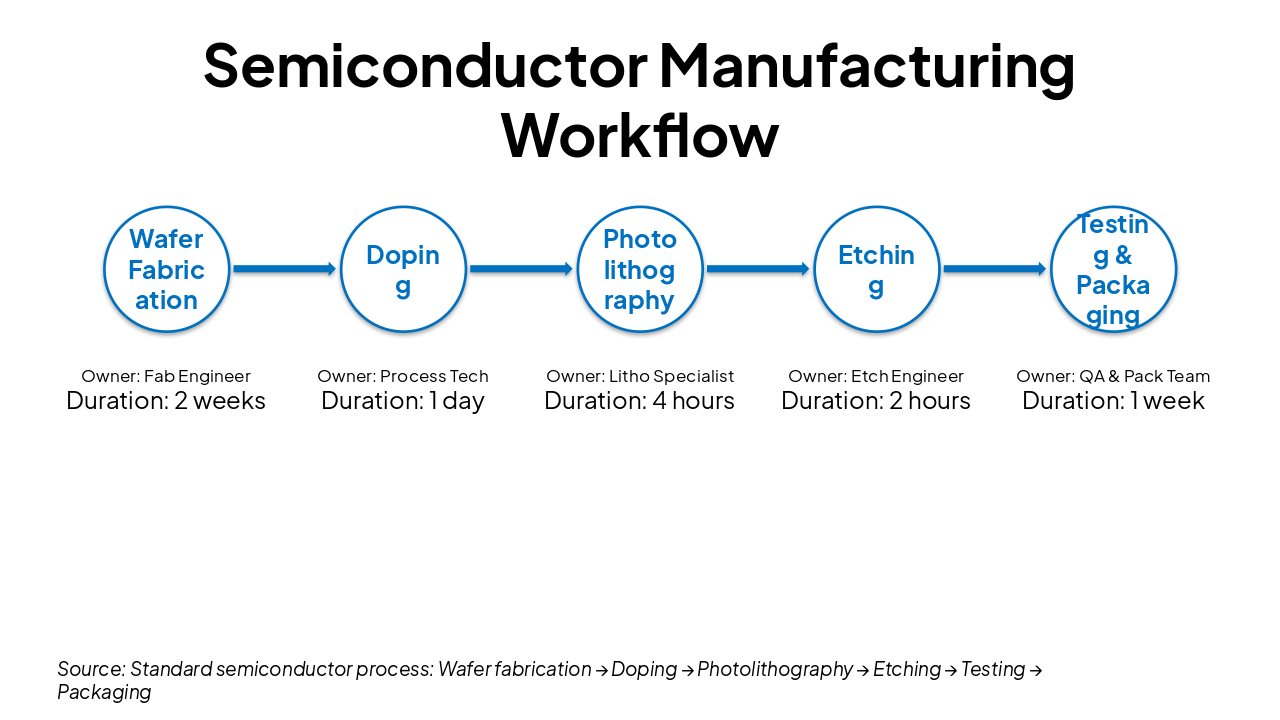
Slide 9 - Semiconductor Manufacturing Workflow

Slide 9 - Semiconductor Manufacturing Workflow
Powered by AI

Create Your Own Presentation

Generate professional presentations in seconds with Karaf's AI. Customize this presentation or start from scratch.

Create New Presentation

Powered by Karaf.ai — AI-Powered Presentation Generator