Reducing Churn with ML Canvas

Generated from prompt:

Create an 8-slide business-oriented presentation for the management board of a telecommunication company with mobile contracts in the public market. The presentation should focus on reducing customer churn using the Machine Learning Canvas framework. Emphasize solution design and strategic understanding, keeping it accessible to non-technical decision-makers. Include the following slides: 1) Title, 2) Problem overview and business impact of churn, 3) Introduction to the Machine Learning Canvas, 4) Problem definition and business objectives, 5) Data and model design overview, 6) Key churn drivers and insights, 7) Retention strategies and operational integration, 8) Conclusion and next steps.

8-slide presentation for telecom execs using ML Canvas to tackle 20-30% churn, highlighting business impact, data/models, key drivers, retention strategies, and ROI-focused next steps. (148 chars)

January 5, 20268 slides
Slide 1 of 8

Slide 1 - Reducing Customer Churn: ML Canvas Framework

This title slide introduces the "Reducing Customer Churn: ML Canvas Framework," focusing on a Machine Learning approach to tackle customer retention. It is a presentation prepared for the Telecom Management Board, emphasizing strategic solution design.

Reducing Customer Churn

Machine Learning Canvas Framework

Presentation for Telecom Management Board Strategic Solution Design

Source: Telecom Management Board | Strategic Solution Design | [Your Name/Company]

Slide 1 - Reducing Customer Churn: ML Canvas Framework
Slide 2 of 8

Slide 2 - Problem Overview: Customer Churn Impact

High annual churn rates of 20-30% erode recurring revenue and result in an average lifetime value loss of €500 per churned customer. This creates a competitive disadvantage in the public mobile market and wastes millions on customer acquisition expenses.

Problem Overview: Customer Churn Impact

  • High annual churn rates (20-30%) erode recurring revenue
  • Lost lifetime value averages €500 per churned customer
  • Creates competitive disadvantage in public mobile market
  • Millions wasted on customer acquisition expenses

Source: High churn erodes revenue, lifetime value, competitiveness, and acquisition costs.

Speaker Notes
Highlight the financial and strategic stakes of churn to set urgency for ML solution.
Slide 2 - Problem Overview: Customer Churn Impact
Slide 3 of 8

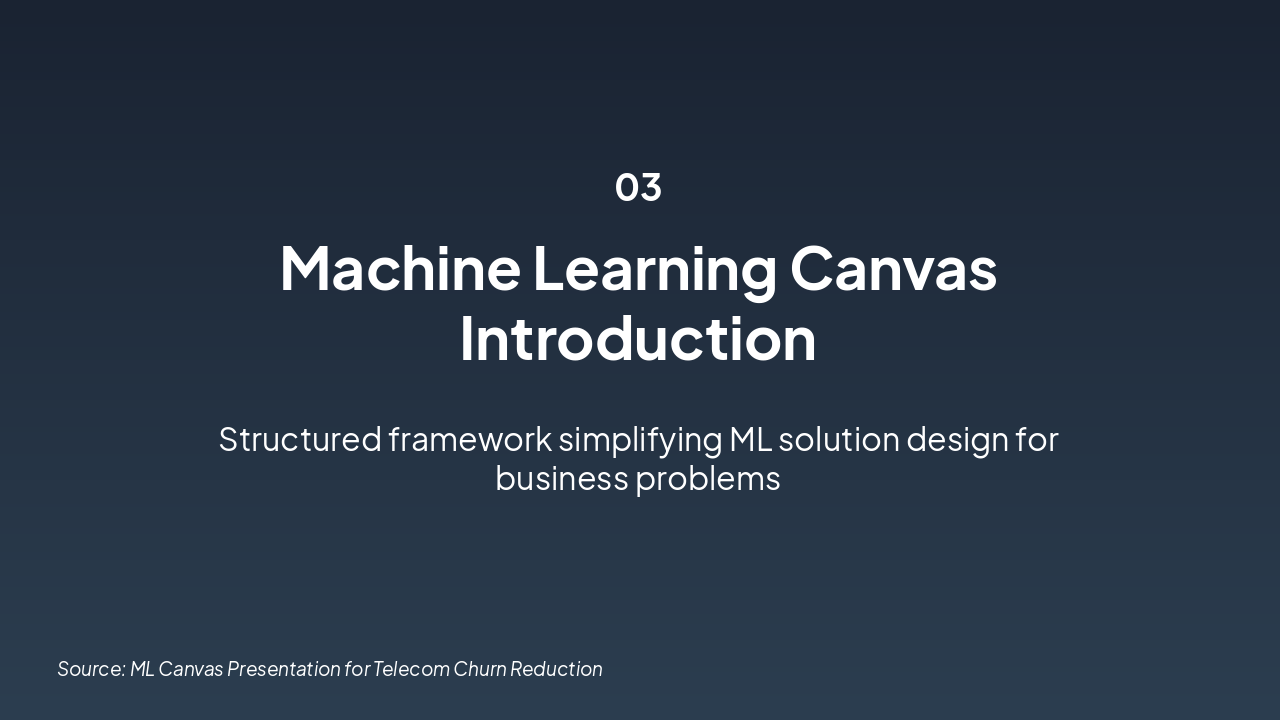
Slide 3 - Introduction to Machine Learning Canvas

This slide introduces the "Machine Learning Canvas" as Section 03. It presents a structured framework that simplifies designing ML solutions for business problems.

Introduction to Machine Learning Canvas

03

Machine Learning Canvas Introduction

Structured framework simplifying ML solution design for business problems

Source: ML Canvas Presentation for Telecom Churn Reduction

Speaker Notes
Introduce the ML Canvas as a simple framework that breaks down ML into strategic steps: Problem, Data, Model, Deployment. Emphasize accessibility for business leaders.
Slide 3 - Introduction to Machine Learning Canvas
Slide 4 of 8

Slide 4 - Problem Definition & Business Objectives

The slide defines the churn prediction problem as forecasting which mobile contract customers will cancel service within 30-90 days, enabling proactive retention to prevent revenue loss from high-value cancellations. It outlines key business objectives: achieving 15% churn reduction, 3x ROI on retention initiatives, and actionable insights for targeted campaigns to boost customer loyalty and profitability.

Problem Definition & Business Objectives

Churn Prediction ProblemKey Business Objectives
Predicting which mobile contract customers will cancel service within 30-90 days. Enables proactive retention efforts to identify at-risk subscribers early and prevent revenue loss from high-value contract cancellations.Achieve 15% churn reduction, deliver 3x ROI on retention initiatives, and provide actionable insights for targeted campaigns to improve customer loyalty and profitability.

Source: Telecom Churn Reduction Presentation - Slide 4

Slide 4 - Problem Definition & Business Objectives
Slide 5 of 8

Slide 5 - Data & Model Design Overview

The slide provides an overview of data sources including usage, billing, and support tickets, along with key features such as contract length, payments, and usage patterns. It describes an XGBoost ensemble ML model achieving 85% accuracy, following a canvas flow from inputs through processing to outputs.

Data & Model Design Overview

  • Data sources: Usage, billing, support tickets
  • Features: Contract length, payments, usage patterns
  • Model: XGBoost ensemble ML, 85% accuracy
  • Canvas flow: Inputs → Processing → Outputs
Slide 5 - Data & Model Design Overview
Slide 6 of 8

Slide 6 - Key Churn Drivers & Insights

The slide highlights key churn drivers, with late payments at 35% as the top factor, followed by low usage at 25% and poor support at 20%. It also notes a 60-day early warning window for pre-churn detection.

Key Churn Drivers & Insights

  • 35%: Late Payments
  • Top churn driver

  • 25%: Low Usage
  • Second major factor

  • 20%: Poor Support
  • Key service issue

  • 60 days: Early Warning
  • Pre-churn detection window

Speaker Notes
Highlight top drivers with bar chart visualization; emphasize 60-day early warning for proactive retention.
Slide 6 - Key Churn Drivers & Insights
Slide 7 of 8

Slide 7 - Retention Strategies & Operational Integration

This workflow slide outlines a four-phase retention strategy: predicting churn risk with ML scoring by the Data Science Team, segmenting high-risk customers by the Analytics Team, deploying personalized interventions by Retention & Marketing, and monitoring impact by the Operations Team. Each phase integrates with the CRM through automated pipelines, segment syncing, campaign triggers, and real-time dashboards for seamless operational execution.

Retention Strategies & Operational Integration

Source: Workflow: Predict → Segment → Intervene (discounts, upgrades) → Monitor. Integrate with CRM for auto-alerts and campaigns.

Slide 7 - Retention Strategies & Operational Integration
Slide 8 of 8

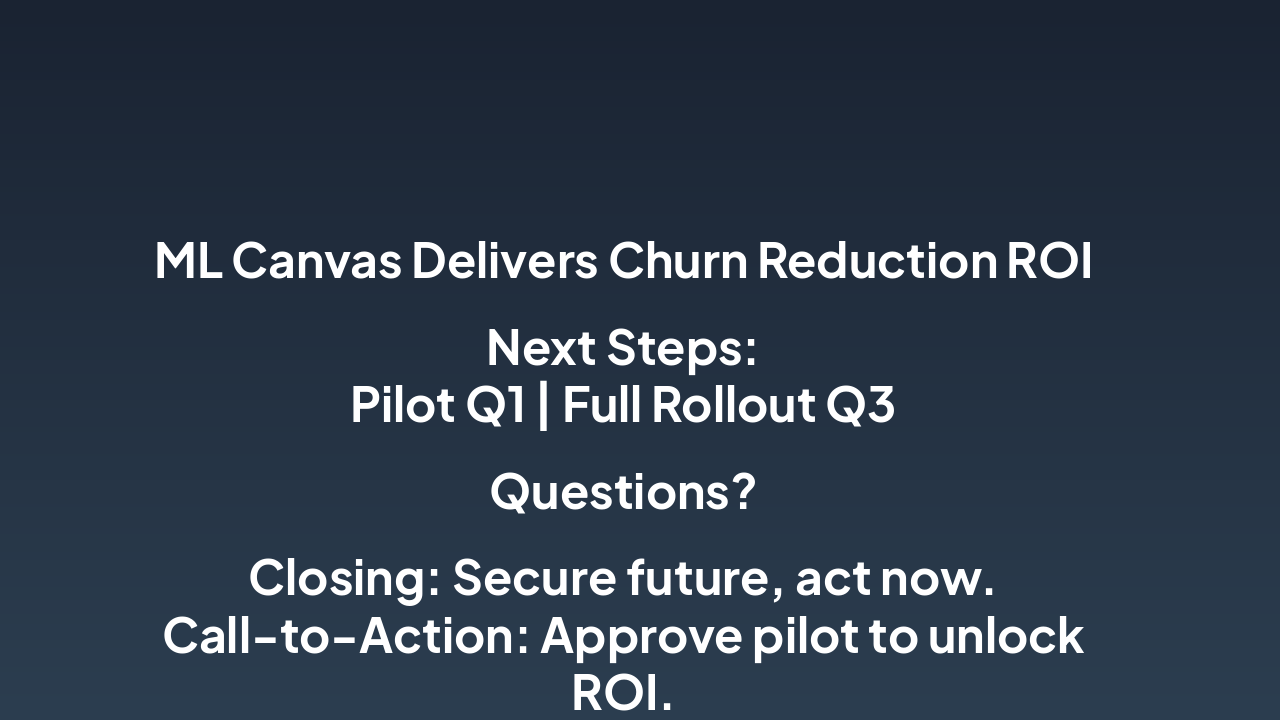
Slide 8 - Conclusion & Next Steps

ML Canvas delivers churn reduction ROI. Next steps include a Q1 pilot, Q3 full rollout, with a call to approve the pilot now to secure the future and unlock ROI.

Conclusion & Next Steps

**ML Canvas Delivers Churn Reduction ROI

Next Steps: Pilot Q1 | Full Rollout Q3

Questions?

Closing: Secure future, act now. Call-to-Action: Approve pilot to unlock ROI.**

Speaker Notes
Summarize key value, outline timeline, open for Q&A.
Slide 8 - Conclusion & Next Steps

Discover More Presentations

Explore thousands of AI-generated presentations for inspiration

Browse Presentations
Powered by AI

Create Your Own Presentation

Generate professional presentations in seconds with Karaf's AI. Customize this presentation or start from scratch.

Create New Presentation

Powered by Karaf.ai — AI-Powered Presentation Generator