Bilingualism and Brain Maintenance in Alzheimer’s Disease

Generated from prompt:

Make a presentation about this paper Bilinguals show evidence of brain maintenance in Alzheimer’s disease by Coulter et al 2024. Include background, rational, aims, method, results and strengths and limitations on seperate slides

Review of Coulter et al. (2024) study showing bilinguals exhibit greater hippocampal volumes in AD, suggesting brain maintenance rather than reserve. Covers background on resilience, study aims, methods using neuroimaging, key results, strengths, and

April 3, 202612 slides
Slide 1 of 12

Slide 1 - Bilinguals Show Evidence of Brain Maintenance in Alzheimer’s Disease

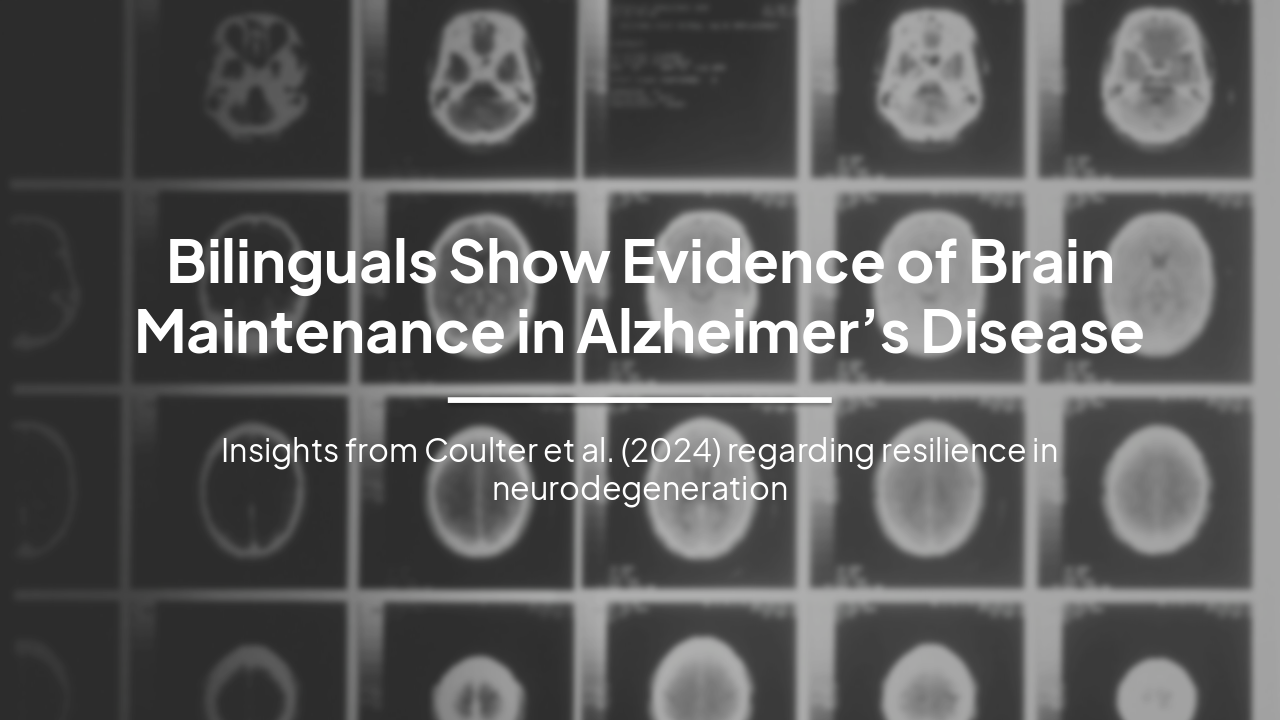
Bilinguals Show Evidence of Brain Maintenance in Alzheimer’s Disease

Insights from Coulter et al. (2024) regarding resilience in neurodegeneration

---

Photo by National Cancer Institute on Unsplash
Slide 1 - Bilinguals Show Evidence of Brain Maintenance in Alzheimer’s Disease
Slide 2 of 12

Slide 2 - Presentation Outline

  • Background and Context
  • Rationale of the Study
  • Research Aims
  • Methodology
  • Key Results
  • Strengths and Limitations
  • Conclusion

---

Photo by National Cancer Institute on Unsplash
Slide 2 - Presentation Outline
Slide 3 of 12

Slide 3 - Background and Rationale

1

Background and Rationale

Understanding resilience and the role of bilingualism in aging

---

Photo by National Cancer Institute on Unsplash

Slide 3 - Background and Rationale
Slide 4 of 12

Slide 4 - Background: Defining Resilience

  • Dementia, particularly Alzheimer's Disease (AD), is a major cause of disability in older adults.
  • 'Reserve' and 'resilience' explain why cognitive performance often exceeds expected pathology.
  • Mechanisms include Brain Reserve (substrate amount), Cognitive Reserve (neural efficiency/compensation), and Brain Maintenance (preserved structure over time).
  • Previous studies suggest bilingualism may provide a 4–5 year delay in AD symptom onset.
Slide 4 - Background: Defining Resilience
Slide 5 of 12

Slide 5 - Rationale: Why this study?

  • Bilingualism is hypothesized to contribute to resilience against AD.
  • Previous research indicated bilingualism associates with greater brain/cognitive reserve in healthy and some clinical populations.
  • The study sought to test these hypotheses using structural neuroimaging across the continuum of AD development, including Subjective Cognitive Decline (SCD), Mild Cognitive Impairment (MCI), and AD.
Slide 5 - Rationale: Why this study?
Slide 6 of 12

Slide 6 - Study Aims and Methods

2

Study Aims and Methods

Investigating brain structure across the AD continuum

---

Photo by National Cancer Institute on Unsplash
Slide 6 - Study Aims and Methods
Slide 7 of 12

Slide 7 - Research Aims

  • Aim: Explore bilingualism-related brain and cognitive reserve in older adults.
  • Predicting greater brain reserve (cortical thickness/volume) in language areas for bilinguals.
  • Predicting greater cognitive reserve (higher atrophy in AD regions despite stable cognition) for bilinguals.
  • Testing if bilingualism influences structural integrity along the AD continuum.
Slide 7 - Research Aims
Slide 8 of 12

Slide 8 - Methodology

  • Participants: 364 older adults (from CCNA and CIMA-Q studies).
  • Groups: Cognitively Unimpaired (CU), SCD, MCI, and AD.
  • Method: Surface-based morphometry using FreeSurfer to measure cortical thickness and subcortical volume.
  • Analysis: Hierarchical regression to test effects of diagnosis, language group, and their interaction on brain structure.
  • Language groups strictly matched for age, sex, education, and cognition.
Slide 8 - Methodology
Slide 9 of 12

Slide 9 - Results and Evaluation

3

Results and Evaluation

Evidence for brain maintenance in Alzheimer's Disease

---

Photo by National Cancer Institute on Unsplash
Slide 9 - Results and Evaluation
Slide 10 of 12

Slide 10 - Key Results

  • No evidence of brain reserve in language-related regions for bilinguals.
  • No evidence of cognitive reserve (differential atrophy) in AD-related regions.
  • Key Finding: Bilinguals with AD showed greater hippocampal volumes (including CA1 and subiculum) compared to monolinguals with AD.
  • Interpretation: Findings suggest bilingualism may support brain maintenance, rather than just reserve or compensation.
Slide 10 - Key Results
Slide 11 of 12

Slide 11 - Strengths and Limitations

Strengths

  • Large, well-characterized sample across the AD continuum (CU, SCD, MCI, AD).
  • Strict group matching on demographic and cognitive factors.
  • Use of surface-based morphometry for precise anatomical measurement.

Limitations

  • Cross-sectional design limits inferences about progression.
  • Bilingualism treated as a dichotomous variable (lacking detailed usage data for all).
  • Imbalanced sex distribution in diagnosis groups.
Slide 11 - Strengths and Limitations
Slide 12 of 12

Slide 12 - Conclusion

Bilingualism supports brain maintenance in the context of Alzheimer's Disease.

Bilingualism acts as a potential mechanism for preserving brain structure in AD.

Slide 12 - Conclusion

Discover More Presentations

Explore thousands of AI-generated presentations for inspiration

Browse Presentations
Powered by AI

Create Your Own Presentation

Generate professional presentations in seconds with Karaf's AI. Customize this presentation or start from scratch.

Create New Presentation

Powered by Karaf.ai — AI-Powered Presentation Generator