Geopolitics in Disputed Territories: Power and Diplomacy

Generated from prompt:

Make a presentation about Geopolitical powers and diplomatic relations in disputed territories

An in-depth analysis of global powers' influence in contested regions, diplomatic strategies, key case studies (South China Sea, Kashmir, Arctic), conflict resolution mechanisms, and future outlooks for international stability.

April 18, 202620 slides
Slide 1 of 20

Slide 1 - Geopolitical Powers and Diplomatic Relations

Geopolitical Powers and Diplomatic Relations in Disputed Territories

Navigating Global Influence and Contested Sovereignty

---

Photo by Andrew Stutesman on Unsplash
Slide 1 - Geopolitical Powers and Diplomatic Relations
Slide 2 of 20

Slide 2 - Geopolitical Powers and Disputed Territories

Geopolitical Powers and Diplomatic Relations in Disputed Territories

An analysis of global influence and conflict in contested zones

---

Photo by Andrew Stutesman on Unsplash
Slide 2 - Geopolitical Powers and Disputed Territories
Slide 3 of 20

Slide 3 - Presentation Agenda

  • Understanding Disputed Territories
  • The Role of Global Powers
  • Diplomatic Strategies and Conflict Resolution
  • Case Studies in Modern Geopolitics
  • Future Outlook and Global Stability

---

Photo by Samantha Gades on Unsplash
Slide 3 - Presentation Agenda
Slide 4 of 20

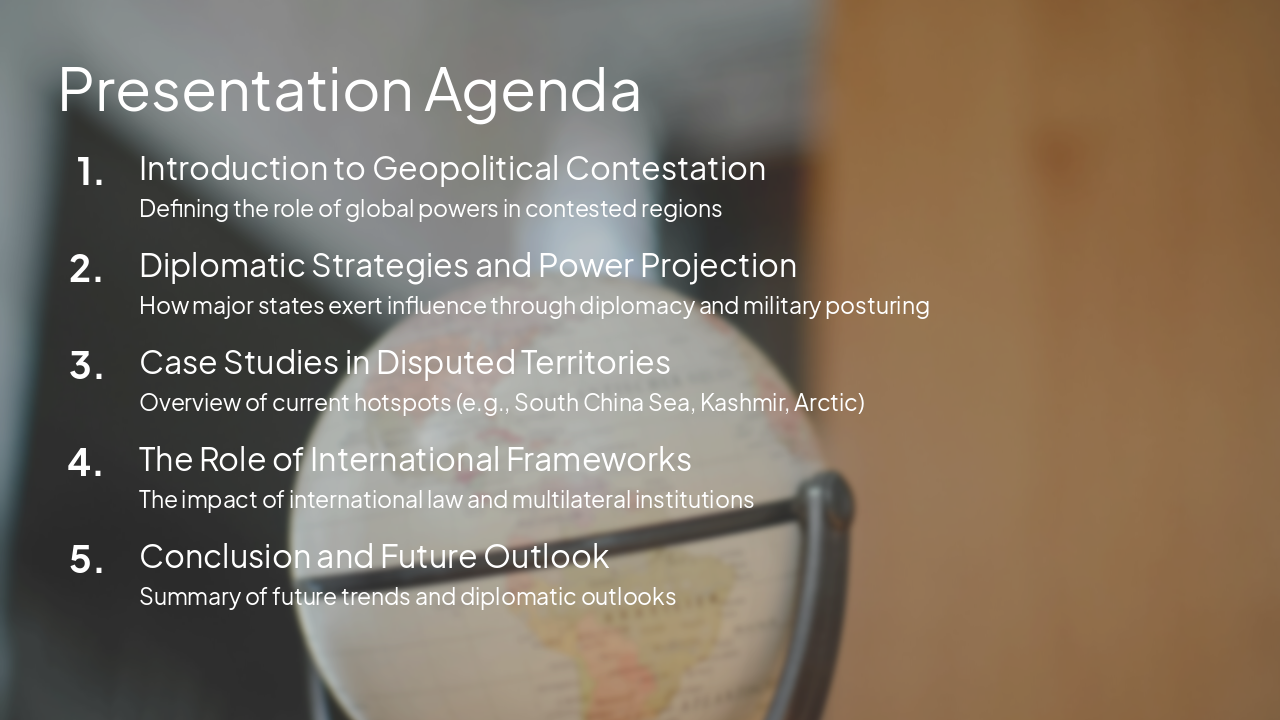
Slide 4 - Presentation Agenda

  • Introduction to Geopolitical Contestation: Defining the role of global powers in contested regions
  • Diplomatic Strategies and Power Projection: How major states exert influence through diplomacy and military posturing
  • Case Studies in Disputed Territories: Overview of current hotspots (e.g., South China Sea, Kashmir, Arctic)
  • The Role of International Frameworks: The impact of international law and multilateral institutions
  • Conclusion and Future Outlook: Summary of future trends and diplomatic outlooks

---

Photo by bady abbas on Unsplash

Slide 4 - Presentation Agenda
Slide 5 of 20

Slide 5 - Section 1

1

Introduction to Contestation

Understanding why territories remain points of friction between global actors

---

Photo by Jorge Zapata on Unsplash
Slide 5 - Section 1
Slide 6 of 20

Slide 6 - Section One

1

Understanding Disputed Territories

Definitions, causes, and the nature of sovereignty disputes

---

Photo by Kyle Glenn on Unsplash
Slide 6 - Section One
Slide 7 of 20

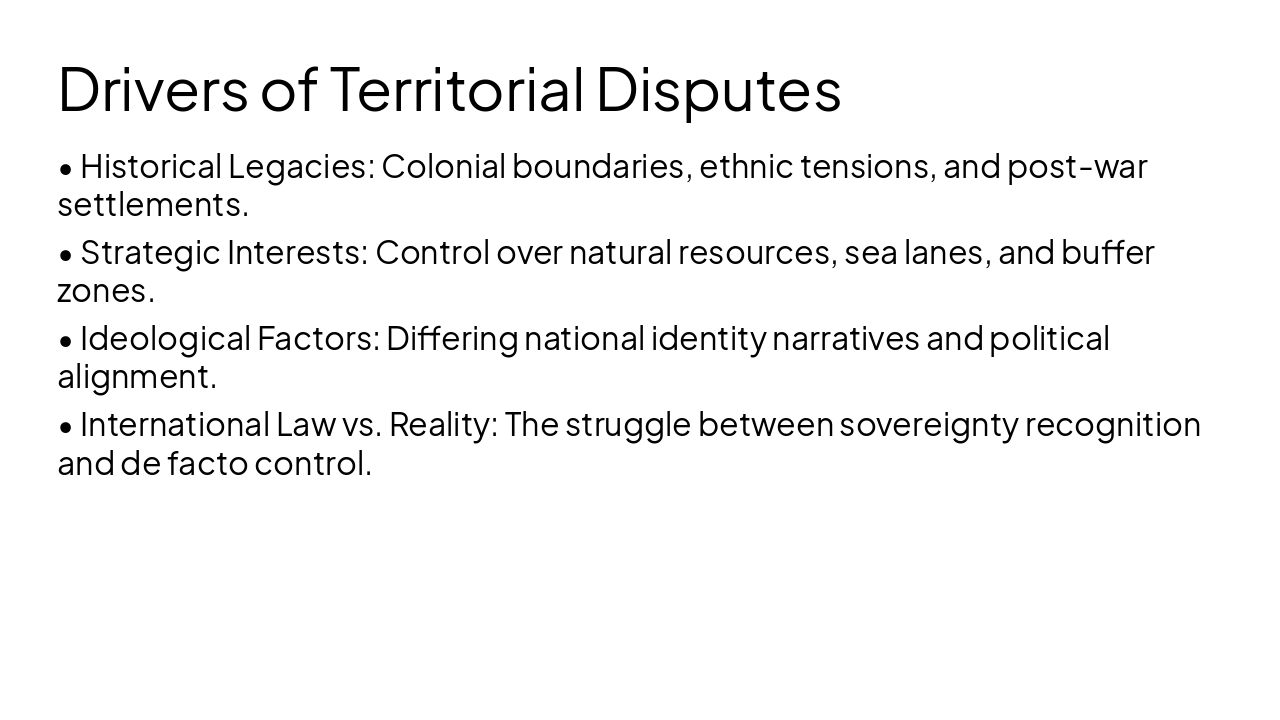
Slide 7 - Drivers of Territorial Disputes

  • Historical Legacies: Colonial boundaries, ethnic tensions, and post-war settlements.
  • Strategic Interests: Control over natural resources, sea lanes, and buffer zones.
  • Ideological Factors: Differing national identity narratives and political alignment.
  • International Law vs. Reality: The struggle between sovereignty recognition and de facto control.
Slide 7 - Drivers of Territorial Disputes
Slide 8 of 20

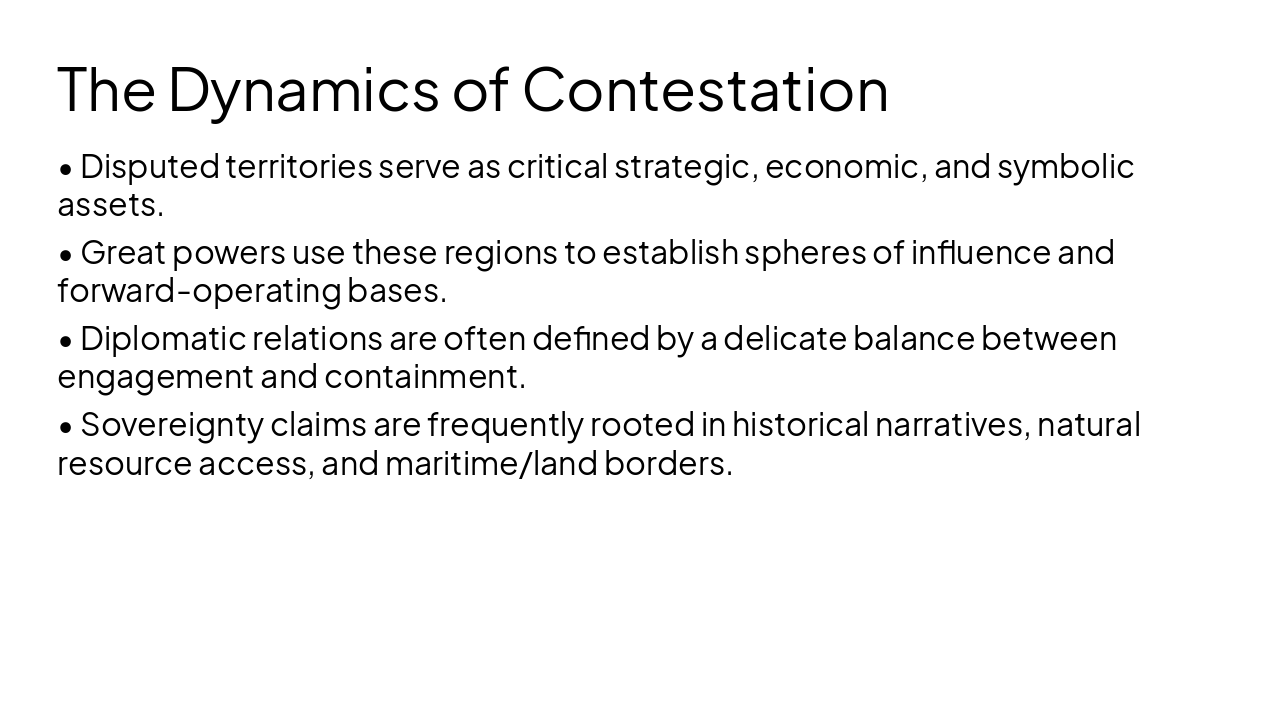
Slide 8 - The Dynamics of Contestation

  • Disputed territories serve as critical strategic, economic, and symbolic assets.
  • Great powers use these regions to establish spheres of influence and forward-operating bases.
  • Diplomatic relations are often defined by a delicate balance between engagement and containment.
  • Sovereignty claims are frequently rooted in historical narratives, natural resource access, and maritime/land borders.
Slide 8 - The Dynamics of Contestation
Slide 9 of 20

Slide 9 - Section Two

2

The Role of Global Powers

How major nations influence and manage contested regions

---

Photo by Evangeline Shaw on Unsplash

Slide 9 - Section Two
Slide 10 of 20

Slide 10 - Section 2

2

Diplomatic Strategies

Tools and frameworks used by powers to manage contested claims
Slide 10 - Section 2
Slide 11 of 20

Slide 11 - Global Power Strategies

Soft Power Diplomacy Utilizing economic aid, cultural influence, and international forums to sway territorial recognition and legitimacy.

Hard Power Projection Deploying military assets, security pacts, and naval presence to assert claims and deter opposition.
Slide 11 - Global Power Strategies
Slide 12 of 20

Slide 12 - Strategies of Influence

Soft Power Diplomacy Economic investments, development aid, and cultural influence to win local support and legitimacy for claims.

Hard Power Realpolitik Military drills, freedom of navigation operations, and security alliances to deter rivals and protect interests.
Slide 12 - Strategies of Influence
Slide 13 of 20

Slide 13 - Section 3

3

Case Studies

Examining specific regions of high geopolitical tension
Slide 13 - Section 3
Slide 14 of 20

Slide 14 - Section Three

3

Conflict and Resolution

Diplomatic tools and mechanisms for navigating disputes

---

Photo by Vitaly Gariev on Unsplash

Slide 14 - Section Three
Slide 15 of 20

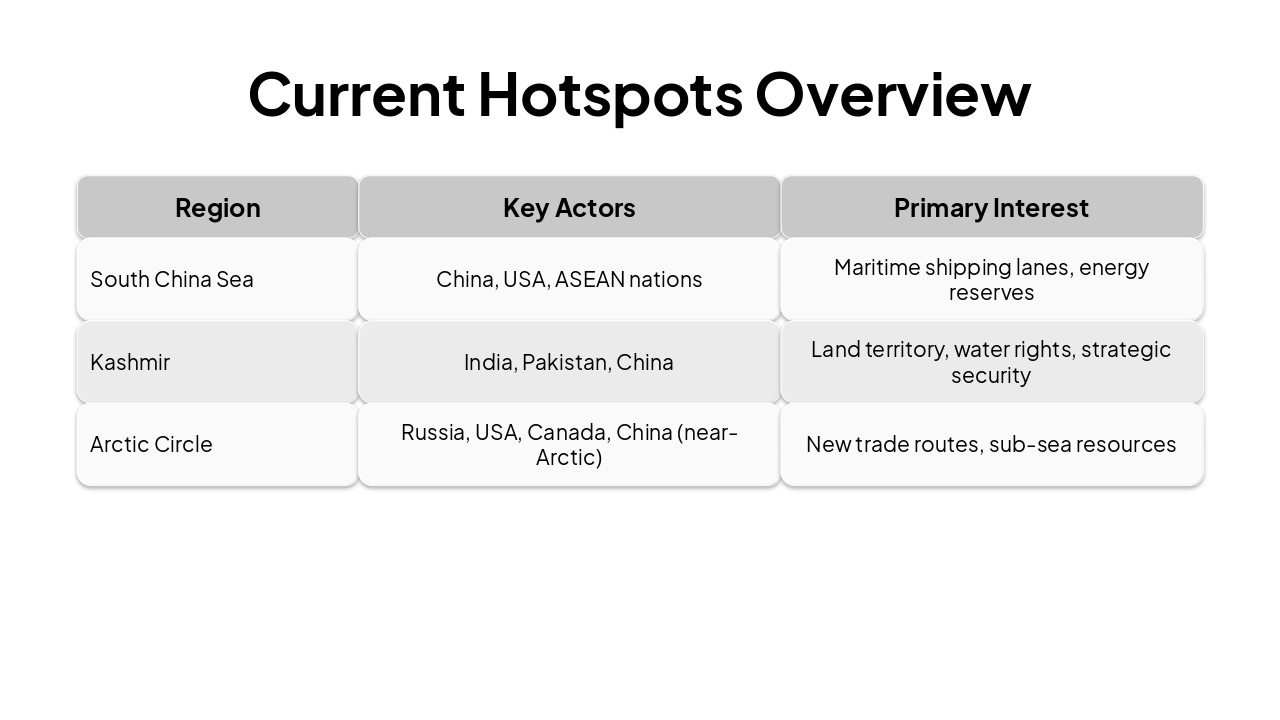
Slide 15 - Current Hotspots Overview

RegionKey ActorsPrimary Interest
South China SeaChina, USA, ASEAN nationsMaritime shipping lanes, energy reserves
KashmirIndia, Pakistan, ChinaLand territory, water rights, strategic security
Arctic CircleRussia, USA, Canada, China (near-Arctic)New trade routes, sub-sea resources
Slide 15 - Current Hotspots Overview
Slide 16 of 20

Slide 16 - Diplomatic Resolution Mechanisms

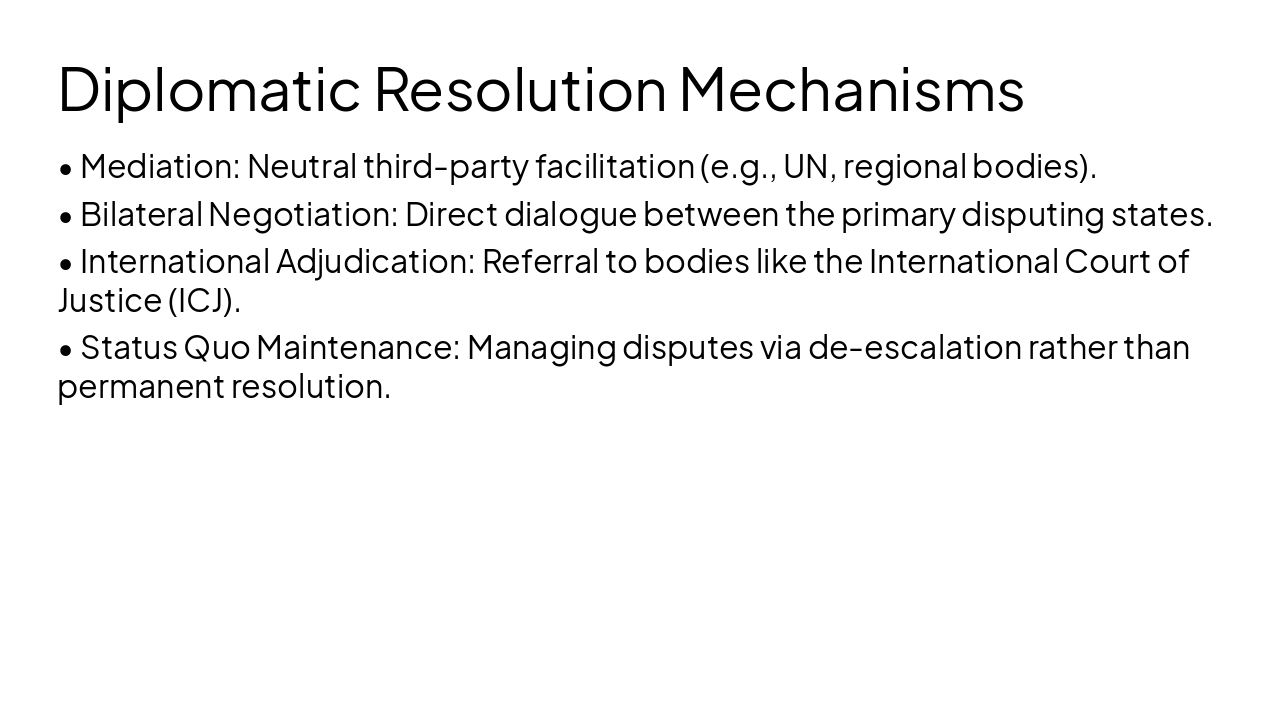
  • Mediation: Neutral third-party facilitation (e.g., UN, regional bodies).
  • Bilateral Negotiation: Direct dialogue between the primary disputing states.
  • International Adjudication: Referral to bodies like the International Court of Justice (ICJ).
  • Status Quo Maintenance: Managing disputes via de-escalation rather than permanent resolution.
Slide 16 - Diplomatic Resolution Mechanisms
Slide 17 of 20

Slide 17 - Case Study: South China Sea

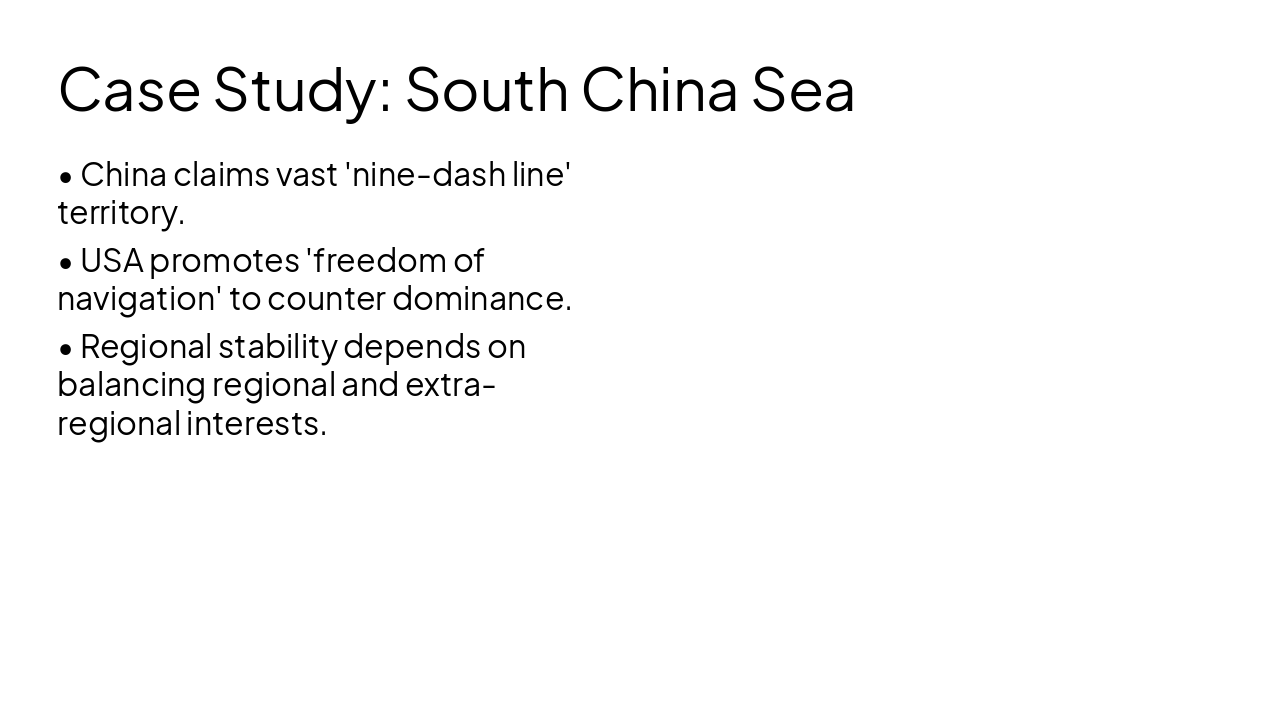
  • China claims vast 'nine-dash line' territory.
  • USA promotes 'freedom of navigation' to counter dominance.
  • Regional stability depends on balancing regional and extra-regional interests.
Slide 17 - Case Study: South China Sea
Slide 18 of 20

Slide 18 - Conclusion

Diplomatic Engagement is Essential for Global Security

Navigating towards stability through dialogue and international cooperation.

---

Photo by Evan Jeung on Unsplash
Slide 18 - Conclusion
Slide 19 of 20

Slide 19 - Geopolitical Stakes in Numbers

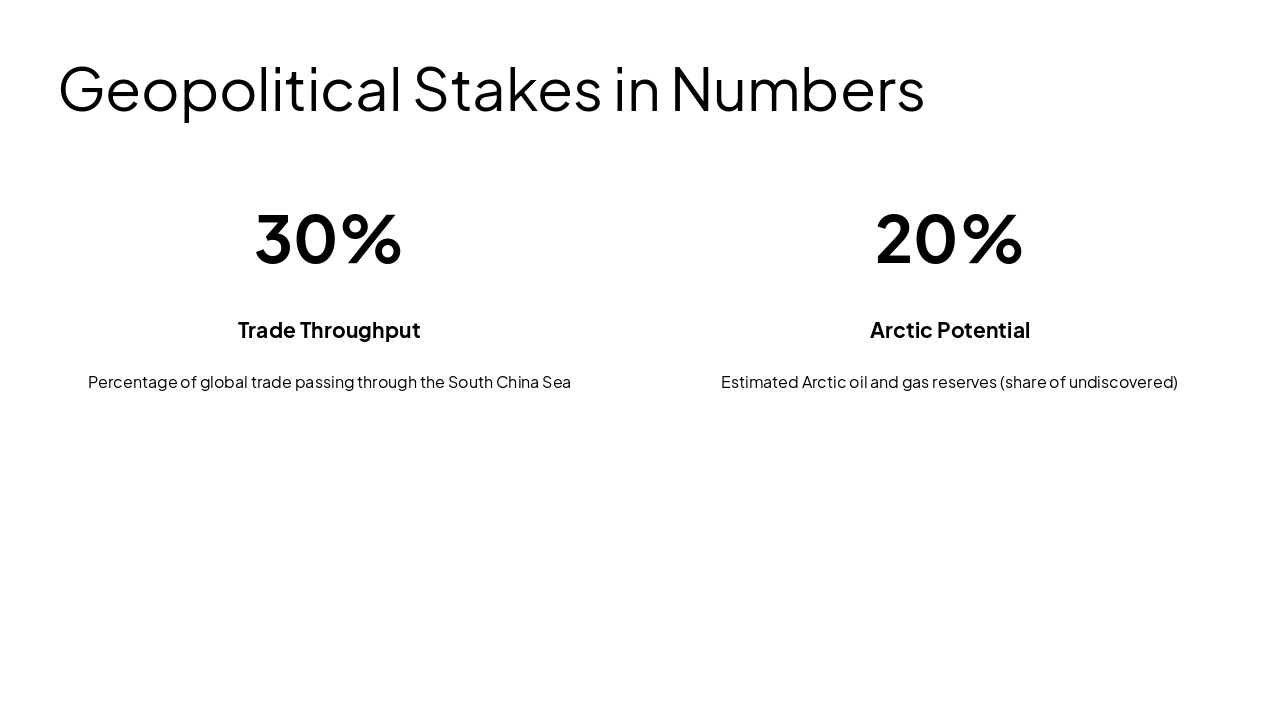
  • 30%: Trade Throughput
  • 20%: Arctic Potential
Slide 19 - Geopolitical Stakes in Numbers
Slide 20 of 20

Slide 20 - Summary and Outlook

Diplomacy in Disputed Territories: A Persistent Balancing Act

Diplomatic engagement remains the primary alternative to open conflict in managing these complex, long-standing disputes.

---

Photo by Tiange Xiang on Unsplash
Slide 20 - Summary and Outlook

Discover More Presentations

Explore thousands of AI-generated presentations for inspiration

Browse Presentations
Powered by AI

Create Your Own Presentation

Generate professional presentations in seconds with Karaf's AI. Customize this presentation or start from scratch.

Create New Presentation

Powered by Karaf.ai — AI-Powered Presentation Generator