Exploring Artificial Intelligence

Generated from prompt:

Create a presentation about artificial intelligence

This presentation introduces AI fundamentals, covering its definition as a computer science field for intelligent machines, key components, goals like autonomy and success maximization, insightful quo

November 9, 20259 slides
Slide 1 of 9

Slide 1 - Introduction to Artificial Intelligence

This title slide introduces the topic of Artificial Intelligence. Its subtitle highlights an exploration of AI's definition, key areas, and societal impact.

Introduction to Artificial Intelligence

Exploring AI's Definition, Key Areas, and Societal Impact
Slide 1
Slide 2 of 9

Slide 2 - Presentation Agenda

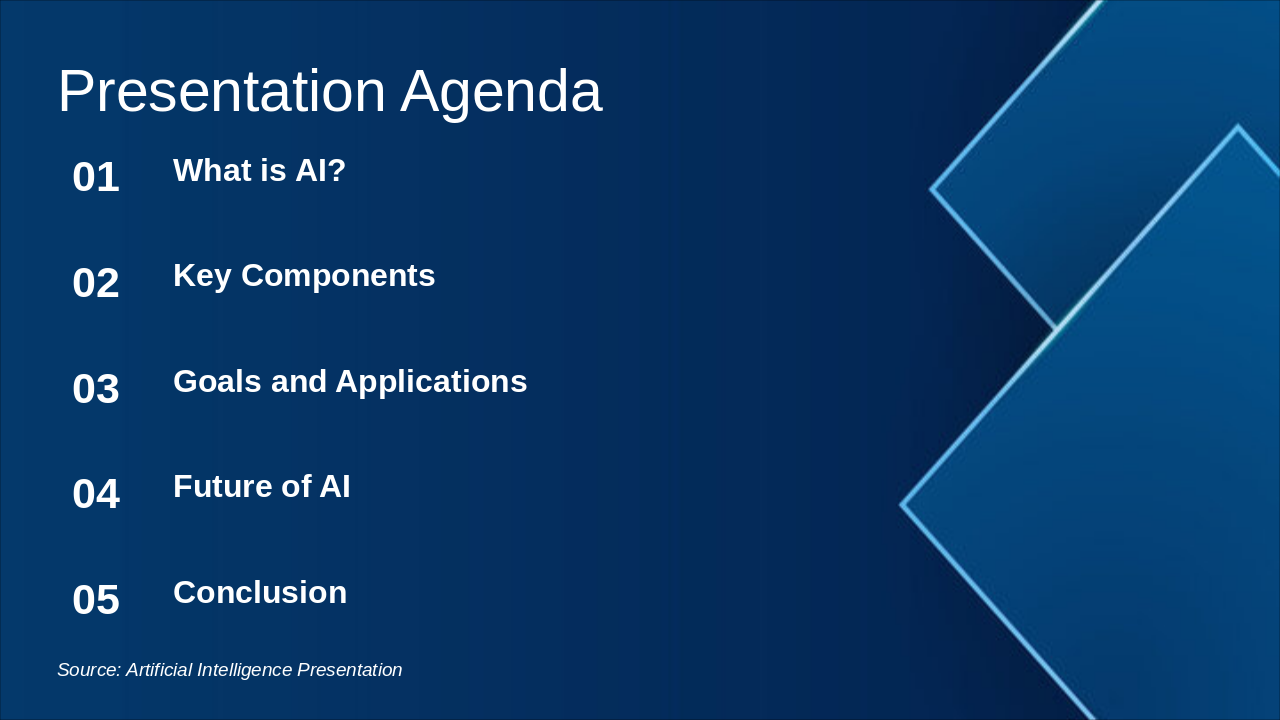
The presentation agenda outlines a structured overview of artificial intelligence, beginning with a fundamental explanation of "What is AI?" followed by its "Key Components." It then covers "Goals and Applications," explores the "Future of AI," and concludes with a summary section.

Presentation Agenda

  1. What is AI?
  1. Key Components
  1. Goals and Applications
  1. Future of AI
  1. Conclusion

Source: Artificial Intelligence Presentation

Slide 2
Slide 3 of 9

Slide 3 - What is Artificial Intelligence?

The slide titled "What is Artificial Intelligence?" serves as a section header introducing the fundamentals of AI. It features a subtitle explaining that AI empowers machines to execute tasks such as learning, reasoning, and decision-making by imitating human intelligence.

What is Artificial Intelligence?

What is Artificial Intelligence?

AI enables machines to perform tasks like learning, reasoning, and decision-making, mimicking human intelligence.

Slide 3
Slide 4 of 9

Slide 4 - Core Definition

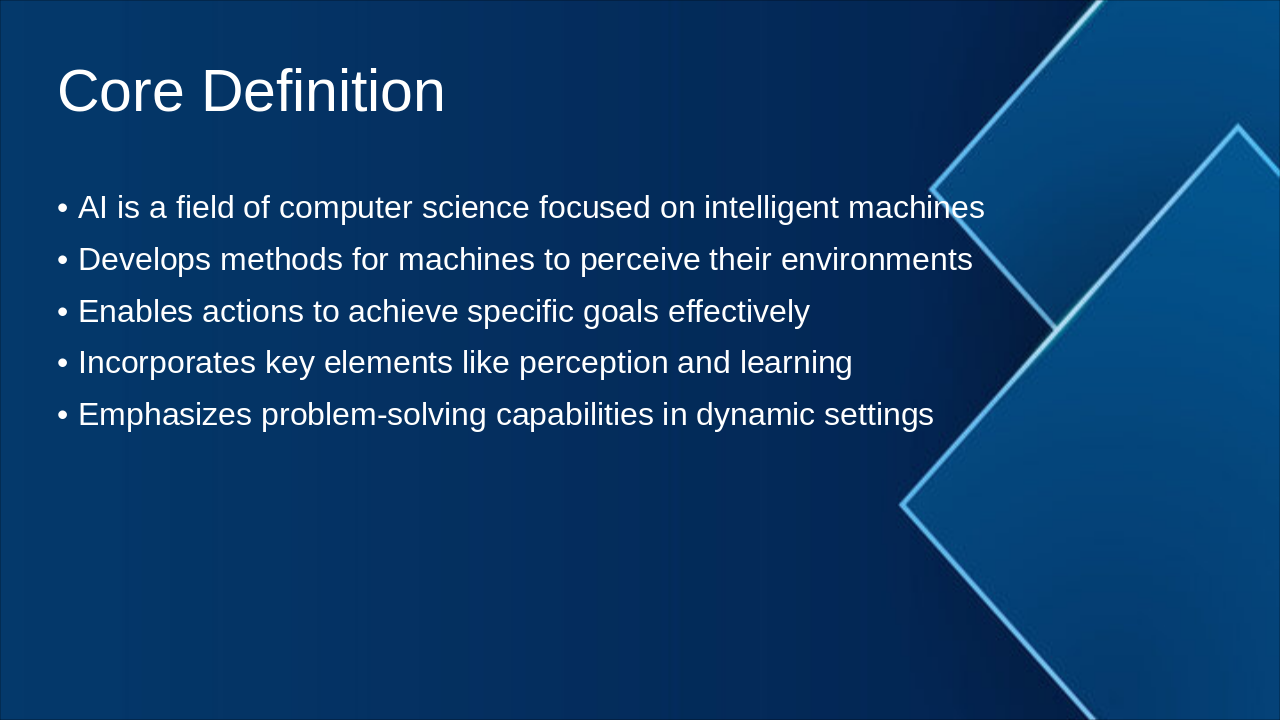
Artificial Intelligence (AI) is a branch of computer science dedicated to creating intelligent machines that can perceive their environments and take effective actions to meet specific goals. It integrates essential components like perception and learning to enable robust problem-solving in dynamic scenarios.

Core Definition

  • AI is a field of computer science focused on intelligent machines
  • Develops methods for machines to perceive their environments
  • Enables actions to achieve specific goals effectively
  • Incorporates key elements like perception and learning
  • Emphasizes problem-solving capabilities in dynamic settings
Slide 4
Slide 5 of 9

Slide 5 - Key Components of AI

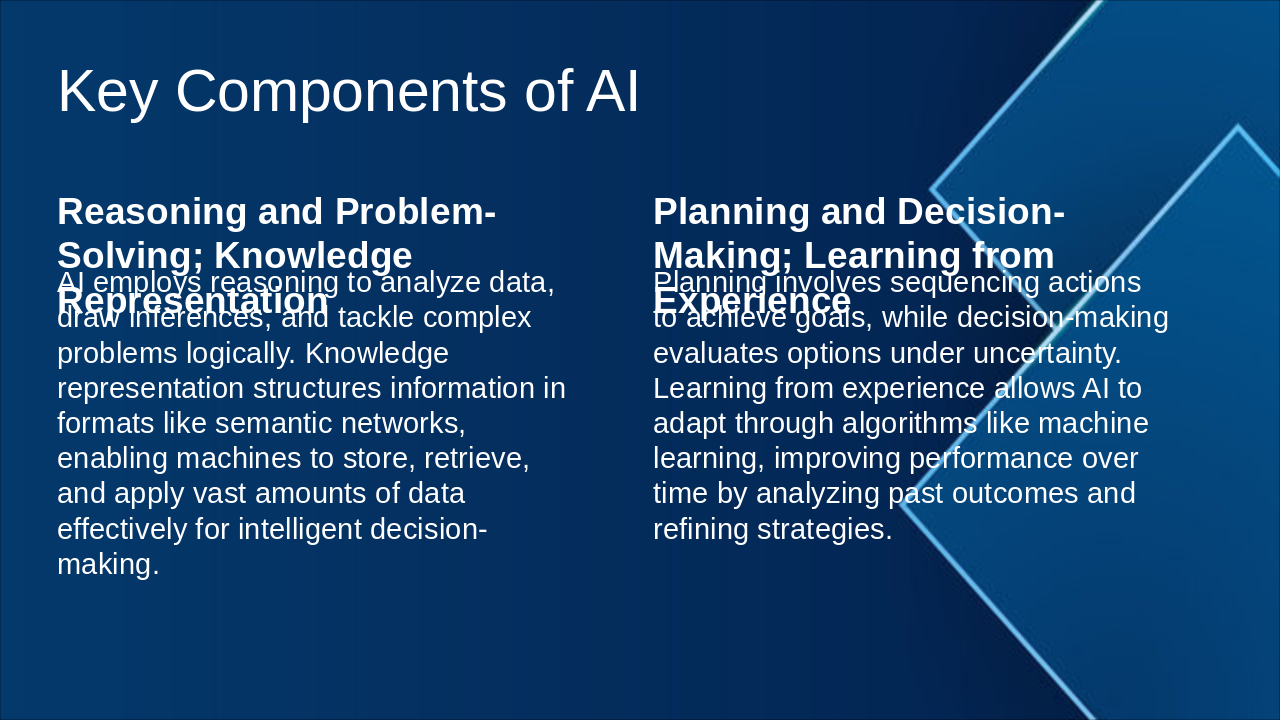
The slide on Key Components of AI is divided into two columns. The left column covers reasoning and problem-solving, where AI analyzes data and draws inferences logically, alongside knowledge representation using structures like semantic networks to store and apply information for decision-making. The right column discusses planning, which sequences actions to meet goals, decision-making under uncertainty, and learning from experience via machine learning algorithms that refine performance based on past outcomes.

Key Components of AI

Reasoning and Problem-Solving; Knowledge RepresentationPlanning and Decision-Making; Learning from Experience
AI employs reasoning to analyze data, draw inferences, and tackle complex problems logically. Knowledge representation structures information in formats like semantic networks, enabling machines to store, retrieve, and apply vast amounts of data effectively for intelligent decision-making.Planning involves sequencing actions to achieve goals, while decision-making evaluates options under uncertainty. Learning from experience allows AI to adapt through algorithms like machine learning, improving performance over time by analyzing past outcomes and refining strategies.
Slide 5
Slide 6 of 9

Slide 6 - Goals of AI

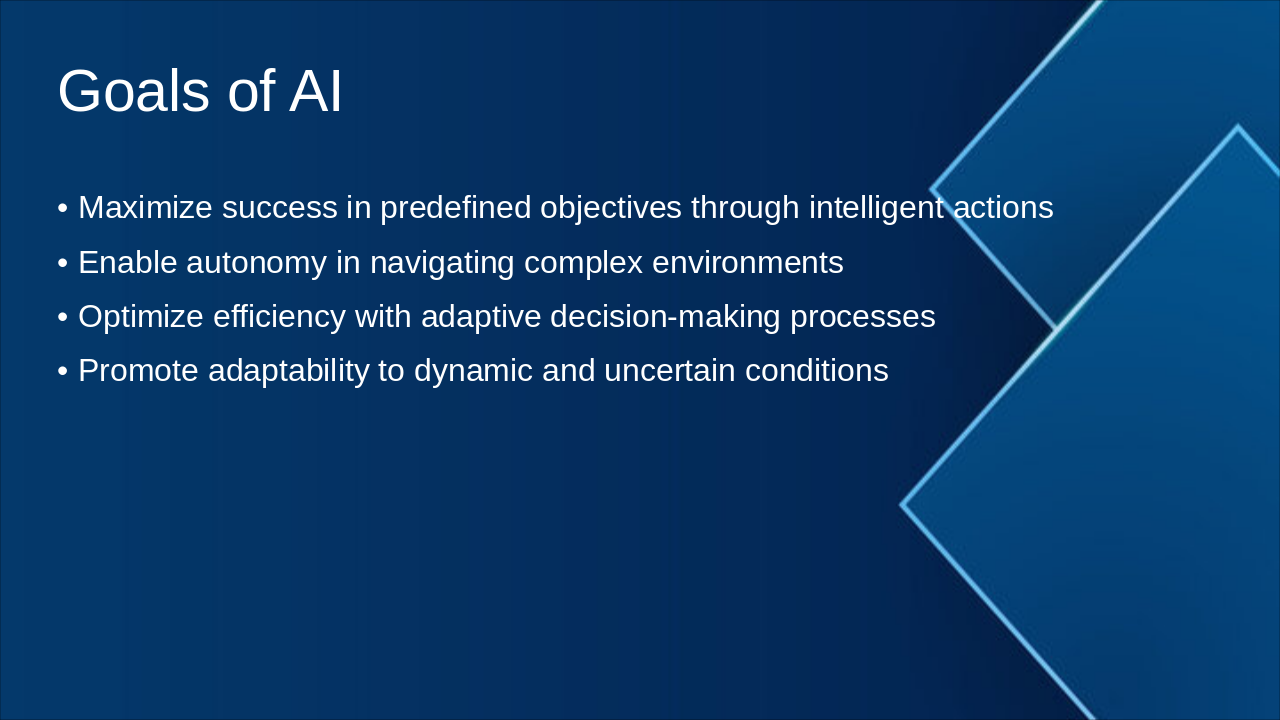
The "Goals of AI" slide outlines key objectives, including maximizing success in predefined tasks via intelligent actions and enabling autonomy in complex environments. It also emphasizes optimizing efficiency through adaptive decision-making and promoting adaptability to dynamic, uncertain conditions.

Goals of AI

  • Maximize success in predefined objectives through intelligent actions
  • Enable autonomy in navigating complex environments
  • Optimize efficiency with adaptive decision-making processes
  • Promote adaptability to dynamic and uncertain conditions
Slide 6
Slide 7 of 9

Slide 7 - Insight on AI

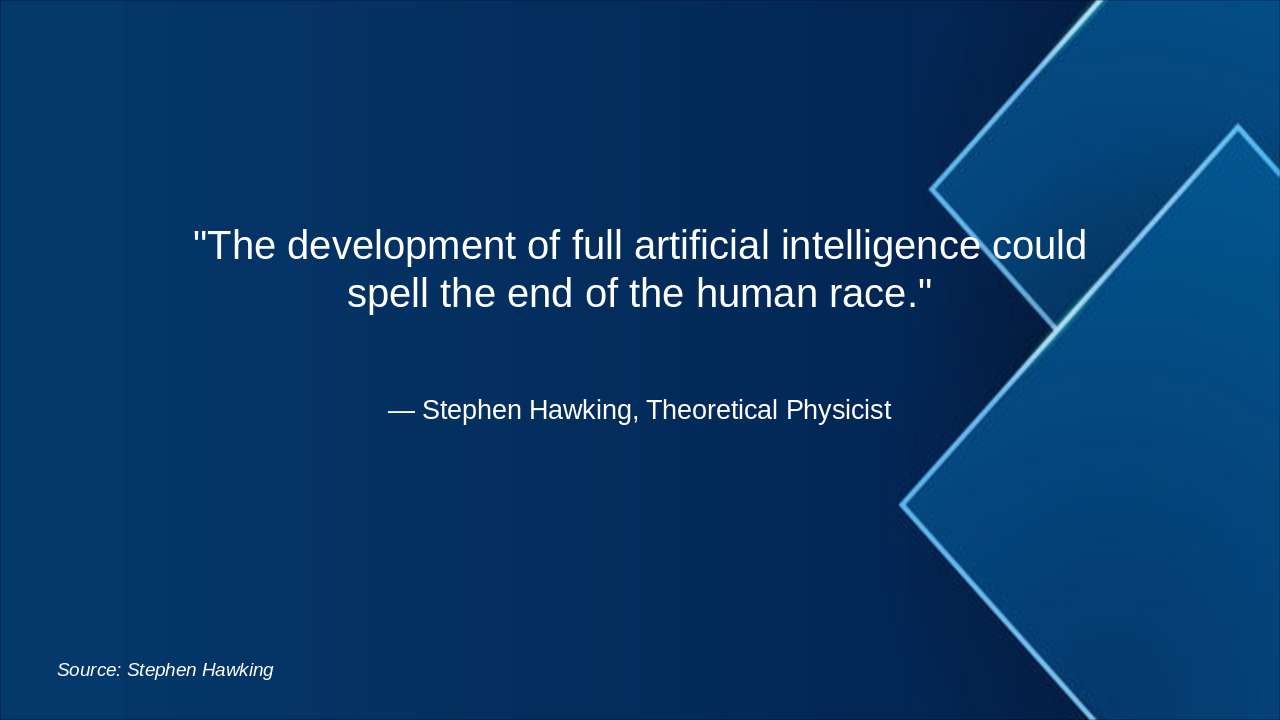
This slide, titled "Insight on AI," features a quote from theoretical physicist Stephen Hawking warning about the risks of advanced technology. The quote states: "The development of full artificial intelligence could spell the end of the human race."

Insight on AI

> The development of full artificial intelligence could spell the end of the human race.

— Stephen Hawking, Theoretical Physicist

Source: Stephen Hawking

--- Speaker Notes: Reflects AI's profound potential and risks.

Slide 7
Slide 8 of 9

Slide 8 - AI Statistics

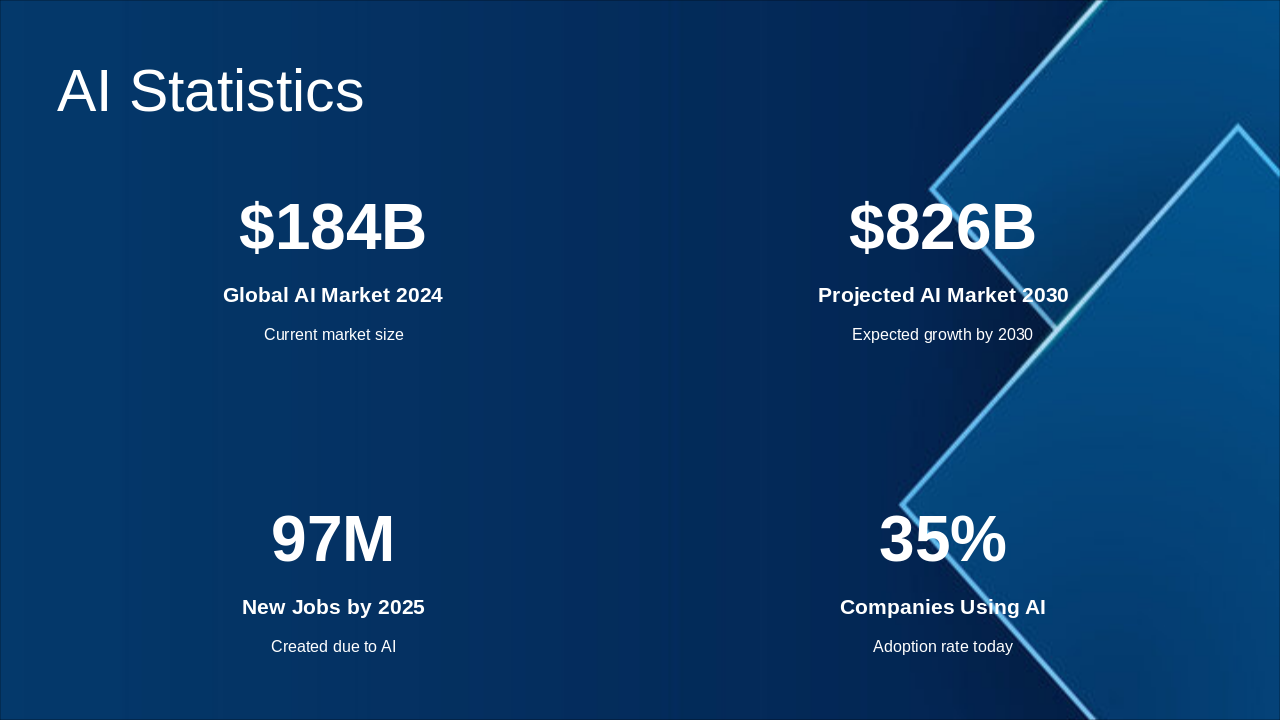
The global AI market is currently valued at $184 billion in 2024 and is projected to reach $826 billion by 2030. AI is expected to create 97 million new jobs by 2025, with 35% of companies already adopting the technology today.

AI Statistics

  • $184B: Global AI Market 2024

Current market size

  • $826B: Projected AI Market 2030

Expected growth by 2030

  • 97M: New Jobs by 2025

Created due to AI

  • 35%: Companies Using AI

Adoption rate today

Slide 8
Slide 9 of 9

Slide 9 - Conclusion: The AI Frontier

The slide titled "Conclusion: The AI Frontier" highlights how AI is transforming industries and everyday life, urging the embrace of ethical development to ensure a beneficial future. Its subtitle emphasizes that "The future of AI is in our hands," ending with a thank you note.

Conclusion: The AI Frontier

AI transforms industries and daily life. Embrace ethical development for a beneficial future. Thank you!

The future of AI is in our hands.

Slide 9
Powered by AI

Create Your Own Presentation

Generate professional presentations in seconds with Karaf's AI. Customize this presentation or start from scratch.

Create New Presentation

Powered by Karaf.ai — AI-Powered Presentation Generator