Homopolysaccharides: Structures, Examples & Roles (48 chars)

Generated from prompt:

Create an 8-10 slide college-level scientific PowerPoint presentation on 'Homo Polysaccharides'. Include introduction, classification, examples (starch, glycogen, cellulose, etc.), chemical structure, sources, biological importance, functions, and conclusion. Use a clean scientific theme with visuals and diagrams.

Explores homopolysaccharides—polymers of one monosaccharide type—covering classification (glucans, etc.), structures (starch α-1,4/1,6; cellulose β-1,4), examples/sources (starch in grains, glycogen i

December 8, 20259 slides
Slide 1 of 9

Slide 1 - Homopolysaccharides

This title slide is titled "Homopolysaccharides" and features the main text "Homopolysaccharides: Structure, Examples, and Functions." The subtitle describes it as a "College-Level Overview of Single-Monosaccharide Polymers."

Homopolysaccharides: Structure, Examples, and Functions

College-Level Overview of Single-Monosaccharide Polymers

Source: College-level overview of homopolysaccharides: single-monosaccharide polymers like starch & cellulose. Includes structure, examples, functions.

Speaker Notes
Title slide for college-level presentation on homopolysaccharides. Use clean scientific theme.
Slide 1 - Homopolysaccharides
Slide 2 of 9

Slide 2 - Presentation Agenda

This slide presents the agenda for a presentation on homo polysaccharides. It outlines five sections: introduction and objectives, classification and chemical structure, key examples like starch, glycogen, and cellulose with sources, biological functions, and conclusion.

Presentation Agenda

  1. 1. Introduction
  2. Overview of homo polysaccharides and presentation objectives.

  3. 2. Classification & Chemical Structure
  4. Types of homo polysaccharides and their molecular structures.

  5. 3. Key Examples & Natural Sources
  6. Starch, glycogen, cellulose; plant and animal origins.

  7. 4. Biological Importance & Functions
  8. Roles in energy storage, structure, and metabolism.

  9. 5. Conclusion
  10. Summary of key points and future implications.

Slide 2 - Presentation Agenda
Slide 3 of 9

Slide 3 - Introduction to Homo Polysaccharides

Homo polysaccharides are polymers composed of a single monosaccharide type. They serve key roles in energy storage and structural support, with examples including starch and cellulose in plants, and glycogen in animals.

Introduction to Homo Polysaccharides

  • Polymers composed of a single monosaccharide type
  • Serve key roles in energy storage and structural support
  • Examples: starch (plants), glycogen (animals), cellulose (plants)

Source: Biochemistry Presentation

Speaker Notes
Define homopolysaccharides, highlight their roles, and introduce key examples to set the stage.
Slide 3 - Introduction to Homo Polysaccharides
Slide 4 of 9

Slide 4 - Classification

The slide classifies polysaccharides by monosaccharide (e.g., glucans from glucose, fructans from fructose, galactans from galactose) and by chain structure (linear versus branched). It also distinguishes storage types (e.g., starch, glycogen) from structural types (e.g., cellulose, chitin).

Classification

  • By monosaccharide: glucans (glucose), fructans (fructose), galactans (galactose)
  • Linear versus branched chain structures
  • Storage types (e.g., starch, glycogen)
  • Structural types (e.g., cellulose, chitin)
Speaker Notes
Highlight how classification aids in understanding structure-function relationships; mention examples briefly.
Slide 4 - Classification
Slide 5 of 9

Slide 5 - Chemical Structure

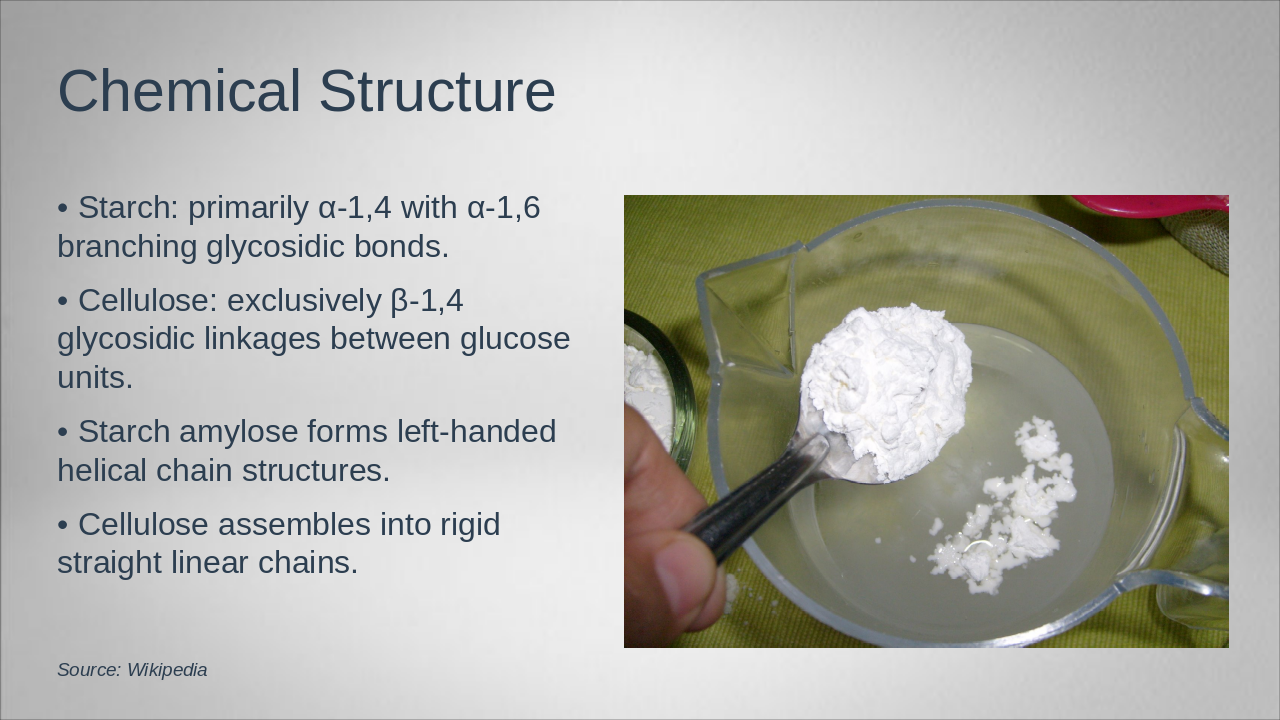
The slide titled "Chemical Structure" compares starch and cellulose, with starch featuring primarily α-1,4 glycosidic bonds and α-1,6 branching, while cellulose has exclusively β-1,4 linkages between glucose units. It also notes that starch amylose forms left-handed helical chains, contrasting cellulose's rigid straight linear chains.

Chemical Structure

!Image

  • Starch: primarily α-1,4 with α-1,6 branching glycosidic bonds.
  • Cellulose: exclusively β-1,4 glycosidic linkages between glucose units.
  • Starch amylose forms left-handed helical chain structures.
  • Cellulose assembles into rigid straight linear chains.

Source: Wikipedia

Speaker Notes
Diagram of glycosidic bonds (α-1,4 & α-1,6 in starch; β-1,4 in cellulose). Visual: helical starch vs. linear cellulose chains.
Slide 5 - Chemical Structure
Slide 6 of 9

Slide 6 - Key Examples

The slide's left column covers storage polysaccharides: plant starch with α-1,4 and α-1,6 links forming helical amylose/amylopectin for energy storage, and animal glycogen with highly branched α-links for rapid glucose release. The right column details structural polysaccharides: plant cellulose with β-1,4 glucose links in straight fibrous chains for rigid cell walls, and chitin with β-linked N-acetylglucosamine in arthropod exoskeletons and fungi for tough support.

Key Examples

Storage PolysaccharidesStructural Polysaccharides
Starch: Plants, α-1,4 & α-1,6 links, helical amylose/amylopectin for energy storage. Glycogen: Animals, highly branched α-links enabling rapid glucose release.Cellulose: Plants, β-1,4 glucose links, straight fibrous chains for rigid cell walls. Chitin: Arthropod exoskeletons/fungi, β-linked N-acetylglucosamine for tough support.
Slide 6 - Key Examples
Slide 7 of 9

Slide 7 - Natural Sources

The slide "Natural Sources" lists key polysaccharides and their origins. Starch comes from grains, potatoes, and rice; glycogen from liver and muscles; cellulose from plant cell walls, cotton, and wood; chitin from fungi and arthropod exoskeletons.

Natural Sources

  • Starch: grains, potatoes, rice
  • Glycogen: liver, muscles
  • Cellulose: plant cell walls, cotton, wood
  • Chitin: fungi, arthropod exoskeletons
Slide 7 - Natural Sources
Slide 8 of 9

Slide 8 - Biological Importance & Functions

Carbohydrates comprise 80% of plant dry weight as starch/glycogen for energy storage and 50% of plant biomass as cellulose for structural support. Humans possess 0% cellulase, lacking the enzyme to digest cellulose.

Biological Importance & Functions

  • 80%: Plant Dry Weight
  • Starch/glycogen energy storage

  • 50%: Plant Biomass
  • Cellulose structural component

  • 0%: Human Cellulase
  • Lack enzyme for digestion

Slide 8 - Biological Importance & Functions
Slide 9 of 9

Slide 9 - Conclusion

The conclusion slide emphasizes that homo polysaccharides are vital for life, supporting energy, structure, and protection. It highlights their potential in biotech applications like biofuels, ends with "Questions?", and thanks the audience.

Conclusion

Homo polysaccharides are vital for life:

  • Energy
  • Structure
  • Protection

Unlock biotech applications like biofuels.

Questions?

Thank you!

Source: Homo Polysaccharides Presentation

Speaker Notes
Closing message: Vital for life, powering biotech innovation. (5 words) Call-to-action: Understanding their chemistry unlocks applications like biofuels. Questions? (7 words)
Slide 9 - Conclusion

Discover More Presentations

Explore thousands of AI-generated presentations for inspiration

Browse Presentations
Powered by AI

Create Your Own Presentation

Generate professional presentations in seconds with Karaf's AI. Customize this presentation or start from scratch.

Create New Presentation

Powered by Karaf.ai — AI-Powered Presentation Generator