Optimizing Security Assurance Visuals

Generated from prompt:

Add a “Depth of Assurance” Visual (Must-Have) Best Visual: 3-Level Pyramid or Maturity Stack Use this on Slide 2 or as a new Slide 3. Structure Top (High Effort) Evidence-Based Assessments CyberVadis, EcoVadis Middle (Medium Effort) Structured Questionnaires & Contract Reviews Bottom (Low Effort) High-Level / Conversational Assurance Why it works Instantly explains why some requests take months Makes the “casual vs evidence-heavy” message very clear Executives intuitively understand pyramids/maturity models Tip Use icons instead of text-heavy bullets: 📄 documents for evidence 📝 checklist for questionnaires 💬 speech bubble for conversations 2️⃣ Customer Distribution Chart (Quick Impact) Best Visual: Bar Chart or Donut Chart What to show “How many customers fall into each assurance depth level in 2025” Example: Low Effort: 4–5 customers Medium Effort: 5–6 customers High Effort: 5+ customers Why it works Shows effort concentration at a glance Reinforces that a small number of customers drive most workload Placement New slide titled: “Customer Security Requests by Depth (2025)” 3️⃣ Time vs Effort Bubble Chart (Very Executive-Friendly) Best Visual: Bubble Chart Axes X-axis: Number of requests Y-axis: Time spent (hours or days) Bubble size: Depth of assurance (bigger = heavier) Why it works Shows disproportionate effort clearly Makes a strong case for investing in reusable evidence Excellent for leadership discussions Alternative (simpler) If bubble charts feel too complex: Use a 2-column comparison table: “Few Customers” → “High Time Spent” “Many Customers” → “Low Time Spent” 4️⃣ Add a Simple Process Flow (Very Low Effort) Best Visual: Left-to-Right Flow Diagram Flow Customer Request → Initial Triage → Conversation / Questionnaire / Assessment → Evidence Reuse → Closure Why it works Makes your team’s work visible Helps non-security audiences understand why effort varies Works well for Sales, Legal, and Procurement audiences 5️⃣ Use Icons Instead of Bullet Points (Fast Win) Replace text blocks with: 🔐 Security 📊 Assessment 📁 Evidence ⏱ Time 🧩 Complexity This keeps slides readable while presenting dense information. 6️⃣ Optional: Add a “Key Takeaways” Visual Slide Best Visual: 3 Callout Boxes Example 30–40% of customers need only light-touch assurance Formal evidence requests are increasing Reusable evidence reduces cycle time significantly This slide is ideal as a closing or summary slide. Recommended Final Slide Structure (Clean & Executive) Overview – Who Asked About Security in 2025 (Add icons + logos if allowed) Depth of Security Engagement (Pyramid or stacked visual) Customer Distribution by Assurance Depth (Bar or donut chart) Effort Concentration (Bubble chart or simplified comparison) Key Takeaways / What This Means (3 visual callouts)

6 slide recommendations with pyramid, charts, flow, and icons to clarify assurance levels, customer distribution, effort concentration, and process—proving reusable evidence cuts workload for execs. (

January 5, 20266 slides
Slide 1 of 6

Slide 1 - Security Assurance Efforts 2025

This title slide, titled "Security Assurance Efforts 2025," presents an overview of Security Assurance Efforts for 2025. The subtitle highlights "Managing Customer Requests by Depth of Assurance."

Security Assurance Efforts Overview 2025

Managing Customer Requests by Depth of Assurance

Source: Welcome slide introducing management of customer security requests by depth of assurance

Speaker Notes
Introduce the key theme: Managing customer security requests categorized by depth of assurance (low, medium, high effort). Use 3-level pyramid visual with icons: speech bubble (low), checklist (medium), documents (high). Explains effort variation instantly.
Slide 1 - Security Assurance Efforts 2025
Slide 2 of 6

Slide 2 - Depth of Security Engagement

This section header slide is titled "Depth of Security Engagement" and marked as section 02. It features a subtitle describing a pyramid visual that contrasts high-effort evidence with low-effort assurance.

Depth of Security Engagement

02

Depth of Security Engagement

Pyramid Visual: High Effort Evidence vs Low Effort Assurance

Source: Security Assurance Pyramid: Evidence-Based (Top), Questionnaires (Middle), High-Level Assurance (Bottom)

Speaker Notes
Introduce 3-level pyramid visual showing effort levels: Top (High Effort: CyberVadis/EcoVadis), Middle (Questionnaires/Reviews), Bottom (Conversational). Explains why some requests take months. Use icons: 📄 📝 💬. Follow with customer distribution, effort chart, and takeaways.
Slide 2 - Depth of Security Engagement
Slide 3 of 6

Slide 3 - Customer Distribution by Assurance Depth (2025)

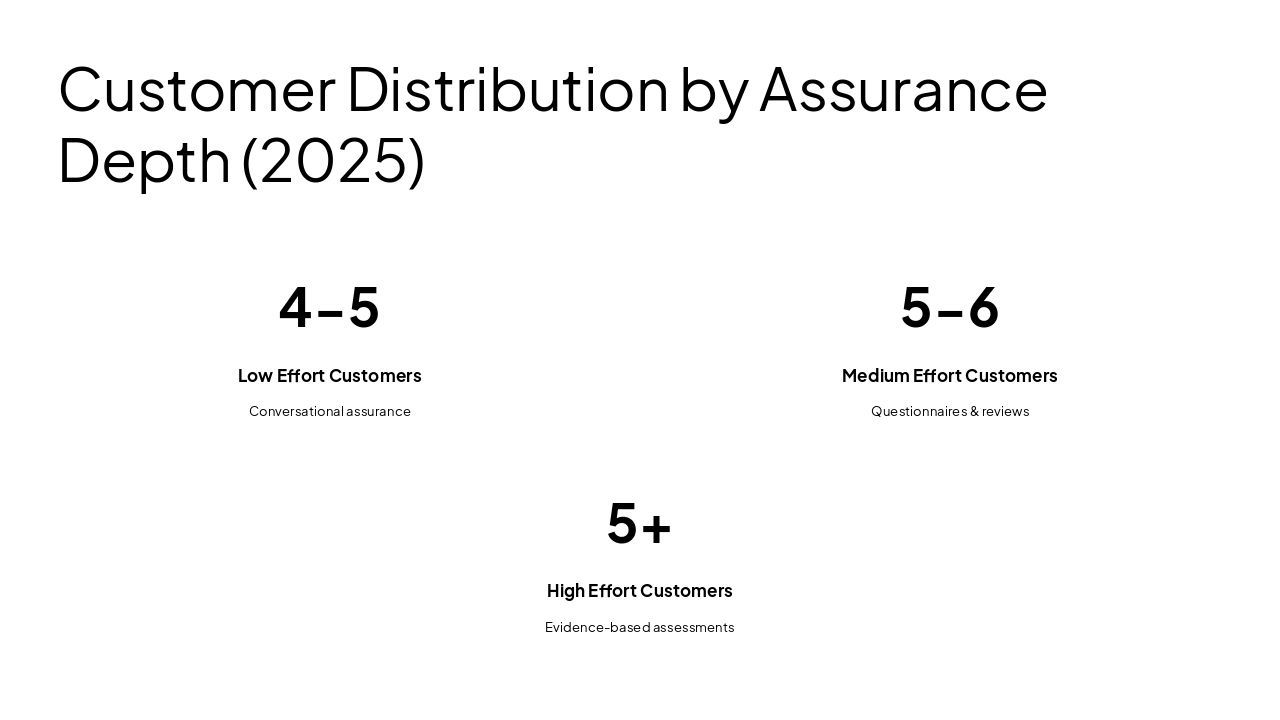
In 2025, customer distribution by assurance depth shows 4-5 low-effort customers relying on conversational assurance, 5-6 medium-effort customers using questionnaires and reviews, and 5+ high-effort customers requiring evidence-based assessments. This stats slide categorizes customers based on the level of effort needed for assurance.

Customer Distribution by Assurance Depth (2025)

  • 4-5: Low Effort Customers
  • Conversational assurance

  • 5-6: Medium Effort Customers
  • Questionnaires & reviews

  • 5+: High Effort Customers
  • Evidence-based assessments

Speaker Notes
Highlights effort concentration: most workload from few high-effort customers. Low: 4-5, Medium: 5-6, High: 5+. Use bar or donut chart.
Slide 3 - Customer Distribution by Assurance Depth (2025)
Slide 4 of 6

Slide 4 - Effort Concentration

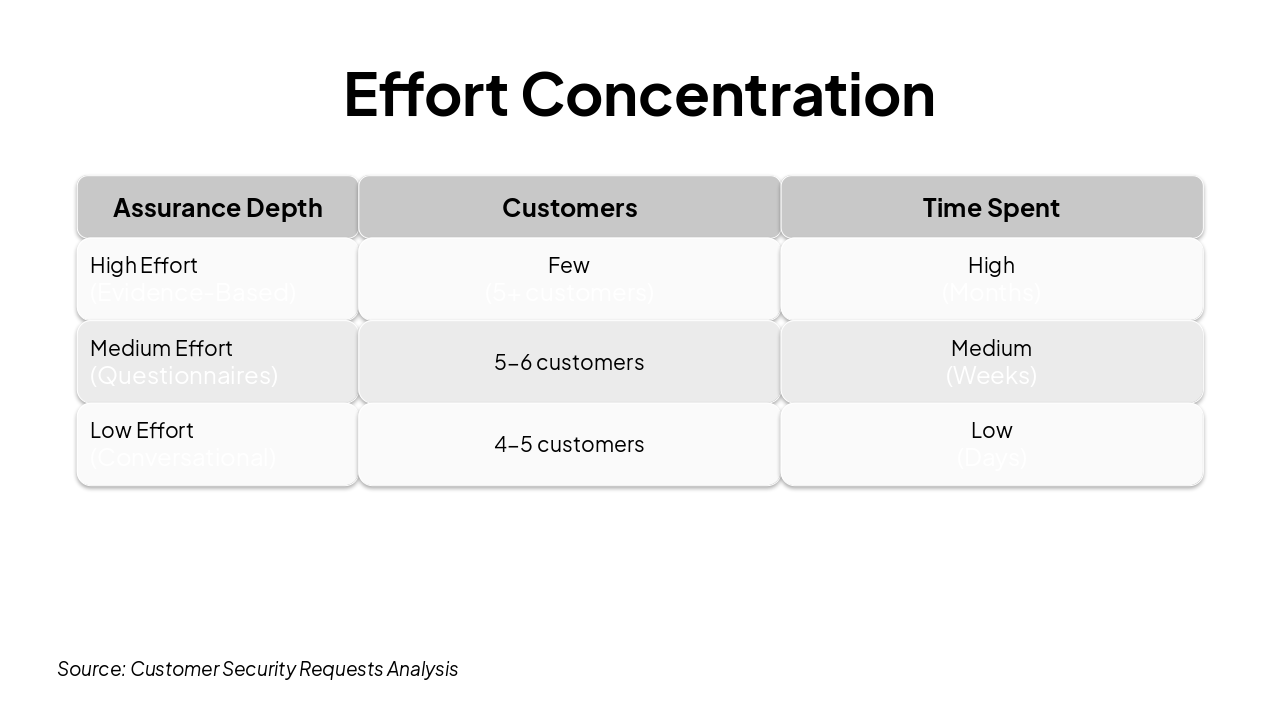
The slide "Effort Concentration" table outlines three levels of assurance depth—High (Evidence-Based), Medium (Questionnaires), and Low (Conversational)—with corresponding customer numbers and time spent. High effort targets few (5+) customers over months, medium involves 5-6 customers over weeks, and low covers 4-5 customers in days.

Effort Concentration

Assurance DepthCustomersTime Spent

| High Effort (Evidence-Based) | Few (5+ customers) | High (Months) | | Medium Effort (Questionnaires) | 5-6 customers | Medium (Weeks) | | Low Effort (Conversational) | 4-5 customers | Low (Days) |

Source: Customer Security Requests Analysis

Slide 4 - Effort Concentration
Slide 5 of 6

Slide 5 - Security Request Process Flow

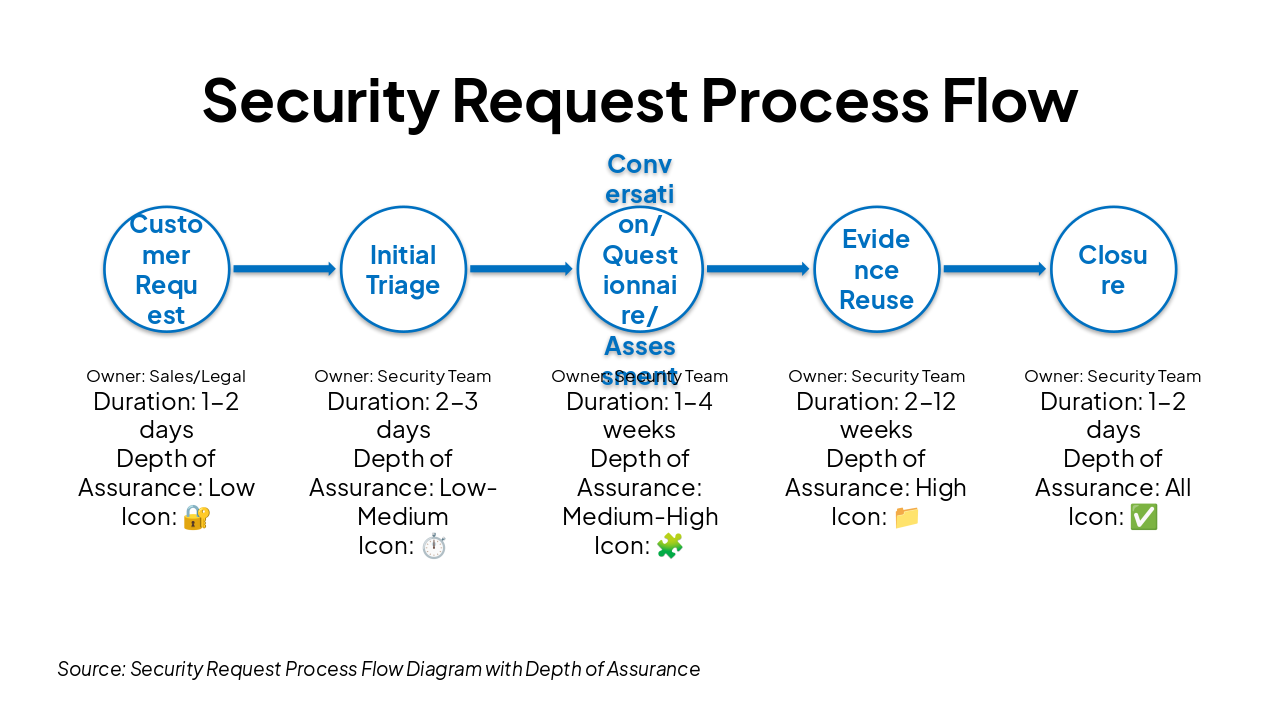
The Security Request Process Flow outlines five phases: Customer Request (owned by Sales/Legal, 1-2 days, low assurance), Initial Triage (Security Team, 2-3 days, low-medium), Conversation/Questionnaire/Assessment (Security Team, 1-4 weeks, medium-high), Evidence Reuse (Security Team, 2-12 weeks, high), and Closure (Security Team, 1-2 days, all levels). Each phase includes details on owner, duration, depth of assurance, and an associated icon.

Security Request Process Flow

Source: Security Request Process Flow Diagram with Depth of Assurance

Speaker Notes
Left-to-Right flow showing the Security Request process. Includes Depth of Assurance pyramid visual and icons for clarity. Highlights why some requests take longer based on assurance depth.
Slide 5 - Security Request Process Flow
Slide 6 of 6

Slide 6 - Key Takeaways

Optimize assurance by reusing evidence from an approved library to reduce cycle time and handle rising demands efficiently. Key points include 30-40% light-touch conversational approvals, an increasing trend in formal requests, and reusable evidence that cuts cycle time.

Key Takeaways

<div style='font-size: 1.2em; text-align: center; color: #333;'>Optimize Assurance: Reuse Evidence, Reduce Cycle Time</div><div style='text-align: center; margin-top: 1em; font-size: 0.9em; color: #666;'>Approve reusable evidence library to handle rising demands efficiently</div>

<div style='display: flex; justify-content: space-around; margin-top: 2em; gap: 1em;'> <div style='background: #e8f4fd; padding: 1.5em; border-radius: 8px; flex: 1; text-align: center;'> 💬<br>30-40% Light-Touch<br><small>Conversational OK</small> </div> <div style='background: #fff3cd; padding: 1.5em; border-radius: 8px; flex: 1; text-align: center;'> 📝📄<br>Formal Requests ↑<br><small>Increasing Trend</small> </div> <div style='background: #d1ecf1; padding: 1.5em; border-radius: 8px; flex: 1; text-align: center;'> 🔄<br>Reusable Evidence<br><small>Cuts Cycle Time</small> </div> </div>

Source: Customer Security Assurance Analysis 2025

Speaker Notes
Summarize: 30-40% light-touch needs, rising formal requests, reusable evidence cuts time. Push for leadership action on evidence reuse.
Slide 6 - Key Takeaways
Powered by AI

Create Your Own Presentation

Generate professional presentations in seconds with Karaf's AI. Customize this presentation or start from scratch.

Create New Presentation

Powered by Karaf.ai — AI-Powered Presentation Generator