A Small Place: Rage Against Colonial Tourism (39 chars)

Generated from prompt:

Create a 15-slide critical presentation on *A Small Place* by Jamaica Kincaid. Include: 1) a brief overview of the text; 2) key themes and critical issues (colonialism, tourism, identity, power); 3) the author’s perspective and narrative style (tone, second-person narration, anger, irony); 4) a critical analysis and reflection that discusses postcolonial critique, emotional intensity, and relevance today. Make it clear, well-structured, and visually engaging for academic use.

Critical 16-slide analysis of Jamaica Kincaid's *A Small Place*: overview, themes (colonialism, tourism, identity, power), second-person style & anger, postcolonial critique, emotional intensity, and

December 5, 202516 slides
Slide 1 of 16

Slide 1 - Critical Presentation: A Small Place

This title slide presents "Critical Presentation: A Small Place" as the main title. The subtitle describes an exploration of Jamaica Kincaid's provocative essay on Antigua, focusing on its themes, style, and postcolonial critique.

Critical Presentation: A Small Place

Exploring Jamaica Kincaid's Provocative Essay on Antigua: Themes, Style, and Postcolonial Critique

Source: Jamaica Kincaid's A Small Place

Slide 1 - Critical Presentation: A Small Place
Slide 2 of 16

Slide 2 - Presentation Agenda

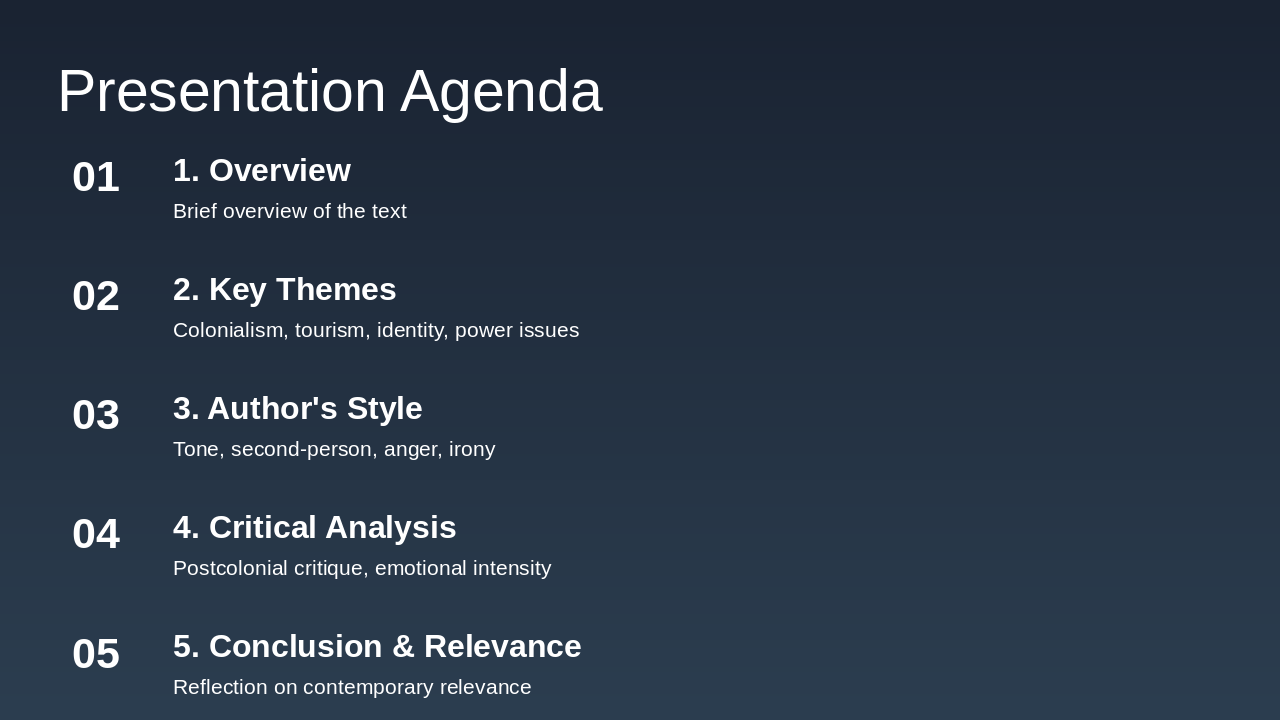
The slide presents an agenda for a literary analysis presentation on a text. It lists five sections: Overview, Key Themes (colonialism, tourism, identity, power), Author's Style (tone, second-person, anger, irony), Critical Analysis (postcolonial critique, emotional intensity), and Conclusion & Relevance.

Presentation Agenda

  1. 1. Overview
  2. Brief overview of the text

  3. 2. Key Themes
  4. Colonialism, tourism, identity, power issues

  5. 3. Author's Style
  6. Tone, second-person, anger, irony

  7. 4. Critical Analysis
  8. Postcolonial critique, emotional intensity

  9. 5. Conclusion & Relevance
  10. Reflection on contemporary relevance

Slide 2 - Presentation Agenda
Slide 3 of 16

Slide 3 - Overview of A Small Place

This section header slide, titled "Overview of A Small Place" and numbered 01, introduces Jamaica Kincaid's 1988 essay. The subtitle describes it as a second-person address to tourists in Antigua that blends memoir and political rant.

Overview of A Small Place

01

Overview of A Small Place

Jamaica Kincaid's 1988 essay: second-person address to tourists in Antigua blending memoir and political rant

Source: Jamaica Kincaid, 1988

Speaker Notes
Introduce the text: 1988 nonfiction essay using second-person narration to address tourists in Antigua, blending memoir, travelogue, and political critique.
Slide 3 - Overview of A Small Place
Slide 4 of 16

Slide 4 - Text Summary

The slide titled "Text Summary" introduces Jamaica Kincaid as an Antiguan-American author who critiques Antigua's colonial past and present. It outlines her work's four parts: tourist gaze, corruption, history, and exile.

Text Summary

  • Jamaica Kincaid: Antiguan-American author
  • Critiques Antigua's colonial past and present
  • Four parts: tourist gaze, corruption, history, exile

Source: A Small Place by Jamaica Kincaid

Slide 4 - Text Summary
Slide 5 of 16

Slide 5 - Antigua's Beauty and Decay

The slide "Antigua's Beauty and Decay" contrasts stunning turquoise seas that lure tourists with polluted harbors revealing neglect. Kincaid's perspective shows how tourist allure masks local suffering.

Antigua's Beauty and Decay

!Image

  • Stunning turquoise seas lure tourists
  • Polluted harbors reveal neglect and decay
  • Kincaid contrasts beauty with reality
  • Tourist allure masks local suffering

Source: Saint John's, Antigua and Barbuda

Speaker Notes
Image of turquoise Caribbean sea contrasting polluted harbors. Symbolizes allure vs. reality in Kincaid's Antigua.
Slide 5 - Antigua's Beauty and Decay
Slide 6 of 16

Slide 6 - Key Themes: Colonialism & Tourism

This section header slide is titled "Key Themes: Colonialism & Tourism." Its subtitle portrays tourists as oblivious invaders and colonialism's enduring scars on Antigua's identity and power structures.

Key Themes: Colonialism & Tourism

Tourists as oblivious invaders; colonialism's lingering scars on Antigua's identity and power structures.

Slide 6 - Key Themes: Colonialism & Tourism
Slide 7 of 16

Slide 7 - Colonialism's Legacy

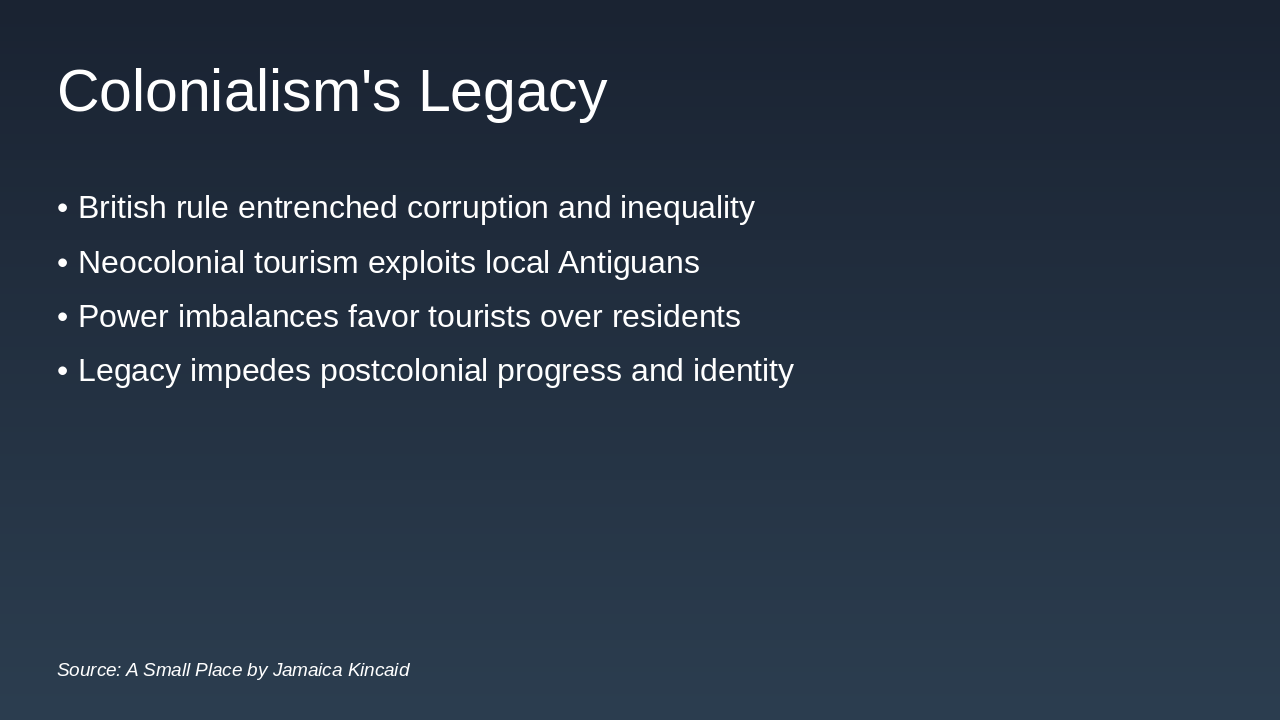
British colonial rule entrenched corruption and inequality in Antigua, perpetuated by neocolonial tourism that exploits local residents. This legacy creates power imbalances favoring tourists and impedes postcolonial progress and identity.

Colonialism's Legacy

  • British rule entrenched corruption and inequality
  • Neocolonial tourism exploits local Antiguans
  • Power imbalances favor tourists over residents
  • Legacy impedes postcolonial progress and identity

Source: A Small Place by Jamaica Kincaid

Speaker Notes
Highlight Kincaid's critique of how British colonialism's effects linger in corruption, inequality, and modern tourism exploitation. Connect to postcolonial power dynamics.
Slide 7 - Colonialism's Legacy
Slide 8 of 16

Slide 8 - Tourism vs. Identity

The slide contrasts tourism's selective blindness to Antigua's poverty, crumbling infrastructure, and corruption—mocked via Kincaid's narration—with its erosion of locals' cultural identity through servile roles and economic dependence. This perpetuates colonial power dynamics that Kincaid critiques.

Tourism vs. Identity

Tourism Blinds to PovertyLocals' Identity Eroded
Tourists bask in Antigua's 'paradise,' ignoring crumbling infrastructure, widespread poverty, and corruption. Kincaid's second-person narration mocks this selective blindness, revealing the island's harsh realities hidden from vacationers' gaze.Outsiders' gaze reduces Antiguans to servile roles, fostering economic dependence on tourism. This erodes cultural identity, as locals internalize inferiority, perpetuating colonial power dynamics Kincaid bitterly critiques.

Source: A Small Place by Jamaica Kincaid

Speaker Notes
Highlight Kincaid's irony in contrasting tourist ignorance with local erosion; connect to postcolonial themes of power imbalance.
Slide 8 - Tourism vs. Identity
Slide 9 of 16

Slide 9 - On the Tourist

The slide, titled "On the Tourist," features a quote from Antiguan-American novelist and essayist Jamaica Kincaid. The quote states: "You are on vacation so you needn't worry about... the misery."

On the Tourist

> You are on vacation so you needn't worry about... the misery.

— Jamaica Kincaid, Antiguan-American novelist and essayist

Source: A Small Place by Jamaica Kincaid

Speaker Notes
Kincaid's ironic jab at tourist ignorance, highlighting the disconnect between vacation bliss and local suffering.
Slide 9 - On the Tourist
Slide 10 of 16

Slide 10 - Author's Perspective & Style

This section header slide, titled "Author's Perspective & Style" (section 09), introduces the topic. Its subtitle describes an angry, ironic tone using second-person "you" to implicate the reader as a tourist.

Author's Perspective & Style

09

Author's Perspective & Style

Angry, ironic tone with second-person 'you' implicating reader as tourist.

Source: A Small Place by Jamaica Kincaid

Speaker Notes
Angry, ironic tone; second-person 'you' implicates reader as tourist.
Slide 10 - Author's Perspective & Style
Slide 11 of 16

Slide 11 - Narrative Techniques

The slide "Narrative Techniques" outlines provocative storytelling methods. It covers second-person narration to accuse the reader, an angry bitter tone for outrage, irony and sarcasm to expose hypocrisies, and stream-of-consciousness to unleash rage.

Narrative Techniques

  • Second-person narration directly accuses reader
  • Angry, bitter tone conveys outrage
  • Irony and sarcasm expose hypocrisies
  • Stream-of-consciousness unleashes rage
Slide 11 - Narrative Techniques
Slide 12 of 16

Slide 12 - Kincaid's Fierce Voice

Kincaid's Fierce Voice slide showcases an image with bullet points on Jamaica Kincaid's confrontational prose that challenges colonial narratives and implicates tourist readers through second-person narration. It highlights her intense anger exposing tourism's hypocrisies and irony underscoring Antigua's postcolonial struggles.

Kincaid's Fierce Voice

!Image

  • Confrontational prose challenges colonial narratives
  • Second-person narration implicates tourist reader
  • Intense anger exposes tourism's hypocrisies
  • Irony underscores Antigua's postcolonial struggles

Source: Wikipedia

Speaker Notes
Portrait of Jamaica Kincaid; evokes intensity of her confrontational prose.
Slide 12 - Kincaid's Fierce Voice
Slide 13 of 16

Slide 13 - Critical Analysis

This slide serves as a section header titled "Critical Analysis." Its subtitle highlights postcolonial critique, emotional power, and modern relevance.

Critical Analysis

Postcolonial critique, emotional power, and modern relevance.

Slide 13 - Critical Analysis
Slide 14 of 16

Slide 14 - Postcolonial Critique

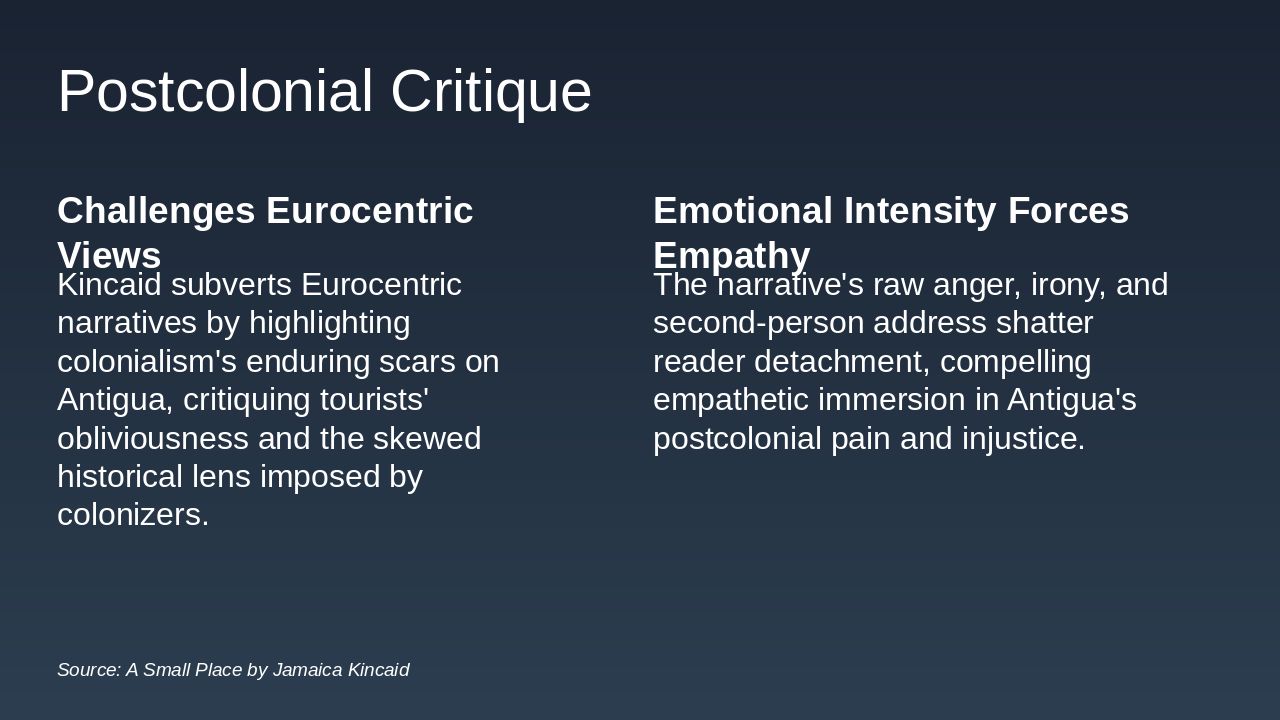
The "Postcolonial Critique" slide challenges Eurocentric views by showing Kincaid's subversion of colonial narratives, highlighting Antigua's enduring scars and tourists' obliviousness. It also describes how the narrative's raw anger, irony, and second-person address compel empathetic immersion in postcolonial pain and injustice.

Postcolonial Critique

Challenges Eurocentric ViewsEmotional Intensity Forces Empathy
Kincaid subverts Eurocentric narratives by highlighting colonialism's enduring scars on Antigua, critiquing tourists' obliviousness and the skewed historical lens imposed by colonizers.The narrative's raw anger, irony, and second-person address shatter reader detachment, compelling empathetic immersion in Antigua's postcolonial pain and injustice.

Source: A Small Place by Jamaica Kincaid

Slide 14 - Postcolonial Critique
Slide 15 of 16

Slide 15 - Relevance Today

The "Relevance Today" slide highlights how the topic echoes modern tourism ethics debates, addresses climate change and inequality in small islands, and challenges colonial legacies. It calls for decolonizing travel narratives and informs sustainable, postcolonial travel practices.

Relevance Today

  • Echoes modern debates on tourism ethics
  • Addresses climate change and inequality in small islands
  • Calls for decolonizing travel narratives
  • Informs sustainable, postcolonial travel practices
  • Challenges ongoing colonial legacies in tourism
Slide 15 - Relevance Today
Slide 16 of 16

Slide 16 - Final Reflections

The conclusion slide, titled "Final Reflections," asserts that Kincaid's rage endures because tourism masks colonialism. It prompts reflection on consuming places ethically and invites Q&A.

Final Reflections

Kincaid's rage endures: Tourism masks colonialism.

Reflect: How do we consume places ethically? Q&A

Source: A Small Place by Jamaica Kincaid

Speaker Notes
Closing message: Kincaid's rage endures (3 words). Call-to-action: Reflect on ethical consumption of places and open for Q&A (9 words). End presentation.
Slide 16 - Final Reflections

Discover More Presentations

Explore thousands of AI-generated presentations for inspiration

Browse Presentations
Powered by AI

Create Your Own Presentation

Generate professional presentations in seconds with Karaf's AI. Customize this presentation or start from scratch.

Create New Presentation

Powered by Karaf.ai — AI-Powered Presentation Generator