Saussure's Course in General Linguistics: Foundations of Structural Linguistics
Generated from prompt:
Make a presentation about
This presentation provides an overview of Ferdinand de Saussure's influential Course in General Linguistics, posthumously published in 1916. It covers his biography, key concepts including the linguistic sign (signifier and signified), arbitrariness of the sign, distinction between langue (system) and parole (speech), synchronic versus diachronic analysis, and meaning derived from differences within the language system. The deck concludes with his lasting impact on linguistics, semiotics, and structuralism.
Slide 2 - Presentation Outline
- Biography
- The Linguistic Sign
- Arbitrariness of the Sign
- Langue and Parole
- Synchronic and Diachronic Linguistics
- Meaning through Differences
- Legacy and Influence
---
Photo by Rasa Kasparaviciene on Unsplash
Slide 3 - Who Was Ferdinand de Saussure?
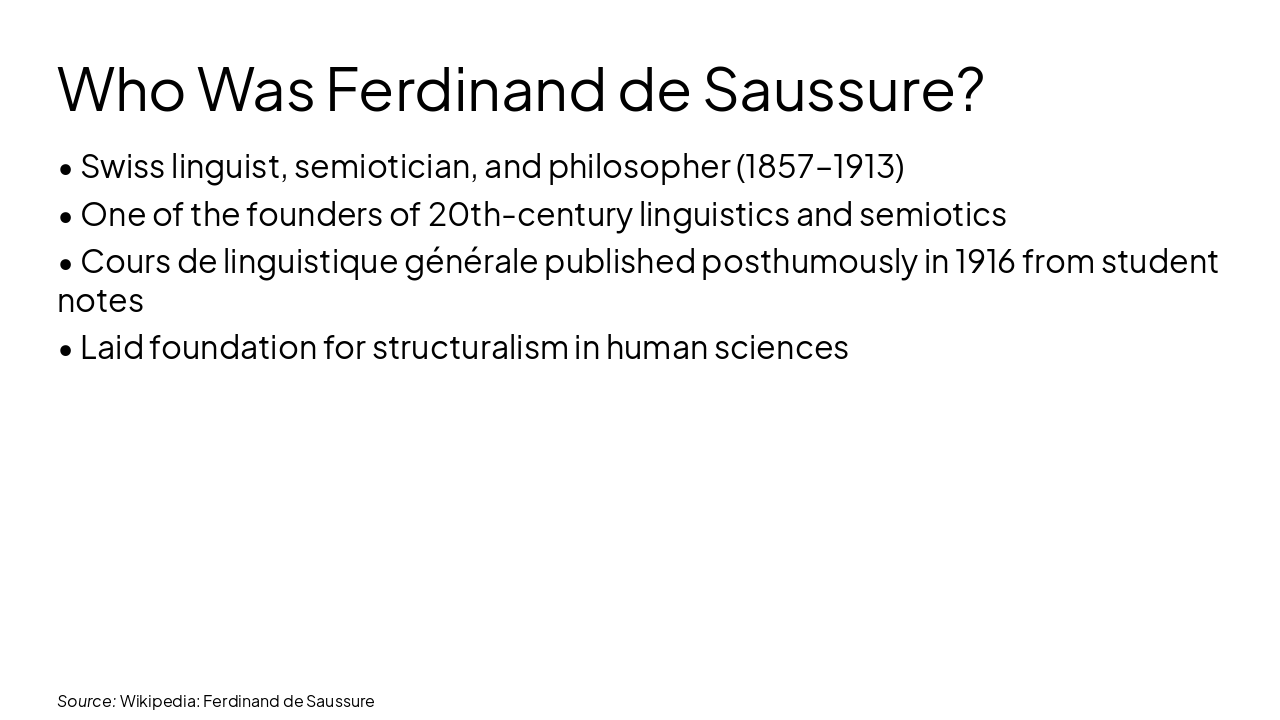
- Swiss linguist, semiotician, and philosopher (1857–1913)
- One of the founders of 20th-century linguistics and semiotics
- Cours de linguistique générale published posthumously in 1916 from student notes
- Laid foundation for structuralism in human sciences
Source: Wikipedia: Ferdinand de Saussure
Slide 4 - Key Concepts

Slide 5 - The Linguistic Sign
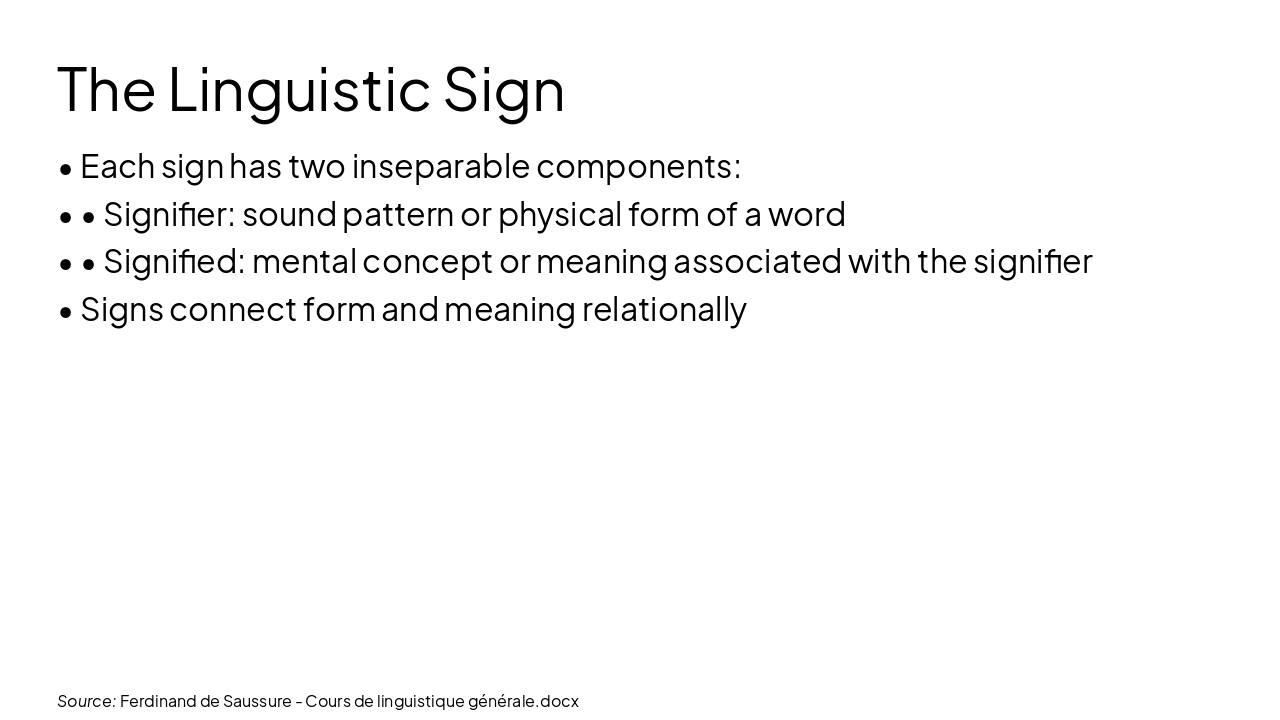
- Each sign has two inseparable components:
- • Signifier: sound pattern or physical form of a word
- • Signified: mental concept or meaning associated with the signifier
- Signs connect form and meaning relationally
Source: Ferdinand de Saussure - Cours de linguistique générale.docx
Slide 6 - Arbitrariness of the Sign
- Link between signifier and signified is arbitrary, not inherent
- Established through social convention in speech communities
- Example: Word 'tree' linked to concept by shared usage, not resemblance
- Highlights language's conventional and evolving nature
Source: Ferdinand de Saussure - Cours de linguistique générale.docx
Slide 7 - Langue vs. Parole
Langue Abstract, systematic rules and conventions of language Social institution, stable framework Prioritized for scientific analysis
Parole Individual acts of speech or utterances Variable and context-dependent Manifests langue in practice
Source: Ferdinand de Saussure - Cours de linguistique générale.docx
Slide 8 - Synchronic vs. Diachronic
- Synchronic: Studies language at a fixed point in time, focusing on structure
- Diachronic: Examines language change and evolution over time
- Saussure prioritizes synchronic analysis to reveal systemic relations
Source: Ferdinand de Saussure - Cours de linguistique générale.docx
Slide 9 - Meaning from Differences
- Meaning derived from differences and oppositions between signs
- Not from inherent qualities of individual signs
- Value depends on relations and position within the linguistic system
- Dynamic and context-dependent
Source: Ferdinand de Saussure - Cours de linguistique générale.docx
Slide 10 - Saussure's Sign Model
- Visual representation of the sign
- Signifier (sound-image) above arrow
- Signified (concept) below arrow
- Inseparable yet distinct
Source: Ferdinand de Saussure - Cours de linguistique générale.docx
Slide 11 - Enduring Impact
> He has given us the theoretical basis for a science of human speech.
— Leonard Bloomfield
---
Photo by Tolu Olarewaju on Unsplash
Source: Wikipedia: Ferdinand de Saussure
Slide 12 - Conclusion
Saussure's framework: Language as a relational system of arbitrary signs (langue), enabling scientific synchronic analysis.
Transformed linguistics, semiotics, and structuralism across human sciences.
---
Photo by Drew Walker on Unsplash
Discover More Presentations
Explore thousands of AI-generated presentations for inspiration
Create Your Own Presentation
Generate professional presentations in seconds with Karaf's AI. Customize this presentation or start from scratch.