Fiber Optics: Deriving Acceptance Angle & NA (38 chars)

Generated from prompt:

Create a dark-themed presentation titled 'Derivation of Acceptance Angle and Numerical Aperture of Optical Fiber'. Slide 1: Title Slide - Title: Derivation of Acceptance Angle and Numerical Aperture of Optical Fiber - Subtitle: Engineering Physics – Photonics and Fiber Optics - Dark theme background with optical fiber glowing lines. Slide 2: Introduction - Brief overview of light propagation in optical fibers. - Define core, cladding, and refractive indices (n₀, n₁, n₂). Slide 3: Acceptance Angle Concept - Explain incident ray AB entering the fiber core. - Define θ₀ as angle of incidence at air-core interface. - Diagram: Light ray entering optical fiber showing θ₀ and internal reflections. Slide 4: Applying Snell’s Law at Air-Core Interface - Equation: n₀ sinθ₀ = n₁ sin(90° − c) - Simplify: n₀ sinθ₀ = n₁ cos c Slide 5: Relation between cos c and sin c - Use identity: sin²c + cos²c = 1 - Hence, cos c = √(1 − sin²c) - Substitute into Snell’s Law: n₀ sinθ₀ = n₁ √(1 − sin²c) Slide 6: Snell’s Law at Core-Cladding Interface - Equation: n₁ sin c = n₂ sin 90° = n₂ - Therefore, sin c = n₂ / n₁ - Derive sin²c = (n₂² / n₁²) Slide 7: Substituting and Simplifying - Substitute sin²c in previous equation: n₀ sinθ₀ = n₁ √(1 − n₂² / n₁²) - Simplify for sinθ₀: sinθ₀ = (1 / n₀) √(n₁² − n₂²) Slide 8: Acceptance Angle Formula - For air (n₀ = 1): θ₀ = sin⁻¹(√(n₁² − n₂²)) - Diagram: Acceptance cone showing θ₀. Slide 9: Numerical Aperture (NA) - Definition: NA = sin θ₀ = √(n₁² − n₂²) - Explain NA as measure of light acceptance capability. Slide 10: Simplified Expression for NA - When n₁ ≈ n₂: NA = n₁ √(2Δ) where Δ = (n₁ − n₂) / n₁ - Derivation steps shown clearly. Slide 11: Graphical Representation - Diagram: Variation of NA with acceptance angle (Figure 5.16). - Explanation: Smaller NA → difficult to launch light. Slide 12: Summary - Key equations: 1. θ₀ = sin⁻¹(√(n₁² − n₂²)) 2. NA = √(n₁² − n₂²) = n₁ √(2Δ) - Importance of NA in optical communication. Design: Use dark background (navy or black) with cyan and neon-blue highlights for text and diagrams.

Dark-themed slides derive optical fiber acceptance angle θ₀ = sin⁻¹(√(n₁² - n₂²)) and NA = √(n₁² - n₂²) via Snell's law, total internal reflection, and Δ approximation; includes diagrams, graphs, and

December 16, 202512 slides
Slide 1 of 12

Slide 1 - Derivation of Acceptance Angle and Numerical Aperture of Optical Fiber

This title slide presents the topic "Derivation of Acceptance Angle and Numerical Aperture of Optical Fiber." It is subtitled under "Engineering Physics – Photonics and Fiber Optics."

Derivation of Acceptance Angle and Numerical Aperture of Optical Fiber

Engineering Physics – Photonics and Fiber Optics

Speaker Notes
Dark navy background with glowing optical fiber lines. Use cyan and neon-blue highlights for text.
Slide 1 - Derivation of Acceptance Angle and Numerical Aperture of Optical Fiber
Slide 2 of 12

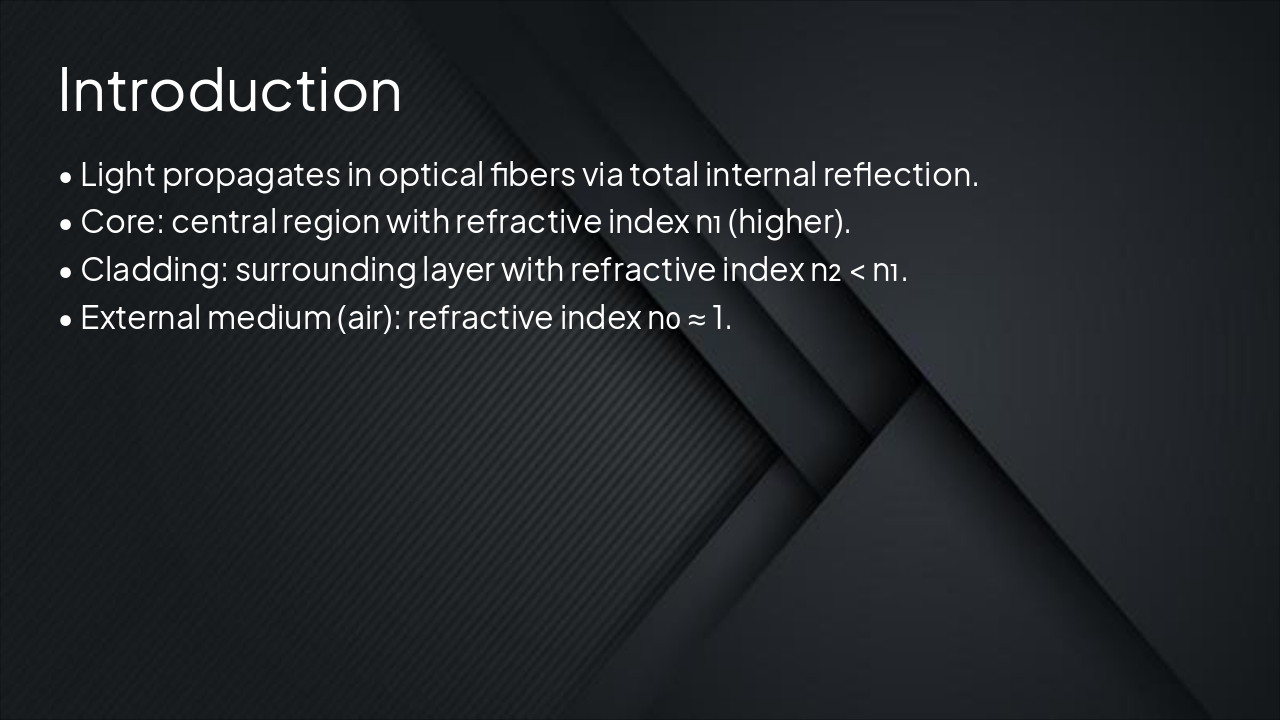
Slide 2 - Introduction

This introductory slide explains light propagation in optical fibers via total internal reflection. It describes the core with higher refractive index n₁, surrounded by cladding with n₂ < n₁, and external air with n₀ ≈ 1.

Introduction

  • Light propagates in optical fibers via total internal reflection.
  • Core: central region with refractive index n₁ (higher).
  • Cladding: surrounding layer with refractive index n₂ < n₁.
  • External medium (air): refractive index n₀ ≈ 1.
Slide 2 - Introduction
Slide 3 of 12

Slide 3 - Acceptance Angle Concept

The slide depicts the acceptance angle concept in optical fibers, showing incident ray AB entering the core at angle θ₀ from air. The maximum θ₀ allows total internal reflection at the core-cladding interface for light guidance.

Acceptance Angle Concept

!Image

  • Incident ray AB enters core at angle θ₀.
  • θ₀: air-core incidence angle for acceptance.
  • Internal reflections at core-cladding interface.
  • Maximum θ₀ enables total internal reflection.

Source: Wikipedia Numerical aperture

Speaker Notes
Diagram: Incident ray AB entering fiber core at θ₀ (air-core angle). Show internal reflections at core-cladding. Explain θ₀ definition.
Slide 3 - Acceptance Angle Concept
Slide 4 of 12

Slide 4 - Snell’s Law at Air-Core Interface

This slide applies Snell's Law at the air-core interface for an incident ray, expressed as n₀ sin θ₀ = n₁ sin(90° - c). It simplifies to n₀ sin θ₀ = n₁ cos c, the key equation governing ray entry into the fiber core.

Snell’s Law at Air-Core Interface

  • Apply Snell’s Law at air-core interface for incident ray.
  • n₀ sin θ₀ = n₁ sin(90° - c)
  • sin(90° - c) = cos c, so n₀ sin θ₀ = n₁ cos c
  • Key equation governing ray entry into fiber core
Slide 4 - Snell’s Law at Air-Core Interface
Slide 5 of 12

Slide 5 - cos c from Trigonometric Identity

The slide derives cos c using the Pythagorean identity sin²c + cos²c = 1, yielding cos c = √(1 - sin²c). It then substitutes this into Snell's law as n₀ sin θ₀ = n₁ √(1 - sin²c).

cos c from Trigonometric Identity

  • • Apply identity: sin²c + cos²c = 1
  • • Isolate: cos²c = 1 - sin²c
  • • Derive: cos c = √(1 - sin²c)
  • • Substitute: n₀ sin θ₀ = n₁ √(1 - sin²c)

Source: Derivation of Acceptance Angle and Numerical Aperture of Optical Fiber

Speaker Notes
sin²c + cos²c = 1 → cos c = √(1 - sin²c). Substitute: n₀ sin θ₀ = n₁ √(1 - sin²c).
Slide 5 - cos c from Trigonometric Identity
Slide 6 of 12

Slide 6 - Snell’s Law at Core-Cladding

The slide applies Snell's Law at the core-cladding interface: n₁ sin c = n₂ sin 90°. Simplifying with sin 90° = 1, it derives sin c = n₂ / n₁ and sin² c = (n₂ / n₁)².

Snell’s Law at Core-Cladding

  • Snell's Law: n₁ sin c = n₂ sin 90°
  • sin 90° = 1, so n₁ sin c = n₂
  • sin c = n₂ / n₁
  • sin² c = (n₂ / n₁)²

Source: n₁ sin c = n₂ sin 90° = n₂ → sin c = n₂ / n₁ → sin²c = (n₂ / n₁)².

Speaker Notes
Discuss critical angle c for total internal reflection at core-cladding.
Slide 6 - Snell’s Law at Core-Cladding
Slide 7 of 12

Slide 7 - Substituting and Simplifying

The slide's left column shows the equation after substituting sin²c = n₂²/n₁², yielding n₀ sin θ₀ = n₁ √(1 - n₂²/n₁²). The right column simplifies it to sin θ₀ = (1/n₀) √(n₁² - n₂²), noting that √(n₁²(1 - n₂²/n₁²)) = √(n₁² - n₂²).

Substituting and Simplifying

After SubstitutionSimplify for sin θ₀

| From previous: n₀ sin θ₀ = n₁ √(1 − sin²c) Substitute sin²c = n₂² / n₁²: n₀ sin θ₀ = n₁ √(1 - n₂²/n₁²) | Divide both sides by n₀: sin θ₀ = (1/n₀) √(n₁² - n₂²)

Note: √(n₁²(1 - n₂²/n₁²)) = √(n₁² - n₂²) |

Source: Engineering Physics – Photonics and Fiber Optics

Speaker Notes
Highlight the substitution of sin²c = n₂²/n₁² from core-cladding Snell's law into the air-core equation, then simplify by dividing by n₀. Key step towards acceptance angle formula.
Slide 7 - Substituting and Simplifying
Slide 8 of 12

Slide 8 - Acceptance Angle Formula

The slide presents the acceptance angle formula for air (n₀ = 1): θ₀ = sin⁻¹(√(n₁² - n₂²)), representing the maximum angle for total internal reflection. It depicts the acceptance cone, illustrating the cone of light acceptance and the limit for incident ray entry angles.

Acceptance Angle Formula

!Image

  • For air (n₀ = 1): θ₀ = sin⁻¹(√(n₁² - n₂²))
  • Maximum angle for total internal reflection
  • Acceptance cone shows cone of light acceptance
  • Defines limit of incident ray entry angle

Source: Image from Wikipedia article "Numerical aperture"

Slide 8 - Acceptance Angle Formula
Slide 9 of 12

Slide 9 - Numerical Aperture (NA)

Numerical Aperture (NA) is defined as sin θ₀, the sine of the maximum acceptance angle, and calculated as √(n₁² - n₂²) using refractive indices. It measures a fiber's light-gathering capability and efficiency, with higher NA enabling a larger cone of accepted light.

Numerical Aperture (NA)

  • NA defined as sin θ₀, maximum acceptance angle.
  • NA = √(n₁² - n₂²), derived from refractive indices.
  • Measures fiber's light-gathering capability and efficiency.
  • Higher NA enables larger cone of accepted light.

Source: Slide 9: Definition and significance

Speaker Notes
Emphasize NA as key parameter for light acceptance; link to previous acceptance angle derivation.
Slide 9 - Numerical Aperture (NA)
Slide 10 of 12

Slide 10 - Simplified NA Expression

When \( n1 \approx n2 \), the slide defines \( \Delta = (n1 - n2)/n1 \) and expresses \( n2 = n1 (1 - \Delta) \). It then approximates \( n1^2 - n2^2 \approx 2 n1^2 \Delta \), yielding \( \text{NA} = \sqrt{n1^2 - n2^2} \approx n_1 \sqrt{2\Delta} \).

Simplified NA Expression

  • When n₁ ≈ n₂, define Δ = (n₁ - n₂)/n₁
  • Express n₂ = n₁ (1 - Δ)
  • Approximate n₂² ≈ n₁² (1 - 2Δ)
  • n₁² - n₂² ≈ 2 n₁² Δ
  • NA = √(n₁² - n₂²) ≈ n₁ √(2Δ)
Slide 10 - Simplified NA Expression
Slide 11 of 12

Slide 11 - Graphical Representation

The slide displays a diagram (Fig 5.16) graphing Numerical Aperture (NA) versus acceptance angle variation. It highlights the direct relationship NA = sin θ₀, where a smaller NA reduces θ₀ and complicates light launch.

Graphical Representation

!Image

  • Diagram (Fig 5.16): NA vs. acceptance angle variation
  • NA = sin θ₀ shows direct relationship
  • Smaller NA reduces θ₀, harder light launch

Source: Numerical aperture optical fiber

Speaker Notes
Note: Smaller NA makes light launch harder.
Slide 11 - Graphical Representation
Slide 12 of 12

Slide 12 - Summary

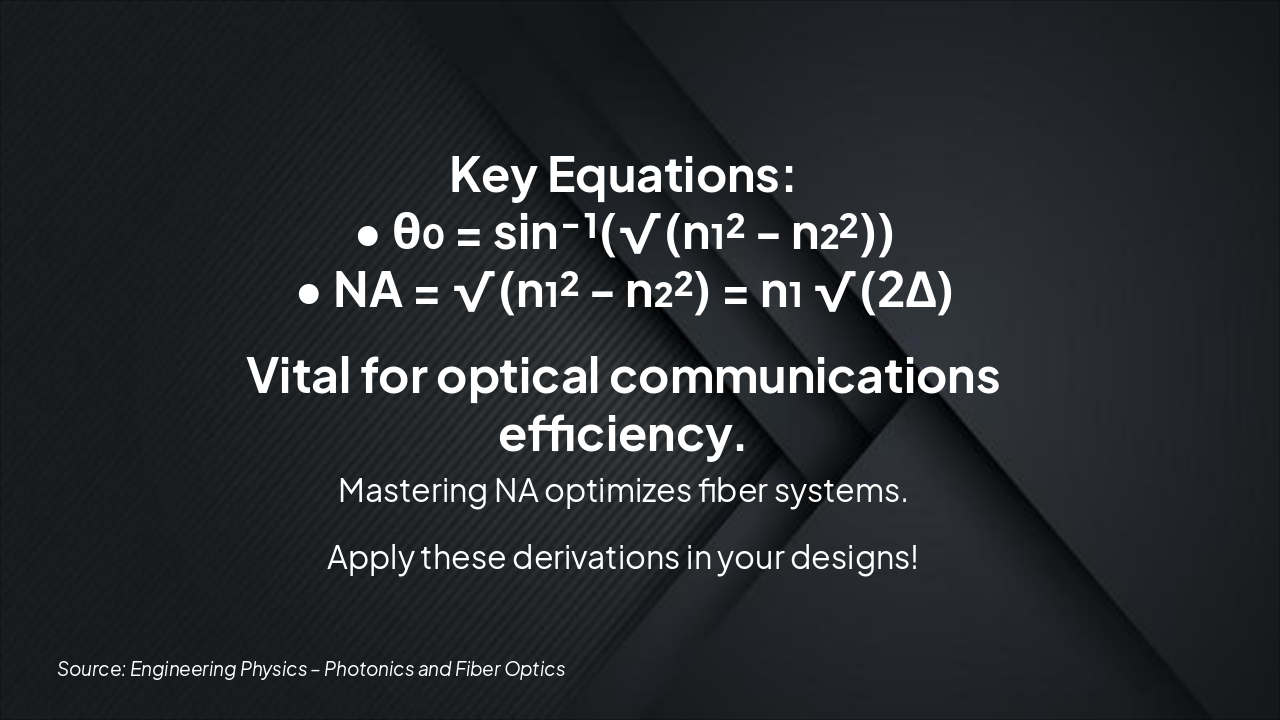
The slide summarizes key equations for the acceptance angle θ₀ = sin⁻¹(√(n₁² - n₂²)) and numerical aperture NA = √(n₁² - n₂²) = n₁ √(2Δ), essential for optical communications efficiency. It stresses that mastering NA optimizes fiber systems and urges applying these derivations in designs.

Summary

**Key Equations:

  • θ₀ = sin⁻¹(√(n₁² - n₂²))
  • NA = √(n₁² - n₂²) = n₁ √(2Δ)

Vital for optical communications efficiency.**

Mastering NA optimizes fiber systems.

Apply these derivations in your designs!

Source: Engineering Physics – Photonics and Fiber Optics

Speaker Notes
Recap key equations, emphasize importance in optical comms. Deliver closing message confidently.
Slide 12 - Summary

Discover More Presentations

Explore thousands of AI-generated presentations for inspiration

Browse Presentations
Powered by AI

Create Your Own Presentation

Generate professional presentations in seconds with Karaf's AI. Customize this presentation or start from scratch.

Create New Presentation

Powered by Karaf.ai — AI-Powered Presentation Generator