Microbubble Screens to Curb Gulf Sediment Plumes (45 chars)

Generated from prompt:

Reducing Sediment Plumes in the Arabian Gulf Using Microbubble Screens presentation with 9 slides covering title, introduction, causes, impact, microbubble screens, evidence, challenges, conclusion, and references.

This presentation explores sediment plumes in the Arabian Gulf caused by dredging and development, their environmental impacts on biodiversity and fisheries, and the use of microbubble screens to redu

November 28, 20259 slides
Slide 1 of 9

Slide 1 - Reducing Sediment Plumes in the Arabian Gulf Using Microbubble Screens

The title slide introduces a presentation on reducing sediment plumes in the Arabian Gulf through the innovative use of microbubble screens. Its subtitle emphasizes protecting marine ecosystems from the environmental impacts caused by dredging activities.

Reducing Sediment Plumes in the Arabian Gulf Using Microbubble Screens

Protecting Marine Ecosystems from Dredging-Induced Environmental Impacts

Speaker Notes
Presenter: [Your Name], Environmental Specialist
Slide 1 - Reducing Sediment Plumes in the Arabian Gulf Using Microbubble Screens
Slide 2 of 9

Slide 2 - Introduction

Sediment plumes in the Arabian Gulf pose a significant threat to marine ecosystems by reducing water clarity and damaging biodiversity and fisheries. The slide introduces microbubble screens as an innovative, sustainable solution for containment, while providing an overview of the causes, impacts, and mitigation strategies.

Introduction

  • Sediment plumes threaten Arabian Gulf marine ecosystems
  • Plumes reduce water clarity, harming biodiversity and fisheries
  • Microbubble screens offer innovative, sustainable containment solutions
  • Overview: causes, impacts, and mitigation strategies explored
Slide 2 - Introduction
Slide 3 of 9

Slide 3 - Causes of Sediment Plumes

Sediment plumes arise from human activities like dredging, which disturbs the seabed and suspends sediments, as well as coastal development that boosts runoff and erosion. Natural processes such as wave-induced erosion and turbulence from shipping propellers also resuspend coastal materials, contributing to these plumes.

Causes of Sediment Plumes

  • Dredging activities disturb seabed, suspending sediments
  • Coastal development increases runoff and erosion
  • Natural erosion from waves mobilizes coastal materials
  • Shipping traffic propellers create turbulence, resuspending sediments
Slide 3 - Causes of Sediment Plumes
Slide 4 of 9

Slide 4 - Impact on the Environment

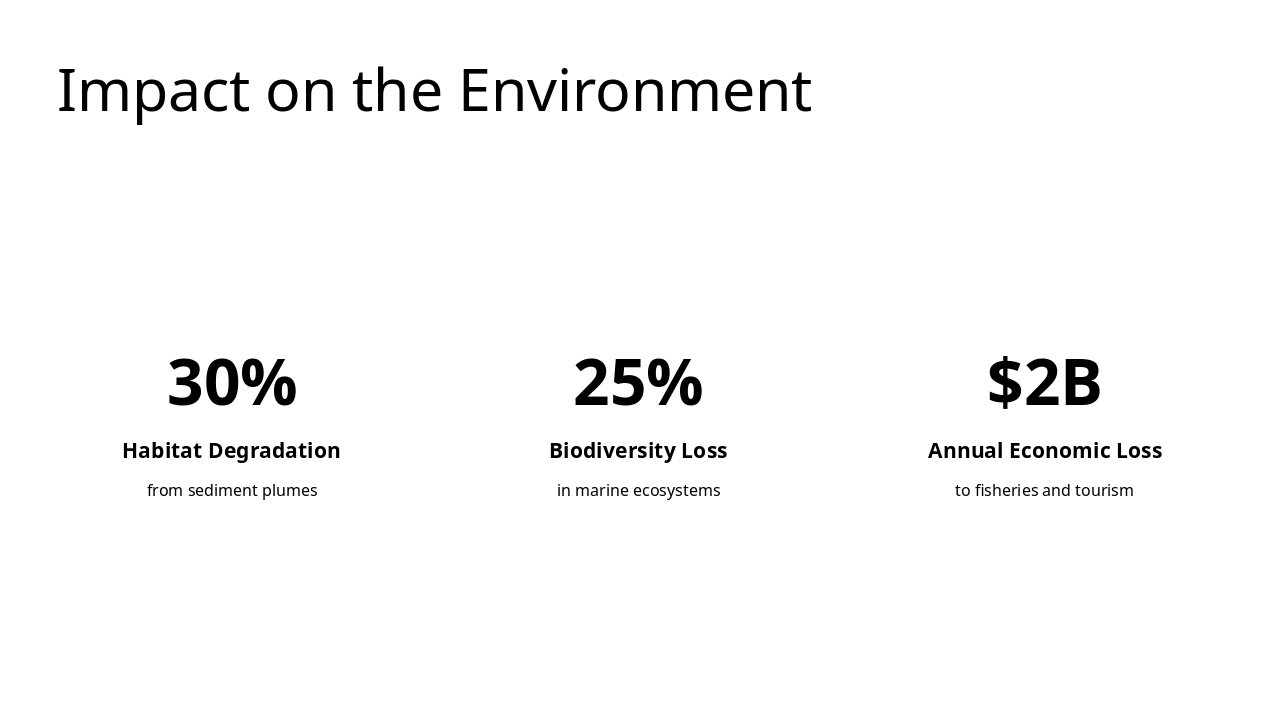
The slide highlights the environmental impacts of an unspecified activity, showing that habitat degradation from sediment plumes affects 30% of areas, while biodiversity loss in marine ecosystems reaches 25%. Additionally, it reports an annual economic loss of $2 billion to fisheries and tourism.

Impact on the Environment

  • 30%: Habitat Degradation
  • from sediment plumes

  • 25%: Biodiversity Loss
  • in marine ecosystems

  • $2B: Annual Economic Loss
  • to fisheries and tourism

Slide 4 - Impact on the Environment
Slide 5 of 9

Slide 5 - Microbubble Screens Technology

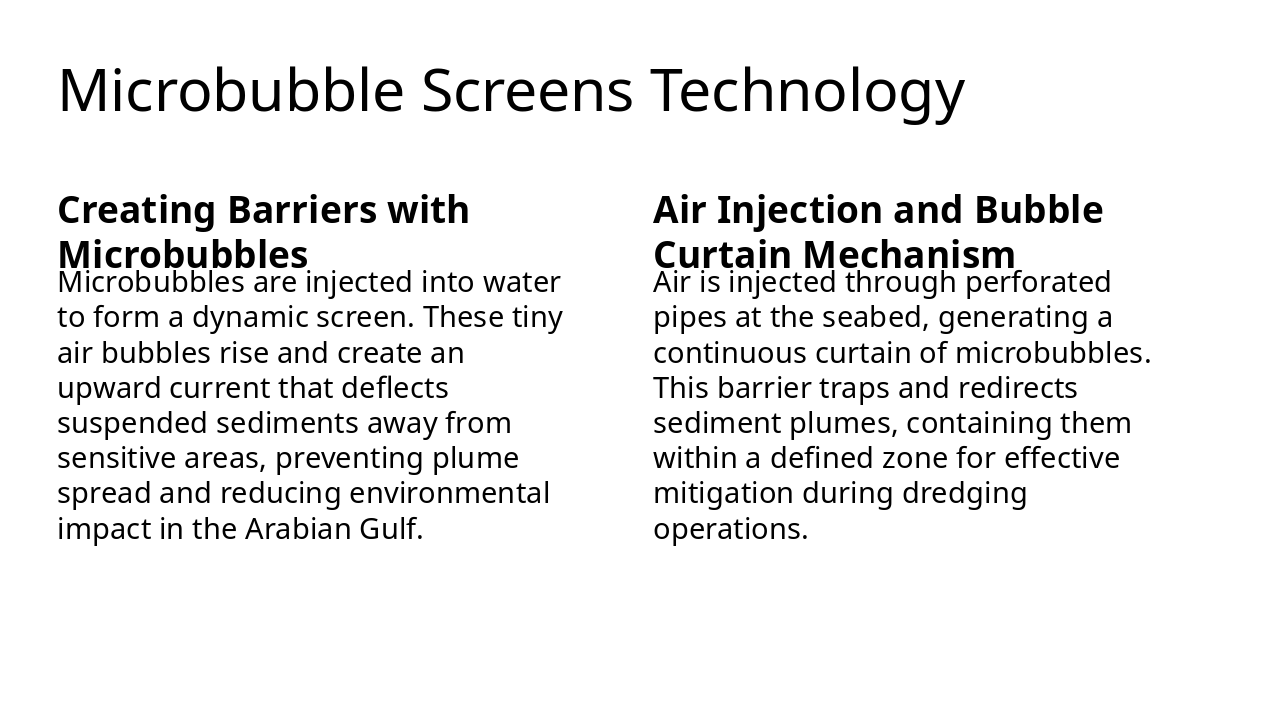
Microbubble Screens Technology involves injecting tiny air bubbles into water to create dynamic barriers that generate upward currents, deflecting suspended sediments from sensitive areas and minimizing environmental impact in the Arabian Gulf. Air is injected through perforated seabed pipes to form a continuous bubble curtain, which traps and redirects sediment plumes during dredging, containing them within a defined zone for effective mitigation.

Microbubble Screens Technology

Creating Barriers with MicrobubblesAir Injection and Bubble Curtain Mechanism
Microbubbles are injected into water to form a dynamic screen. These tiny air bubbles rise and create an upward current that deflects suspended sediments away from sensitive areas, preventing plume spread and reducing environmental impact in the Arabian Gulf.Air is injected through perforated pipes at the seabed, generating a continuous curtain of microbubbles. This barrier traps and redirects sediment plumes, containing them within a defined zone for effective mitigation during dredging operations.
Slide 5 - Microbubble Screens Technology
Slide 6 of 9

Slide 6 - Evidence of Effectiveness

The slide titled "Evidence of Effectiveness" presents a case study demonstrating a 70% reduction in plume spread, supported by simulation visuals showing decreased dispersion in the Gulf. It also includes a data chart comparing plume dispersion before and after the intervention.

Evidence of Effectiveness

!Image

  • Case study: 70% reduction in plume spread
  • Simulation visuals: Decreased dispersion in Gulf
  • Data chart: Before-after plume comparison

Source: Image from Wikipedia article "Marine sediment"

Speaker Notes
Visuals of case studies or simulations showing reduced plume dispersion by up to 70% in similar marine environments; include data charts.
Slide 6 - Evidence of Effectiveness
Slide 7 of 9

Slide 7 - Challenges and Limitations

The slide outlines key challenges and limitations in marine bubble technology, including bubble stability amid strong ocean currents and the high costs associated with deployment and installation. It also highlights the need for ongoing maintenance and monitoring, as well as difficulties in integrating the system with existing marine operations.

Challenges and Limitations

  • Bubble stability in strong ocean currents
  • High deployment and installation costs
  • Ongoing maintenance and monitoring needs
  • Integration with existing marine operations
Slide 7 - Challenges and Limitations
Slide 8 of 9

Slide 8 - Conclusion

Microbubble screens are highlighted as an effective solution to reduce sediment plumes, safeguard marine ecosystems, and promote sustainable coastal management in the Arabian Gulf. The slide urges innovation for a clearer future and calls for immediate adoption of this technology to protect coasts, under the subtitle "Join the movement for Gulf sustainability."

Conclusion

Microbubble screens reduce sediment plumes, protect marine ecosystems, and enable sustainable coastal management in the Arabian Gulf.

Closing: Innovate for a clearer future.

Call to Action: Adopt microbubble technology now to safeguard our coasts.

Join the movement for Gulf sustainability.

Source: Reducing Sediment Plumes in the Arabian Gulf Using Microbubble Screens

Speaker Notes
Summarize key benefits: reduced plumes, ecosystem protection, sustainability. Urge adoption in Gulf region for long-term coastal management.
Slide 8 - Conclusion
Slide 9 of 9

Slide 9 - References

The "References" slide lists key sources on environmental and coastal issues in the Persian Gulf region. It includes Smith et al. (2020) on microbubble curtains for sediment control, Al-Mansoori (2018) on sediment plumes in the Arabian Gulf, and Johnson & Lee (2019) on coastal erosion studies.

References

  • Smith et al. (2020). Microbubble curtains for sediment control. Journal of Environmental Engineering.
  • Al-Mansoori (2018). Sediment plumes in the Arabian Gulf. Gulf Environmental Report.
  • Johnson & Lee (2019). Coastal erosion studies in Persian Gulf regions. Marine Pollution Bulletin.
Slide 9 - References

Discover More Presentations

Explore thousands of AI-generated presentations for inspiration

Browse Presentations
Powered by AI

Create Your Own Presentation

Generate professional presentations in seconds with Karaf's AI. Customize this presentation or start from scratch.

Create New Presentation

Powered by Karaf.ai — AI-Powered Presentation Generator