End-to-End Latency in Modern Wireless Networks: Challenges and Solutions for 5G and Wi-Fi

Generated from prompt:

Middle East University Faculty of Information Technology The Impact of End-to-End Latency on Modern Wireless Communication: Challenges and Solutions in 5G and Wi-Fi Networks. Prepared by: Osama Aljouhary-202510446 Instructor: Dr. Sadeq Al-Suhemat. Course: Wireless Network. The Challenge The core challenge is End-to-End IP Latency, specifically measured as Round-Trip Time (RTT). Unlike simple signal speed, this represents the total cumulative time for data to travel from a source device, across the entire network infrastructure to the server, and back. In modern wireless communication, achieving "deterministic" responsiveness is now more critical than raw bandwidth. 2. Causes and Effects • Causes: o Multi-Layer Accumulation: Processing delays added by every device (routers, firewalls, switches) across the OSI layers. o Physical Distance (Propagation Delay): Large geographical distances between the user and the cloud server. o Network Congestion & Handovers: Queuing delays during peak traffic and temporary spikes during "roaming" between Access Points. • Effects: o Operational Failure: High latency disrupts real-time feedback loops in industrial robotics (AMRs), leading to safety risks or production halts. o User Experience: Causes "motion sickness" in AR/VR systems if latency exceeds 50 ms and disrupts natural flow in VoIP/video calls. o Economic Impact: Significant financial losses in smart factories due to unsynchronized machinery. 3. Existing Solutions • 5G URLLC: Provides specialized "Ultra-Reliable Low-Latency" channels for mission-critical tasks (1–5 ms radio latency). • Wi-Fi 6/7 (OFDMA & TWT): Enhances determinism by allowing multiple devices to communicate simultaneously and scheduling precise wake/sleep times to reduce queuing. • Cisco URWB: A specialized backhaul technology ensuring "zero-millisecond handoffs" for high-speed moving assets like trains or factory robots. 4. Recommended Solution: Edge-Integrated Hybrid Architecture The proposed solution is to implement a Local Edge Computing model combined with a Multi-Access Wireless Strategy (5G and URWB). • Mechanism: By hosting the application logic at the "Local Edge" (within the enterprise network), the longest part of the data path—the public internet—is eliminated. • Why it Works: It addresses the root cause of physical distance. Bringing the server within 200 km of the device ensures the RTT remains consistently below the 10–20 ms threshold. • Outcome: This transforms the network from a "best-effort" system to a deterministic one, ensuring safety, reliability, and high performance for autonomous and interactive systems.

This presentation analyzes the impact of end-to-end IP latency (RTT) on contemporary wireless communications in 5G and Wi-Fi networks. It covers core challenges, causes like multi-layer delays, propagation distance, and congestion, and their effects on real-time applications such as AR/VR, industrial robotics, and smart factories. Existing solutions including 5G URLLC, Wi-Fi 6/7 OFDMA/TWT, and Cisco URWB are evaluated, with a recommended hybrid architecture leveraging local edge computing and multi-access wireless to achieve deterministic RTT under 10-20 ms for reliable performance.

May 12, 202614 slides
Slide 1 of 14

Slide 1 - The Impact of End-to-End Latency on Modern Wireless Communication: Challenges and Solutions in 5G and Wi-Fi Networks

The Impact of End-to-End Latency on Modern Wireless Communication: Challenges and Solutions in 5G and Wi-Fi Networks

Middle East University Faculty of Information Technology Prepared by: Osama Aljouhary - 202510446 Instructor: Dr. Sadeq Al-Suhemat Course: Wireless Network

---

Photo by Joakim Honkasalo on Unsplash
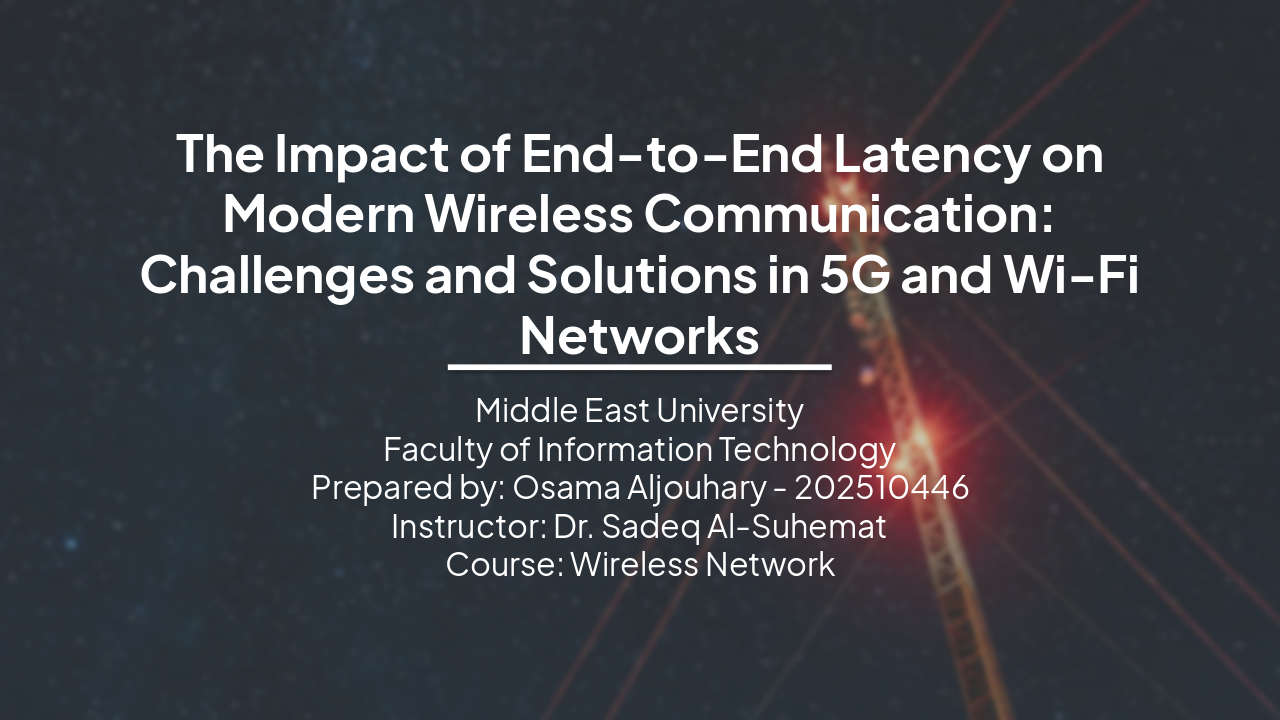
Slide 1 - The Impact of End-to-End Latency on Modern Wireless Communication: Challenges and Solutions in 5G and Wi-Fi Networks
Slide 2 of 14

Slide 2 - Presentation Agenda

  • The Challenge
  • Causes and Effects
  • Existing Solutions
  • Recommended Solution

---

Photo by HaLo on Unsplash

Slide 2 - Presentation Agenda
Slide 3 of 14

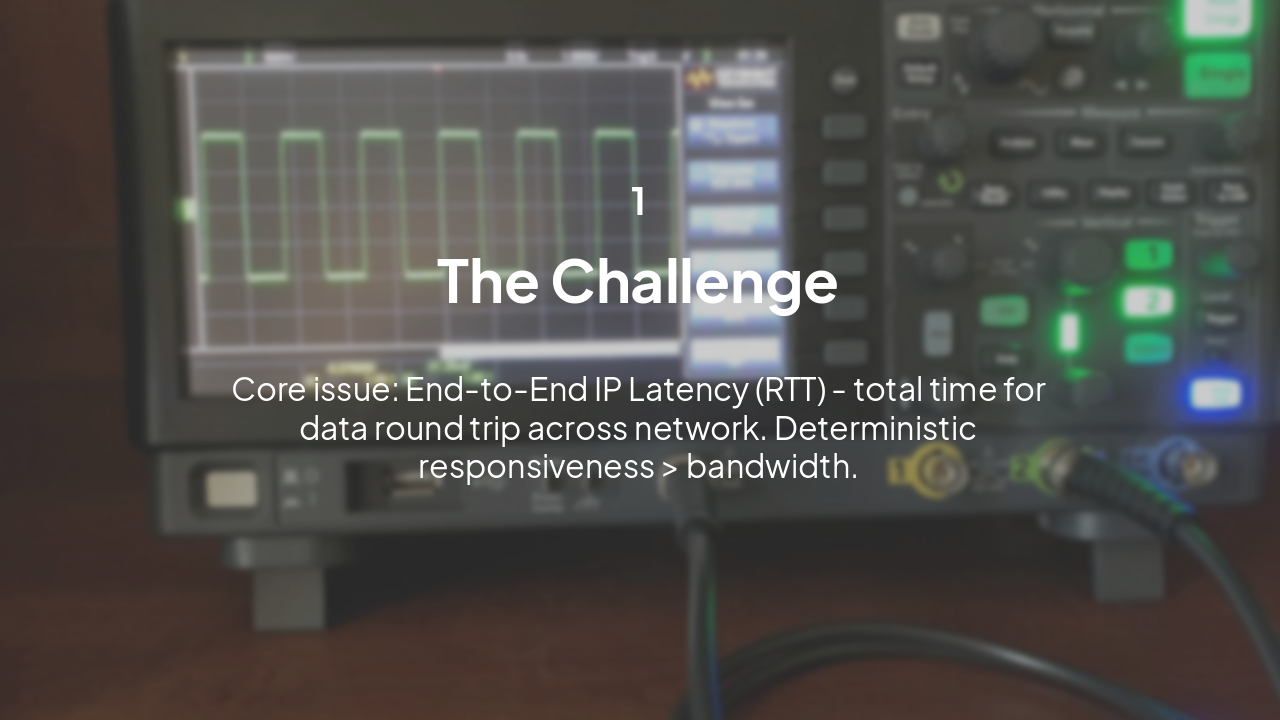
Slide 3 - The Challenge

1

The Challenge

Core issue: End-to-End IP Latency (RTT) - total time for data round trip across network. Deterministic responsiveness > bandwidth.

---

Photo by Doug Baney on Unsplash

Slide 3 - The Challenge
Slide 4 of 14

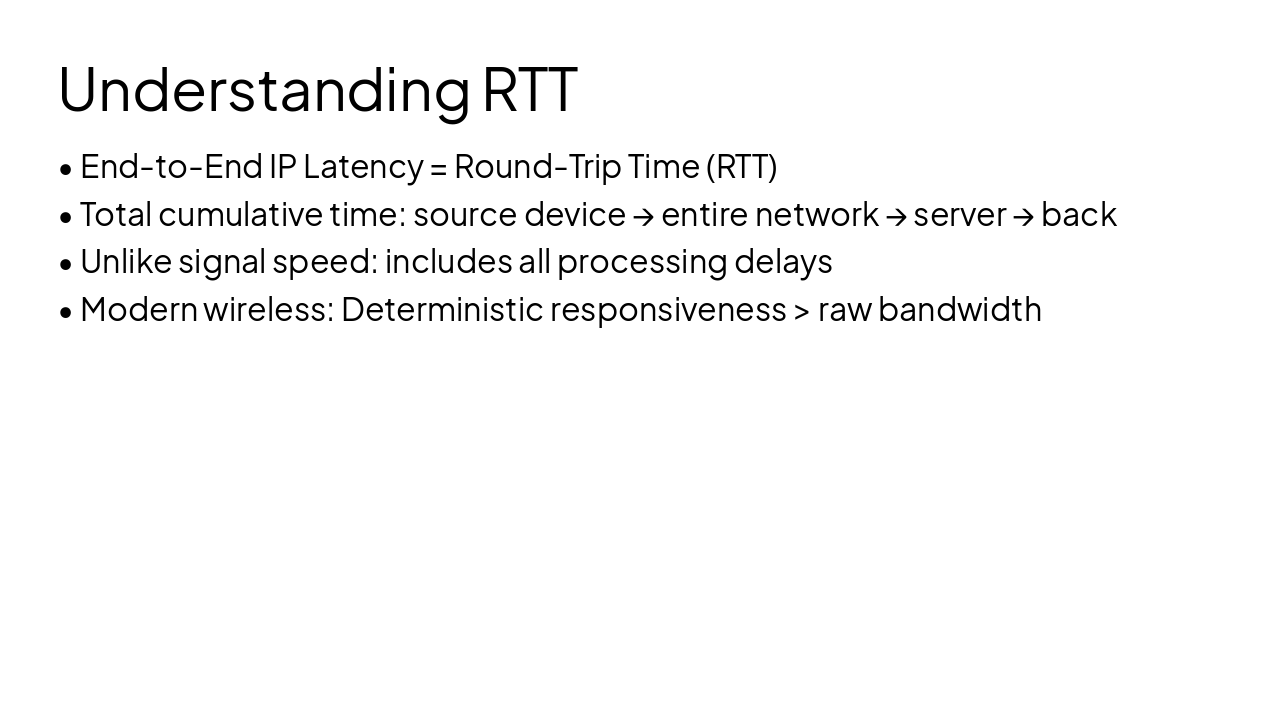
Slide 4 - Understanding RTT

  • End-to-End IP Latency = Round-Trip Time (RTT)
  • Total cumulative time: source device → entire network → server → back
  • Unlike signal speed: includes all processing delays
  • Modern wireless: Deterministic responsiveness > raw bandwidth
Slide 4 - Understanding RTT
Slide 5 of 14

Slide 5 - Causes and Effects

2

Causes and Effects

Multi-layer delays, distance, congestion → operational failures, poor UX, economic losses

---

Photo by Logan Voss on Unsplash

Slide 5 - Causes and Effects
Slide 6 of 14

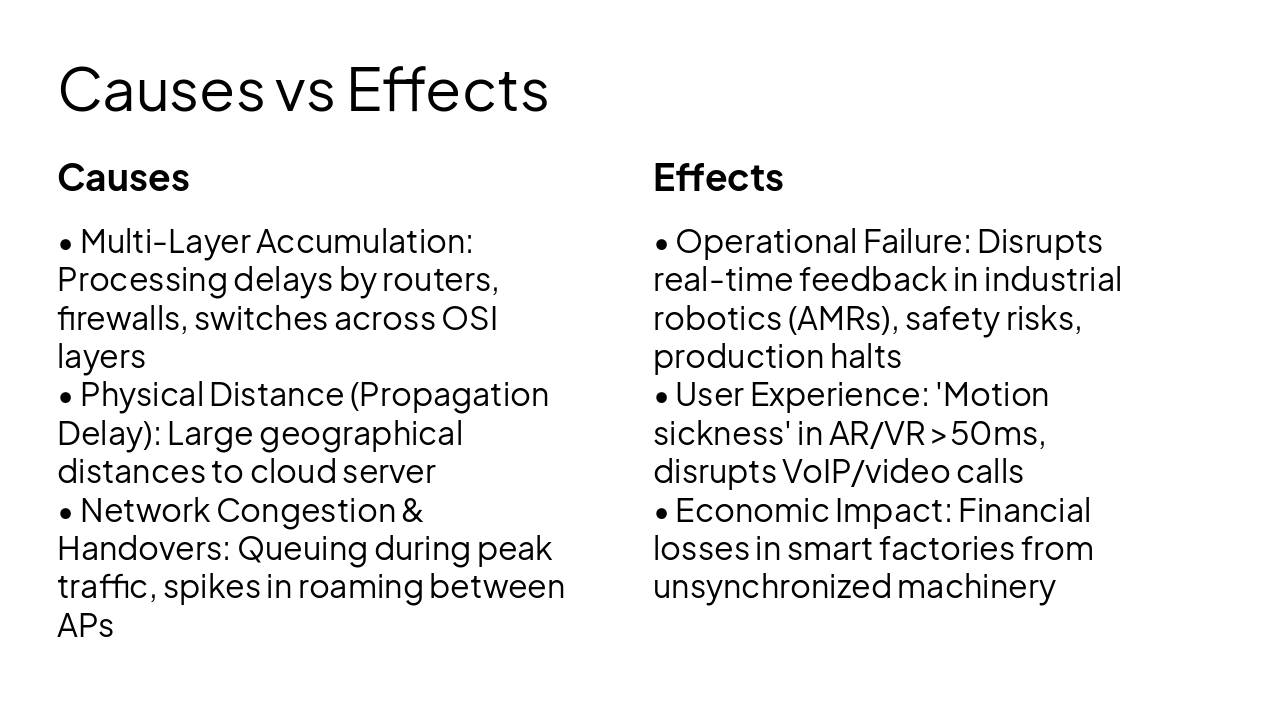
Slide 6 - Causes vs Effects

Causes

  • Multi-Layer Accumulation: Processing delays by routers, firewalls, switches across OSI layers
  • Physical Distance (Propagation Delay): Large geographical distances to cloud server
  • Network Congestion & Handovers: Queuing during peak traffic, spikes in roaming between APs

Effects

  • Operational Failure: Disrupts real-time feedback in industrial robotics (AMRs), safety risks, production halts
  • User Experience: 'Motion sickness' in AR/VR >50ms, disrupts VoIP/video calls
  • Economic Impact: Financial losses in smart factories from unsynchronized machinery
Slide 6 - Causes vs Effects
Slide 7 of 14

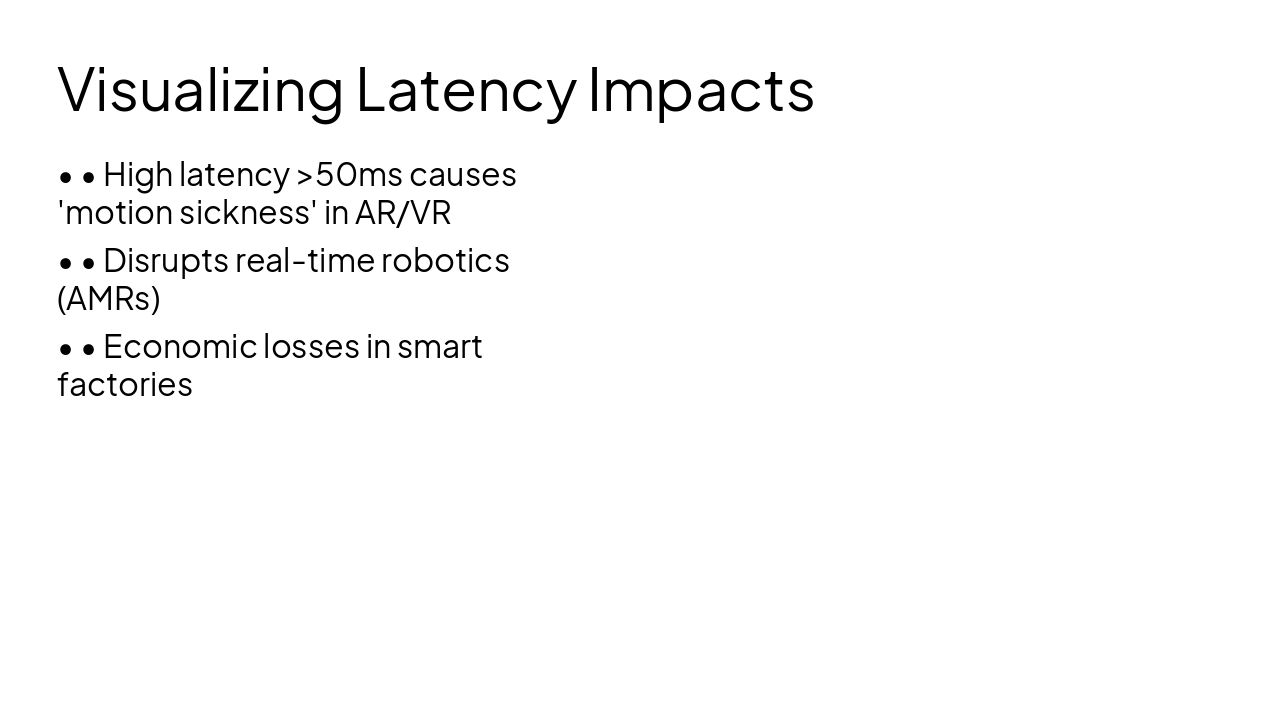
Slide 7 - Visualizing Latency Impacts

  • • High latency >50ms causes 'motion sickness' in AR/VR
  • • Disrupts real-time robotics (AMRs)
  • • Economic losses in smart factories

---

Photo by Andres Siimon on Unsplash

Slide 7 - Visualizing Latency Impacts
Slide 8 of 14

Slide 8 - Existing Solutions

3

Existing Solutions

5G URLLC, Wi-Fi 6/7 (OFDMA & TWT), Cisco URWB for low-latency channels

---

Photo by İsmail Enes Ayhan on Unsplash

Slide 8 - Existing Solutions
Slide 9 of 14

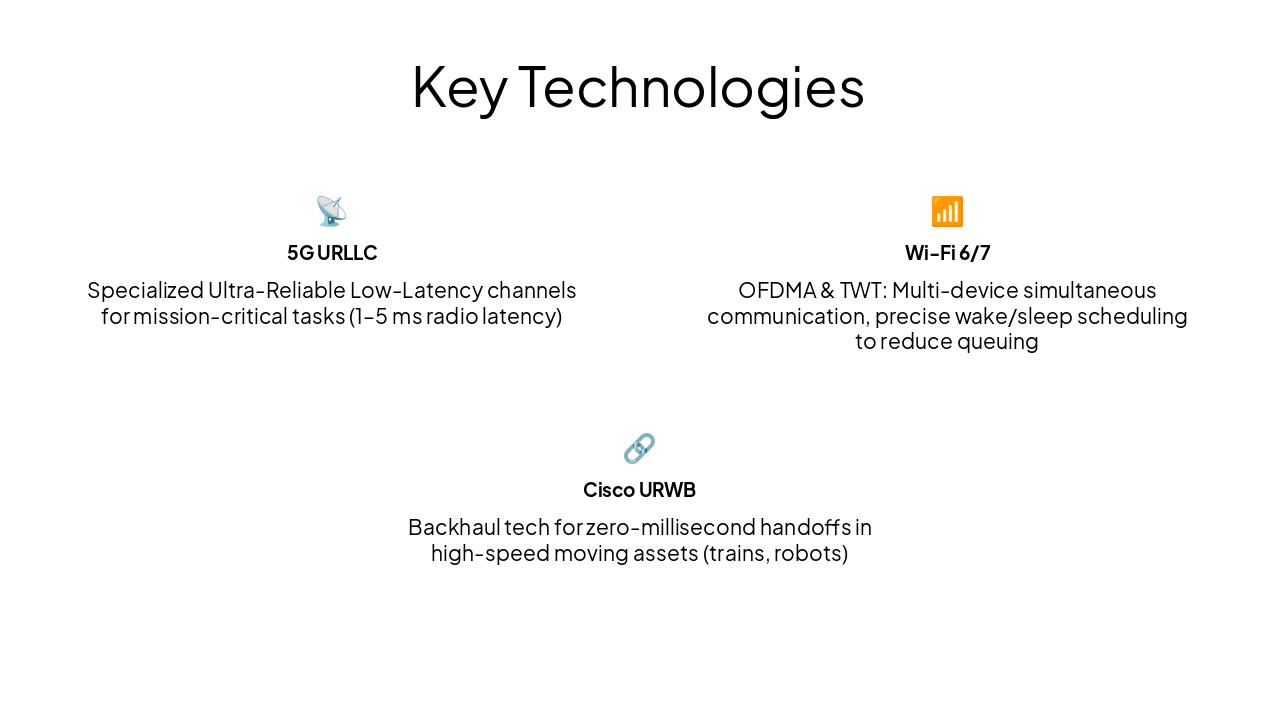
Slide 9 - Key Technologies

📡 5G URLLC Specialized Ultra-Reliable Low-Latency channels for mission-critical tasks (1–5 ms radio latency)

📶 Wi-Fi 6/7 OFDMA & TWT: Multi-device simultaneous communication, precise wake/sleep scheduling to reduce queuing

🔗 Cisco URWB Backhaul tech for zero-millisecond handoffs in high-speed moving assets (trains, robots)

Slide 9 - Key Technologies
Slide 10 of 14

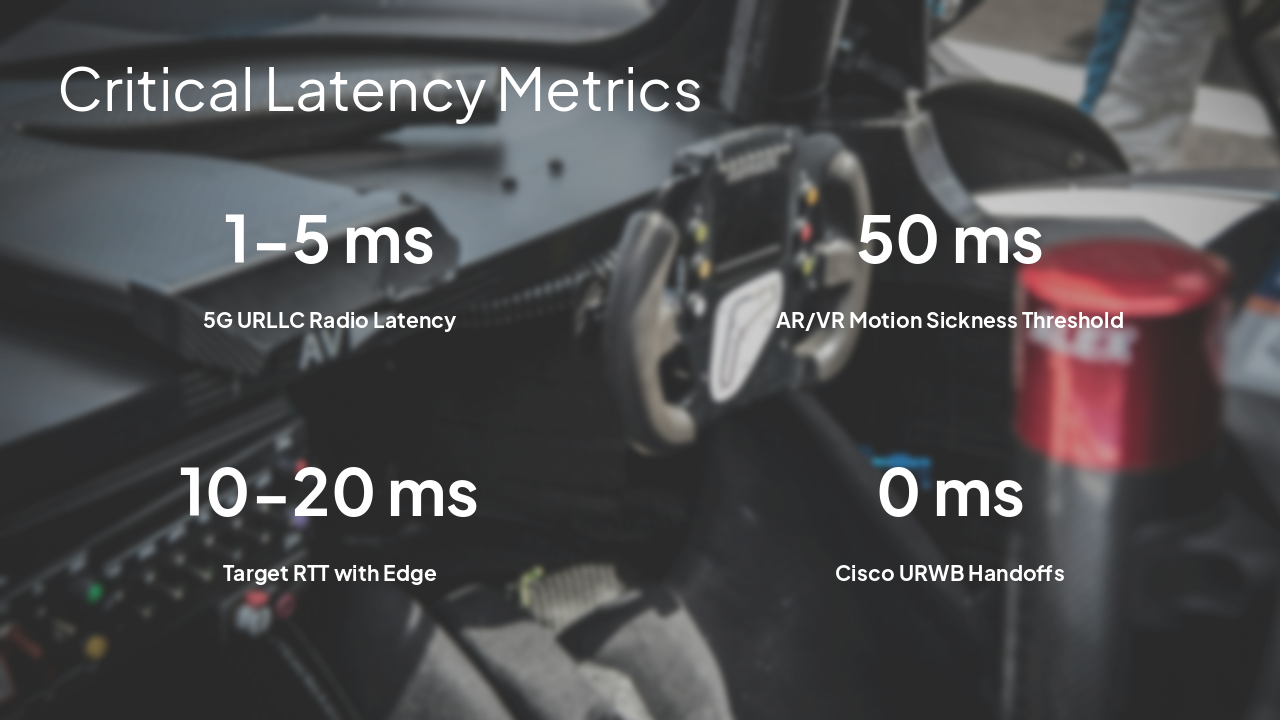
Slide 10 - Critical Latency Metrics

  • 1-5 ms: 5G URLLC Radio Latency
  • 50 ms: AR/VR Motion Sickness Threshold
  • 10-20 ms: Target RTT with Edge
  • 0 ms: Cisco URWB Handoffs

---

Photo by Alessandro Zuffi on Unsplash

Slide 10 - Critical Latency Metrics
Slide 11 of 14

Slide 11 - Recommended Solution

4

Recommended Solution

Local Edge Computing + Multi-Access Wireless (5G & URWB)

---

Photo by Simon Kadula on Unsplash

Slide 11 - Recommended Solution
Slide 12 of 14

Slide 12 - Proposed Architecture

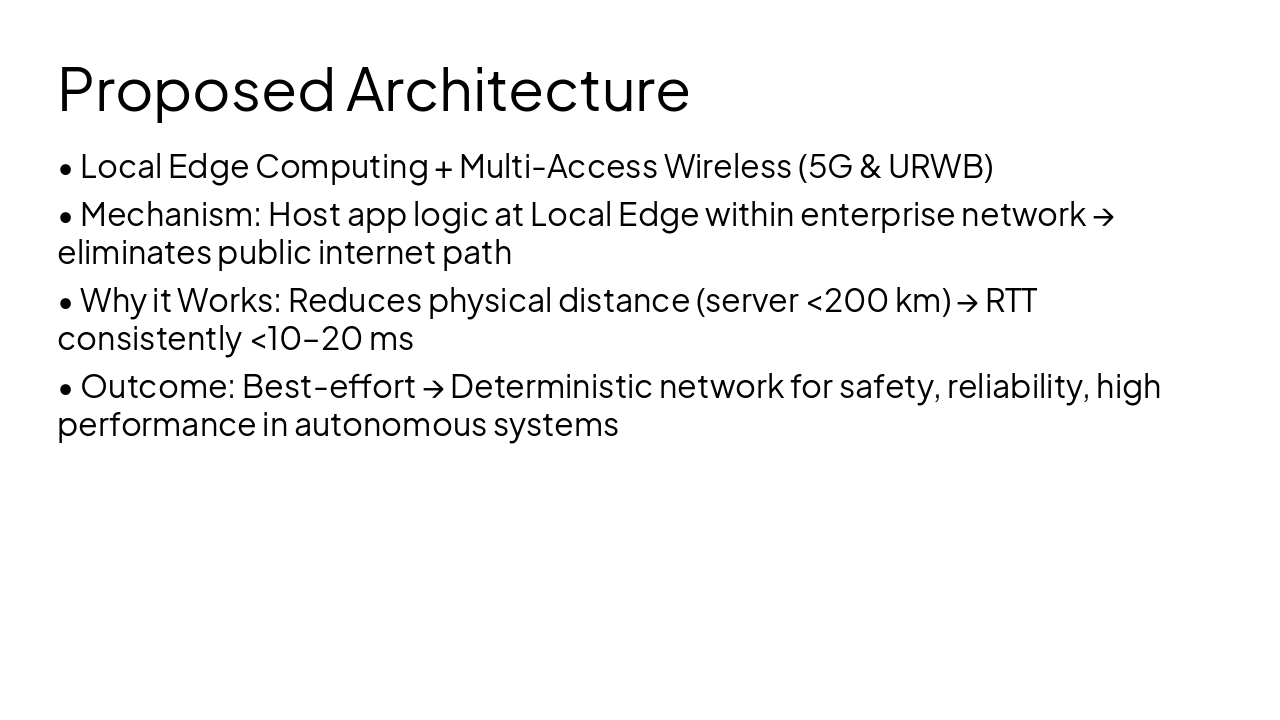
  • Local Edge Computing + Multi-Access Wireless (5G & URWB)
  • Mechanism: Host app logic at Local Edge within enterprise network → eliminates public internet path
  • Why it Works: Reduces physical distance (server <200 km) → RTT consistently <10–20 ms
  • Outcome: Best-effort → Deterministic network for safety, reliability, high performance in autonomous systems
Slide 12 - Proposed Architecture
Slide 13 of 14

Slide 13 - Hybrid Architecture

  • • Bypasses public internet
  • • RTT <10-20 ms
  • • Deterministic performance
  • • Supports robotics, AR/VR, factories

---

Photo by Kabiur Rahman Riyad on Unsplash

Slide 13 - Hybrid Architecture
Slide 14 of 14

Slide 14 - Key Takeaway

Implement Edge-Integrated Hybrid Architecture (Local Edge + 5G/URWB) Achieve <10-20 ms RTT for deterministic, safe, reliable wireless networks

Transforming challenges into opportunities Thank you! Questions?

---

Photo by Davide Zacchello on Unsplash

Slide 14 - Key Takeaway

Discover More Presentations

Explore thousands of AI-generated presentations for inspiration

Browse Presentations
Powered by AI

Create Your Own Presentation

Generate professional presentations in seconds with Karaf's AI. Customize this presentation or start from scratch.

Create New Presentation

Powered by Karaf.ai — AI-Powered Presentation Generator