Deepfake Detection Website

Generated from prompt:

Create a 5-slide PowerPoint presentation titled 'Deepfake Detection Website' based on a B.Tech project report. The slides should include: Slide 1: Introduction – Project title, team members (Aditya Harsh, Aradhy Tripathi, Shreyash Shaurya Srivastav), supervisor (Er. Paritosh Tripathi), institution (IET, Dr. Rammanohar Lohia Avadh University, Ayodhya), and overall goal of developing a deepfake detection website. Slide 2: Problem Statement & Objectives – Explain the growing issue of deepfakes, lack of real-time detection, and project objectives (MesoNet model, React.js frontend, Flask backend, cloud deployment). Slide 3: System Architecture – Describe components (frontend, backend, model, hosting) and show a high-level architecture flow. Slide 4: Implementation & Results – Steps of development (data preprocessing, model training, web integration, deployment) and performance metrics (accuracy 92.4%, precision 91.7%, recall 93.1%, F1-score 92.4%). Slide 5: Conclusion & Future Scope – Summarize outcomes and suggest future enhancements (video detection, mobile app, blockchain integration, media verification tools).

A B.Tech project developing a real-time deepfake detection website using MesoNet model, React.js frontend, Flask backend, and cloud deployment. Achieves 92.4% accuracy with plans for video detection a

January 16, 20265 slides
Slide 1 of 5

Slide 1 - Deepfake Detection Website

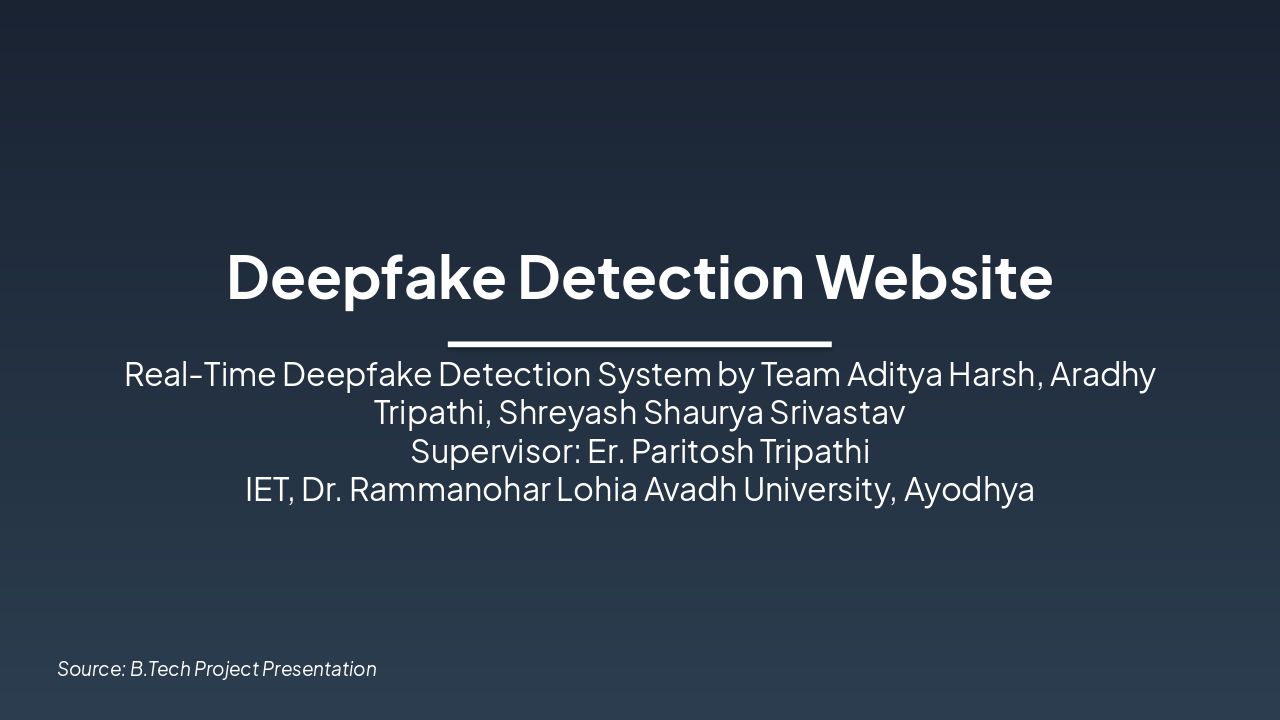
This title slide introduces a "Deepfake Detection Website" focused on a real-time deepfake detection system. It credits Team Aditya Harsh, Aradhy Tripathi, and Shreyash Shaurya Srivastav, under supervisor Er. Paritosh Tripathi at IET, Dr. Rammanohar Lohia Avadh University, Ayodhya.

Introduction

Real-Time Deepfake Detection System by Team Aditya Harsh, Aradhy Tripathi, Shreyash Shaurya Srivastav Supervisor: Er. Paritosh Tripathi IET, Dr. Rammanohar Lohia Avadh University, Ayodhya

Source: B.Tech Project Presentation

Speaker Notes
Introduce the project team, supervisor, institution, and goal during presentation.
Slide 1 - Deepfake Detection Website
Slide 2 of 5

Slide 2 - Problem Statement & Objectives

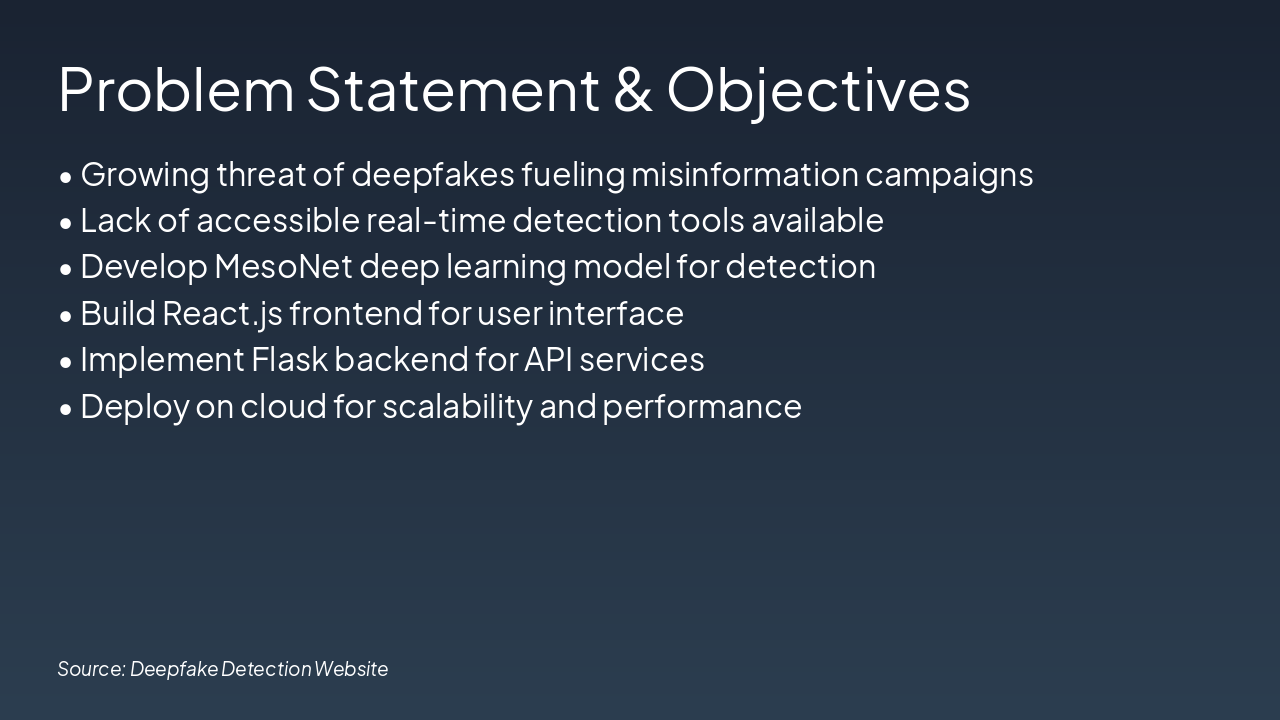
The slide addresses the growing threat of deepfakes driving misinformation and the lack of accessible real-time detection tools. It outlines objectives to develop a MesoNet deep learning model, build a React.js frontend and Flask backend, and deploy on the cloud for scalability.

Problem Statement & Objectives

  • Growing threat of deepfakes fueling misinformation campaigns
  • Lack of accessible real-time detection tools available
  • Develop MesoNet deep learning model for detection
  • Build React.js frontend for user interface
  • Implement Flask backend for API services
  • Deploy on cloud for scalability and performance

Source: Deepfake Detection Website

Slide 2 - Problem Statement & Objectives
Slide 3 of 5

Slide 3 - System Architecture

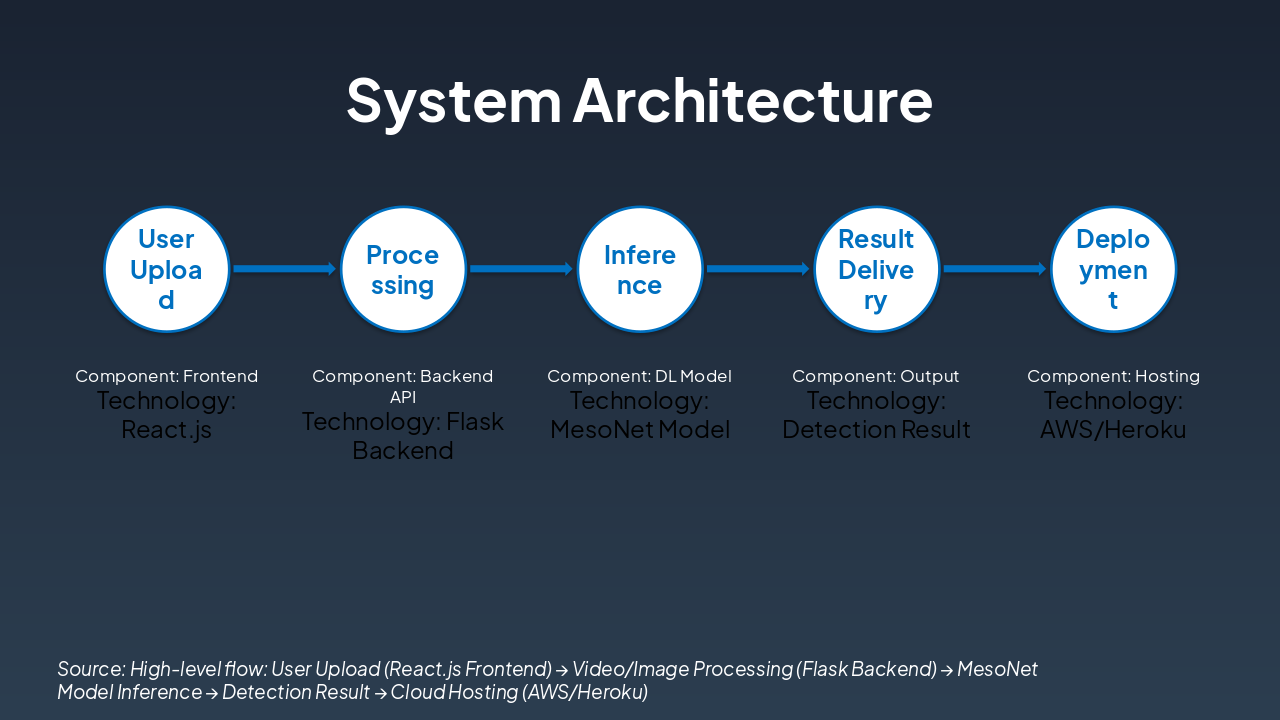
The slide outlines the system architecture as a workflow with phases including User Upload (Frontend: React.js), Processing (Backend API: Flask Backend), Inference (DL Model: MesoNet Model), Result Delivery (Output: Detection Result), and Deployment (Hosting: AWS/Heroku). It uses a tabular format with columns for Phase, Component, and Technology to detail each step.

System Architecture

Source: High-level flow: User Upload (React.js Frontend) → Video/Image Processing (Flask Backend) → MesoNet Model Inference → Detection Result → Cloud Hosting (AWS/Heroku)

Speaker Notes
The system follows a streamlined architecture with React.js frontend for user interaction, Flask backend for processing, MesoNet deep learning model for inference, and cloud deployment for scalability.
Slide 3 - System Architecture
Slide 4 of 5

Slide 4 - Implementation & Results

The slide "Implementation & Results" showcases strong model performance with 92.4% accuracy and a balanced 92.4% F1-score. It also highlights 91.7% precision for low false positives and 93.1% recall for effective true positive detection.

Implementation & Results

  • 92.4%: Model Accuracy
  • High detection performance

  • 91.7%: Precision Score
  • Low false positives achieved

  • 93.1%: Recall Score
  • Effective true positive capture

  • 92.4%: F1-Score

Balanced model performance Source: B.Tech Project Report

Slide 4 - Implementation & Results
Slide 5 of 5

Slide 5 - Conclusion & Future Scope

The slide summarizes a real-time deepfake detection website achieving 92.4% accuracy with the MesoNet model. It outlines future enhancements like video detection, mobile app, blockchain verification, and media tool integration, ending with a "Mission Accomplished!" message and a call to explore deepfake defenses.

Conclusion & Future Scope

**Project Summary ✅ Real-time deepfake detection website ✅ 92.4% accuracy using MesoNet model

Future Enhancements

  • Video deepfake detection
  • Mobile app development
  • Blockchain for verification
  • Integration with media tools

Closing Message: Mission Accomplished! Call-to-Action: Explore deepfake defense innovations today!**

Pioneering Trust in the Digital Age

Source: Deepfake Detection Website - B.Tech Project

Speaker Notes
Summarize the project's success and outline exciting future directions to engage the audience.
Slide 5 - Conclusion & Future Scope

Discover More Presentations

Explore thousands of AI-generated presentations for inspiration

Browse Presentations
Powered by AI

Create Your Own Presentation

Generate professional presentations in seconds with Karaf's AI. Customize this presentation or start from scratch.

Create New Presentation

Powered by Karaf.ai — AI-Powered Presentation Generator