Exploring Artificial Intelligence

Generated from prompt:

Create a presentation about artificial intelligence

This presentation delves into AI fundamentals, including core goals, reasoning vs. learning, historical timeline, impact stats, applications in healthcare and recommendations, planning techniques, and

November 9, 202511 slides
Slide 1 of 11

Slide 1 - Exploring Artificial Intelligence

The slide is titled "Exploring Artificial Intelligence" and serves as a title slide. Its subtitle describes how machines mimic human intelligence to solve complex problems.

Exploring Artificial Intelligence

Machines Mimic Human Intelligence to Solve Complex Problems

Source: Based on Wikipedia

--- Speaker Notes: Explore the fascinating world of AI, where machines mimic human intelligence to solve complex problems. AI enables systems to learn, reason, and achieve goals.

Slide 1
Slide 2 of 11

Slide 2 - Presentation Agenda

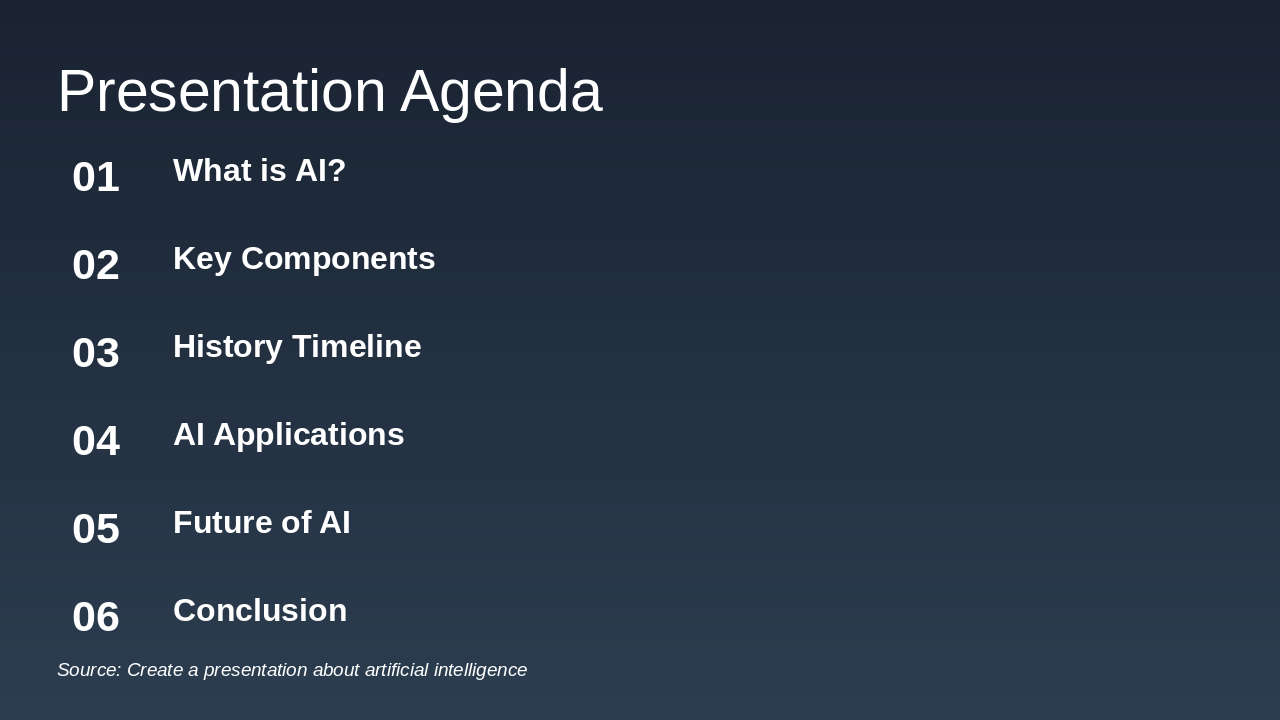
The presentation agenda outlines a structured overview of artificial intelligence, starting with a basic explanation of "What is AI?" followed by its key components. It then covers the history timeline, current applications, future prospects, and concludes with final remarks.

Presentation Agenda

  1. What is AI?
  1. Key Components
  1. History Timeline
  1. AI Applications
  1. Future of AI
  1. Conclusion

Source: Create a presentation about artificial intelligence

Slide 2
Slide 3 of 11

Slide 3 - What is Artificial Intelligence?

This section header slide, titled "What is Artificial Intelligence?" and numbered as 01, introduces the core concept of AI. It defines AI as the capability of systems to mimic human intelligence through processes like learning, reasoning, and decision-making.

What is Artificial Intelligence?

01

What is Artificial Intelligence?

Capability of systems to mimic human intelligence in learning, reasoning, and decision-making.

--- Speaker Notes: AI is the capability of computational systems to perform tasks typically requiring human intelligence, such as learning, reasoning, and decision-making.

Slide 3
Slide 4 of 11

Slide 4 - Core Goals of AI

The Core Goals of AI slide outlines how AI systems achieve objectives by perceiving their environments and taking intelligent actions to maximize success. It also emphasizes enabling machines to learn from data and experiences while supporting problem-solving and planning.

Core Goals of AI

  • Achieve defined goals by perceiving environments
  • Maximize success through intelligent actions
  • Enable machines to learn from data and experiences
  • Support problem-solving and planning
Slide 4
Slide 5 of 11

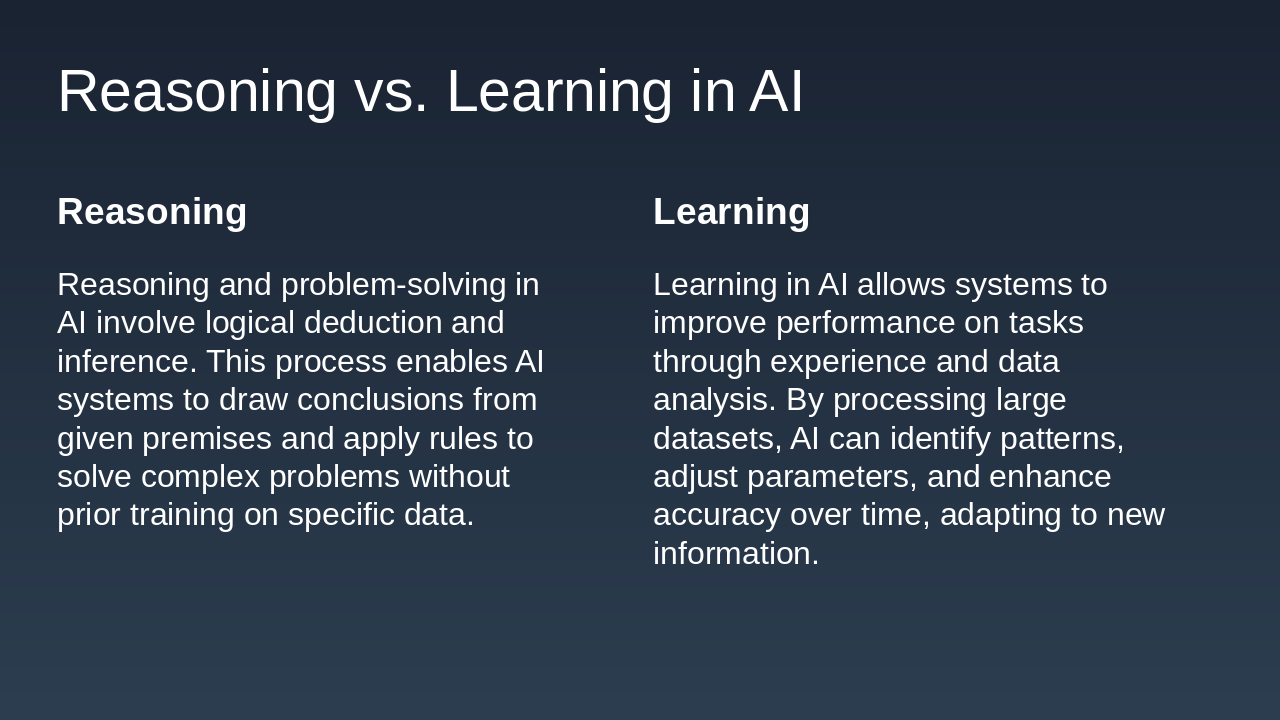
Slide 5 - Reasoning vs. Learning in AI

In AI, reasoning involves logical deduction and inference to draw conclusions from premises and solve complex problems without needing specific prior training. In contrast, learning enables AI systems to improve task performance through experience, data analysis, pattern identification, and parameter adjustments to adapt over time.

Reasoning vs. Learning in AI

ReasoningLearning
Reasoning and problem-solving in AI involve logical deduction and inference. This process enables AI systems to draw conclusions from given premises and apply rules to solve complex problems without prior training on specific data.Learning in AI allows systems to improve performance on tasks through experience and data analysis. By processing large datasets, AI can identify patterns, adjust parameters, and enhance accuracy over time, adapting to new information.
Slide 5
Slide 6 of 11

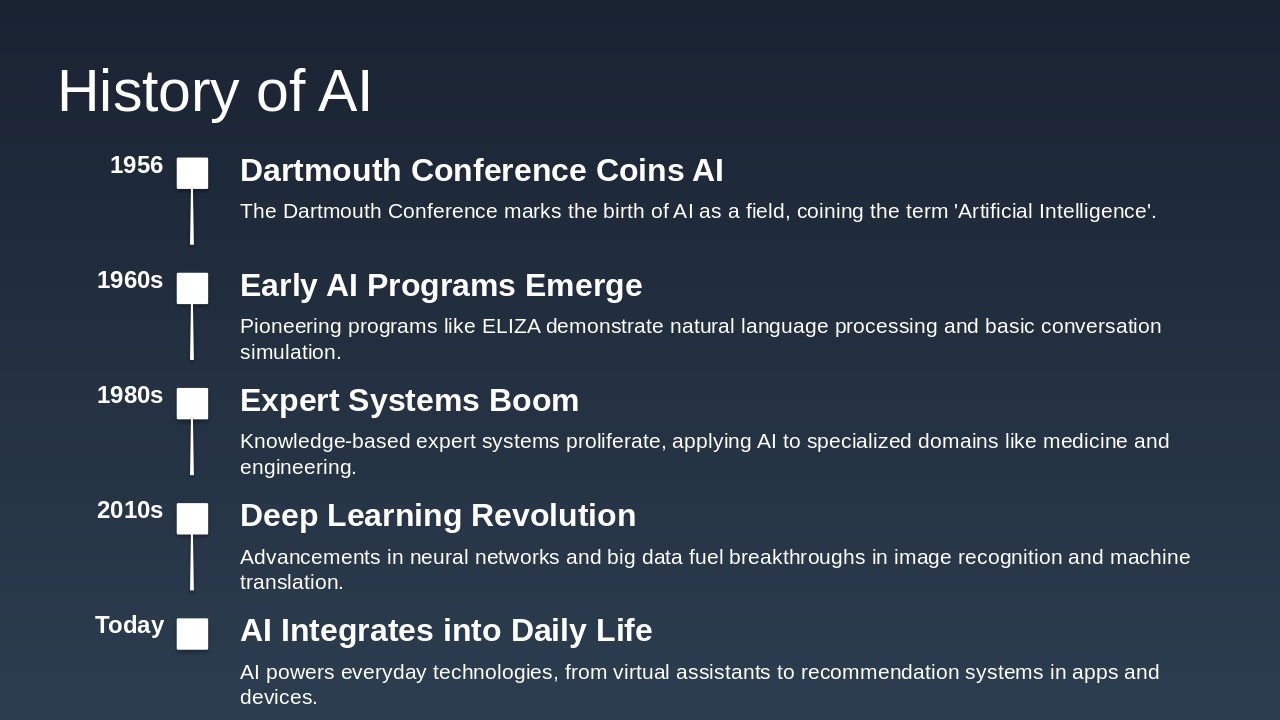
Slide 6 - History of AI

The History of AI timeline slide outlines key milestones starting with the 1956 Dartmouth Conference, which coined the term "Artificial Intelligence" and established the field. It then traces progress through the 1960s emergence of early programs like ELIZA, the 1980s boom in expert systems for specialized domains, the 2010s deep learning revolution in areas like image recognition, and today's integration of AI into daily life via virtual assistants and recommendation systems.

History of AI

1956: Dartmouth Conference Coins AI The Dartmouth Conference marks the birth of AI as a field, coining the term 'Artificial Intelligence'. 1960s: Early AI Programs Emerge Pioneering programs like ELIZA demonstrate natural language processing and basic conversation simulation. 1980s: Expert Systems Boom Knowledge-based expert systems proliferate, applying AI to specialized domains like medicine and engineering. 2010s: Deep Learning Revolution Advancements in neural networks and big data fuel breakthroughs in image recognition and machine translation. Today: AI Integrates into Daily Life AI powers everyday technologies, from virtual assistants to recommendation systems in apps and devices.
Slide 6
Slide 7 of 11

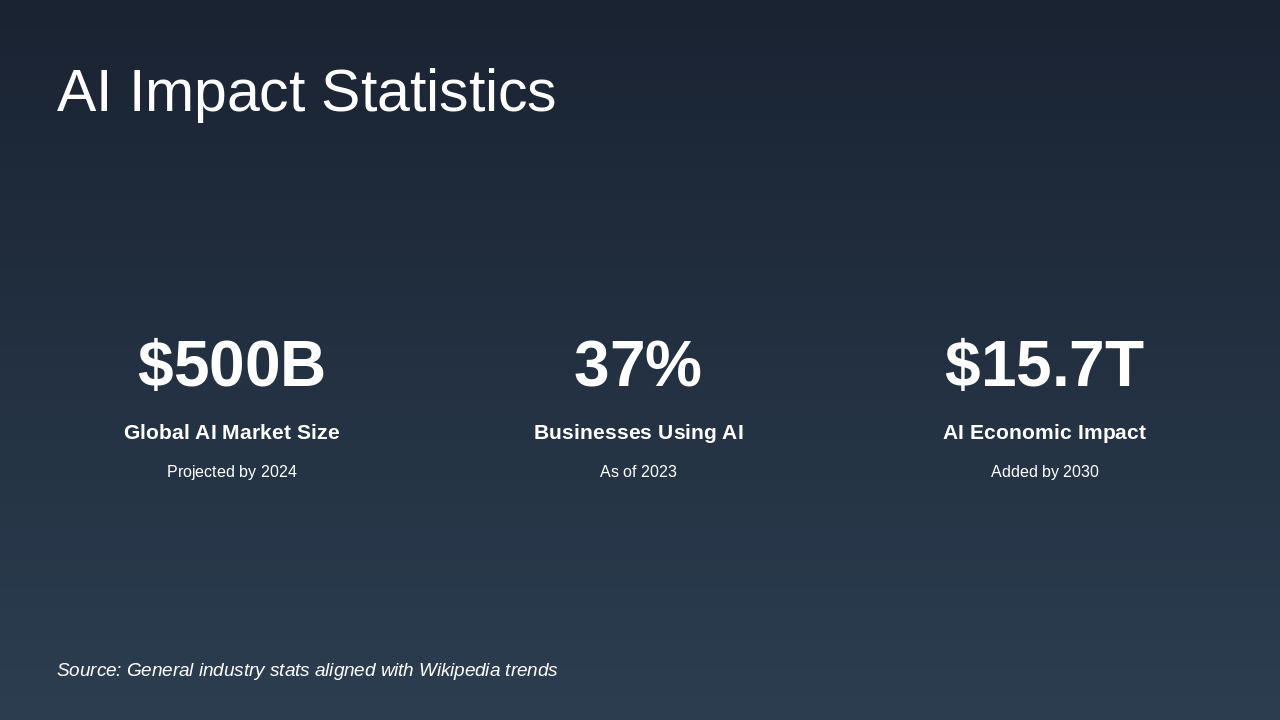
Slide 7 - AI Impact Statistics

The AI Impact Statistics slide highlights key projections, including a global AI market size of $500 billion by 2024. It also notes that 37% of businesses are using AI as of 2023, with an expected economic impact of $15.7 trillion added by 2030.

AI Impact Statistics

  • $500B: Global AI Market Size

Projected by 2024

  • 37%: Businesses Using AI

As of 2023

  • $15.7T: AI Economic Impact

Added by 2030

Source: General industry stats aligned with Wikipedia trends

Slide 7
Slide 8 of 11

Slide 8 - AI Applications

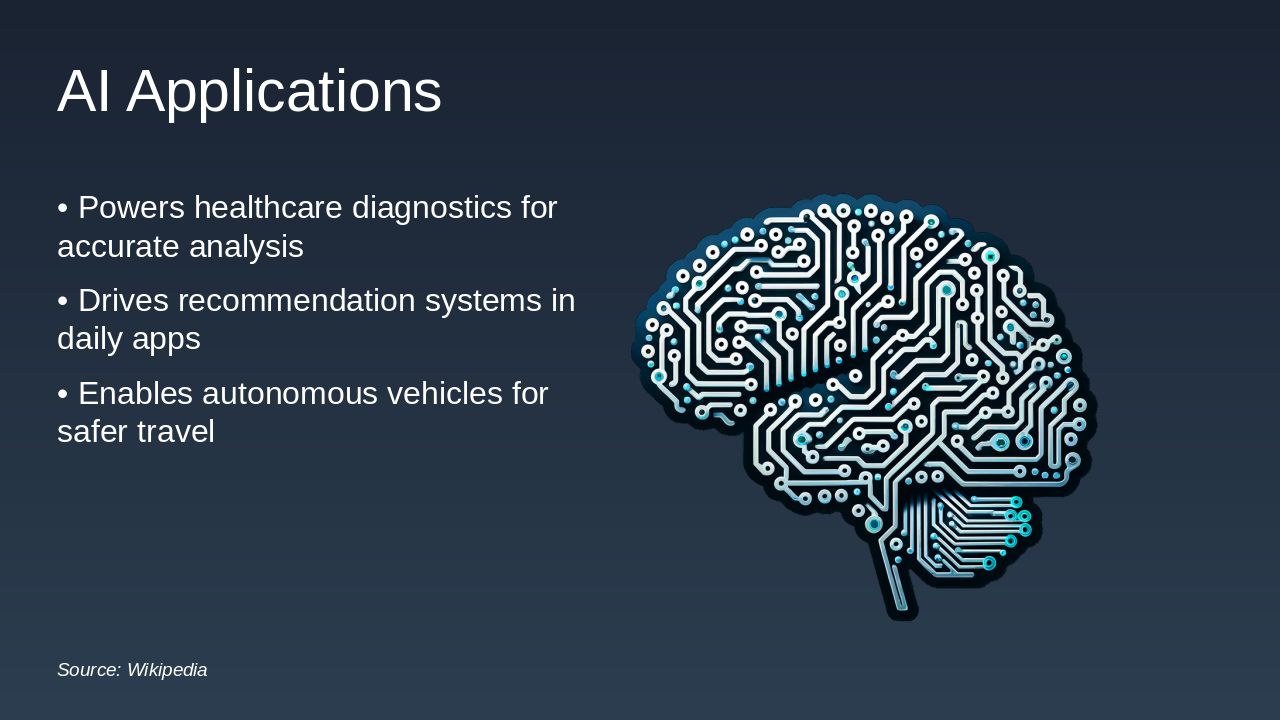
The slide titled "AI Applications" highlights key real-world uses of artificial intelligence through an accompanying image. It lists three main points: powering accurate healthcare diagnostics, driving recommendation systems in everyday apps, and enabling safer autonomous vehicles.

AI Applications

!Image

  • Powers healthcare diagnostics for accurate analysis
  • Drives recommendation systems in daily apps
  • Enables autonomous vehicles for safer travel

Source: Wikipedia

--- Speaker Notes: Visual: Robots, self-driving cars, virtual assistants. AI powers healthcare diagnostics, recommendation systems, and autonomous vehicles for efficient problem-solving. Context: Create a presentation about artificial intelligence

Slide 8
Slide 9 of 11

Slide 9 - A Famous Quote on AI

The slide features a famous quote warning about the risks of artificial intelligence, stating that its full development could lead to the end of the human race. It is attributed to Stephen Hawking, the renowned physicist.

A Famous Quote on AI

> The development of full artificial intelligence could spell the end of the human race.

— Stephen Hawking, Renowned Physicist

--- Speaker Notes: This highlights both potential and risks in AI advancement.

Slide 9
Slide 10 of 11

Slide 10 - Planning and Decision-Making

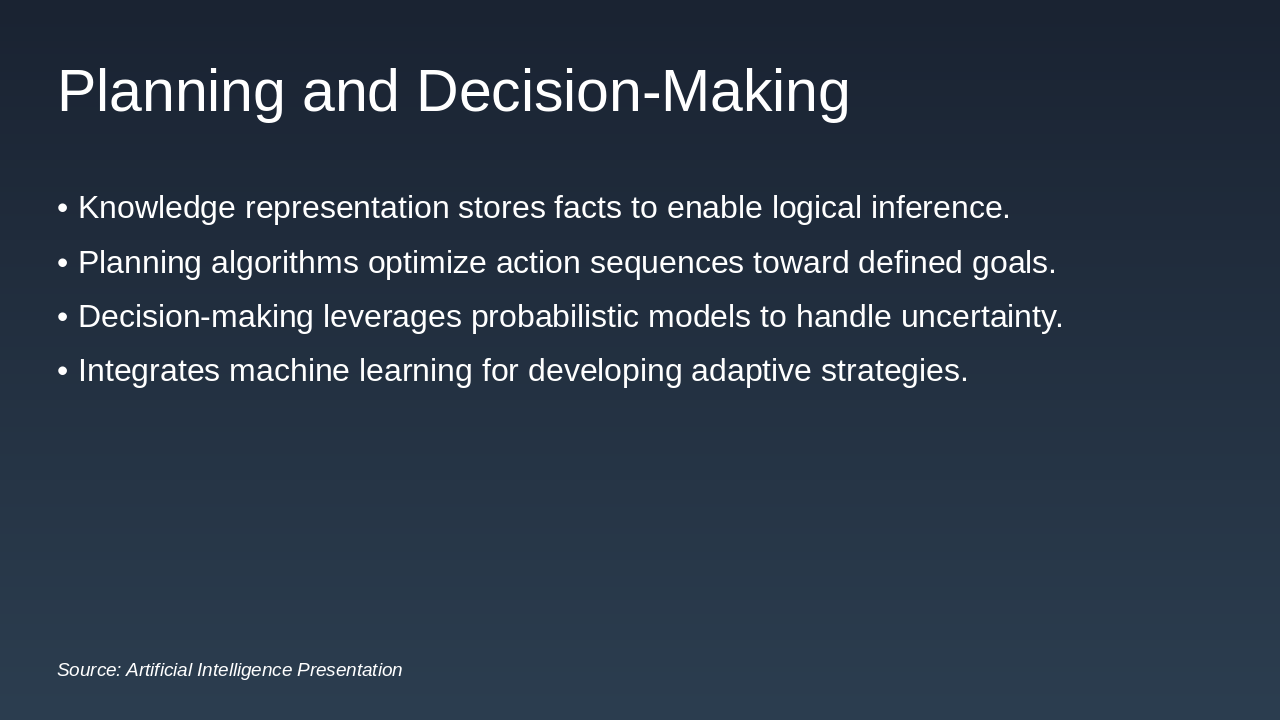
Planning and Decision-Making involves knowledge representation to store facts for logical inference, alongside planning algorithms that optimize action sequences to achieve goals. It also employs probabilistic models for decision-making under uncertainty and integrates machine learning to create adaptive strategies.

Planning and Decision-Making

  • Knowledge representation stores facts to enable logical inference.
  • Planning algorithms optimize action sequences toward defined goals.
  • Decision-making leverages probabilistic models to handle uncertainty.
  • Integrates machine learning for developing adaptive strategies.

Source: Artificial Intelligence Presentation

--- Speaker Notes: Highlights key components of AI planning and decision processes.

Slide 10
Slide 11 of 11

Slide 11 - Conclusion: The AI Frontier

The slide's conclusion highlights how AI is revolutionizing industries by mimicking human intelligence. It urges embracing ethical development to ensure a positive future and invites questions for discussion.

Conclusion: The AI Frontier

AI transforms industries through intelligence mimicking humans. Embrace ethical development for a beneficial future. Questions? Let's discuss!

--- Speaker Notes: Closing message: Embrace AI's transformative potential responsibly. Call-to-action: Let's discuss ethical AI applications together.

Slide 11
Powered by AI

Create Your Own Presentation

Generate professional presentations in seconds with Karaf's AI. Customize this presentation or start from scratch.

Create New Presentation

Powered by Karaf.ai — AI-Powered Presentation Generator