Partnership Profits & Losses: Philippine Civil Code

Generated from prompt:

Create a comprehensive presentation titled "Chapter 12: Partnership Operations" based entirely on the uploaded document "Partnership Operations.pdf" (15 pages). Structure: 1. Title Slide – Chapter 12: Partnership Operations 2. Learning Objectives (as shown on page 1) 3. Concept Overview – Division of Profits and Losses - Rules under Art. 1797 of the Philippine Civil Code - Industrial vs Capitalist Partner definitions 4. Partnership Agreements – Key Provisions - Salaries - Bonuses - Interest on Capital Contributions - Order of Allocation Include ALL Illustrations exactly as shown in the document. For each Illustration (1 to 9): - Create separate slides per case (Case 1, Case 2, etc.) - Snip and insert the original illustration tables/calculation layouts as images for clarity (use the scanned visuals per page). - Add a short discussion slide before each illustration explaining the concept involved. Illustrations to include: - Illustration 1: Salaries (Case 1 and Case 2) - Illustration 2: No P/L Ratio - Illustration 3: Bonus (Profit and Loss cases) - Illustration 4: Bonus with limit - Illustration 5: Interest on Capital (weighted average computation) - Illustration 6: Profit after salaries (salaries recognized as expenses) - Illustration 7: Reconstruction of information (T-account squeeze method) - Illustration 8: Reconstruction (Pro forma method) - Illustration 9: P/L ratio in fractions End with: - Chapter Summary (page 15 content) Ensure calculations and tables match the document exactly. Keep layout clean and academic. Use clear section dividers for each Illustration.

This chapter explores division of profits and losses in partnerships under Philippine Civil Code Art. 1797. Covers default rules, industrial vs. capitalist partners, key agreement provisions (salaries, bonuses, interest on capital, allocation order),

March 1, 202620 slides
Slide 1 of 20

Slide 1 - Chapter 12: Partnership Operations

Chapter 12: Partnership Operations

Division of Profits and Losses Under Philippine Civil Code

---

Photo by Iñaki del Olmo on Unsplash
Slide 1 - Chapter 12: Partnership Operations
Slide 2 of 20

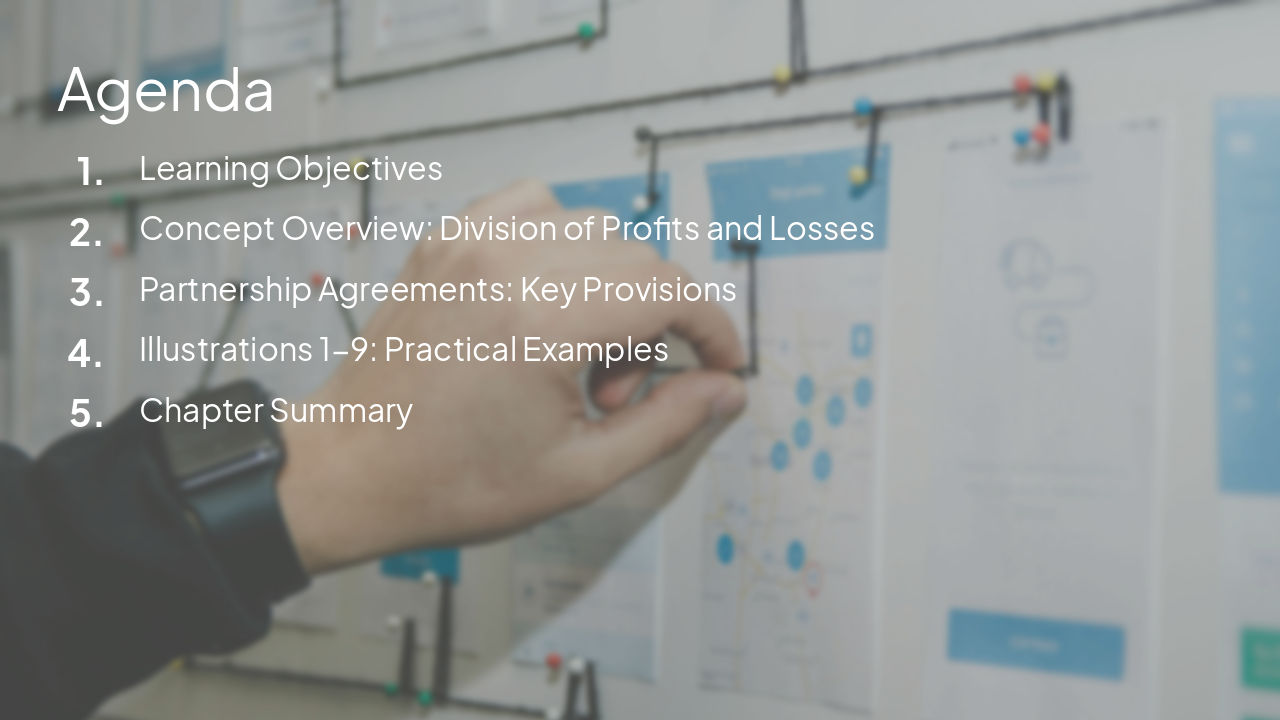
Slide 2 - Agenda

  • Learning Objectives
  • Concept Overview: Division of Profits and Losses
  • Partnership Agreements: Key Provisions
  • Illustrations 1-9: Practical Examples
  • Chapter Summary

---

Photo by Alvaro Reyes on Unsplash

Slide 2 - Agenda
Slide 3 of 20

Slide 3 - Learning Objectives

1

Learning Objectives

Key goals for understanding partnership operations

---

Photo by Dom Fou on Unsplash
Slide 3 - Learning Objectives
Slide 4 of 20

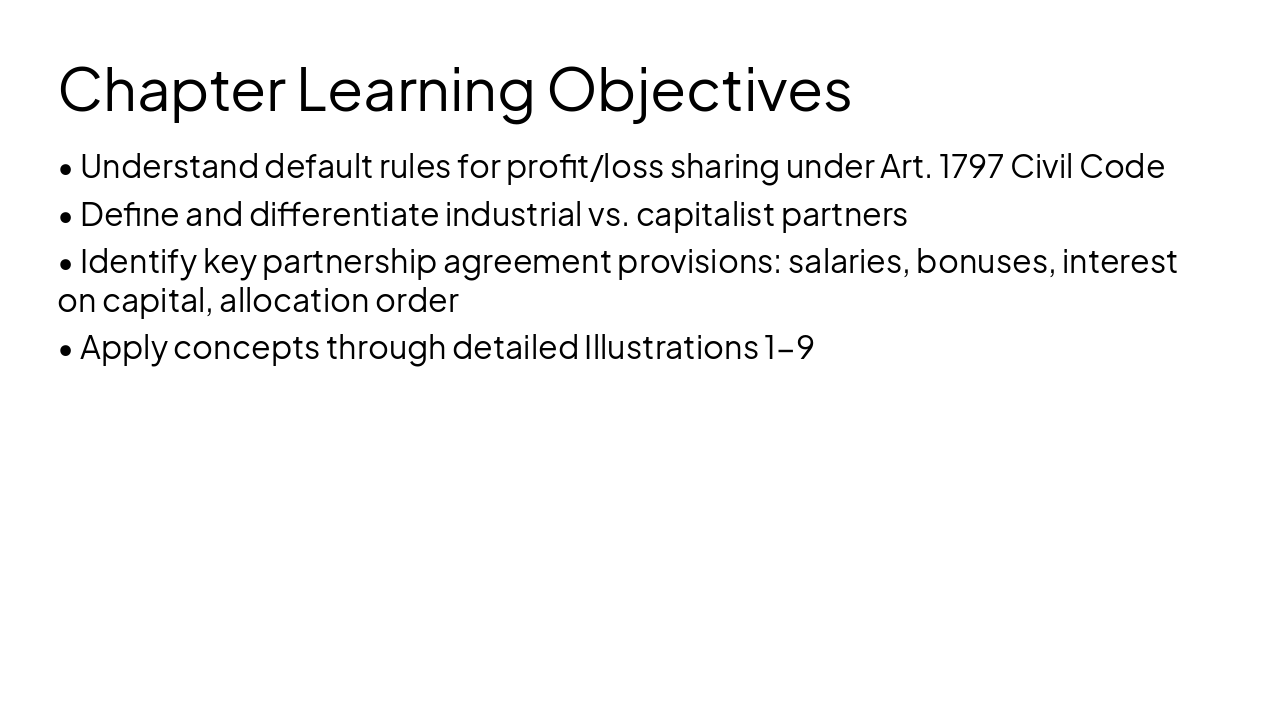
Slide 4 - Chapter Learning Objectives

  • Understand default rules for profit/loss sharing under Art. 1797 Civil Code
  • Define and differentiate industrial vs. capitalist partners
  • Identify key partnership agreement provisions: salaries, bonuses, interest on capital, allocation order
  • Apply concepts through detailed Illustrations 1-9
Slide 4 - Chapter Learning Objectives
Slide 5 of 20

Slide 5 - Concept Overview

2

Division of Profits and Losses

Rules under Philippine Civil Code

Slide 5 - Concept Overview
Slide 6 of 20

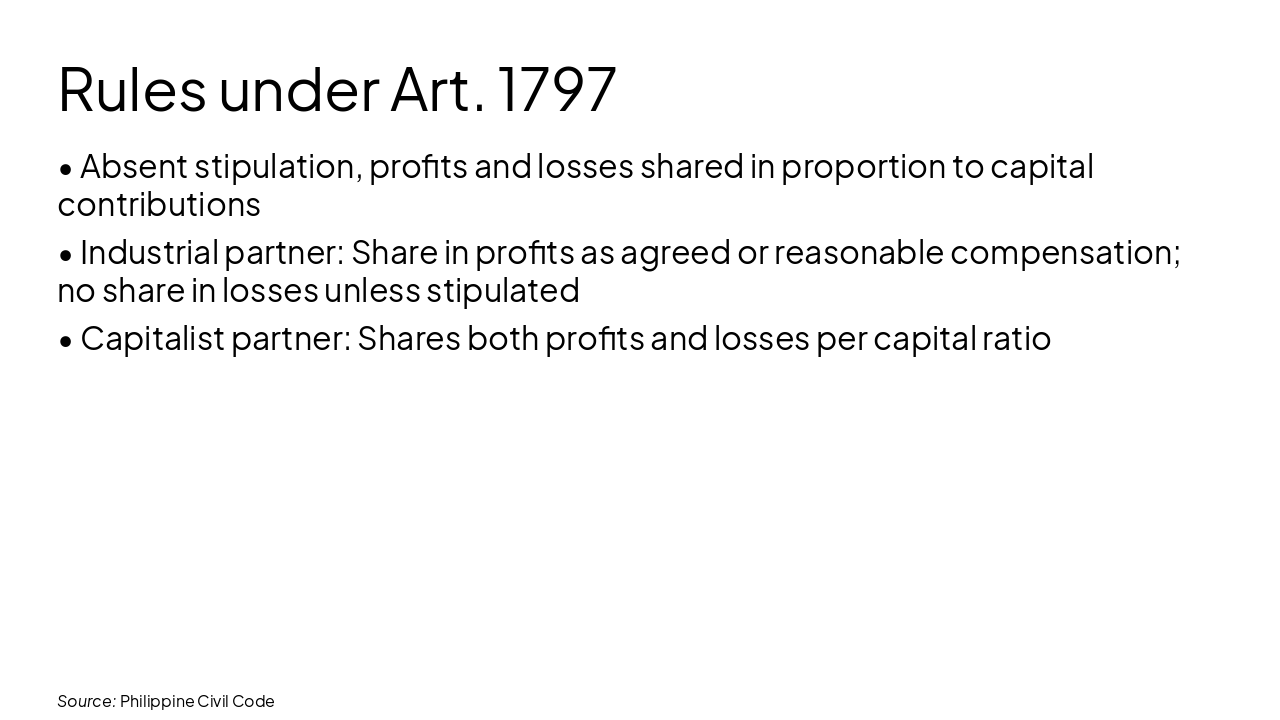
Slide 6 - Rules under Art. 1797

  • Absent stipulation, profits and losses shared in proportion to capital contributions
  • Industrial partner: Share in profits as agreed or reasonable compensation; no share in losses unless stipulated
  • Capitalist partner: Shares both profits and losses per capital ratio

Source: Philippine Civil Code

Slide 6 - Rules under Art. 1797
Slide 7 of 20

Slide 7 - Industrial vs. Capitalist Partners

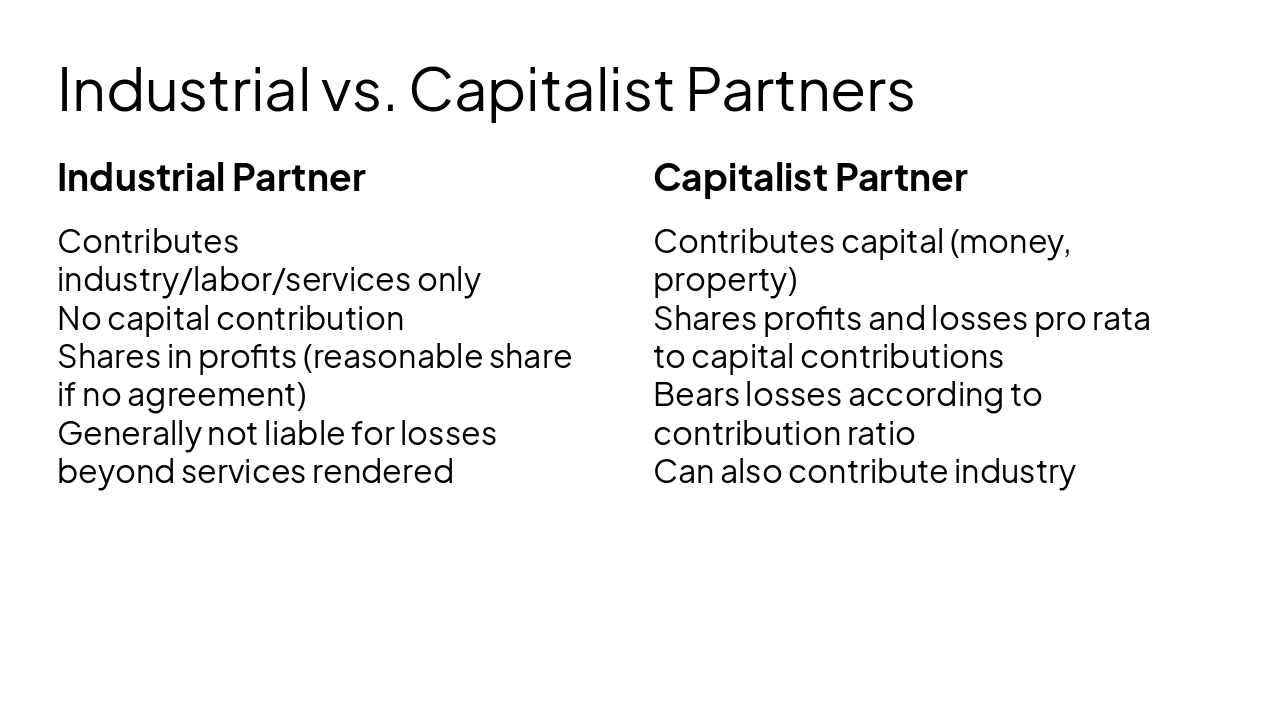
Industrial Partner Contributes industry/labor/services only No capital contribution Shares in profits (reasonable share if no agreement) Generally not liable for losses beyond services rendered

Capitalist Partner Contributes capital (money, property) Shares profits and losses pro rata to capital contributions Bears losses according to contribution ratio Can also contribute industry
Slide 7 - Industrial vs. Capitalist Partners
Slide 8 of 20

Slide 8 - Partnership Agreements

3

Key Provisions

Salaries, Bonuses, Interest, Allocation Order

---

Photo by Romain Dancre on Unsplash

Slide 8 - Partnership Agreements
Slide 9 of 20

Slide 9 - Key Provisions in Agreements

  • Salaries: Fixed amounts to partners as expense before profit sharing
  • Bonuses: Percentage of profits or fixed based on performance
  • Interest on Capital: 12% or agreed rate on advances/contributions, paid from profits
  • Order of Allocation: Salaries first, then interest/bonuses, remainder per P/L ratio
Slide 9 - Key Provisions in Agreements
Slide 10 of 20

Slide 10 - Illustration 1

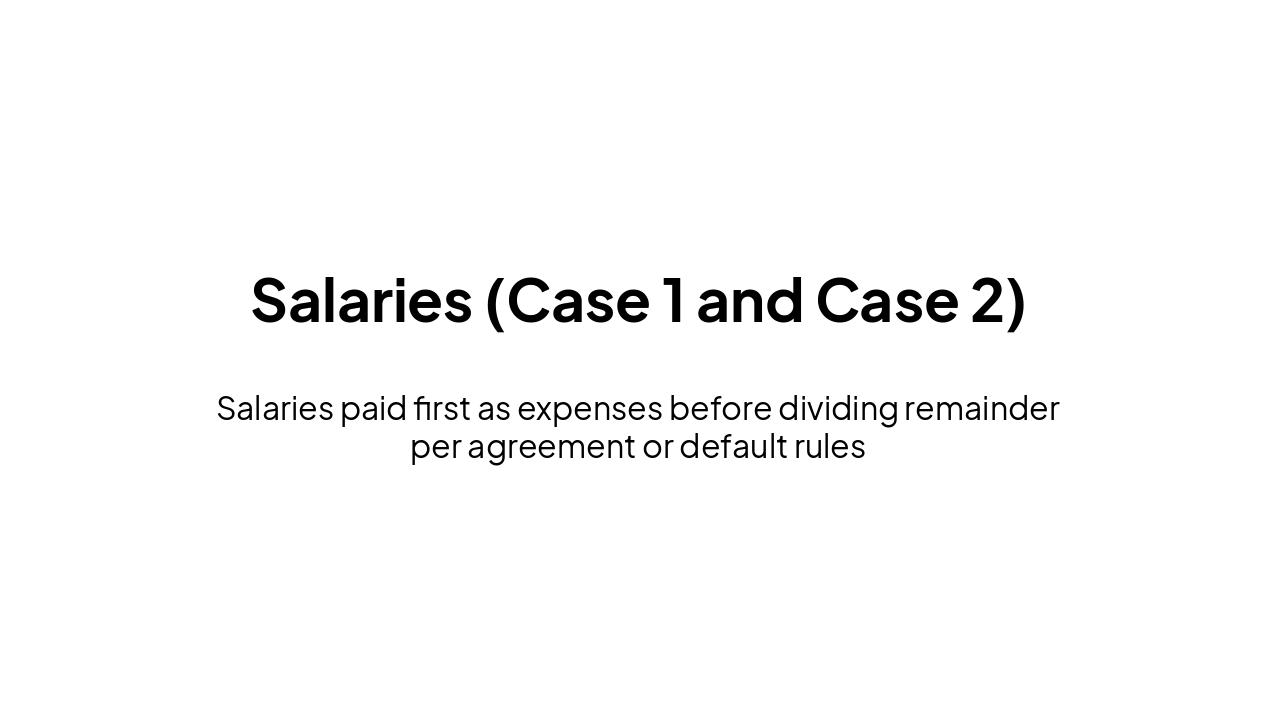
Salaries (Case 1 and Case 2)

Salaries paid first as expenses before dividing remainder per agreement or default rules
Slide 10 - Illustration 1
Slide 11 of 20

Slide 11 - Illustration 1 - Case 1: Salaries Only

  • Salaries paid regardless of profit
  • Remainder of profit divided equally (no P/L ratio)
  • Demonstrates priority of salaries in allocation

---

Photo by Blake Wisz on Unsplash

Slide 11 - Illustration 1 - Case 1: Salaries Only
Slide 12 of 20

Slide 12 - Illustration 1 - Case 2: Salaries with P/L Ratio

  • Salaries deducted first
  • Remainder divided per agreed P/L ratio (e.g., 5:3:2)
  • Shows interaction between salaries and ratio
Slide 12 - Illustration 1 - Case 2: Salaries with P/L Ratio
Slide 13 of 20

Slide 13 - Illustration 2

No P/L Ratio

Default equal sharing of profits when no ratio specified

---

Photo by Arturo Añez on Unsplash
Slide 13 - Illustration 2
Slide 14 of 20

Slide 14 - Illustration 2: No P/L Ratio

  • Total profit divided equally among partners
  • Applies default rule under Civil Code
  • Equal despite different capital contributions
Slide 14 - Illustration 2: No P/L Ratio
Slide 15 of 20

Slide 15 - Illustration 3

Bonus (Profit and Loss Cases)

Bonuses allocated before remainder profit sharing; losses absorb bonuses if insufficient profit
Slide 15 - Illustration 3
Slide 16 of 20

Slide 16 - Illustration 3: Bonus Examples

  • Bonus given to specific partner(s)
  • In profit: deducted before remainder
  • In loss: Bonus still paid if possible, or adjusted
Slide 16 - Illustration 3: Bonus Examples
Slide 17 of 20

Slide 17 - Illustration 4

Bonus with Limit

Bonus capped at certain amount or percentage to protect other partners

---

Photo by Adam Śmigielski on Unsplash

Slide 17 - Illustration 4
Slide 18 of 20

Slide 18 - Illustration 4: Bonus with Limit

  • Bonus not to exceed e.g., 20% of partner's share
  • Ensures equitable distribution
  • Computation shows cap application

---

Photo by Charles Forerunner on Unsplash
Slide 18 - Illustration 4: Bonus with Limit
Slide 19 of 20

Slide 19 - Illustration 5

Interest on Capital

Weighted average capital for interest computation

---

Photo by rc.xyz NFT gallery on Unsplash

Slide 19 - Illustration 5
Slide 20 of 20

Slide 20 - Illustration 5: Interest on Capital (Weighted Avg)

  • Interest computed on average capital during period
  • E.g., monthly weighted capitals averaged
  • Interest deducted before profit sharing
Slide 20 - Illustration 5: Interest on Capital (Weighted Avg)

Discover More Presentations

Explore thousands of AI-generated presentations for inspiration

Browse Presentations
Powered by AI

Create Your Own Presentation

Generate professional presentations in seconds with Karaf's AI. Customize this presentation or start from scratch.

Create New Presentation

Powered by Karaf.ai — AI-Powered Presentation Generator