O Agnosticismo: Filosofia do Desconhecido

Generated from prompt:

quero fazer uma apresentação em slides no canva sobre o agnosticismo

Esta apresentação explora o agnosticismo, definindo-o como a incapacidade humana de provar ou refutar crenças religiosas, com foco na limitação do conhecimento. Inclui história, comparações com outras

November 11, 202510 slides
Slide 1 of 10

Slide 1 - O Agnosticismo

The slide is titled "O Agnosticismo" and serves as a title page. It features the main text "O Agnosticismo: Filosofia do Desconhecido," with a subtitle introducing the belief in uncertainty and the limits of human knowledge.

O Agnosticismo: Filosofia do Desconhecido

Uma introdução à crença na incerteza e no limite do conhecimento humano.
Slide 1
Slide 2 of 10

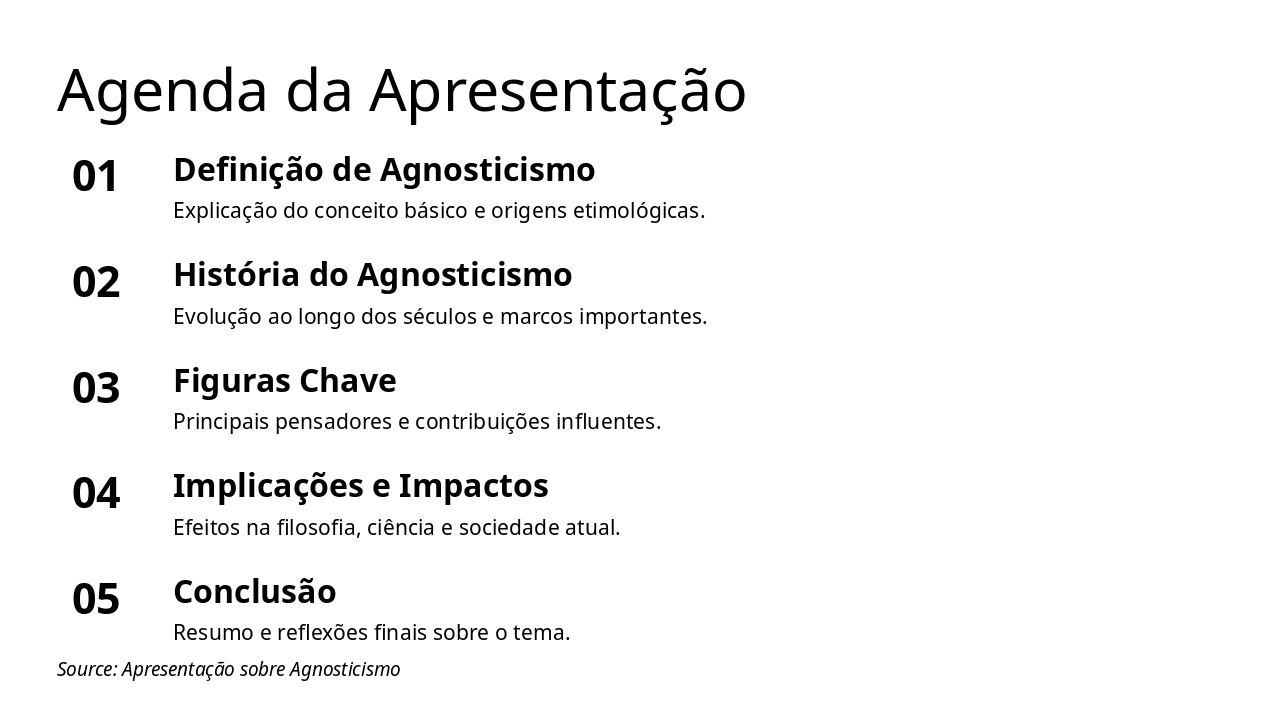
Slide 2 - Agenda da Apresentação

The presentation agenda outlines key sections on agnosticism, starting with its definition and etymological origins. It then covers the history and major milestones, influential figures and their contributions, implications for philosophy, science, and modern society, followed by a concluding summary and reflections.

Agenda da Apresentação

  1. Definição de Agnosticismo

Explicação do conceito básico e origens etimológicas.

  1. História do Agnosticismo

Evolução ao longo dos séculos e marcos importantes.

  1. Figuras Chave

Principais pensadores e contribuições influentes.

  1. Implicações e Impactos

Efeitos na filosofia, ciência e sociedade atual.

  1. Conclusão

Resumo e reflexões finais sobre o tema.

Source: Apresentação sobre Agnosticismo

Slide 2
Slide 3 of 10

Slide 3 - O Que é Agnosticismo?

This slide serves as a section header titled "O Que é Agnosticismo?", which translates to "What is Agnosticism?" in English. Its subtitle introduces the core concept of agnosticism in a clear and accessible manner.

O Que é Agnosticismo?

Introduzindo o conceito central do agnosticismo de forma clara e acessível.

Slide 3
Slide 4 of 10

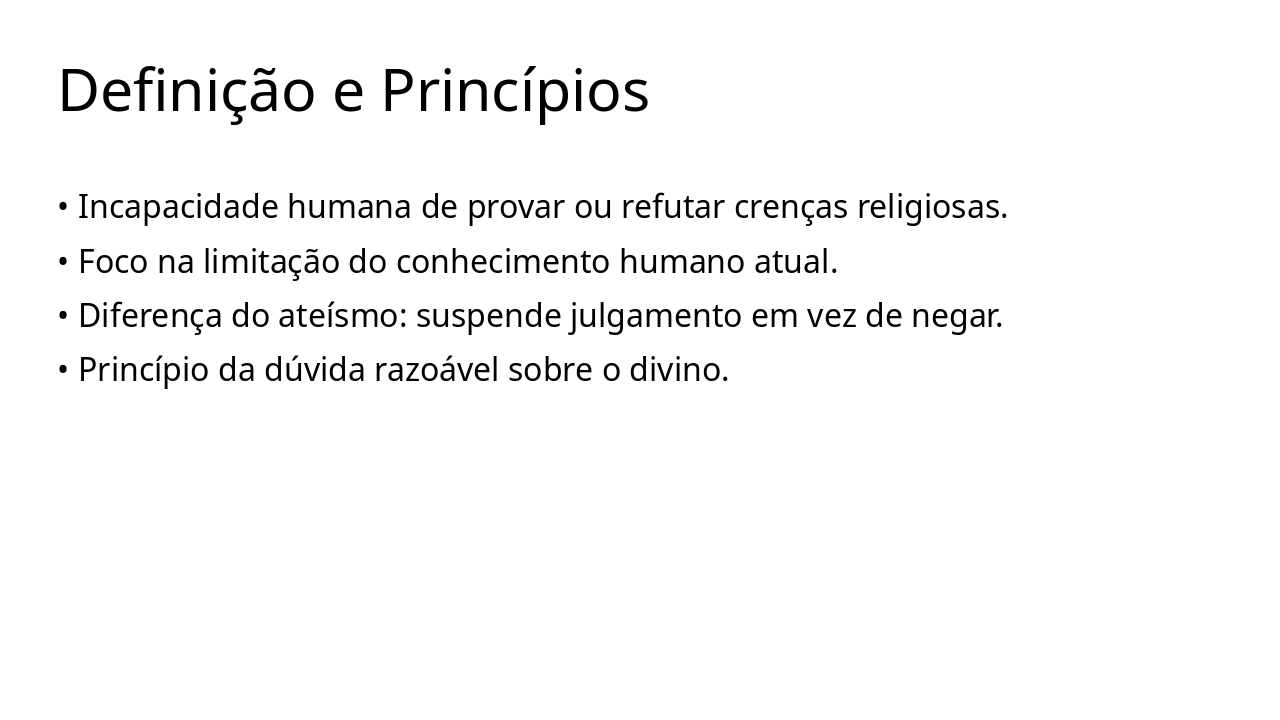
Slide 4 - Definição e Princípios

This slide defines agnosticism as the human inability to prove or disprove religious beliefs, emphasizing the limitations of current human knowledge. Unlike atheism, it suspends judgment rather than denying the divine, guided by the principle of reasonable doubt about the supernatural.

Definição e Princípios

  • Incapacidade humana de provar ou refutar crenças religiosas.
  • Foco na limitação do conhecimento humano atual.
  • Diferença do ateísmo: suspende julgamento em vez de negar.
  • Princípio da dúvida razoável sobre o divino.
Slide 4
Slide 5 of 10

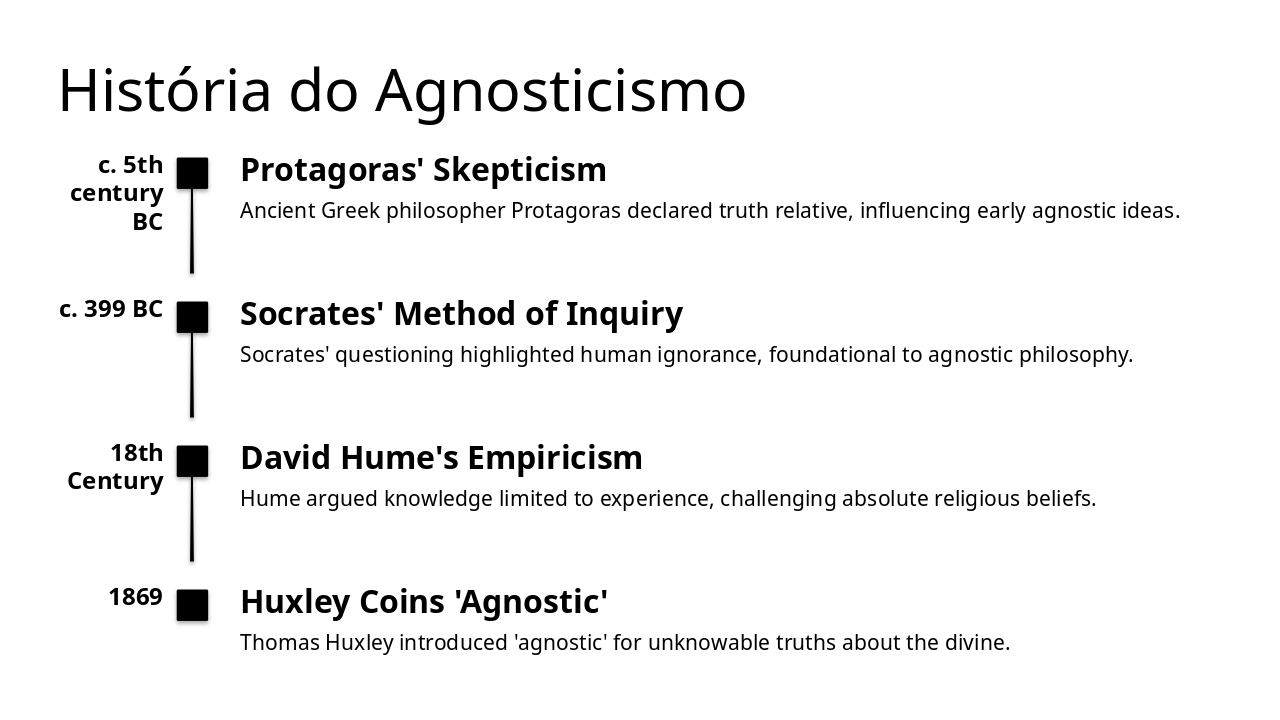
Slide 5 - História do Agnosticismo

The timeline on the history of agnosticism begins in ancient Greece around the 5th century BC with Protagoras' relativist skepticism and Socrates' inquisitive method that emphasized human ignorance in 399 BC. It advances to the 18th century with David Hume's empiricism, which restricted knowledge to sensory experience and questioned religious absolutes, culminating in 1869 when Thomas Huxley coined the term "agnostic" to describe unknowable divine truths.

História do Agnosticismo

c. 5th century BC: Protagoras' Skepticism Ancient Greek philosopher Protagoras declared truth relative, influencing early agnostic ideas. c. 399 BC: Socrates' Method of Inquiry Socrates' questioning highlighted human ignorance, foundational to agnostic philosophy. 18th Century: David Hume's Empiricism Hume argued knowledge limited to experience, challenging absolute religious beliefs. 1869: Huxley Coins 'Agnostic' Thomas Huxley introduced 'agnostic' for unknowable truths about the divine.

Slide 5
Slide 6 of 10

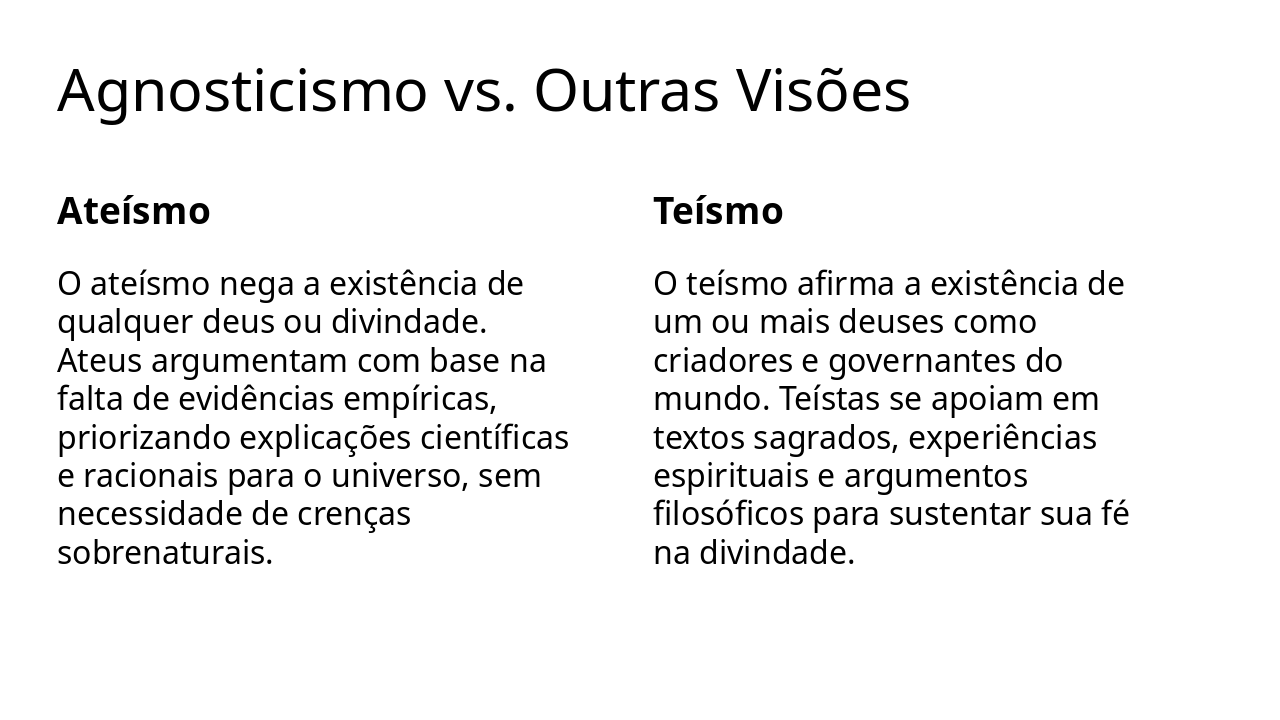
Slide 6 - Agnosticismo vs. Outras Visões

The slide contrasts agnosticism with atheism and theism in a two-column format. Atheism denies the existence of gods based on a lack of empirical evidence and favors scientific explanations, while theism affirms the reality of one or more deities supported by sacred texts, spiritual experiences, and philosophical arguments.

Agnosticismo vs. Outras Visões

AteísmoTeísmo
O ateísmo nega a existência de qualquer deus ou divindade. Ateus argumentam com base na falta de evidências empíricas, priorizando explicações científicas e racionais para o universo, sem necessidade de crenças sobrenaturais.O teísmo afirma a existência de um ou mais deuses como criadores e governantes do mundo. Teístas se apoiam em textos sagrados, experiências espirituais e argumentos filosóficos para sustentar sua fé na divindade.
Slide 6
Slide 7 of 10

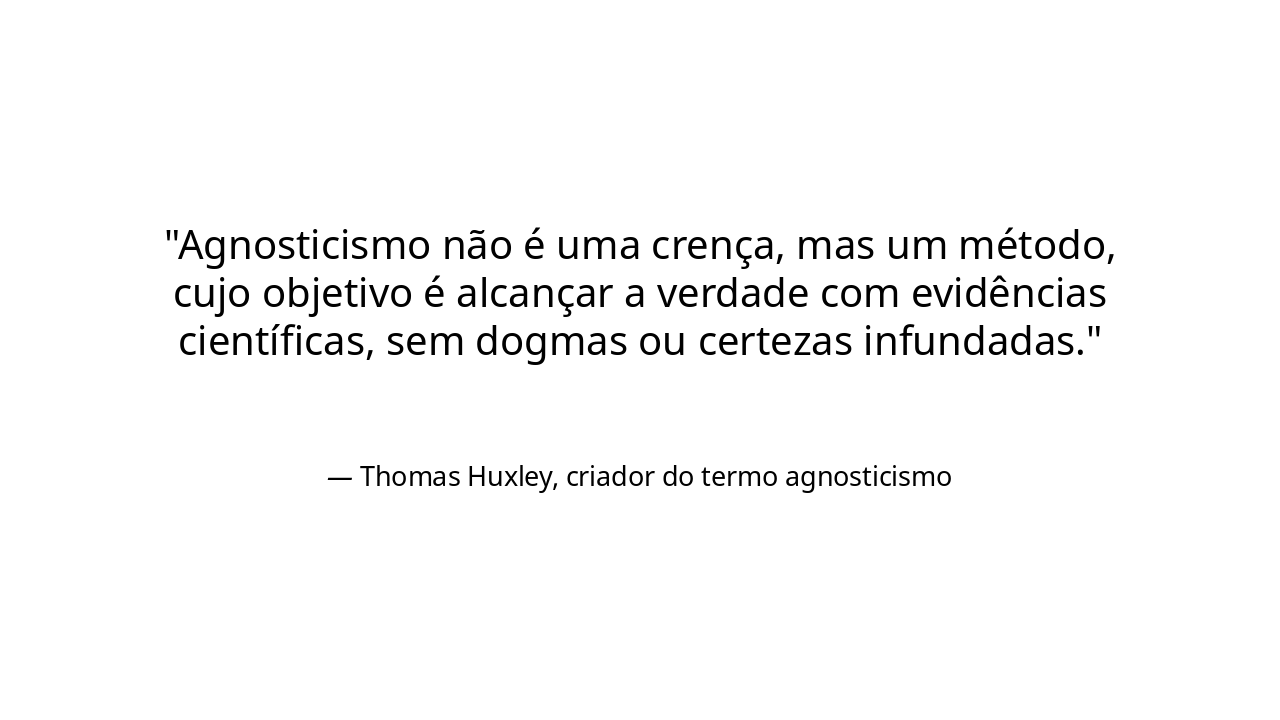
Slide 7 - Citação de Thomas Huxley

The slide features a quote from Thomas Huxley, the originator of the term "agnosticism," defining it as not a belief but a method aimed at discovering truth through scientific evidence, free from dogmas or unfounded certainties. It presents this idea in Portuguese under the title "Citação de Thomas Huxley" as a quote-type slide.

Citação de Thomas Huxley

> Agnosticismo não é uma crença, mas um método, cujo objetivo é alcançar a verdade com evidências científicas, sem dogmas ou certezas infundadas.

— Thomas Huxley, criador do termo agnosticismo

--- Speaker Notes: Apresentação sobre agnosticismo no Canva. Quote impactante: 'Agnosticismo não é uma crença, mas um método.' - Thomas Huxley, criador do termo agnosticismo.

Slide 7
Slide 8 of 10

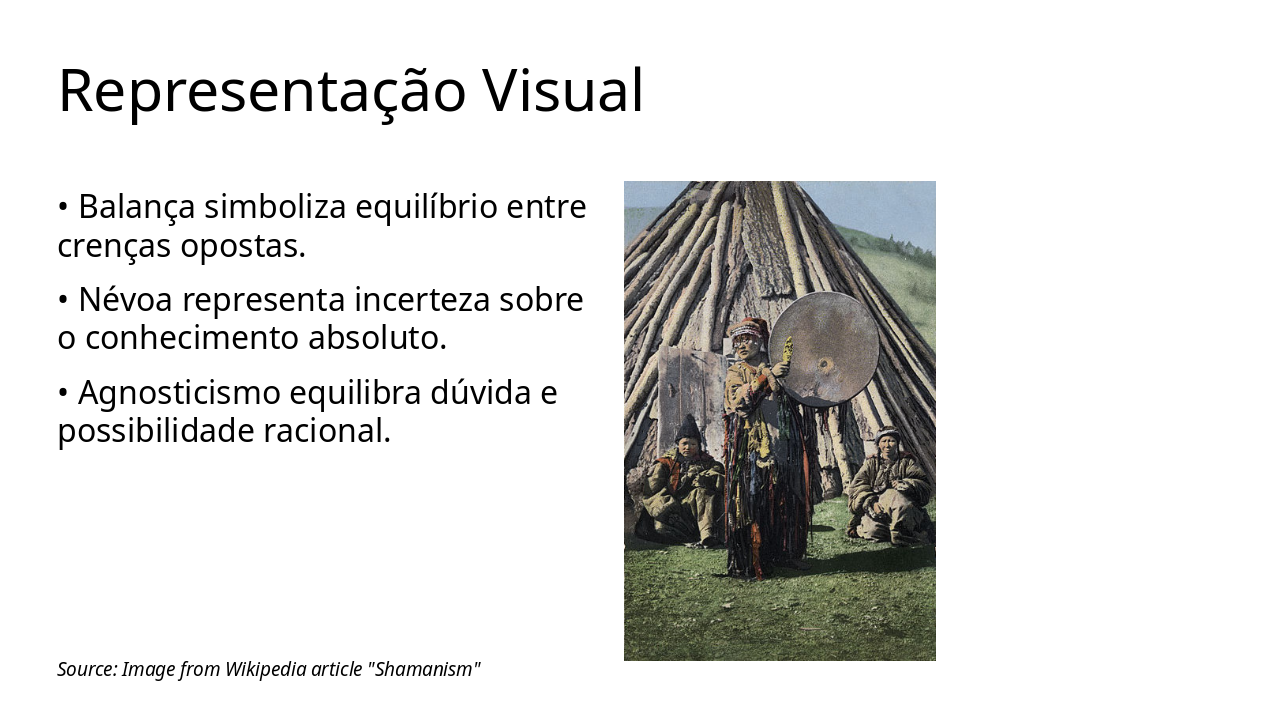
Slide 8 - Representação Visual

The slide titled "Representação Visual" features an image symbolizing agnosticism through a balance scale representing equilibrium between opposing beliefs, shrouded in mist to depict uncertainty about absolute knowledge. It highlights how agnosticism balances rational doubt with the possibility of understanding.

Representação Visual

!Image

  • Balança simboliza equilíbrio entre crenças opostas.
  • Névoa representa incerteza sobre o conhecimento absoluto.
  • Agnosticismo equilibra dúvida e possibilidade racional.

Source: Image from Wikipedia article "Shamanism"

Slide 8
Slide 9 of 10

Slide 9 - Prevalência Atual

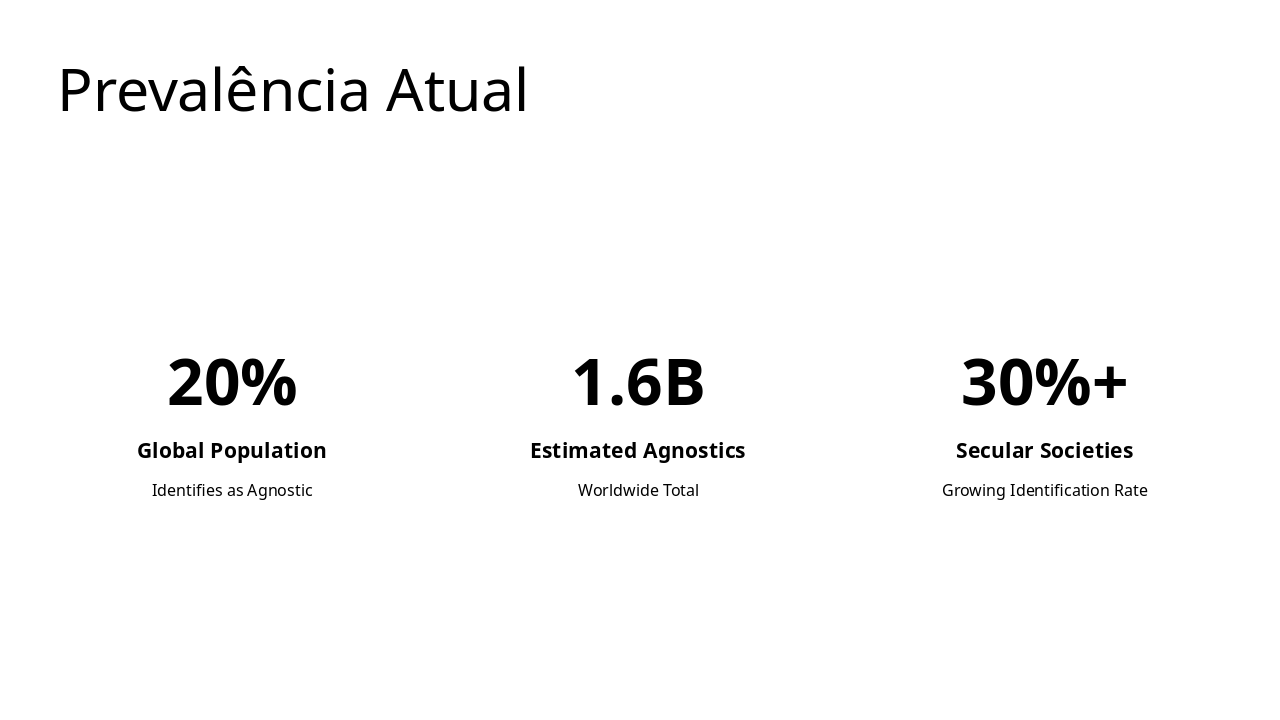
The slide "Prevalência Atual" highlights that 20% of the global population identifies as agnostic, equating to an estimated 1.6 billion people worldwide. It also notes a growing identification rate exceeding 30% in secular societies.

Prevalência Atual

  • 20%: Global Population

Identifies as Agnostic

  • 1.6B: Estimated Agnostics

Worldwide Total

  • 30%+: Secular Societies

Growing Identification Rate

Slide 9
Slide 10 of 10

Slide 10 - Conclusão

The slide's main text presents agnosticism as a stance of intellectual humility and openness to uncertainty. Its subtitle encourages reflecting on one's beliefs and embracing uncertainty throughout life's journey.

Conclusão

Agnosticismo: humildade intelectual e abertura ao incerto.

Reflita sobre suas crenças e abrace a incerteza em sua jornada.

--- Speaker Notes: Resumo: Agnosticismo promove humildade intelectual e abertura ao incerto. Reflexão final para o público.

Slide 10
Powered by AI

Create Your Own Presentation

Generate professional presentations in seconds with Karaf's AI. Customize this presentation or start from scratch.

Create New Presentation

Powered by Karaf.ai — AI-Powered Presentation Generator