Economic Report: Understanding Key Concepts and Theories

Generated from prompt:

Economic Report

This presentation provides an introduction to fundamental economic concepts, differentiating between microeconomics and macroeconomics. It then explores influential schools of thought, including the core principles and historical evolution of Keynesian economics, and the insights from behavioral economics regarding human decision-making.

May 16, 202610 slides
Slide 1 of 10

Slide 1 - Economic Report
Economic Report

Understanding Key Concepts and Theories

---

Photo by Pedro Lastra on Unsplash

Slide 1 - Economic Report
Slide 2 of 10

Slide 2 - Agenda

  • Introduction to Economics
  • Microeconomics vs. Macroeconomics
  • Keynesian Economics
  • Behavioral Economics
  • Conclusion

---

Photo by Markus Winkler on Unsplash

Slide 2 - Agenda
Slide 3 of 10

Slide 3

1

Introduction to Economics

Defining the Study of Scarcity and Choice

---

Photo by Conny Schneider on Unsplash
Slide 3
Slide 4 of 10

Slide 4 - What is Economics?

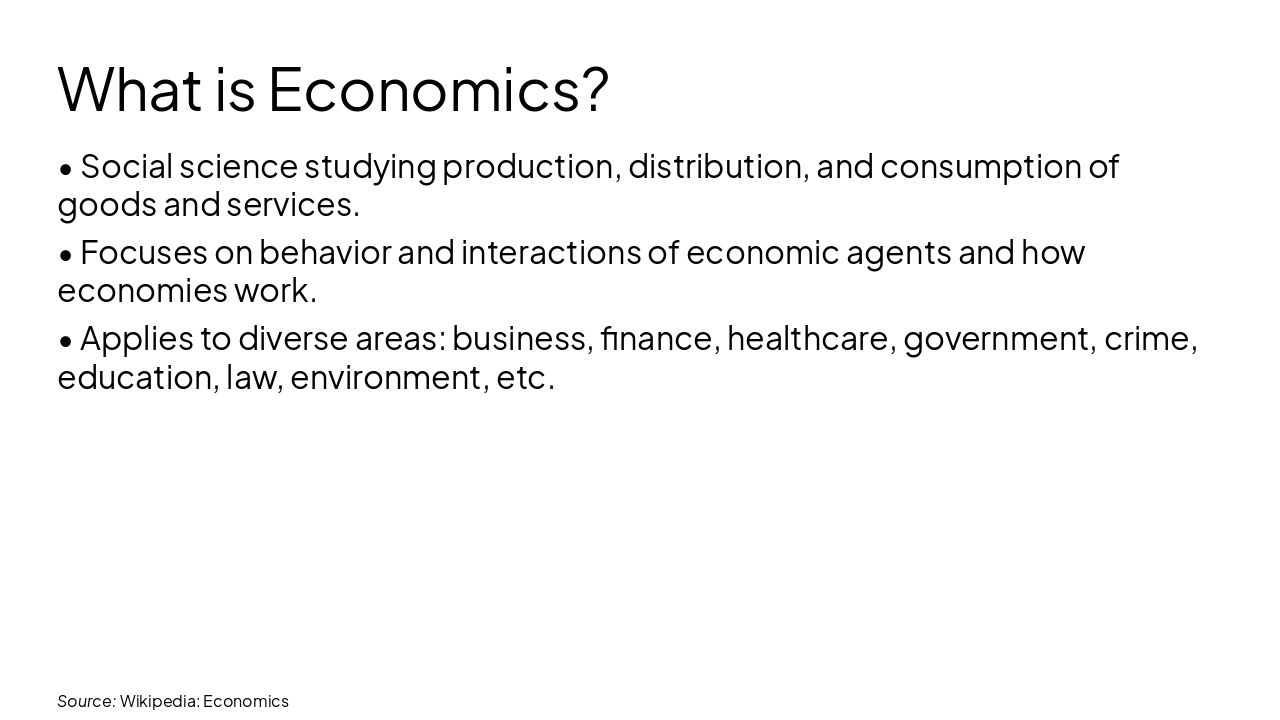
  • Social science studying production, distribution, and consumption of goods and services.
  • Focuses on behavior and interactions of economic agents and how economies work.
  • Applies to diverse areas: business, finance, healthcare, government, crime, education, law, environment, etc.

Source: Wikipedia: Economics

Slide 4 - What is Economics?
Slide 5 of 10

Slide 5 - Microeconomics vs. Macroeconomics

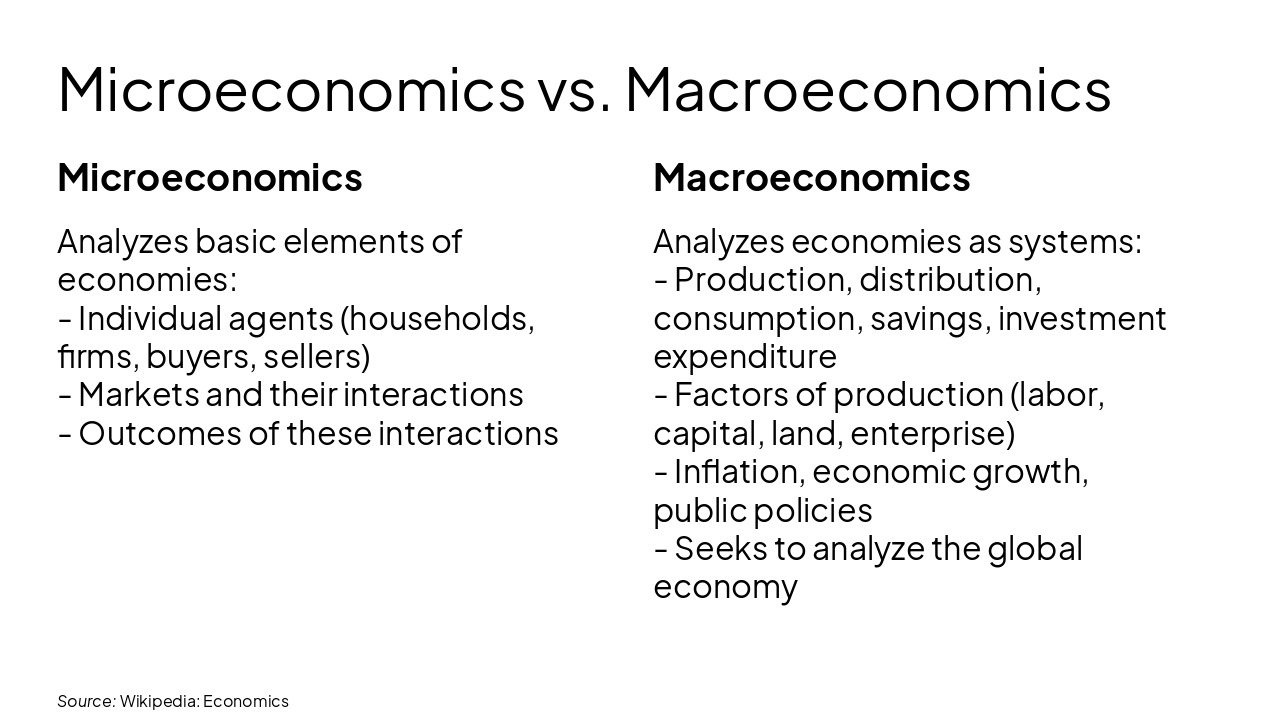
Microeconomics Analyzes basic elements of economies:

  • Individual agents (households, firms, buyers, sellers)
  • Markets and their interactions
  • Outcomes of these interactions

Macroeconomics Analyzes economies as systems:

  • Production, distribution, consumption, savings, investment expenditure
  • Factors of production (labor, capital, land, enterprise)
  • Inflation, economic growth, public policies
  • Seeks to analyze the global economy

Source: Wikipedia: Economics

Slide 5 - Microeconomics vs. Macroeconomics
Slide 6 of 10

Slide 6

2

Key Economic Theories

Exploring Influential Economic Schools of Thought

---

Photo by Heeren Darji on Unsplash
Slide 6
Slide 7 of 10

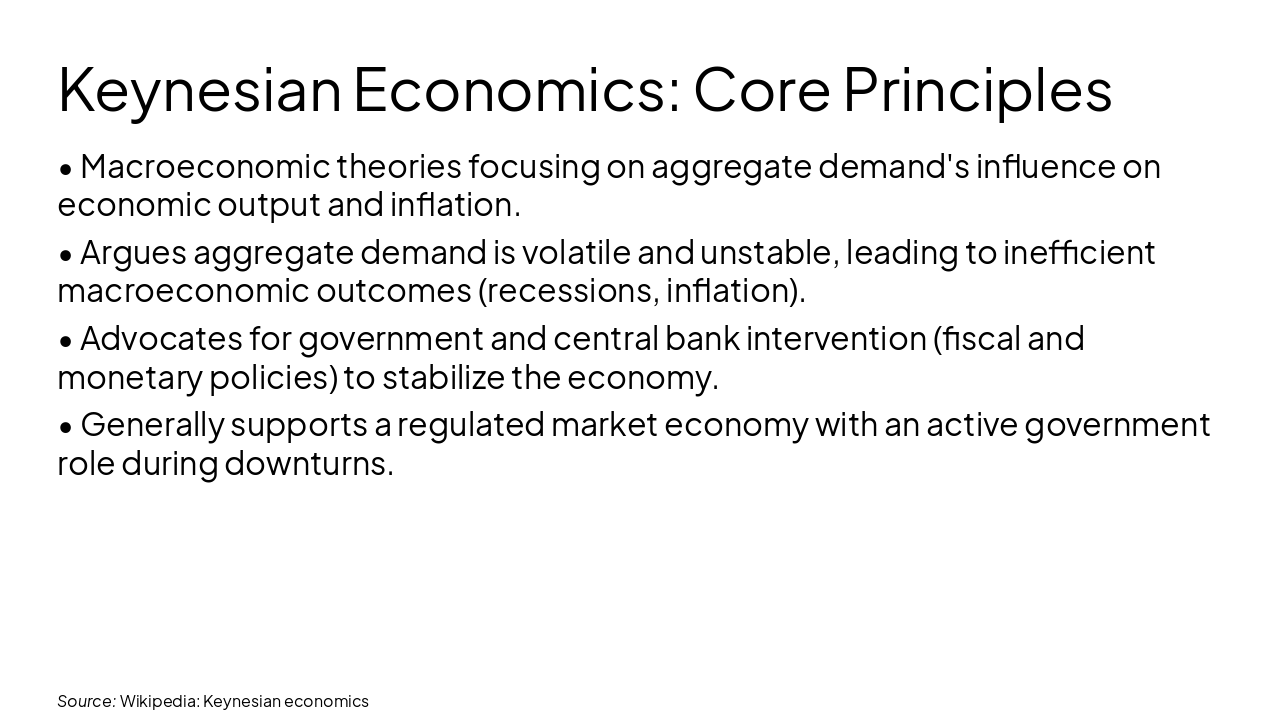
Slide 7 - Keynesian Economics: Core Principles

  • Macroeconomic theories focusing on aggregate demand's influence on economic output and inflation.
  • Argues aggregate demand is volatile and unstable, leading to inefficient macroeconomic outcomes (recessions, inflation).
  • Advocates for government and central bank intervention (fiscal and monetary policies) to stabilize the economy.
  • Generally supports a regulated market economy with an active government role during downturns.

Source: Wikipedia: Keynesian economics
Slide 7 - Keynesian Economics: Core Principles
Slide 8 of 10

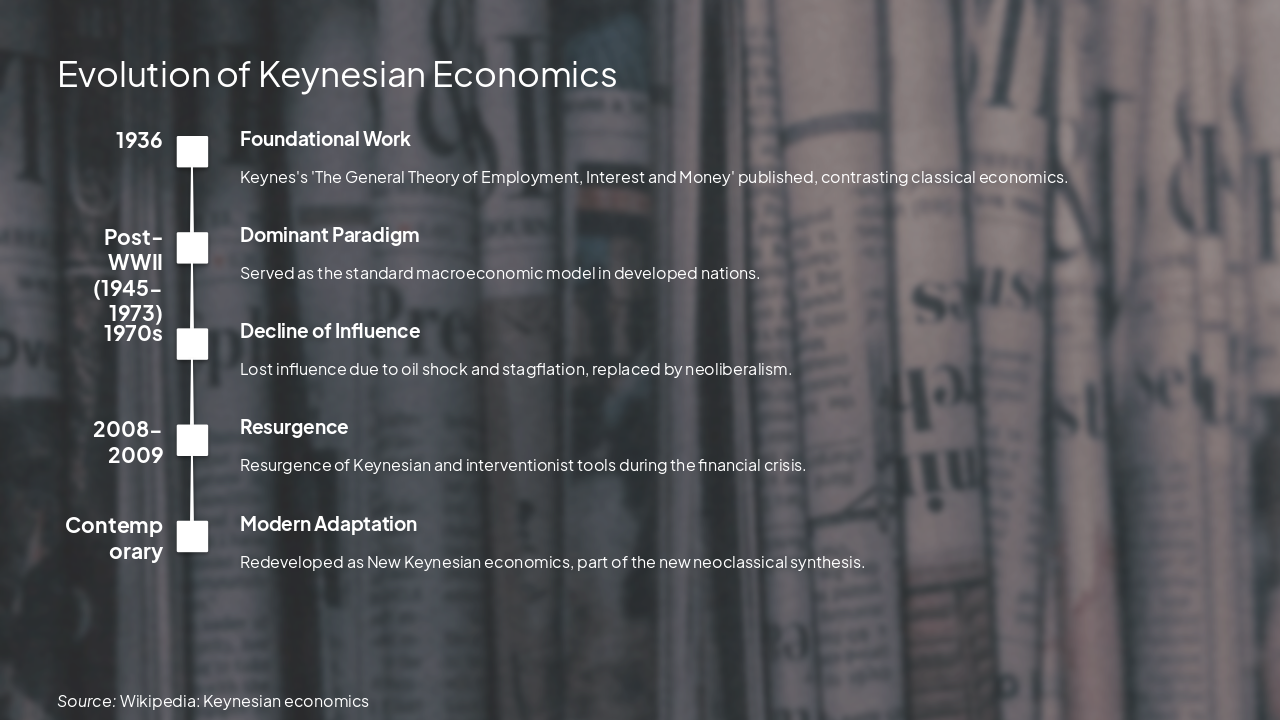
Slide 8 - Evolution of Keynesian Economics

1936: Foundational Work Keynes's 'The General Theory of Employment, Interest and Money' published, contrasting classical economics. Post-WWII (1945-1973): Dominant Paradigm Served as the standard macroeconomic model in developed nations. 1970s: Decline of Influence Lost influence due to oil shock and stagflation, replaced by neoliberalism. 2008-2009: Resurgence Resurgence of Keynesian and interventionist tools during the financial crisis. Contemporary: Modern Adaptation Redeveloped as New Keynesian economics, part of the new neoclassical synthesis.

---

Photo by Jonathan Gong on Unsplash

Source: Wikipedia: Keynesian economics
Slide 8 - Evolution of Keynesian Economics
Slide 9 of 10

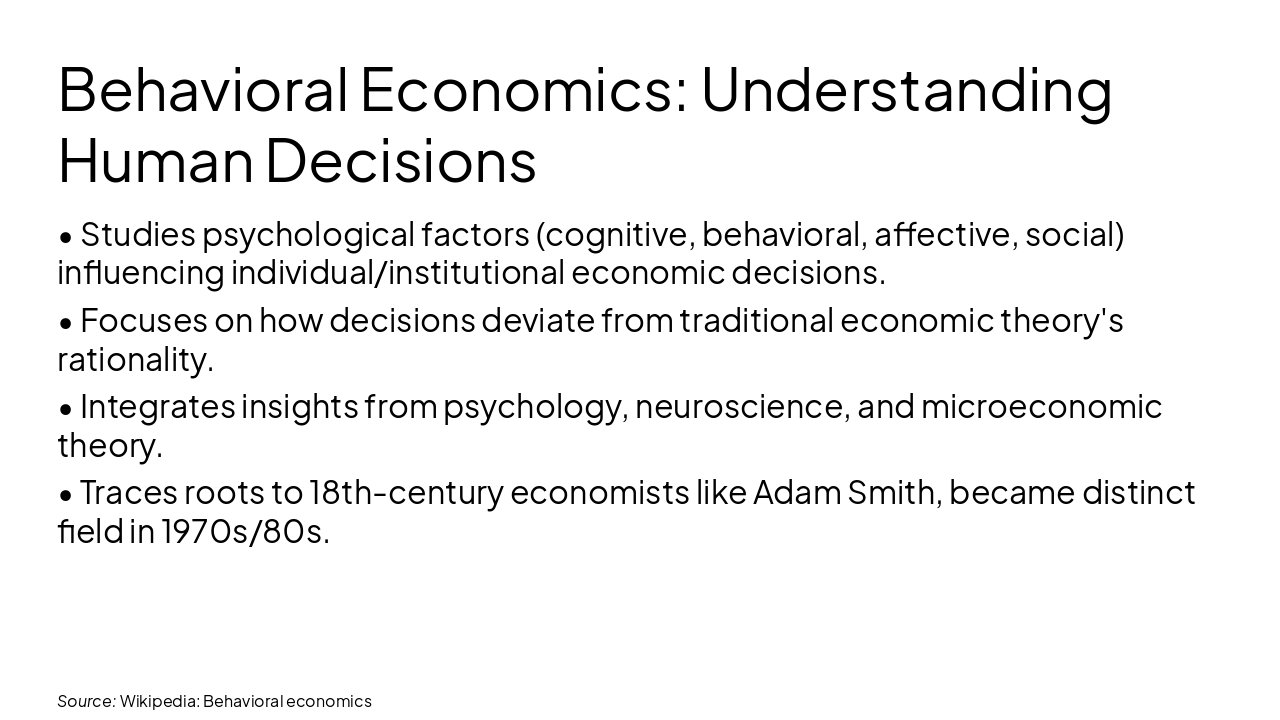
Slide 9 - Behavioral Economics: Understanding Human Decisions

  • Studies psychological factors (cognitive, behavioral, affective, social) influencing individual/institutional economic decisions.
  • Focuses on how decisions deviate from traditional economic theory's rationality.
  • Integrates insights from psychology, neuroscience, and microeconomic theory.
  • Traces roots to 18th-century economists like Adam Smith, became distinct field in 1970s/80s.

Source: Wikipedia: Behavioral economics
Slide 9 - Behavioral Economics: Understanding Human Decisions
Slide 10 of 10

Slide 10 - Conclusion

Economics is a dynamic field that continually evolves to understand complex human and systemic interactions.

---

Photo by Алекс Арцибашев on Unsplash
Slide 10 - Conclusion

Discover More Presentations

Explore thousands of AI-generated presentations for inspiration

Browse Presentations
Powered by AI

Create Your Own Presentation

Generate professional presentations in seconds with Karaf's AI. Customize this presentation or start from scratch.

Create New Presentation

Powered by Karaf.ai — AI-Powered Presentation Generator