Discovering Turtles: Ancient Wonders

Generated from prompt:

Create a Google Slides-style presentation about turtles. Include slides on: 1) Introduction to turtles, 2) Types of turtles, 3) Habitat and diet, 4) Turtle anatomy, 5) Life cycle, 6) Importance to the ecosystem, 7) Threats and conservation efforts, and 8) Fun facts about turtles. Use a clean, nature-inspired design with photos of turtles and ocean backgrounds.

Explore turtles' 220M-year history, 350+ species, habitats/diets, anatomy, life cycle, ecosystem roles, threats/conservation, and fun facts in a nature-inspired slideshow with ocean backgrounds and ph

December 15, 202511 slides
Slide 1 of 11

Slide 1 - Discovering Turtles

This title slide is named "Discovering Turtles." It includes the subtitle "From Habitats to Conservation."

Discovering Turtles

From Habitats to Conservation

Speaker Notes
Vibrant title slide with ocean waves background, majestic sea turtle photo, and subtitle: 'From Habitats to Conservation'. Use a clean, nature-inspired design.
Slide 1 - Discovering Turtles
Slide 2 of 11

Slide 2 - Presentation Agenda

This slide outlines the agenda for a presentation on turtles, covering introduction and types, habitat, diet, anatomy, life cycle, ecosystem role, threats, conservation efforts, and fun facts. Each topic includes a brief description of its focus, from basic overviews to environmental importance and trivia.

Presentation Agenda

  1. Introduction and Types of Turtles
  2. Basic overview and classification of different turtle species.

  3. Habitat, Diet, and Anatomy
  4. Where they live, what they eat, and physical features.

  5. Life Cycle and Ecosystem Role
  6. From egg to adult and their environmental importance.

  7. Threats and Conservation Efforts
  8. Dangers facing turtles and actions to protect them.

  9. Fun Facts about Turtles

Interesting and surprising trivia about these reptiles. Source: Turtles Presentation

Slide 2 - Presentation Agenda
Slide 3 of 11

Slide 3 - Introduction to Turtles

Turtles are ancient reptiles over 220 million years old, with more than 350 species worldwide across land, freshwater, and sea varieties. Their shell serves as both a home and protective armor.

Introduction to Turtles

  • Ancient reptiles: 220 million years old
  • Over 350 species worldwide
  • Land, freshwater, and sea varieties
  • Shell serves as home and armor
Slide 3 - Introduction to Turtles
Slide 4 of 11

Slide 4 - Types of Turtles

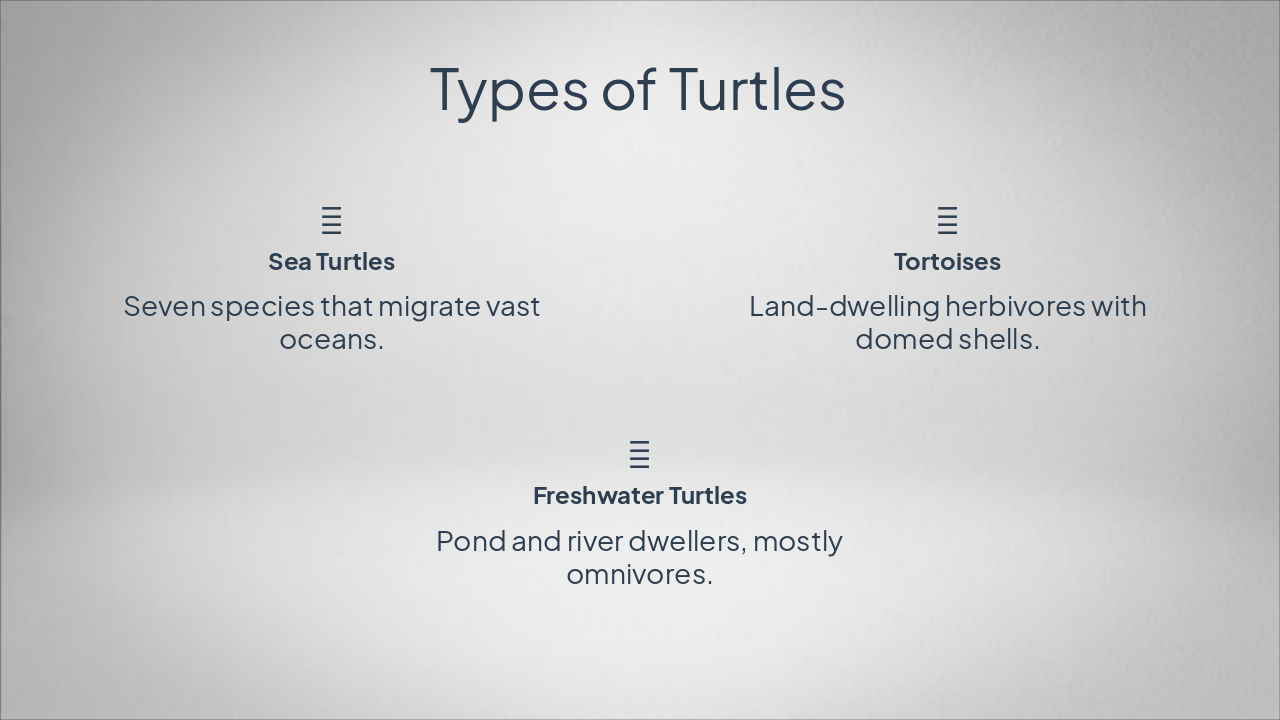
The "Types of Turtles" feature_grid slide categorizes turtles into three main types with turtle icons. It highlights Sea Turtles as seven ocean-migrating species, Tortoises as land-dwelling herbivores with domed shells, and Freshwater Turtles as mostly omnivorous pond and river dwellers.

Types of Turtles

{ "features": [ { "icon": "🐢", "heading": "Sea Turtles", "description": "Seven species that migrate vast oceans." }, { "icon": "🐢", "heading": "Tortoises", "description": "Land-dwelling herbivores with domed shells." }, { "icon": "🐢", "heading": "Freshwater Turtles", "description": "Pond and river dwellers, mostly omnivores." } ] }

Speaker Notes
Sea Turtles (7 species, ocean migrators); Tortoises (land-dwelling, herbivores); Freshwater Turtles (ponds, omnivores). Images of each.
Slide 4 - Types of Turtles
Slide 5 of 11

Slide 5 - Habitat and Diet

Turtles thrive in diverse habitats, including oceans for sea turtles, beaches for nesting, rivers and lakes for freshwater species, and forests for terrestrial ones. Their diet varies by habitat: sea turtles eat jellyfish and krill, land turtles consume plants, and freshwater turtles eat fish, insects, and plants.

Habitat and Diet

HabitatsDiet
Turtles thrive in diverse environments: oceans for sea turtles, beaches for nesting, rivers and lakes for freshwater species, and forests for terrestrial ones.Diet varies by habitat—sea turtles eat jellyfish and krill; land turtles munch on plants; freshwater turtles consume fish, insects, and plants.

Source: Turtle habitat photo

Slide 5 - Habitat and Diet
Slide 6 of 11

Slide 6 - Turtle Anatomy

The "Turtle Anatomy" slide displays an image labeling key features: the protective shell (carapace top, plastron bottom), powerful swimming flippers, sharp tearing beak, and eyes for 360° vision. It highlights that vital organs like the heart are safely housed within the shell.

Turtle Anatomy

!Image

  • Shell: carapace (top) and plastron (bottom) protect vital organs.
  • Flippers: powerful limbs adapted for swimming and propulsion.
  • Beak: hard, sharp structure for tearing food.
  • Eyes: positioned for nearly 360° panoramic vision.
  • Bonus: Heart located safely within the shell.

Source: Image from Wikipedia article "Clitoris"

Slide 6 - Turtle Anatomy
Slide 7 of 11

Slide 7 - Turtle Life Cycle

The Turtle Life Cycle timeline begins with egg development (0-60 days) on sandy beaches, followed by hatchlings emerging and dashing to the ocean. Juveniles grow for 1-20 years, reach sexual maturity as adults (20-50 years), then mate at sea and nest to restart the cycle.

Turtle Life Cycle

Egg (0-60 days): Egg Development Begins Female lays clutch of eggs in sandy beach nest; they incubate for about 60 days before hatching. Hatchling: Hatchling Emerges Baby turtles break free from eggs and instinctively dash across beach toward ocean waves. Juvenile (1-20 years): Juvenile Growth Phase Young turtles roam oceans, feeding and growing while evading predators during early years. Adult (20-50 years): Reaches Sexual Maturity After decades, turtle attains adult size and becomes capable of reproduction. Mating & Nesting: Mating and Nesting Cycle Adults mate at sea; gravid females return to beaches to lay eggs, restarting life cycle.

Slide 7 - Turtle Life Cycle
Slide 8 of 11

Slide 8 - Importance to Ecosystems

These organisms support coastal ecosystems by dispersing seeds for plant growth and aerating beaches through nesting to enhance soil health. They also maintain marine food web balance, serve as ocean health indicators, and promote biodiversity by regulating populations.

Importance to Ecosystems

  • Disperse seeds to promote coastal plant growth
  • Aerate beaches through nesting, enhancing soil health
  • Maintain predator-prey balance in marine food webs
  • Serve as key indicators of ocean health
  • Support biodiversity by regulating populations
Slide 8 - Importance to Ecosystems
Slide 9 of 11

Slide 9 - Threats & Conservation

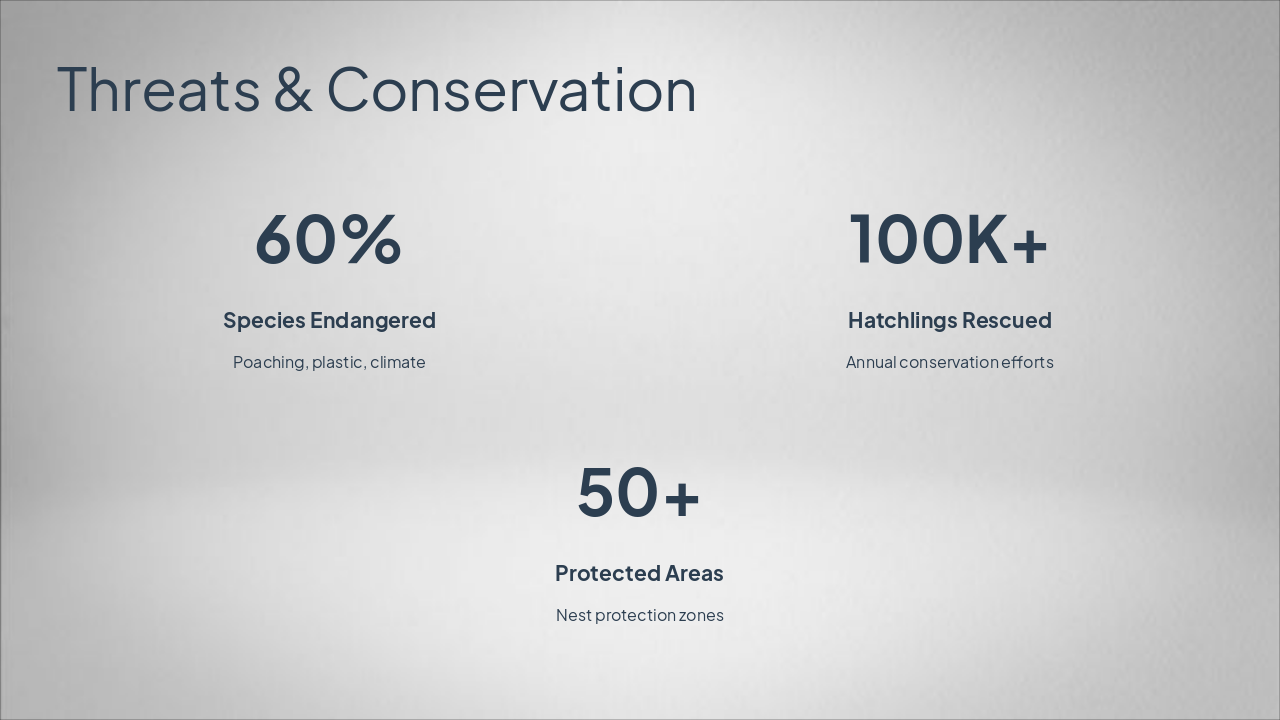
60% of species are endangered by poaching, plastic, and climate threats. Conservation efforts rescue over 100K hatchlings annually across 50+ protected nest zones.

Threats & Conservation

  • 60%: Species Endangered
  • Poaching, plastic, climate

  • 100K+: Hatchlings Rescued
  • Annual conservation efforts

  • 50+: Protected Areas
  • Nest protection zones

Slide 9 - Threats & Conservation
Slide 10 of 11

Slide 10 - Fun Facts About Turtles

The "Fun Facts About Turtles" slide features a quote from Dr. Elena Marine, a marine biologist, noting that turtles can live over 150 years. It highlights leatherback turtles, the largest species, which dive to 4,000 feet, hold their breath for 5 hours, and migrate up to 10,000 miles.

Fun Facts About Turtles

> Turtles can live over 150 years! Leatherbacks, the largest species, dive to 4,000 feet, hold their breath for 5 hours, and migrate up to 10,000 miles. 🐢😲

— Dr. Elena Marine, Marine Biologist

Slide 10 - Fun Facts About Turtles
Slide 11 of 11

Slide 11 - Protect Our Turtles

The conclusion slide, titled "Protect Our Turtles," describes turtles as vital ancient creatures facing challenges, ending with a thank-you note and emojis. Its subtitle calls to reduce plastic use and support conservation efforts.

Protect Our Turtles

Vital ancient creatures facing challenges. Thank you! 🌍🐢

Reduce plastic, support conservation efforts.

Source: Presentation summary

Speaker Notes
Deliver with enthusiasm, show turtle image, pause for applause.
Slide 11 - Protect Our Turtles

Discover More Presentations

Explore thousands of AI-generated presentations for inspiration

Browse Presentations
Powered by AI

Create Your Own Presentation

Generate professional presentations in seconds with Karaf's AI. Customize this presentation or start from scratch.

Create New Presentation

Powered by Karaf.ai — AI-Powered Presentation Generator