Slide 1 of 7
Slide 1 - Effective Communication Skills
Mastering Clear and Impactful Interactions
Enhancing Professional and Personal Relationships Presenter: Baratova Lobar Date: 1 December 2025

Generated from prompt:
Create a 7-slide PowerPoint presentation titled 'Effective Communication Skills'. Slides: 1) Title slide, 2) Introduction to Communication, 3) Elements of Communication, 4) Types of Communication, 5) Active Listening and Empathy, 6) Overcoming Barriers to Communication, 7) Conclusion and Key Takeaways. Use a clean, modern design with icons, visuals, and concise bullet points.
This 7-slide presentation explores the fundamentals of effective communication, from its elements and types to active listening, empathy, and overcoming barriers, concluding with key takeaways for cle
Mastering Clear and Impactful Interactions
Enhancing Professional and Personal Relationships Presenter: Baratova Lobar Date: 1 December 2025
Communication is the exchange of information between individuals, playing a vital role in building personal relationships and driving professional success. Interestingly, humans engage in it around the clock, both verbally and non-verbally.

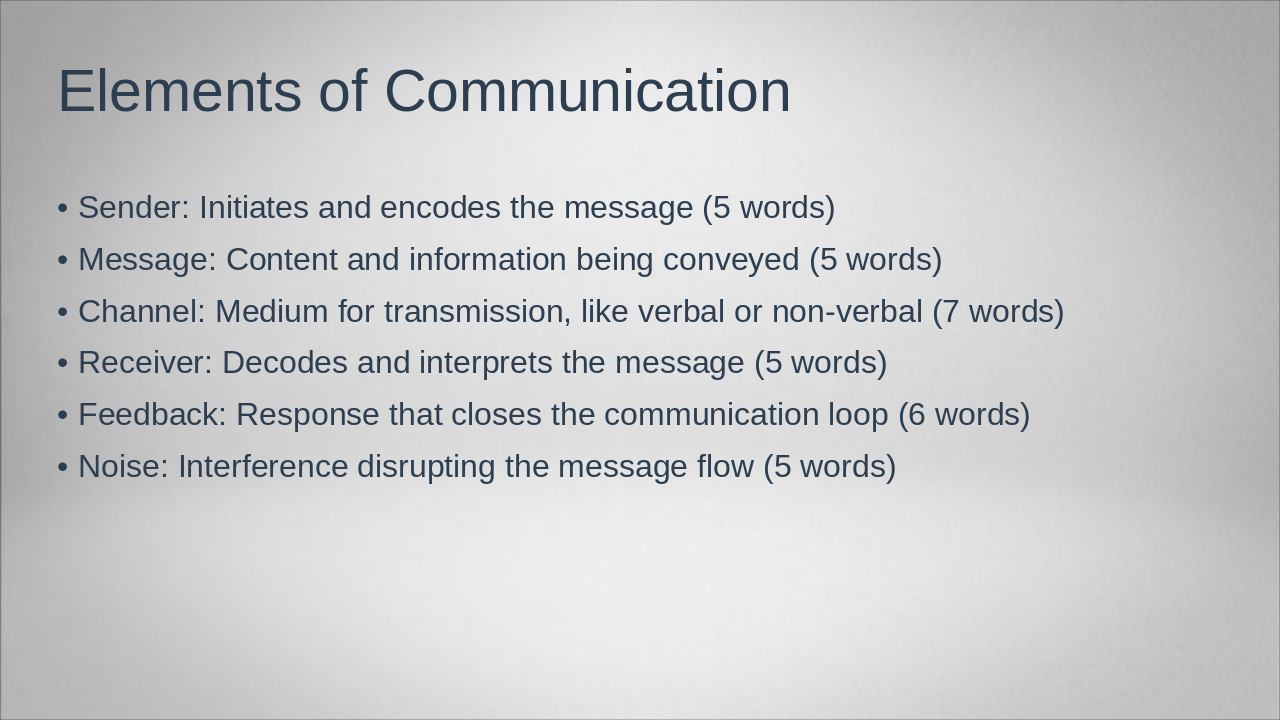
The slide outlines the key elements of communication, including the sender who initiates and encodes the message, the message itself as the conveyed content, and the channel as the transmission medium like verbal or non-verbal. It also covers the receiver who decodes and interprets the message, feedback that closes the loop, and noise as interference disrupting the flow.
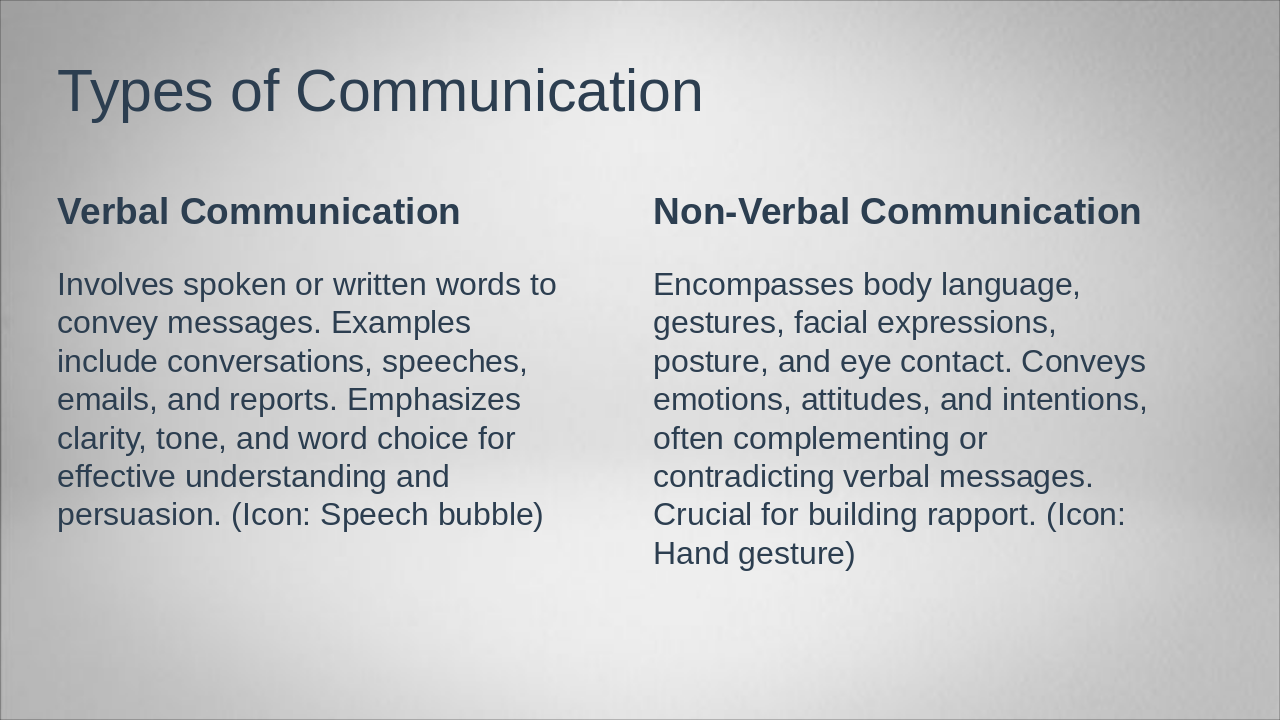
Verbal communication uses spoken or written words, such as conversations, speeches, emails, and reports, to convey messages effectively through clarity, tone, and word choice. Non-verbal communication involves body language, gestures, facial expressions, posture, and eye contact, which express emotions and attitudes while often supporting or contrasting verbal cues to build rapport.
| Verbal Communication | Non-Verbal Communication |
|---|---|
| Involves spoken or written words to convey messages. Examples include conversations, speeches, emails, and reports. Emphasizes clarity, tone, and word choice for effective understanding and persuasion. (Icon: Speech bubble) | Encompasses body language, gestures, facial expressions, posture, and eye contact. Conveys emotions, attitudes, and intentions, often complementing or contradicting verbal messages. Crucial for building rapport. (Icon: Hand gesture) |
Active listening involves giving full attention, paraphrasing the speaker's words, avoiding interruptions, and using techniques like nodding, eye contact, and open questions to show respect and understanding. Demonstrating empathy through acknowledging feelings helps build trust and stronger relationships.

The slide "Overcoming Barriers to Communication" outlines strategies to address physical barriers like noise and distance using clear channels, psychological barriers such as biases and emotions through empathy, and cultural differences via inclusive practices and understanding. It also recommends practical implementation tactics, including clarifying messages, repeating key points, and employing simple language.

The conclusion slide emphasizes mastering communication elements for clarity, active listening to build empathy, and overcoming barriers to connect effectively, with key takeaways to practice daily, seek feedback, and apply these skills immediately to transform interactions. It features the quote, "The single biggest problem in communication is the illusion that it has taken place," by George Bernard Shaw, and contact information at communication@workshop.com.
- Master communication elements for clarity
Key Takeaways:
Apply these skills today and transform your interactions!
"The single biggest problem in communication is the illusion that it has taken place." - George Bernard Shaw
Contact: communication@workshop.com
Unlock Better Connections Now
Source: Effective Communication Skills Presentation

Explore thousands of AI-generated presentations for inspiration
Generate professional presentations in seconds with Karaf's AI. Customize this presentation or start from scratch.