Light Intensity's Impact on Forage & Livestock (42 chars)

Generated from prompt:

Create a thesis presentation based on the document titled 'Pengaruh Intensitas Cahaya terhadap Pertumbuhan Tanaman Pakan dan Performa Ternak'. The presentation should include: 1. **Title Slide**: Title, author, institution, and advisor. 2. **Background**: Importance of light intensity in agriculture and livestock production. 3. **Problem Statement**: Main research questions. 4. **Objectives and Benefits**. 5. **Theoretical Framework**: How light affects photosynthesis, plant growth, and animal metabolism. 6. **Results & Discussion**: - Effects of light intensity on forage growth and nutrient quality. - Effects on livestock feed consumption and performance. - Application of optimal light intensity in integrated management. 7. **Conclusion & Recommendations**. 8. **References**: Key cited works (Pessarakli, Ensminger, Gardner, etc.). Use a scientific and professional visual theme with clean green and yellow tones to represent agriculture.

Explores how light intensity drives photosynthesis, forage growth, nutrient quality, and livestock performance; identifies 4000-6000 lux optima for integrated farming, with 12% weight gain boost and e

December 5, 202517 slides
Slide 1 of 17

Slide 1 - Title Slide

This title slide presents the topic "Pengaruh Intensitas Cahaya terhadap Pertumbuhan Tanaman Pakan dan Performa Ternak," exploring light intensity's impact on forage plant growth and livestock performance. The subtitle credits author [Nama Penulis] from [Universitas], supervised by [Nama Pembimbing].

Pengaruh Intensitas Cahaya terhadap Pertumbuhan Tanaman Pakan dan Performa Ternak

Oleh [Nama Penulis] [Universitas] Pembimbing: [Nama Pembimbing]

Source: Pengaruh Intensitas Cahaya terhadap Pertumbuhan Tanaman Pakan dan Performa Ternak

Slide 1 - Title Slide
Slide 2 of 17

Slide 2 - Background

This slide serves as the section header for "Background" (section 02). Its subtitle highlights the importance of light intensity in agriculture and livestock production.

Background

02

Background

Importance of light intensity in agriculture and livestock production.

Slide 2 - Background
Slide 3 of 17

Slide 3 - Importance of Light Intensity

Light intensity drives photosynthesis in forage plants and influences the nutrient quality of livestock feed. It optimizes growth in integrated farming systems while enhancing agricultural productivity and sustainability.

Importance of Light Intensity

  • Drives photosynthesis in forage plants.
  • Influences nutrient quality of livestock feed.
  • Optimizes growth in integrated farming systems.
  • Enhances agricultural productivity and sustainability.
Slide 3 - Importance of Light Intensity
Slide 4 of 17

Slide 4 - Pengaruh Intensitas Cahaya terhadap Pertumbuhan Tanaman Pakan dan Performa Ternak

This section header slide, titled "Pengaruh Intensitas Cahaya terhadap Pertumbuhan Tanaman Pakan dan Performa Ternak," introduces Section 03: Problem Statement. Its subtitle focuses on the main research questions regarding light effects.

Pengaruh Intensitas Cahaya terhadap Pertumbuhan Tanaman Pakan dan Performa Ternak

03

Problem Statement

Main research questions on light effects.

Source: Thesis Presentation

Speaker Notes
Main research questions on light effects.
Slide 4 - Pengaruh Intensitas Cahaya terhadap Pertumbuhan Tanaman Pakan dan Performa Ternak
Slide 5 of 17

Slide 5 - Research Questions

The slide, titled "Research Questions," lists three key inquiries for a study. They focus on light intensity's impact on forage growth rates, its effects on livestock performance, and optimal levels for integrated systems.

Research Questions

  • How does light intensity impact forage growth rates?
  • What are the effects on livestock performance?
  • What are optimal levels for integrated systems?

Source: Pengaruh Intensitas Cahaya terhadap Pertumbuhan Tanaman Pakan dan Performa Ternak

Speaker Notes
Present the core research questions driving this thesis, highlighting the focus on light intensity in integrated systems.
Slide 5 - Research Questions
Slide 6 of 17

Slide 6 - Objectives and Benefits

This slide serves as the section header for Section 04, titled "Objectives and Benefits." Its subtitle highlights the goals and advantages of the study.

Objectives and Benefits

04

Objectives and Benefits

Goals and advantages of the study.

Source: Pengaruh Intensitas Cahaya terhadap Pertumbuhan Tanaman Pakan dan Performa Ternak

Speaker Notes
Highlight the research goals and practical advantages for agriculture and livestock.
Slide 6 - Objectives and Benefits
Slide 7 of 17

Slide 7 - Objectives

The slide titled "Objectives" outlines goals to analyze light effects on forage plants and livestock. It focuses on identifying optimal light intensities for growth, evaluating impacts on nutrient quality and performance, and achieving improved yields and animal health.

Objectives

  • Analyze light effects on forage plants and livestock.
  • Identify optimal light intensities for growth.
  • Evaluate impacts on nutrient quality and performance.
  • Achieve improved yields and animal health.

Source: Pengaruh Intensitas Cahaya terhadap Pertumbuhan Tanaman Pakan dan Performa Ternak
Speaker Notes
Emphasize dual focus on plants/animals and key benefits for agriculture.
Slide 7 - Objectives
Slide 8 of 17

Slide 8 - Pengaruh Intensitas Cahaya terhadap Pertumbuhan Tanaman Pakan dan Performa Ternak

This section header slide, titled "Pengaruh Intensitas Cahaya terhadap Pertumbuhan Tanaman Pakan dan Performa Ternak," introduces Section 05: Theoretical Framework. Its subtitle emphasizes light's role in photosynthesis, plant growth, and animal metabolism.

Pengaruh Intensitas Cahaya terhadap Pertumbuhan Tanaman Pakan dan Performa Ternak

05

Theoretical Framework

Light's Role in Photosynthesis, Plant Growth, and Animal Metabolism

Source: Thesis Presentation

Speaker Notes
Introduce the theoretical framework, emphasizing light's role in biology, photosynthesis, plant growth, and animal metabolism.
Slide 8 - Pengaruh Intensitas Cahaya terhadap Pertumbuhan Tanaman Pakan dan Performa Ternak
Slide 9 of 17

Slide 9 - Light Effects

Light activates chlorophyll to drive photosynthesis in plants, converting light into glucose for better biomass, nutrients, and livestock forage quality. Optimal light enhances feed quality, boosting livestock metabolism, intake, digestion, nutrient use, growth, health, and behavior.

Light Effects

Photosynthesis and Plant GrowthAnimal Metabolism and Behavior
Light activates chlorophyll, driving photosynthesis. This converts light energy into chemical energy (glucose), promoting biomass accumulation, nutrient enhancement, and superior forage quality for livestock.Optimal light improves feed quality, boosting metabolism, feed intake, digestion, and nutrient utilization. This enhances growth performance, health, and behavioral responses in livestock.
Slide 9 - Light Effects
Slide 10 of 17

Slide 10 - Photosynthesis Process

The slide on the Photosynthesis Process features an image emphasizing how light intensity enhances CO2 uptake. It highlights benefits like boosted biomass and nutrient content in forage plants, improving growth and animal metabolism efficiency.

Photosynthesis Process

!Image

  • Light intensity enhances CO2 uptake in photosynthesis.
  • Higher light boosts biomass in forage plants.
  • Optimal light improves nutrient content for feed.
  • Impacts plant growth and animal metabolism efficiency.

Source: Photosynthesis

Speaker Notes
Explain how varying light intensity influences CO2 uptake, biomass production, and nutrient content in forage plants, linking to livestock performance.
Slide 10 - Photosynthesis Process
Slide 11 of 17

Slide 11 - Results & Discussion

This slide serves as the section header for "Results & Discussion" (Section 06). It previews key findings on light intensity effects on forage growth, nutrient quality, and livestock performance.

Results & Discussion

06

Results & Discussion

Key findings on light intensity effects on forage growth, nutrient quality, and livestock performance.

Slide 11 - Results & Discussion
Slide 12 of 17

Slide 12 - Forage Growth Effects

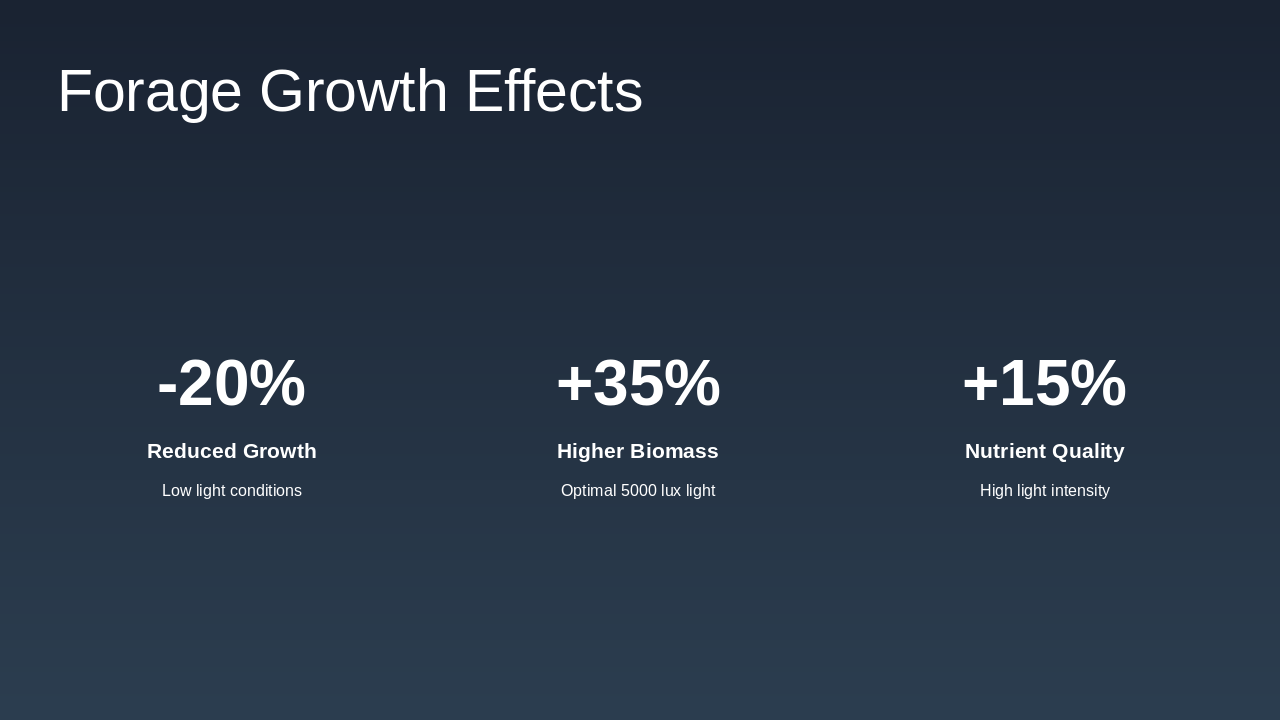
The "Forage Growth Effects" slide shows light's impact on forage. Low light reduces growth by 20%, optimal 5000 lux boosts biomass by 35%, and high intensity improves nutrient quality by 15%.

Forage Growth Effects

  • -20%: Reduced Growth
  • Low light conditions

  • +35%: Higher Biomass
  • Optimal 5000 lux light

  • +15%: Nutrient Quality
  • High light intensity

Slide 12 - Forage Growth Effects
Slide 13 of 17

Slide 13 - Livestock Performance

The Livestock Performance slide highlights benefits under optimal light conditions. It reports higher feed intake, 12% improved weight gain, and enhanced milk production in dairy livestock.

Livestock Performance

  • Higher feed intake under optimal light.
  • 12% improvement in weight gain.
  • Enhanced milk production in dairy livestock.

Source: Pengaruh Intensitas Cahaya terhadap Pertumbuhan Tanaman Pakan dan Performa Ternak

Slide 13 - Livestock Performance
Slide 14 of 17

Slide 14 - Integrated Management

Integrated Management recommends applying 4000-6000 lux for optimal results. It delivers energy cost savings while promoting sustainable farming practices.

Integrated Management

  • Apply 4000-6000 lux for optimal results.
  • Achieve cost savings in energy use.
  • Promote sustainable farming practices.

Source: Pengaruh Intensitas Cahaya terhadap Pertumbuhan Tanaman Pakan dan Performa Ternak

Speaker Notes
Highlight practical application of optimal light for integrated plant-livestock systems.
Slide 14 - Integrated Management
Slide 15 of 17

Slide 15 - Conclusion & Recommendations

This slide, titled "Conclusion & Recommendations" as section 07, marks the final section of the presentation. Its subtitle highlights a summary of key findings and recommendations for optimal light management.

Conclusion & Recommendations

07

Conclusion & Recommendations

Summary of key findings and recommendations for optimal light management.

Source: Pengaruh Intensitas Cahaya terhadap Pertumbuhan Tanaman Pakan dan Performa Ternak
Speaker Notes
Summary and next steps.
Slide 15 - Conclusion & Recommendations
Slide 16 of 17

Slide 16 - Key Takeaways

Optimal light intensity enhances forage growth and livestock performance, with a recommendation of 5000 lux for greenhouse applications. Future research should include field trials for validation, under the subtitle "Enhancing agriculture through science."

Key Takeaways

• Optimal light intensity boosts forage growth and livestock performance.

  • Recommend 5000 lux for greenhouse applications.
  • Future research: Conduct field trials for validation.

Enhancing agriculture through science

Source: Pengaruh Intensitas Cahaya terhadap Pertumbuhan Tanaman Pakan dan Performa Ternak

Speaker Notes
Closing message: Thank you for your attention. (5 words) Call-to-action: Implement 5000 lux lighting and pursue field trials. (7 words)
Slide 16 - Key Takeaways
Slide 17 of 17

Slide 17 - References

This slide, titled "References," lists key sources in bullet points. It includes Pessarakli (2010)'s Handbook of Photosynthesis, Ensminger et al.'s Animal Science, and Gardner's Plant Physiology.

References

  • Pessarakli (2010): Handbook of Photosynthesis.
  • Ensminger et al.: Animal Science.
  • Gardner: Plant Physiology.

Source: Pengaruh Intensitas Cahaya terhadap Pertumbuhan Tanaman Pakan dan Performa Ternak

Speaker Notes
Key references supporting the research on light intensity effects.
Slide 17 - References

Discover More Presentations

Explore thousands of AI-generated presentations for inspiration

Browse Presentations
Powered by AI

Create Your Own Presentation

Generate professional presentations in seconds with Karaf's AI. Customize this presentation or start from scratch.

Create New Presentation

Powered by Karaf.ai — AI-Powered Presentation Generator