Discovering Turtles: Ancient Survivors (38 chars)

Generated from prompt:

Create a Google Slides presentation about turtles

Explore turtles' evolution, unique anatomy, habitats, stats, sea vs. land comparisons, wisdom quotes, and conservation call, highlighting their resilience as ancient survivors. (148 chars)

December 15, 20259 slides
Slide 1 of 9

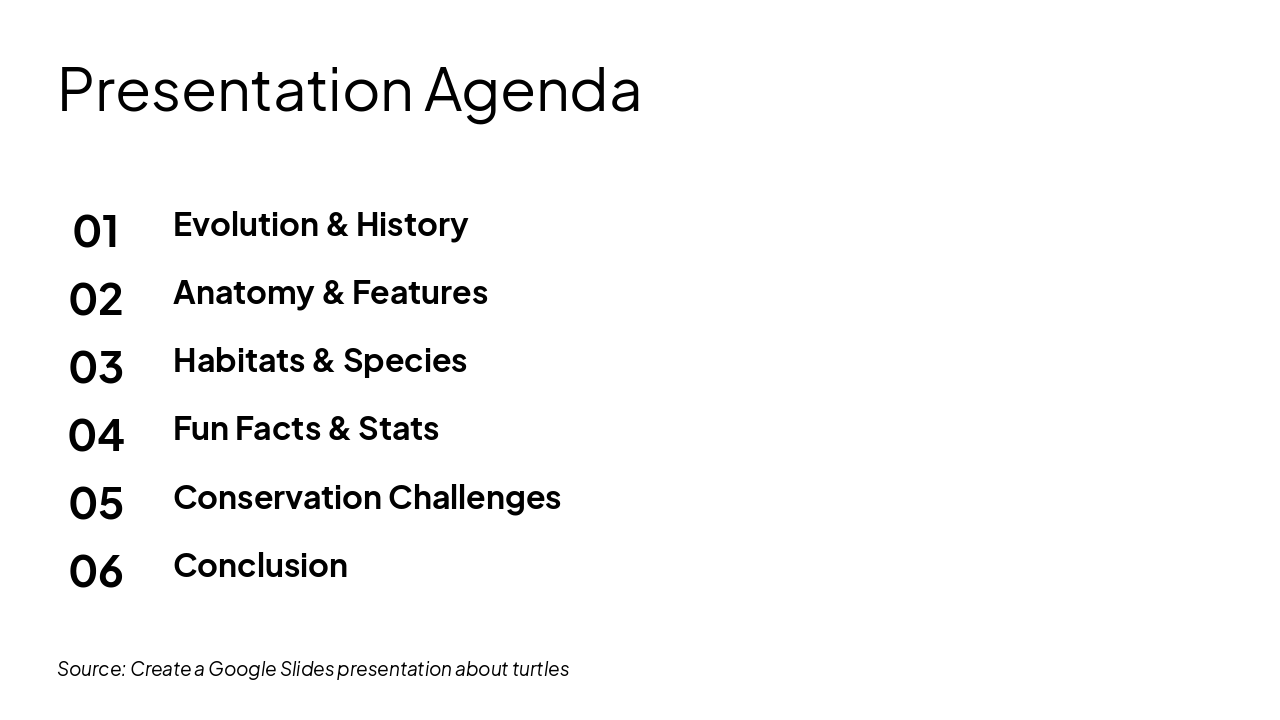
Slide 1 - Discovering Turtles: Ancient Survivors

This title slide is named "Discovering Turtles: Ancient Survivors." Its subtitle describes turtles as fascinating reptiles that have thrived for millions of years.

Discovering Turtles: Ancient Survivors

Fascinating reptiles that have thrived for millions of years

Source: Google Slides presentation about turtles

Speaker Notes
Welcome to an overview of turtles, fascinating reptiles that have thrived for millions of years. Explore their world!
Slide 1 - Discovering Turtles: Ancient Survivors
Slide 2 of 9

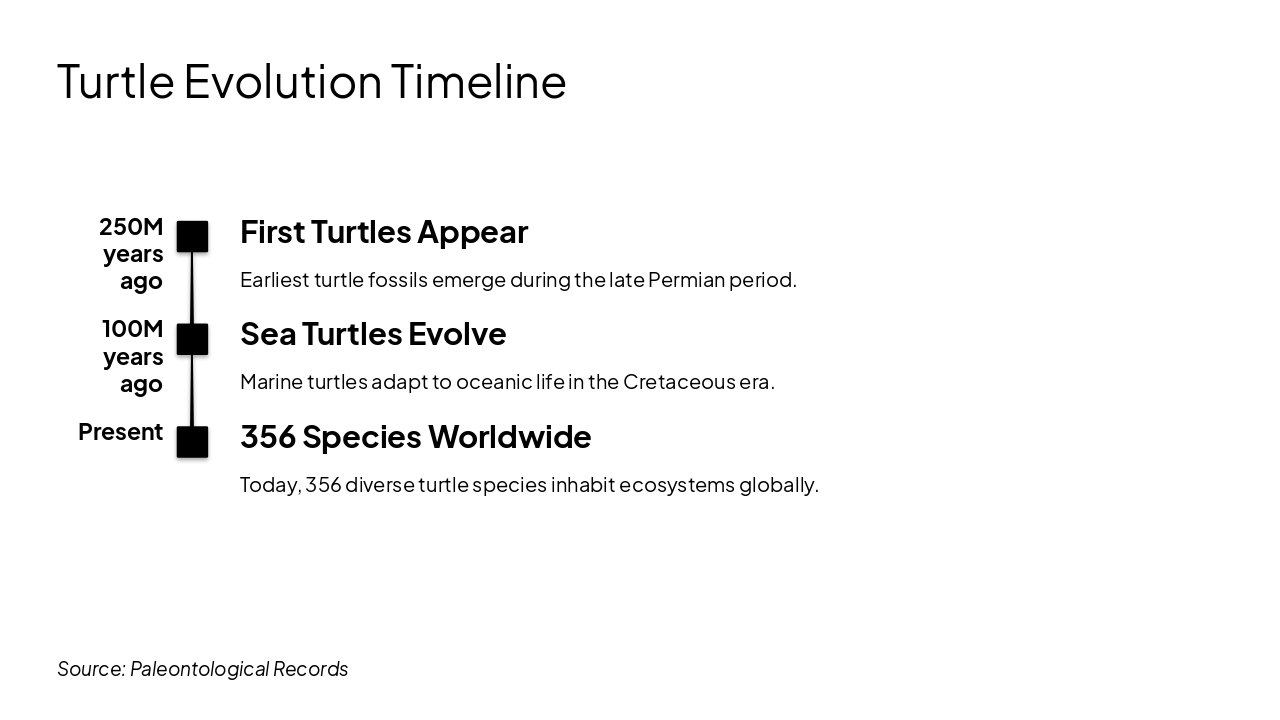
Slide 2 - Presentation Agenda

This slide outlines the agenda for a presentation on the topic's evolution, anatomy, habitats, and more. The key sections include Evolution & History, Anatomy & Features, Habitats & Species, Fun Facts & Stats, Conservation Challenges, and Conclusion.

Presentation Agenda

  1. Evolution & History
  2. Anatomy & Features
  3. Habitats & Species
  4. Fun Facts & Stats
  5. Conservation Challenges
  6. Conclusion

Source: Create a Google Slides presentation about turtles

Slide 2 - Presentation Agenda
Slide 3 of 9

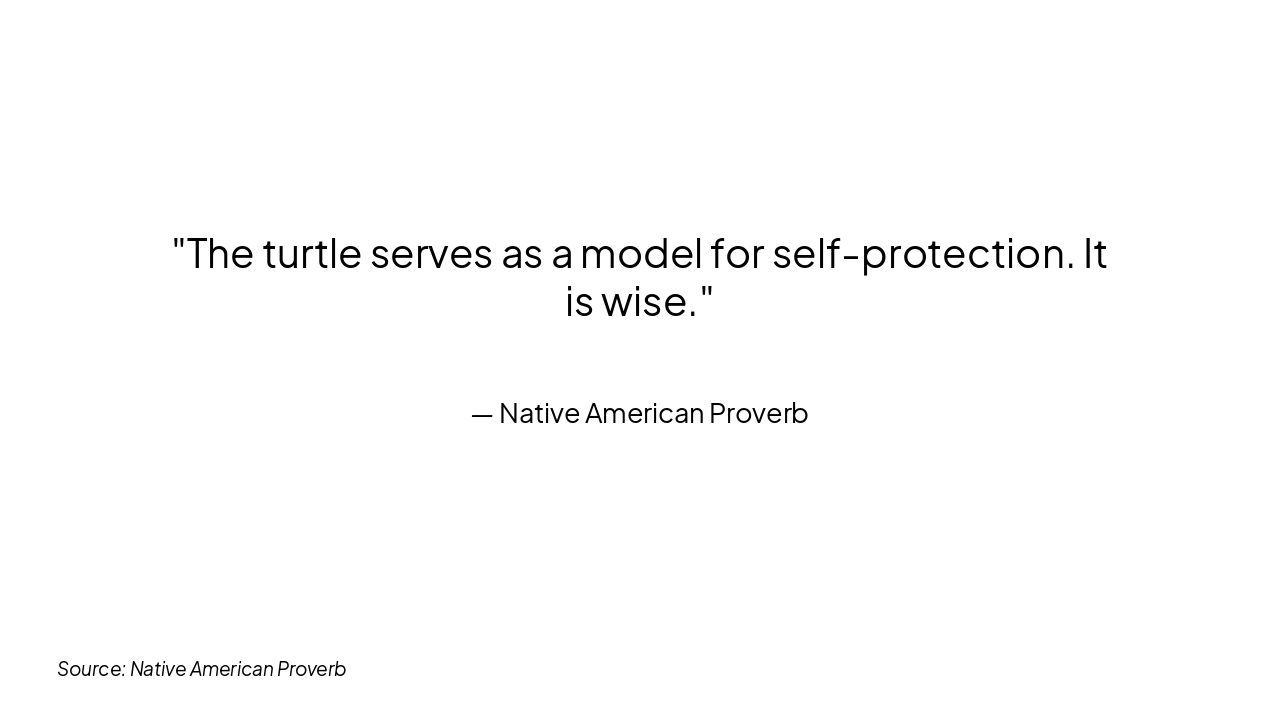
Slide 3 - Turtle Evolution Timeline

The Turtle Evolution Timeline marks the first turtles appearing 250 million years ago in the late Permian period. It then notes sea turtles evolving 100 million years ago in the Cretaceous era, with 356 diverse species inhabiting global ecosystems today.

Turtle Evolution Timeline

250M years ago: First Turtles Appear Earliest turtle fossils emerge during the late Permian period. 100M years ago: Sea Turtles Evolve Marine turtles adapt to oceanic life in the Cretaceous era. Present: 356 Species Worldwide Today, 356 diverse turtle species inhabit ecosystems globally.

Source: Paleontological Records

Speaker Notes
Key milestones in turtle evolution for Google Slides presentation.
Slide 3 - Turtle Evolution Timeline
Slide 4 of 9

Slide 4 - Unique Anatomy

This slide highlights the unique anatomy of a creature with a hard shell for predator protection and retractable head and limbs for safety inside it. It also features a toothless beak for efficient feeding and crushing, plus a slow metabolism enabling exceptionally long lifespans.

Unique Anatomy

  • Hard shell provides superior protection from predators
  • Toothless beak enables efficient feeding and crushing
  • Retractable head and limbs ensure safety in shell
  • Slow metabolism supports exceptionally long lifespans
Slide 4 - Unique Anatomy
Slide 5 of 9

Slide 5 - Turtle Habitats

The slide "Turtle Habitats" features an image alongside key points on turtle environments. Sea turtles inhabit global oceans and coral reefs, box turtles dwell in forests and wooded areas, and tortoises thrive in arid deserts and scrublands.

Turtle Habitats

!Image

  • Sea turtles inhabit oceans and coral reefs globally.
  • Box turtles dwell in forests and wooded areas.
  • Tortoises thrive in arid deserts and scrublands.

Source: Image from Wikipedia article "Green sea turtle"

Slide 5 - Turtle Habitats
Slide 6 of 9

Slide 6 - Impressive Turtle Stats

Turtles boast impressive lifespans exceeding 150 years for some species. The slide highlights the heaviest leatherback at 2,500 lbs, tiniest speckled padloper at 2 oz, and fastest land speed of 1.5 mph.

Impressive Turtle Stats

  • 150+: Lifespan in Years
  • Some species exceed 150 years

  • 2,500 lbs: Largest Leatherback
  • Heaviest recorded turtle

  • 2 oz: Smallest Padloper
  • Speckled padloper tortoise

  • 1.5 mph: Land Speed Max
  • Fastest on dry land

Slide 6 - Impressive Turtle Stats
Slide 7 of 9

Slide 7 - Sea Turtles vs. Land Tortoises

Sea turtles migrate thousands of miles across oceans to nesting beaches, using flippers for powerful swimming. Land tortoises have domed shells for protection, graze on plants as herbivores, and dig extensive burrows for shelter.

Sea Turtles vs. Land Tortoises

Sea TurtlesLand Tortoises
Sea turtles migrate thousands of miles across oceans to reach nesting beaches. Their flippers, modified limbs, provide powerful propulsion for efficient swimming in open waters.Land tortoises feature domed shells for protection on terra firma. As herbivores, they graze on plants and are skilled burrowers, digging extensive underground tunnels for shelter.

Source: Google Slides presentation about turtles

Slide 7 - Sea Turtles vs. Land Tortoises
Slide 8 of 9

Slide 8 - Turtle Wisdom

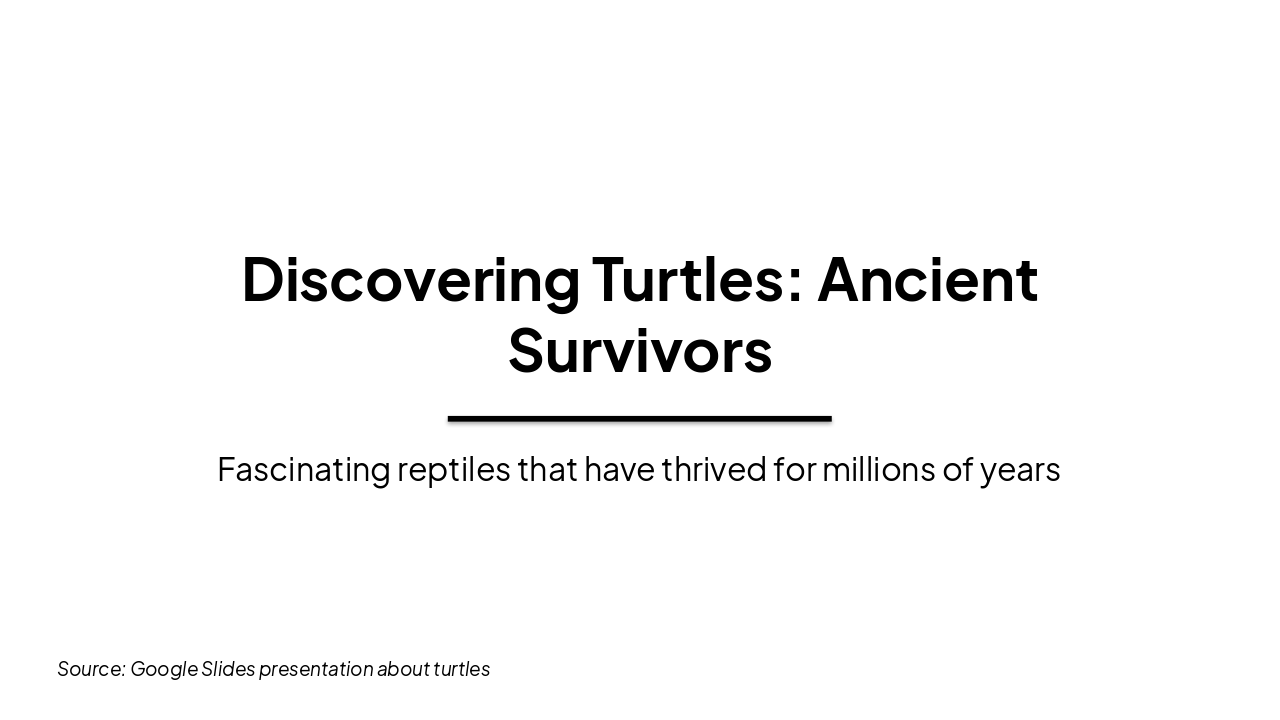
The slide, titled "Turtle Wisdom," presents a quote from a Native American Proverb. It states: "The turtle serves as a model for self-protection. It is wise."

Turtle Wisdom

> The turtle serves as a model for self-protection. It is wise.

— Native American Proverb

Source: Native American Proverb

Speaker Notes
Part of a Google Slides presentation about turtles
Slide 8 - Turtle Wisdom
Slide 9 of 9

Slide 9 - Protect Our Turtles

The conclusion slide, titled "Protect Our Turtles," states that turtles remind us of resilience. It calls for supporting conservation to save these ancient creatures for future generations.

Protect Our Turtles

Turtles remind us of resilience.

Support conservation to save ancient creatures for future generations!

Source: Google Slides presentation about turtles

Speaker Notes
Emphasize resilience and urge action for conservation.
Slide 9 - Protect Our Turtles

Discover More Presentations

Explore thousands of AI-generated presentations for inspiration

Browse Presentations
Powered by AI

Create Your Own Presentation

Generate professional presentations in seconds with Karaf's AI. Customize this presentation or start from scratch.

Create New Presentation

Powered by Karaf.ai — AI-Powered Presentation Generator