Slide 1 - VoLTE Technology
This title slide introduces VoLTE Technology. Its subtitle highlights how it enhances voice calls over LTE networks.
Introduction to VoLTE Technology
Enhancing Voice Calls over LTE Networks

Generated from prompt:
Create a professional PowerPoint presentation on 'VoLTE Technology' for a telecommunications audience. The presentation should include: 1) Introduction and definition of VoLTE, 2) Basic concepts and architecture, 3) How VoLTE works (step-by-step call flow), 4) Key features and advantages, 5) Limitations and disadvantages, 6) Relevant network codes and configuration examples (e.g., SIP, IMS), 7) Real-world use cases and deployment examples, and 8) Summary. Use clear, simple language, and include diagrams and illustrative images to enhance understanding.
Comprehensive overview of VoLTE: definition, architecture, call flow, features/advantages, limitations, SIP/IMS configs, real-world cases, and future impact for telecom pros. (148 chars)
This title slide introduces VoLTE Technology. Its subtitle highlights how it enhances voice calls over LTE networks.
Enhancing Voice Calls over LTE Networks

The slide presents the agenda for the presentation, listing key sections from "Intro & Definition" to "Summary." It covers concepts & architecture, call flow, features & advantages, limitations, codes & config, and use cases.
Source: VoLTE Technology Presentation

This section header slide, titled "VoLTE Technology," introduces Section 01 on the "Introduction and Definition of VoLTE." Its subtitle describes VoLTE as voice calls over 4G LTE using IMS, replacing circuit-switched voice.
01
Voice calls over 4G LTE using IMS, replacing circuit-switched voice

VoLTE delivers high-definition voice over a packet-switched all-IP network, enabling simultaneous voice and data usage. It provides better call setup time and quality while remaining backward compatible with 3G and 2G networks.
Source: VoLTE Technology Presentation

The VoLTE Ecosystem Overview slide depicts UE connecting to eNB over LTE, with eNB routing signaling to MME for control. MME links to the IMS core (P/I/S-CSCF), while media gateways process voice RTP streams.
Source: Image from Wikipedia article "IP Multimedia Subsystem"

This section header slide for VoLTE Technology introduces Section 02: Basic Concepts and Architecture. It outlines the core architecture, featuring EPS bearers for voice, IMS for signaling, and dedicated bearers for QoS.
02
Core architecture: EPS bearer for voice, IMS for signaling, QoS via dedicated bearers.
Source: Telecommunications Presentation

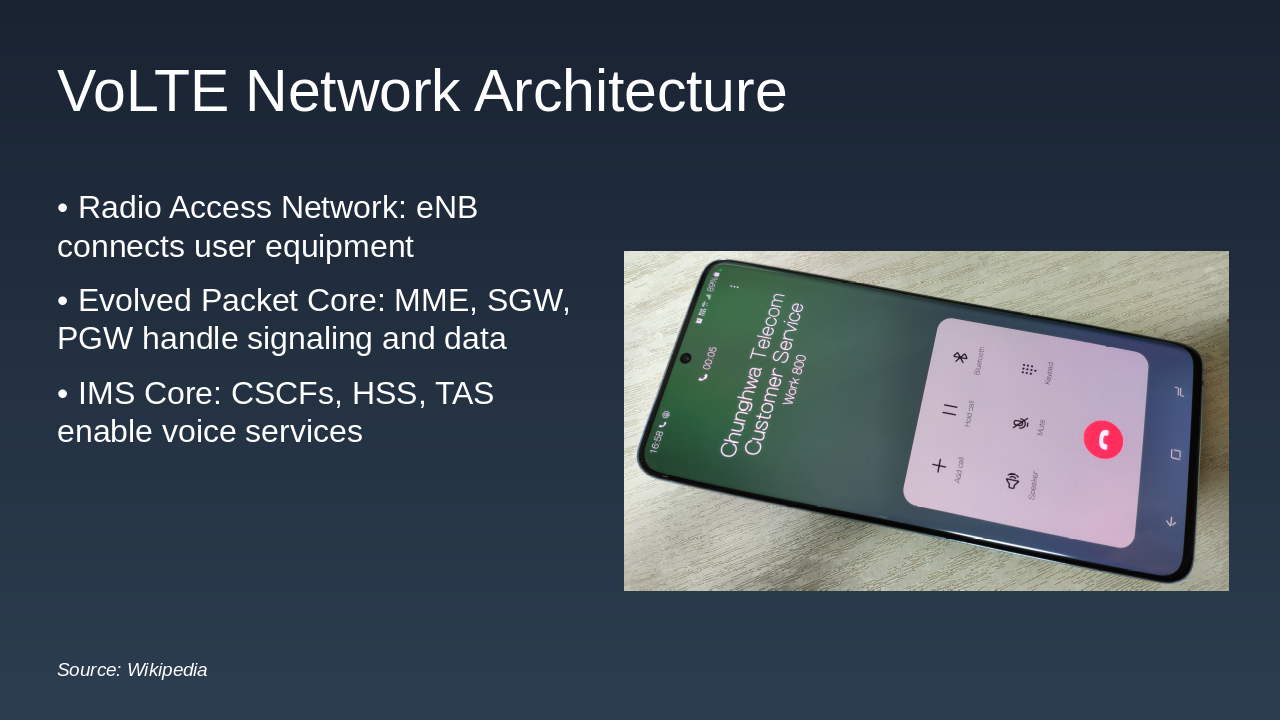
The slide depicts the VoLTE Network Architecture, highlighting the Radio Access Network where eNB connects user equipment. It also shows the Evolved Packet Core (MME, SGW, PGW) for signaling and data handling, plus the IMS Core (CSCFs, HSS, TAS) enabling voice services.
Source: Wikipedia

The slide outlines key IMS voice concepts: SIP signaling and RTP for media. It also covers QCI 1 bearer for low-latency voice and SRVCC for handover to 3G/2G.

This section header slide in the VoLTE Technology presentation introduces Section 03: "How VoLTE Works: Step-by-Step Call Flow." It outlines the process from registration to call setup, media exchange, and release.
03
From registration to call setup, media exchange, and release.
Source: Telecommunications Presentation

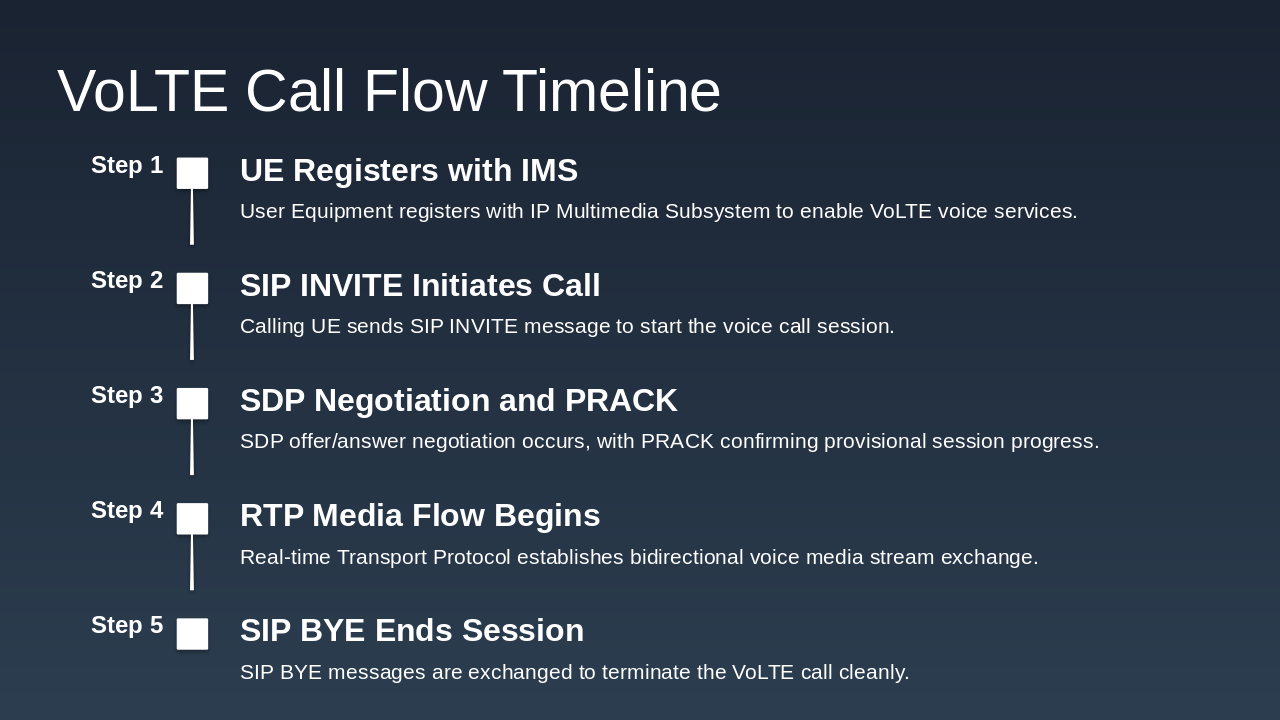
The VoLTE Call Flow Timeline illustrates the sequence of steps for a voice call, starting with UE registration to IMS and SIP INVITE to initiate the session. It proceeds through SDP negotiation with PRACK, RTP media exchange, and ends with SIP BYE to terminate the call.
Step 1: UE Registers with IMS User Equipment registers with IP Multimedia Subsystem to enable VoLTE voice services. Step 2: SIP INVITE Initiates Call Calling UE sends SIP INVITE message to start the voice call session. Step 3: SDP Negotiation and PRACK SDP offer/answer negotiation occurs, with PRACK confirming provisional session progress. Step 4: RTP Media Flow Begins Real-time Transport Protocol establishes bidirectional voice media stream exchange. Step 5: SIP BYE Ends Session SIP BYE messages are exchanged to terminate the VoLTE call cleanly.

This section header slide introduces Section 04: "Key Features and Advantages." Its subtitle emphasizes "Superior performance over legacy voice."
04
Superior performance over legacy voice.

VoLTE offers key advantages including 50ms call setup time (vs. 2s CS fallback) and 40% spectral efficiency gain. It also delivers HD voice quality and always-on data during calls.
vs 2s CS fallback

This slide lists key limitations of the technology, such as requiring mature devices and network infrastructure, coverage gaps needing SRVCC handover, and higher battery drain than legacy voice. It also notes complex IMS core network deployment alongside persistent roaming and interoperability challenges.
Source: VoLTE Technology Presentation

This slide outlines key SIP methods (INVITE for setup, 200 OK for acceptance) and a SIP URI example (sip:user@ims.operator.com). It also details IMS config via the P-Access-Network-Info header and QoS parameters like QCI=1 with high ARP for voice priority.

Verizon pioneered VoLTE in 2014 with HD voice over LTE, quickly followed by AT&T for enhanced call quality, faster connections, and better battery life. Globally, over 200 operators have deployed it per GSMA, targeting 5 billion+ subscribers to boost IMS migration, network efficiency, and user experience.
| Early Adopters | Global Scale |
|---|---|
| Verizon launched VoLTE in 2014, delivering HD voice over LTE. AT&T quickly followed, enabling superior call quality, faster connections, and better battery efficiency for millions of users. | GSMA reports 200+ operators deployed VoLTE worldwide, targeting 5B+ subscribers. This massive rollout accelerates migration to IMS-based voice, boosting network efficiency and user experience. |
Source: GSMA Reports

The VoLTE Deployment Map highlights over 200 operators worldwide supporting VoLTE, with rapid growth in Asia and Europe. The US leads via carriers like Verizon and AT&T, with projected expansion through 5G integration.
Source: Image from Wikipedia article "Voice over LTE"

The slide summarizes VoLTE as revolutionizing voice with IP technology, key to 5G evolution, and essential for future-proof networks. It ends with thanks and an invitation to discuss VoLTE adoption.
• VoLTE revolutionizes voice with IP technology
Thank you! Questions? Let's discuss VoLTE adoption.
Source: VoLTE Technology Presentation

Explore thousands of AI-generated presentations for inspiration
Generate professional presentations in seconds with Karaf's AI. Customize this presentation or start from scratch.