Breadwinner Model & Workfare Policies: Family and Social Shf

Generated from prompt:

can you fix my powerpoint to make sure it has a consistent theme but don't change anything on it and also give some more sources for appendix if possible

This presentation analyzes the traditional breadwinner family model, its evolution amid shifting gender norms, and workfare policies for poverty reduction. It covers historical contexts, modern data, policy examples, and recommended readings on these

April 29, 20269 slides
Slide 1 of 9

Slide 1 - Presentation Title

The Breadwinner Model & Workfare Policies

An Analysis of Family Models and Social Policy Shifts

---

Photo by Hassaan Here on Unsplash
Slide 1 - Presentation Title
Slide 2 of 9

Slide 2 - Agenda

  • Defining the Breadwinner Model
  • Contemporary Shifts in Gender Norms
  • Overview of Workfare Policies
  • Appendix and Further Reading

---

Photo by Albert Stoynov on Unsplash
Slide 2 - Agenda
Slide 3 of 9

Slide 3 - Section 1

1

The Breadwinner Model

Understanding historical definitions and paradigms of family income support

---

Photo by National Gallery of Art on Unsplash
Slide 3 - Section 1
Slide 4 of 9

Slide 4 - The Breadwinner Model Explained

  • Definition: A family model where one member earns income to support others.
  • Traditional Structure: Earner works outside the home (income/benefits), non-earner manages domestic/childcare duties.
  • Historical Development: Rose in Western cultures primarily following industrialization.
  • Pre-industrial Context: All household members (men, women, children) contributed to productivity.
Slide 4 - The Breadwinner Model Explained
Slide 5 of 9

Slide 5 - Evolution of Gender Roles

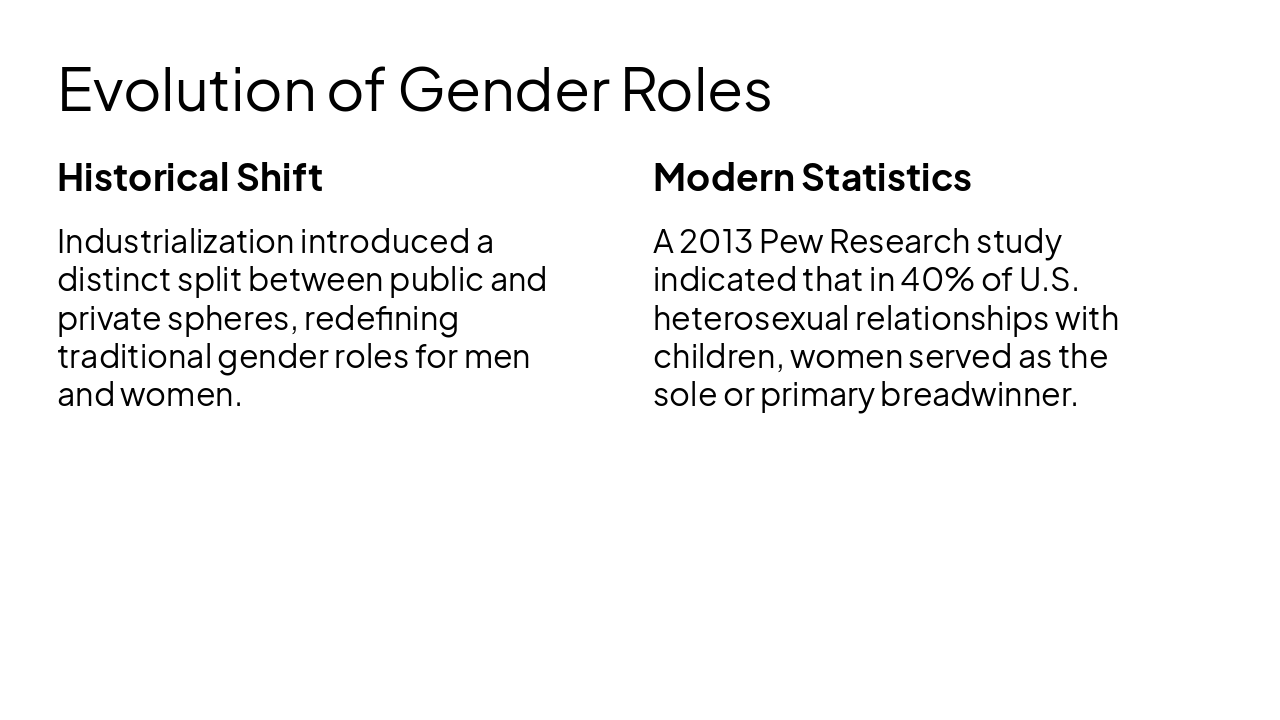
Historical Shift Industrialization introduced a distinct split between public and private spheres, redefining traditional gender roles for men and women.

Modern Statistics A 2013 Pew Research study indicated that in 40% of U.S. heterosexual relationships with children, women served as the sole or primary breadwinner.
Slide 5 - Evolution of Gender Roles
Slide 6 of 9

Slide 6 - Section 2

2

Workfare Policies

Governmental approaches to poverty reduction for able-bodied adults
Slide 6 - Section 2
Slide 7 of 9

Slide 7 - Understanding Workfare

  • Definition: Government plans requiring welfare recipients to accept public-service jobs or participate in training.
  • Objective: Reduce poverty among able-bodied adults through "work-first" initiatives.
  • Execution: Approaches vary significantly across nations despite shared goals.
  • Examples: Both the United States and the United Kingdom utilize workfare systems with different historical backgrounds.
Slide 7 - Understanding Workfare
Slide 8 of 9

Slide 8 - Appendix: Recommended Sources

  • For Further Reading on Breadwinner Model:
  • - Pew Research Center: 'Breadwinner Moms' (2013).
  • - Goldin, C. 'The Quiet Revolution' (understanding female labor force participation).
  • For Further Reading on Workfare:
  • - Peck, J. 'Workfare State' (critical analysis of policy implementation).
  • - OECD Employment Outlook reports on active labor market policies.
Slide 8 - Appendix: Recommended Sources
Slide 9 of 9

Slide 9 - Conclusion

Understanding the intersection of family roles and welfare policy is critical to analyzing modern socioeconomic structures.

Summary of Findings

---

Photo by Dawid Zawiła on Unsplash
Slide 9 - Conclusion

Discover More Presentations

Explore thousands of AI-generated presentations for inspiration

Browse Presentations
Powered by AI

Create Your Own Presentation

Generate professional presentations in seconds with Karaf's AI. Customize this presentation or start from scratch.

Create New Presentation

Powered by Karaf.ai — AI-Powered Presentation Generator