OCT Images: Revolutionizing Diagnostics

Generated from prompt:

create a presentation about oct images

Explore Optical Coherence Tomography (OCT) images: non-invasive, high-res micron-level imaging using interferometry. Covers how it works, types, medical applications, advantages like real-time no-radi

January 7, 20268 slides
Slide 1 of 8

Slide 1 - Optical Coherence Tomography (OCT) Images

This title slide introduces "Optical Coherence Tomography (OCT) Images," highlighting a high-resolution imaging technology. It focuses on medical diagnostics that utilize light waves for detailed visualization.

Optical Coherence Tomography (OCT) Images

Discovering High-Resolution Imaging Technology for Medical Diagnostics Using Light Waves

Source: Presentation on OCT Images

Speaker Notes
Introduction to high-resolution OCT imaging for medical diagnostics using light waves.
Slide 1 - Optical Coherence Tomography (OCT) Images
Slide 2 of 8

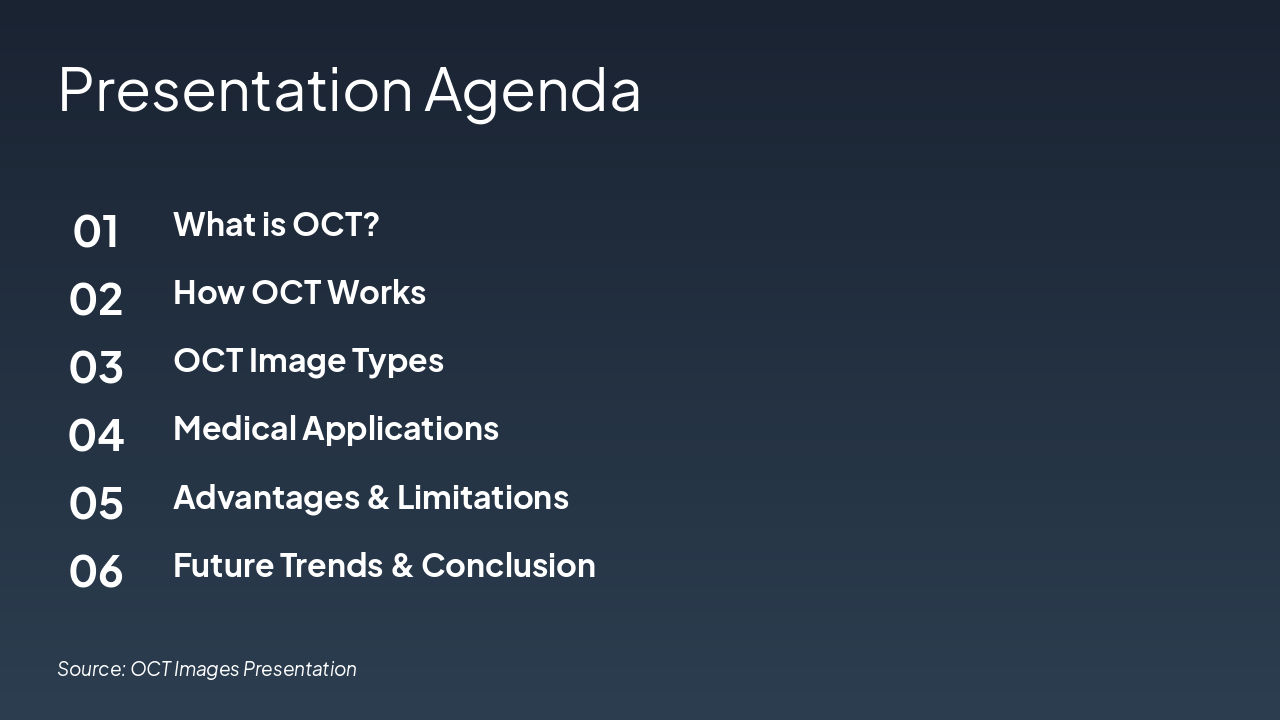
Slide 2 - Presentation Agenda

This agenda slide outlines a presentation on Optical Coherence Tomography (OCT), starting with "What is OCT?" and "How OCT Works." It continues with "OCT Image Types," "Medical Applications," "Advantages & Limitations," and ends with "Future Trends & Conclusion."

Presentation Agenda

  1. What is OCT?
  2. How OCT Works
  3. OCT Image Types
  4. Medical Applications
  5. Advantages & Limitations
  6. Future Trends & Conclusion

Source: OCT Images Presentation

Speaker Notes
Outline the key sections of the presentation on OCT imaging technology.
Slide 2 - Presentation Agenda
Slide 3 of 8

Slide 3 - What is OCT?

OCT (Optical Coherence Tomography) is a non-invasive optical imaging technique that uses low-coherence interferometry to provide cross-sectional images of tissue microstructure with 1-15 micrometer resolution. It was developed in 1991 by Huang et al.

What is OCT?

  • Non-invasive optical imaging technique
  • Uses low-coherence interferometry
  • Provides cross-sectional tissue microstructure images
  • Achieves 1-15 micrometer resolution
  • Developed in 1991 by Huang et al.

Source: OCT Imaging Presentation

Slide 3 - What is OCT?
Slide 4 of 8

Slide 4 - How OCT Works

OCT works by using a broadband light source that emits light, which is then split into reference and sample arms. The sample arm reflects off tissue layers, and the resulting interference pattern generates depth-resolved images.

How OCT Works

!Image

  • Broadband light source emits light
  • Light splits into reference and sample arms
  • Sample arm reflects from tissue layers
  • Interference pattern generates depth-resolved images

Source: OCT presentation

Slide 4 - How OCT Works
Slide 5 of 8

Slide 5 - Types of OCT Images

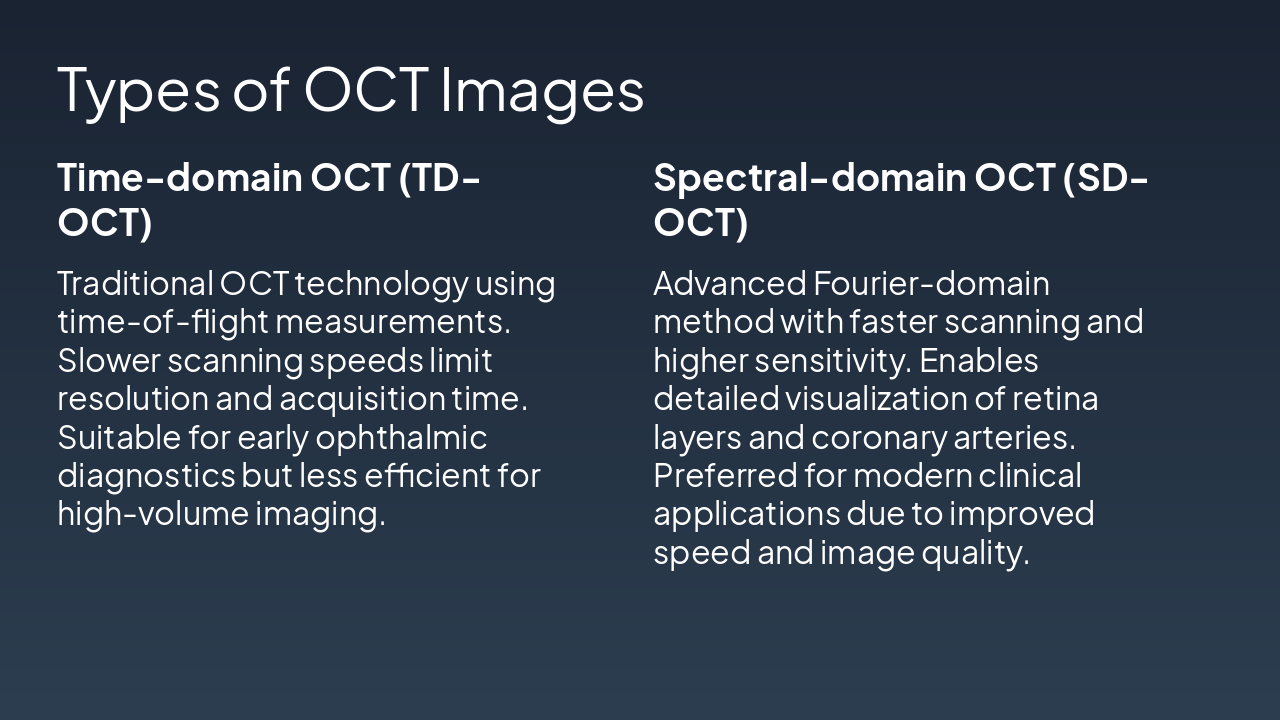
The slide compares two types of OCT images: Time-domain OCT (TD-OCT), which uses traditional time-of-flight measurements but has slower speeds limiting resolution and suitability for early diagnostics, and Spectral-domain OCT (SD-OCT), an advanced Fourier-domain method offering faster scanning, higher sensitivity, and detailed visualization of retina layers and coronary arteries for modern clinical use. SD-OCT is preferred due to its improved speed and image quality over TD-OCT.

Types of OCT Images

Time-domain OCT (TD-OCT)Spectral-domain OCT (SD-OCT)
Traditional OCT technology using time-of-flight measurements. Slower scanning speeds limit resolution and acquisition time. Suitable for early ophthalmic diagnostics but less efficient for high-volume imaging.Advanced Fourier-domain method with faster scanning and higher sensitivity. Enables detailed visualization of retina layers and coronary arteries. Preferred for modern clinical applications due to improved speed and image quality.
Speaker Notes
Highlight the evolution from slower TD-OCT to faster, more sensitive SD-OCT, with applications in retina imaging and coronary arteries.
Slide 5 - Types of OCT Images
Slide 6 of 8

Slide 6 - Medical Applications

The slide highlights key medical applications of OCT technology, with 70% accuracy in retinal disease diagnosis for ophthalmology and 50% improvement in stent visualization for cardiology. It also notes over 10 million annual OCT scans worldwide and non-invasive skin cancer detection as a dermatology breakthrough.

Medical Applications

  • 70%: Retinal Disease Diagnosis
  • Ophthalmology applications

  • 50%: Stent Visualization Improvement
  • Cardiology enhancements

  • 10M+: Annual OCT Scans
  • Worldwide volume

  • Non-invasive: Skin Cancer Detection

Dermatology breakthrough Source: OCT Imaging Presentation

Slide 6 - Medical Applications
Slide 7 of 8

Slide 7 - Advantages & Limitations

This slide outlines the advantages of the imaging technique, including real-time imaging without radiation exposure and high-resolution visualization of tissue structures. It also highlights limitations such as limited penetration depth (~2 mm), the need for expensive specialized equipment, and susceptibility to motion artifacts.

Advantages & Limitations

  • Real-time imaging with no radiation exposure
  • High-resolution visualization of tissue structures
  • Limited penetration depth (~2 mm)
  • Expensive specialized equipment required
  • Susceptible to motion artifacts

Source: OCT Images Presentation

Slide 7 - Advantages & Limitations
Slide 8 of 8

Slide 8 - Conclusion

OCT revolutionizes diagnostics by providing micron-level detail, transforming healthcare and expanding to new fields. The future involves wider accessibility and AI integration, followed by a thank you and Q&A invitation.

Conclusion

**OCT: Revolutionizing Diagnostics

Micron-level detail transforms healthcare. Expanding to new fields.

Future: Wider accessibility & AI integration.

Closing: Thank you for your attention!

Q&A?**

Revolutionizing Diagnostics with OCT

Source: OCT Presentation

Slide 8 - Conclusion

Discover More Presentations

Explore thousands of AI-generated presentations for inspiration

Browse Presentations
Powered by AI

Create Your Own Presentation

Generate professional presentations in seconds with Karaf's AI. Customize this presentation or start from scratch.

Create New Presentation

Powered by Karaf.ai — AI-Powered Presentation Generator