Energy Fundamentals & Interior Conservation (38 chars)

Generated from prompt:

Create a detailed PowerPoint presentation titled 'Fundamentals of Energy and Conservation'. Include sections on: 1) Definition and types of energy (kinetic, potential, thermal, electrical, etc.); 2) Energy consumption in interior spaces: residential, commercial, and institutional interiors; 3) Concept of energy conservation and sustainability in interior design; 4) Importance of reducing energy demand for environmental and economic benefits; 5) Global and national energy scenario: energy shortage, consumption patterns, sector-wise usage; 6) Scope for energy conservation in interiors: lighting, HVAC, appliances, and materials.

Explores energy types, interior consumption patterns (residential/commercial), conservation strategies for sustainability, environmental/economic benefits, global trends, and savings in lighting, HVAC

December 6, 202519 slides
Slide 1 of 19

Slide 1 - Fundamentals of Energy and Conservation

This title slide is named "Fundamentals of Energy and Conservation." Its subtitle outlines explorations of energy basics, interiors consumption, conservation strategies, and global scenarios for sustainable design.

Fundamentals of Energy and Conservation

Exploring energy basics, consumption in interiors, conservation strategies, and global scenarios for sustainable design.
Slide 1 - Fundamentals of Energy and Conservation
Slide 2 of 19

Slide 2 - Presentation Agenda

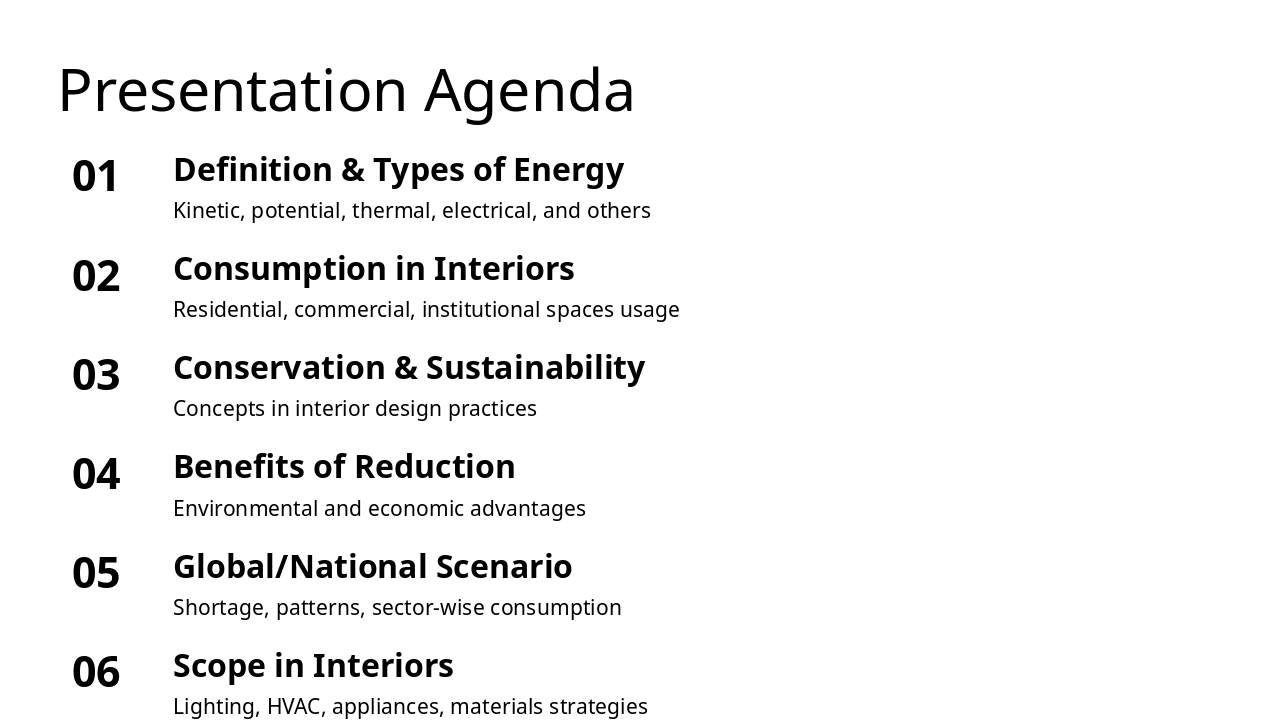
This presentation agenda covers definitions and types of energy, followed by its consumption in residential, commercial, and institutional interiors. It then addresses conservation, sustainability benefits, global/national scenarios, and strategies for reduction in lighting, HVAC, appliances, and materials.

Presentation Agenda

  1. Definition & Types of Energy
  2. Kinetic, potential, thermal, electrical, and others

  3. Consumption in Interiors
  4. Residential, commercial, institutional spaces usage

  5. Conservation & Sustainability
  6. Concepts in interior design practices

  7. Benefits of Reduction
  8. Environmental and economic advantages

  9. Global/National Scenario
  10. Shortage, patterns, sector-wise consumption

  11. Scope in Interiors
  12. Lighting, HVAC, appliances, materials strategies

Slide 2 - Presentation Agenda
Slide 3 of 19

Slide 3 - Fundamentals of Energy and Conservation

This section header slide, titled "Fundamentals of Energy and Conservation," introduces Section 01 on the definition and types of energy. It describes energy as the capacity to do work, listing examples like kinetic, potential, thermal, electrical, chemical, nuclear, and more.

Fundamentals of Energy and Conservation

01

Definition and Types of Energy

Capacity to do work: kinetic, potential, thermal, electrical, chemical, nuclear, and more.

Slide 3 - Fundamentals of Energy and Conservation
Slide 4 of 19

Slide 4 - Common Types of Energy

This slide, titled "Common Types of Energy," lists six main categories in bullet points. They include kinetic (moving objects), potential (stored gravitational or elastic), thermal (particle motion heat), electrical (electron flow), chemical (molecular bonds), and nuclear (atomic nucleus).

Common Types of Energy

  • Kinetic: Energy of moving objects
  • Potential: Stored energy (gravitational, elastic)
  • Thermal: Heat from particle motion
  • Electrical: Flow of electrons
  • Chemical: Stored in molecular bonds
  • Nuclear: Energy in atomic nucleus
Slide 4 - Common Types of Energy
Slide 5 of 19

Slide 5 - Visualizing Energy Types

The slide "Visualizing Energy Types" uses images to illustrate four key energy forms. It shows kinetic energy in a moving car, potential energy in a dam, thermal energy from fire, and electrical energy in lightning strikes.

Visualizing Energy Types

!Image

  • Kinetic energy: motion of objects like a moving car.
  • Potential energy: stored in elevated objects such as a dam.
  • Thermal energy: heat transfer, illustrated by fire.
  • Electrical energy: charge flow, shown in lightning strikes.

Source: Image from Wikipedia article "Energy"

Slide 5 - Visualizing Energy Types
Slide 6 of 19

Slide 6 - 2. Energy Consumption in Interior Spaces

This slide serves as the header for Section 2, titled "Energy Consumption in Interior Spaces." It notes that lighting, HVAC, and appliances dominate energy usage in residential, commercial, and institutional interiors.

2

Energy Consumption in Interior Spaces

Residential, commercial, and institutional interiors: lighting, HVAC, appliances dominate usage

Slide 6 - 2. Energy Consumption in Interior Spaces
Slide 7 of 19

Slide 7 - Consumption by Sector

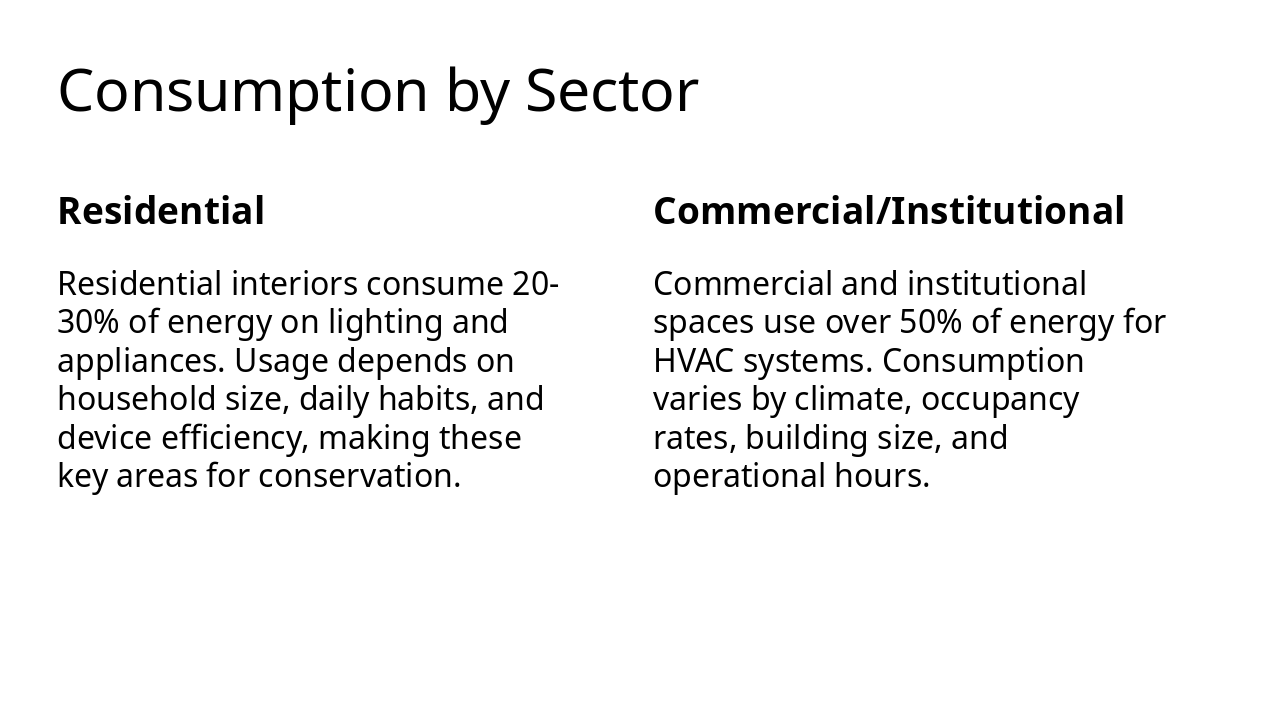
The "Consumption by Sector" slide has two columns: Residential interiors use 20-30% of energy on lighting and appliances, varying by household size, habits, and efficiency for key conservation areas. Commercial/institutional spaces consume over 50% on HVAC systems, influenced by climate, occupancy, building size, and operational hours.

Consumption by Sector

ResidentialCommercial/Institutional
Residential interiors consume 20-30% of energy on lighting and appliances. Usage depends on household size, daily habits, and device efficiency, making these key areas for conservation.Commercial and institutional spaces use over 50% of energy for HVAC systems. Consumption varies by climate, occupancy rates, building size, and operational hours.
Slide 7 - Consumption by Sector
Slide 8 of 19

Slide 8 - Interior Energy Stats

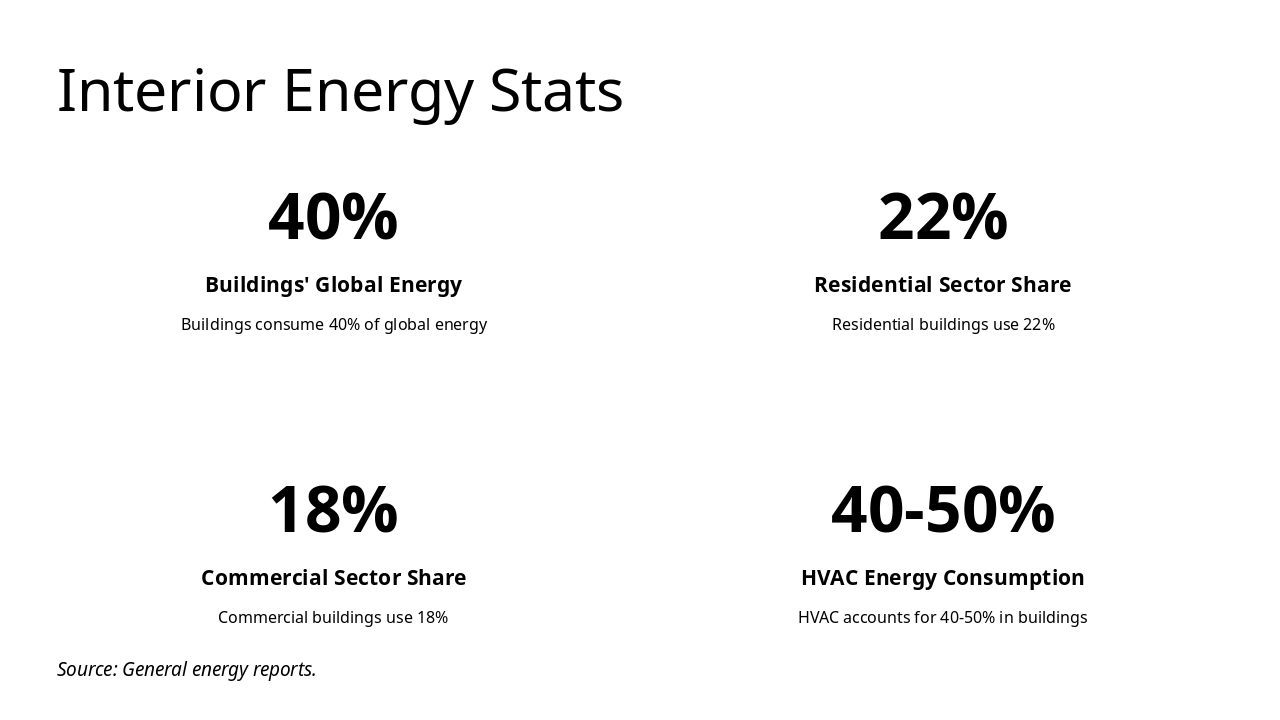
Buildings consume 40% of global energy, with residential buildings using 22% and commercial buildings 18%. HVAC systems account for 40-50% of energy consumption in buildings.

Interior Energy Stats

  • 40%: Buildings' Global Energy
  • Buildings consume 40% of global energy

  • 22%: Residential Sector Share
  • Residential buildings use 22%

  • 18%: Commercial Sector Share
  • Commercial buildings use 18%

  • 40-50%: HVAC Energy Consumption

HVAC accounts for 40-50% in buildings Source: General energy reports.

Slide 8 - Interior Energy Stats
Slide 9 of 19

Slide 9 - 3. Energy Conservation & Sustainability in Interior Design

This slide serves as the section header for "03: Energy Conservation & Sustainability in Interior Design." Its subtitle explains that conservation reduces waste, while sustainability incorporates renewables, efficient materials, and designs promoting long-term environmental health.

03

3. Energy Conservation & Sustainability in Interior Design

Conservation reduces waste; sustainability integrates renewables, efficient materials, and designs for long-term environmental health.

Slide 9 - 3. Energy Conservation & Sustainability in Interior Design
Slide 10 of 19

Slide 10 - Core Concepts

The "Core Concepts" slide highlights key principles for sustainable design. It covers achieving efficiency with less energy, integrating renewables like solar and passive design, using durable recyclable materials, and meeting LEED and Energy Star standards.

Core Concepts

  • Efficiency: Achieve same output with less energy
  • Renewables: Integrate solar and passive design
  • Lifecycle: Use durable, recyclable materials
  • Standards: Meet LEED, Energy Star certifications

Source: Energy conservation and sustainability in interior design

Slide 10 - Core Concepts
Slide 11 of 19

Slide 11 - Sustainability Insight

The "Sustainability Insight" slide features a quote urging designers to harmonize interiors with nature through energy-efficient, eco-friendly practices to boost sustainability and cut environmental impact. It is attributed to pioneering American architect Frank Lloyd Wright.

Sustainability Insight

> Design with nature in mind: harmonize interiors with energy-efficient, eco-friendly practices to foster sustainability and reduce environmental impact.

— Frank Lloyd Wright, Pioneering American Architect

Source: Fundamentals of Energy and Conservation

Speaker Notes
Emphasizing harmony between interiors and energy-efficient, eco-friendly practices in interior design.
Slide 11 - Sustainability Insight
Slide 12 of 19

Slide 12 - Fundamentals of Energy and Conservation

This section header slide, under "Fundamentals of Energy and Conservation," introduces Section 4: "Importance of Reducing Energy Demand." Its subtitle emphasizes environmental benefits (lower emissions) and economic gains (cost savings) that combat climate change and resource depletion.

Fundamentals of Energy and Conservation

4

Importance of Reducing Energy Demand

Yields environmental (lower emissions) and economic (cost savings) benefits, combating climate change and resource depletion.

Slide 12 - Fundamentals of Energy and Conservation
Slide 13 of 19

Slide 13 - Environmental & Economic Benefits

The slide's left column details environmental benefits, including up to 30% CO2 emission reductions, preservation of fossil fuels and water, minimized waste, and ecosystem protection for sustainable interiors. The right column covers economic advantages like 20-50% lower utility bills, 5-15% higher property values, reduced maintenance costs, and eligibility for rebates.

Environmental & Economic Benefits

Environmental BenefitsEconomic Benefits
Reducing energy demand cuts CO2 emissions by up to 30%, combating climate change. Preserves finite resources like fossil fuels and water, minimizes waste, and protects ecosystems for sustainable interiors.Lowers utility bills 20-50% via efficient lighting, HVAC, and appliances. Boosts property value 5-15% through energy-efficient features, reduces maintenance costs, and qualifies for rebates and incentives.
Slide 13 - Environmental & Economic Benefits
Slide 14 of 19

Slide 14 - Fundamentals of Energy and Conservation

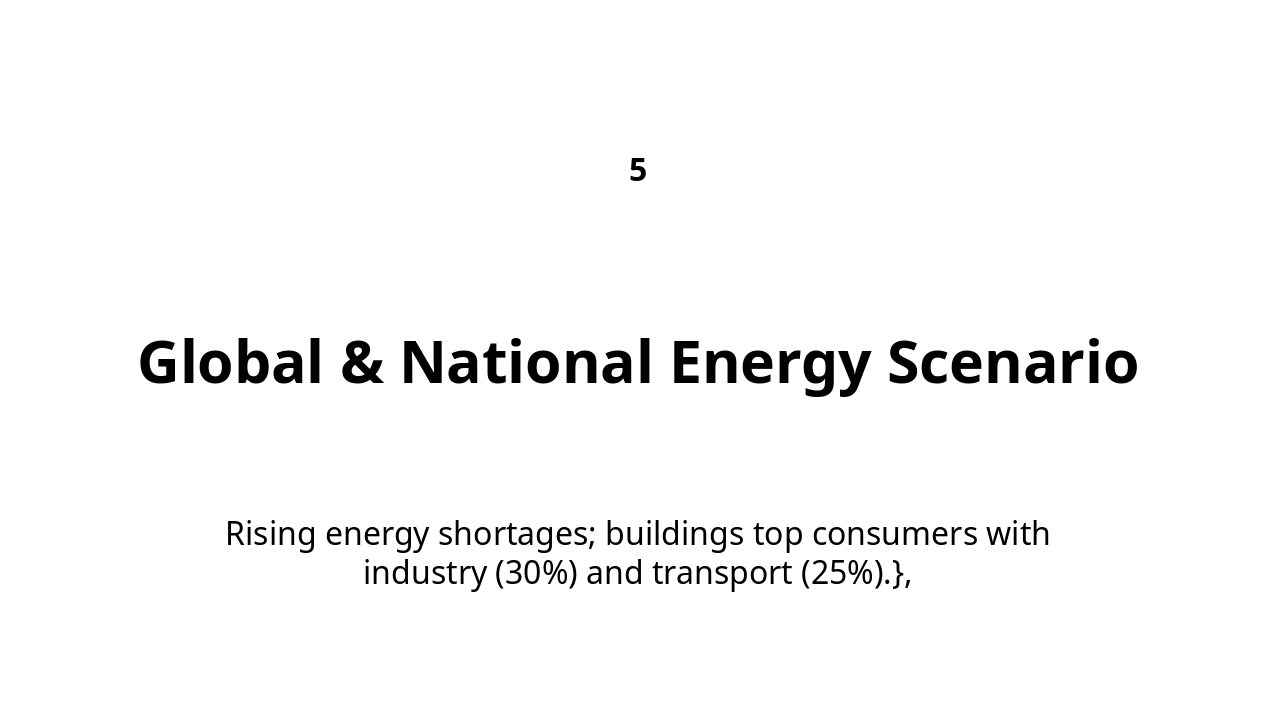
This section header slide introduces Section 5: Global & National Energy Scenario under the topic of Fundamentals of Energy and Conservation. It highlights rising energy shortages, with buildings as top consumers, followed by industry (30%) and transport (25%).

Fundamentals of Energy and Conservation

5

Global & National Energy Scenario

Rising energy shortages; buildings top consumers with industry (30%) and transport (25%).},

Slide 14 - Fundamentals of Energy and Conservation
Slide 15 of 19

Slide 15 - Energy Consumption Trends

The "Energy Consumption Trends" timeline begins with the 1970 Global Oil Crisis sparking shortages and conservation, followed by peak demand growth in 2000 from industrialization and population rise. It then shows renewables surpassing fossil fuels in 2020 amid climate concerns, but projects 2050 net-zero goals challenged by persistent shortages and rising demand.

Energy Consumption Trends

1970: Global Oil Crisis OPEC oil embargo causes energy shortages, price spikes, and conservation awareness worldwide. 2000: Peak Demand Growth Global energy consumption hits peak growth rate driven by rapid industrialization and population rise. 2020: Renewables Surge Forward Renewable energy adoption accelerates, surpassing new fossil fuel capacity amid climate concerns. 2050: Net-Zero Amid Shortages Net-zero emissions goal by 2050 challenged by persistent energy shortages and rising demand.

Slide 15 - Energy Consumption Trends
Slide 16 of 19

Slide 16 - Sector-Wise Usage

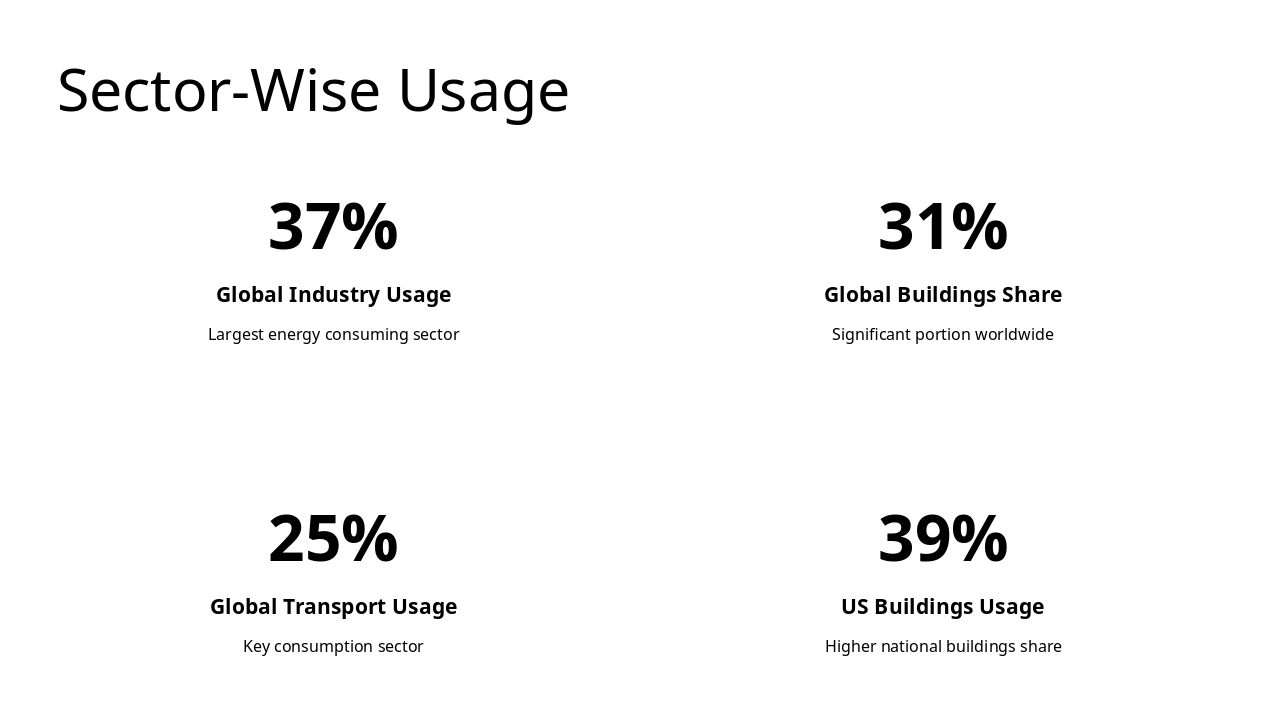
The slide displays sector-wise energy usage stats: global industry at 37% (largest consumer), buildings at 31%, and transport at 25%. US buildings show a higher share at 39%.

Sector-Wise Usage

  • 37%: Global Industry Usage
  • Largest energy consuming sector

  • 31%: Global Buildings Share
  • Significant portion worldwide

  • 25%: Global Transport Usage
  • Key consumption sector

  • 39%: US Buildings Usage
  • Higher national buildings share

Slide 16 - Sector-Wise Usage
Slide 17 of 19

Slide 17 - Fundamentals of Energy and Conservation

This section header slide introduces Section 06 on the "Scope for Conservation in Interiors." It highlights key strategies like LEDs for lighting, smart HVAC controls, efficient appliances, insulation, and low-VOC materials.

Fundamentals of Energy and Conservation

06

Scope for Conservation in Interiors

LEDs for lighting, smart HVAC controls, efficient appliances, insulation & low-VOC materials.

Source: Interior Energy Conservation Section

Speaker Notes
Target lighting (LEDs), HVAC (smart controls), appliances (efficient models), materials (insulation, low-VOC).
Slide 17 - Fundamentals of Energy and Conservation
Slide 18 of 19

Slide 18 - Key Conservation Areas

The "Key Conservation Areas" slide outlines energy-saving strategies for buildings. It highlights LEDs and sensors for lighting (50% savings), zoned high-efficiency HVAC (30-40% savings), Energy Star appliances, and reflective/insulating materials.

Key Conservation Areas

  • Lighting: LEDs and sensors (50% savings)
  • HVAC: Zoning and high-efficiency units (30-40% savings)
  • Appliances: Energy Star rated models
  • Materials: Reflective and insulating surfaces
Slide 18 - Key Conservation Areas
Slide 19 of 19

Slide 19 - Key Takeaways

The Key Takeaways slide highlights understanding energy types, conserving via interior efficiency, reaping environmental and economic benefits, and acting now for sustainability. It includes a subtitle: "Contact help@karaf.ai for custom tweaks."

Key Takeaways

• Understand energy types

  • Conserve via efficiency in interiors
  • Reap env/econ benefits
  • Act now for sustainability!

Contact help@karaf.ai for custom tweaks

Source: Fundamentals of Energy and Conservation

Speaker Notes
Understand energy types, conserve in interiors via efficiency, reap env/econ benefits. Act now for sustainable future! Contact help@karaf.ai for custom tweaks. Closing message: 'Act Now Sustainably!' (3 words). Call-to-action: 'Contact help@karaf.ai for custom tweaks.' (5 words).
Slide 19 - Key Takeaways

Discover More Presentations

Explore thousands of AI-generated presentations for inspiration

Browse Presentations
Powered by AI

Create Your Own Presentation

Generate professional presentations in seconds with Karaf's AI. Customize this presentation or start from scratch.

Create New Presentation

Powered by Karaf.ai — AI-Powered Presentation Generator