Mastering Keq & Equilibrium (HSC Module 5)

Generated from prompt:

Make a presentation about Keq and equilibrium module 5 hsc syllabus new south wales

Explores dynamic equilibrium, Keq expressions (Kc vs Kp), Le Chatelier's Principle, Haber Process example, and key takeaways for NSW HSC Module 5 predictions and calculations.
December 6, 202520 slides
Slide 1 of 20

Slide 1 - Interpreting Keq

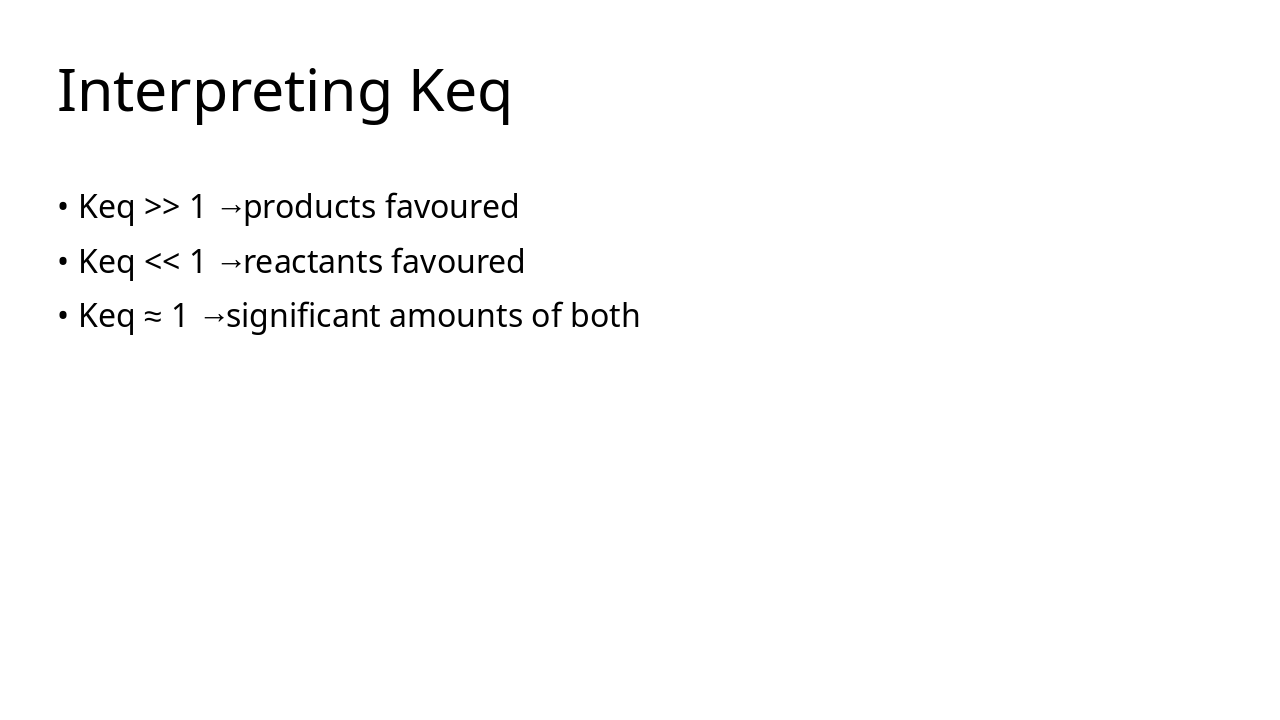
  • Keq >> 1 → products favoured
  • Keq << 1 → reactants favoured
  • Keq ≈ 1 → significant amounts of both
Slide 1 - Interpreting Keq
Slide 2 of 20

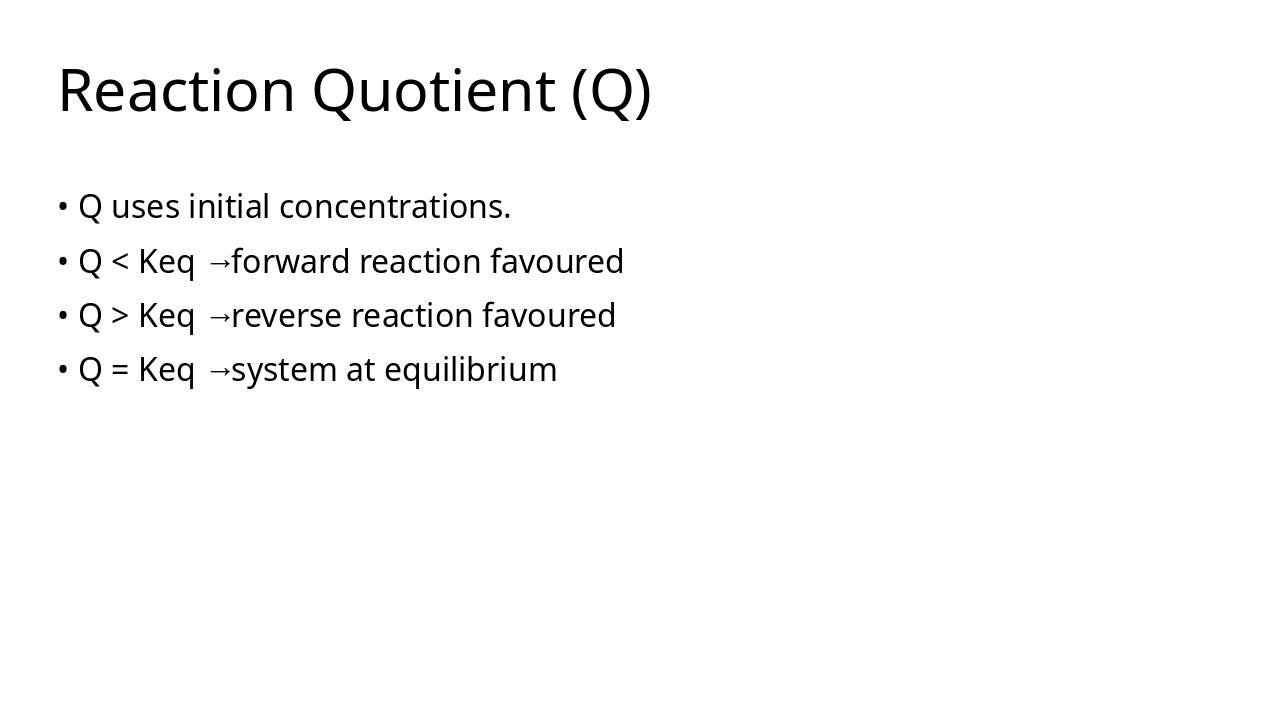
Slide 2 - Reaction Quotient (Q)

  • Q uses initial concentrations.
  • Q < Keq → forward reaction favoured
  • Q > Keq → reverse reaction favoured
  • Q = Keq → system at equilibrium
Slide 2 - Reaction Quotient (Q)
Slide 3 of 20

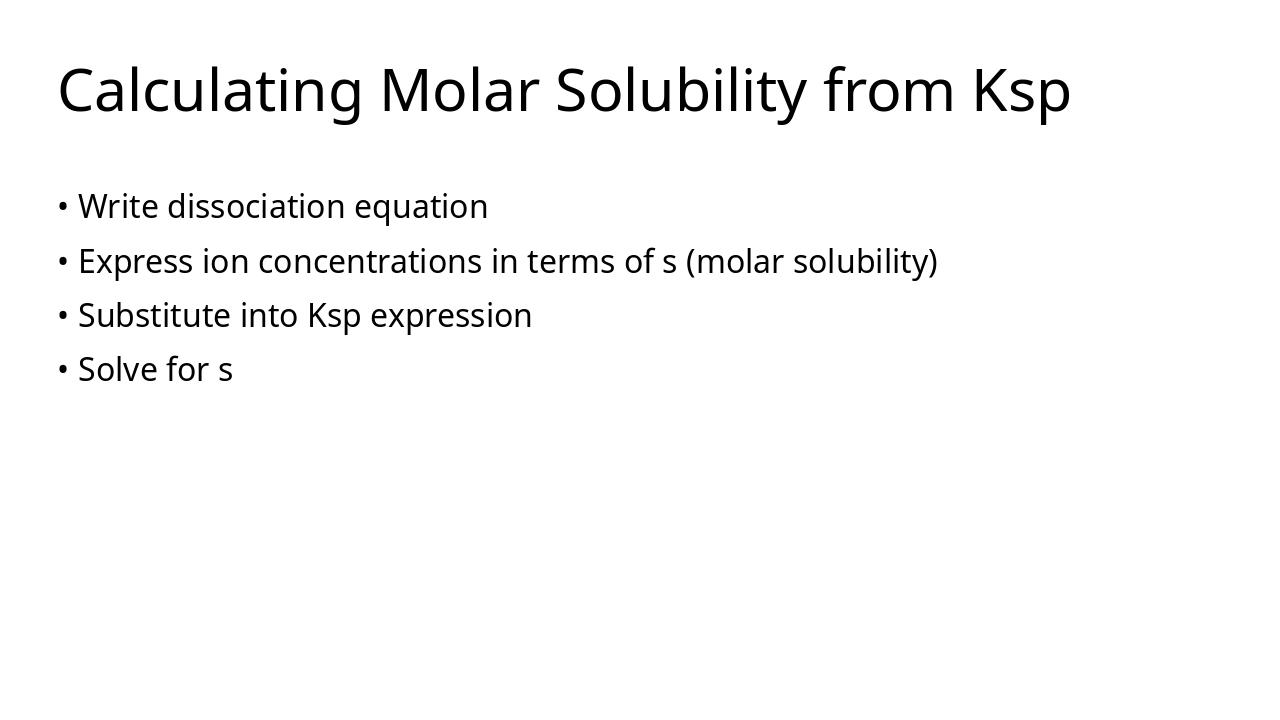
Slide 3 - Calculating Molar Solubility from Ksp

  • Write dissociation equation
  • Express ion concentrations in terms of s (molar solubility)
  • Substitute into Ksp expression
  • Solve for s
Slide 3 - Calculating Molar Solubility from Ksp
Slide 4 of 20

Slide 4 - Effect of Temperature

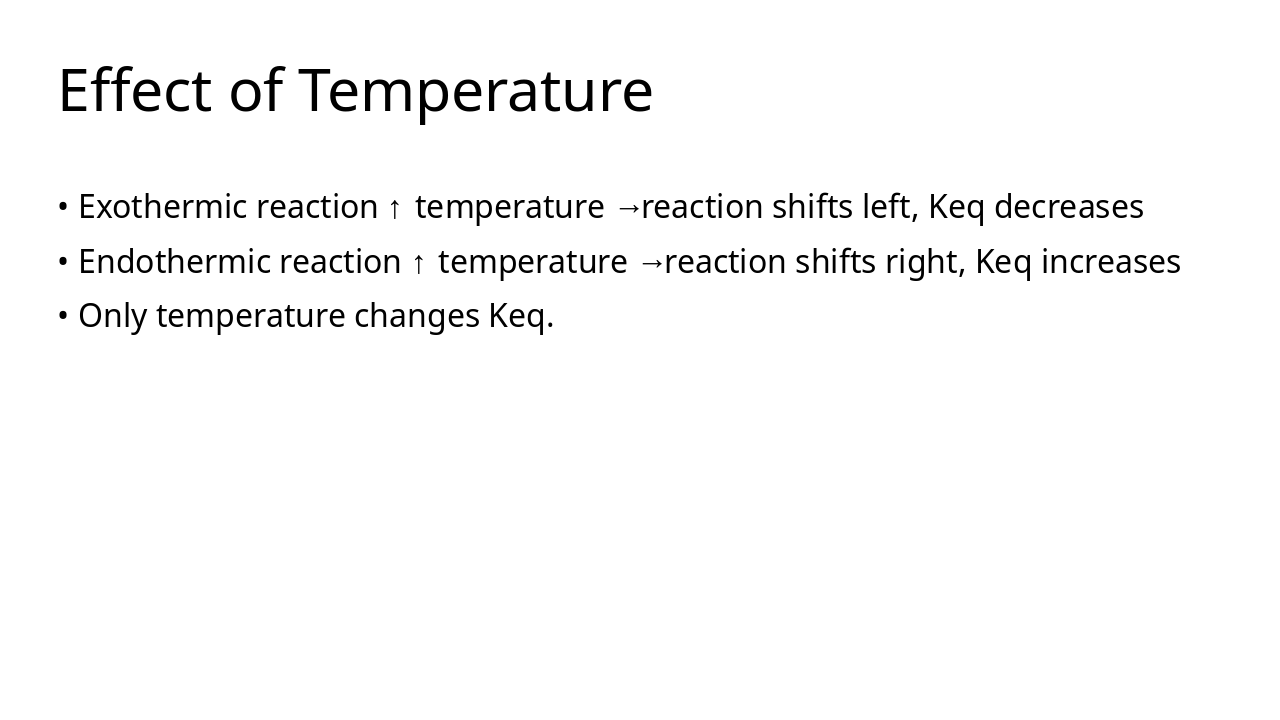
  • Exothermic reaction ↑ temperature → reaction shifts left, Keq decreases
  • Endothermic reaction ↑ temperature → reaction shifts right, Keq increases
  • Only temperature changes Keq.
Slide 4 - Effect of Temperature
Slide 5 of 20

Slide 5 - What is Equilibrium?

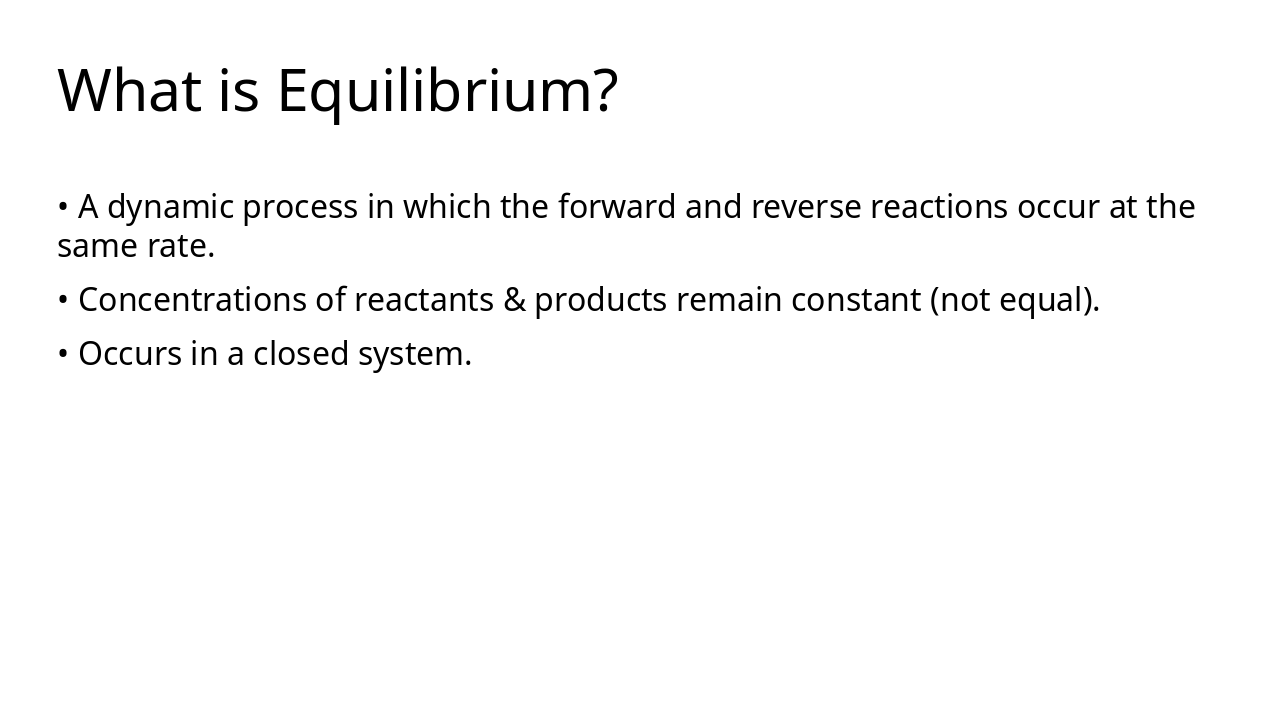
  • A dynamic process in which the forward and reverse reactions occur at the same rate.
  • Concentrations of reactants & products remain constant (not equal).
  • Occurs in a closed system.
Slide 5 - What is Equilibrium?
Slide 6 of 20

Slide 6 - Ksp for Ionic Salts

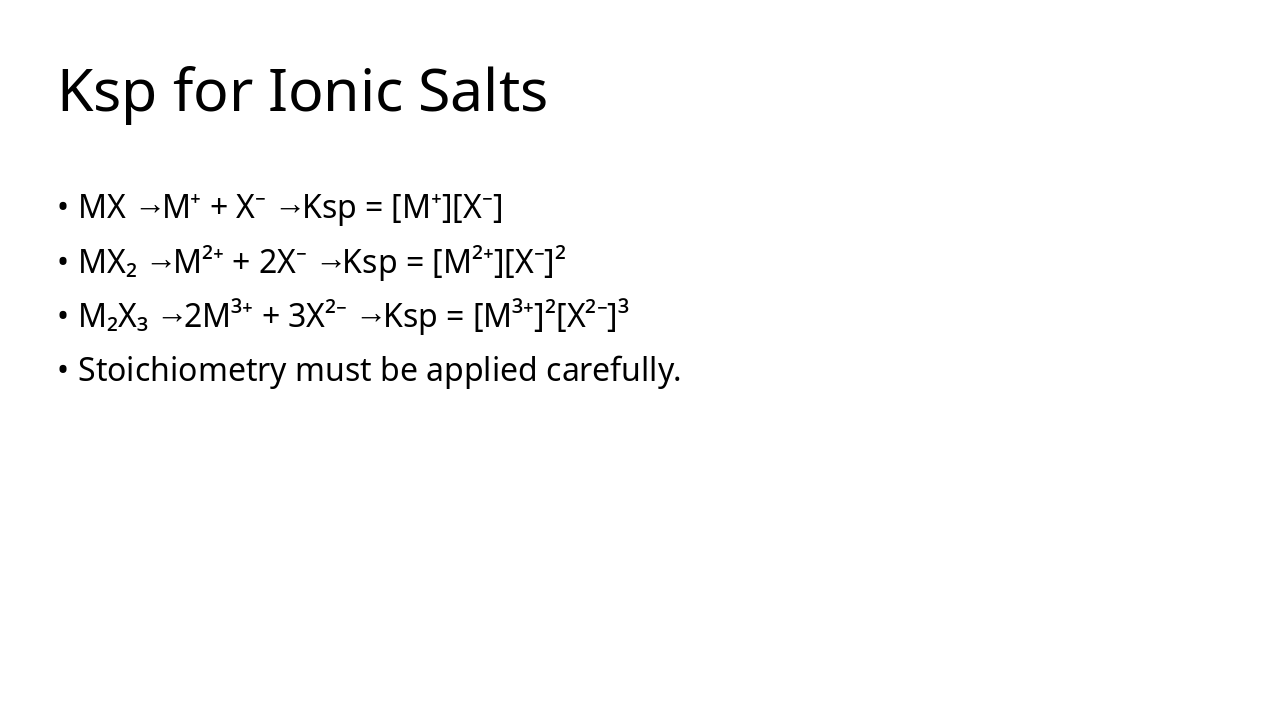
  • MX → M⁺ + X⁻ → Ksp = [M⁺][X⁻]
  • MX₂ → M²⁺ + 2X⁻ → Ksp = [M²⁺][X⁻]²
  • M₂X₃ → 2M³⁺ + 3X²⁻ → Ksp = [M³⁺]²[X²⁻]³
  • Stoichiometry must be applied carefully.
Slide 6 - Ksp for Ionic Salts
Slide 7 of 20

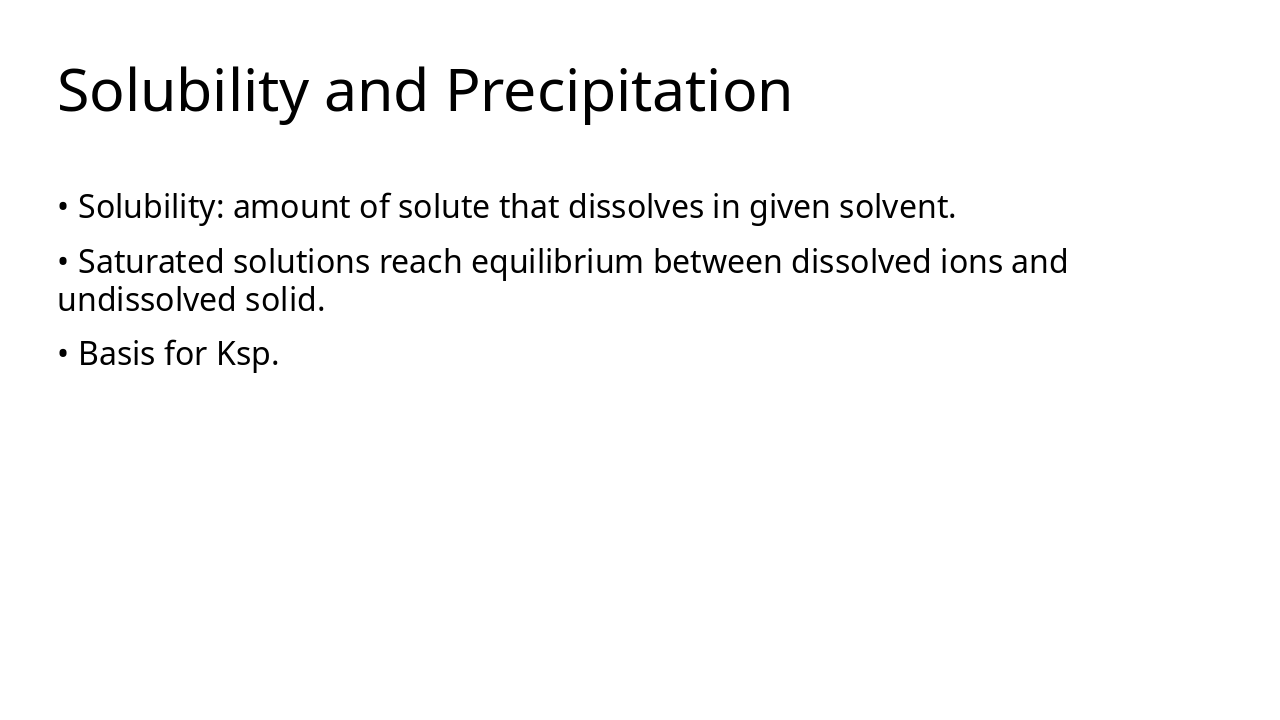
Slide 7 - Solubility and Precipitation

  • Solubility: amount of solute that dissolves in given solvent.
  • Saturated solutions reach equilibrium between dissolved ions and undissolved solid.
  • Basis for Ksp.
Slide 7 - Solubility and Precipitation
Slide 8 of 20

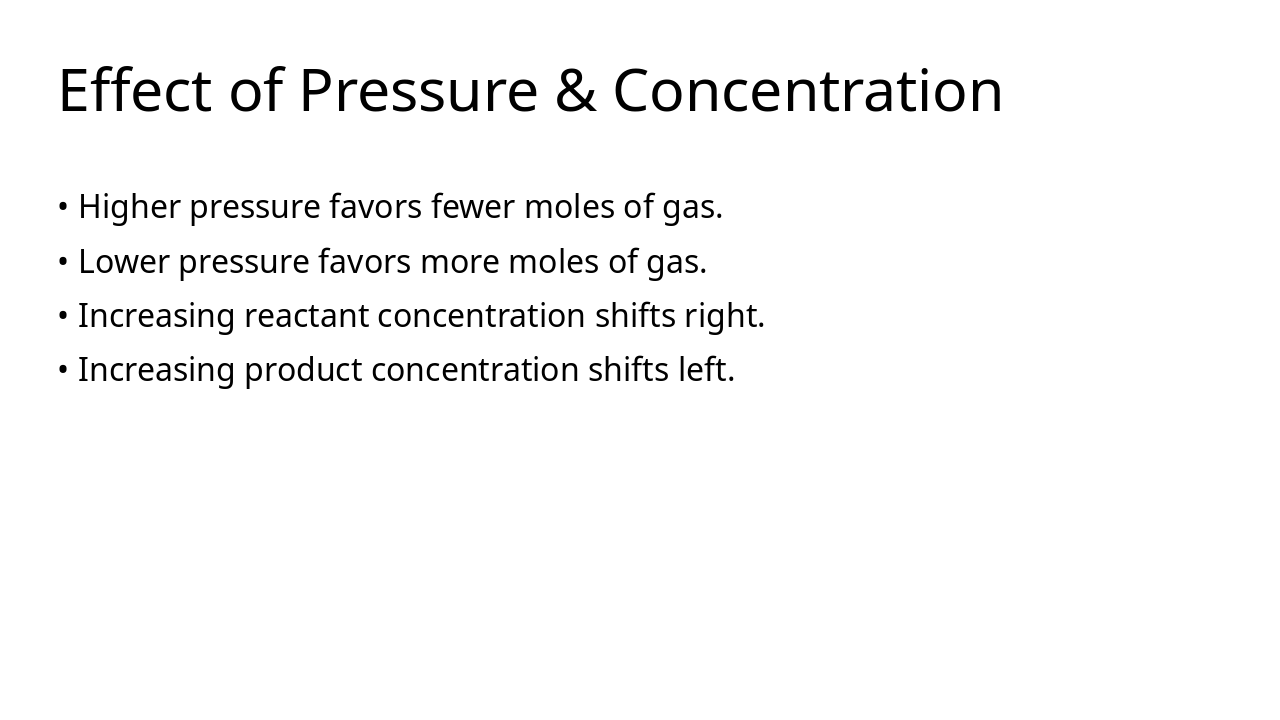
Slide 8 - Effect of Pressure & Concentration

  • Higher pressure favors fewer moles of gas.
  • Lower pressure favors more moles of gas.
  • Increasing reactant concentration shifts right.
  • Increasing product concentration shifts left.
Slide 8 - Effect of Pressure & Concentration
Slide 9 of 20

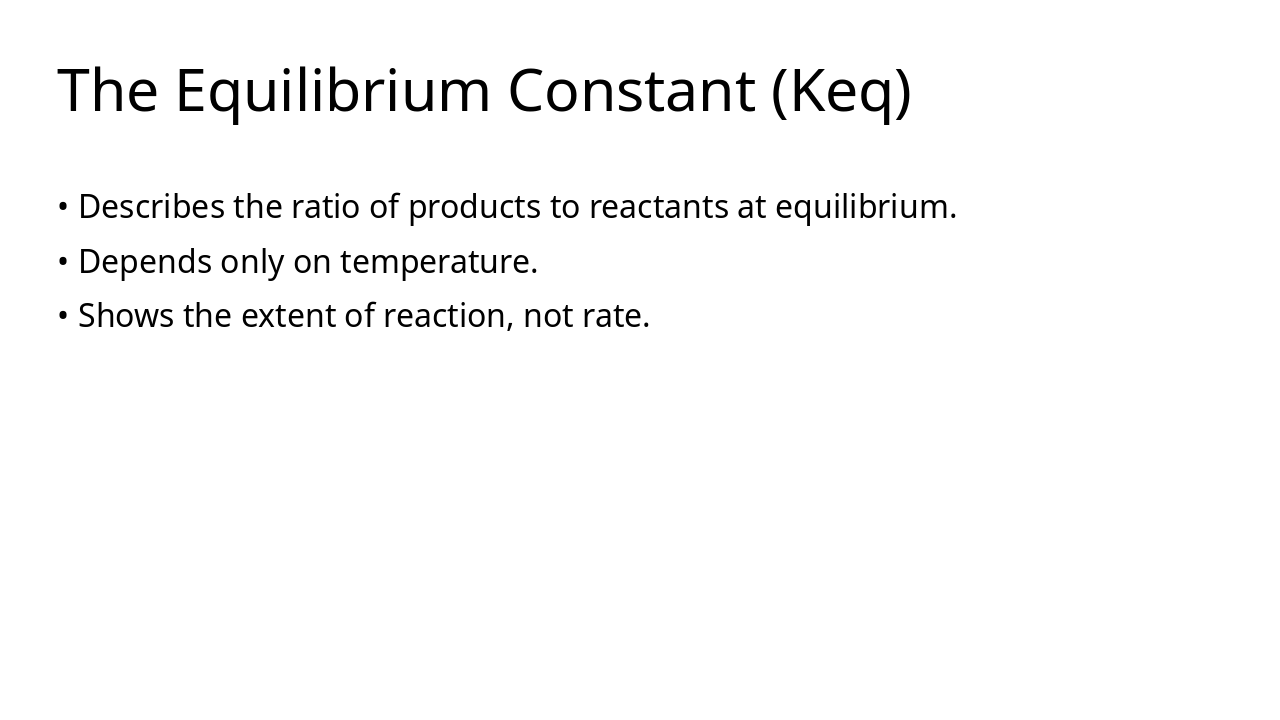
Slide 9 - The Equilibrium Constant (Keq)

  • Describes the ratio of products to reactants at equilibrium.
  • Depends only on temperature.
  • Shows the extent of reaction, not rate.
Slide 9 - The Equilibrium Constant (Keq)
Slide 10 of 20

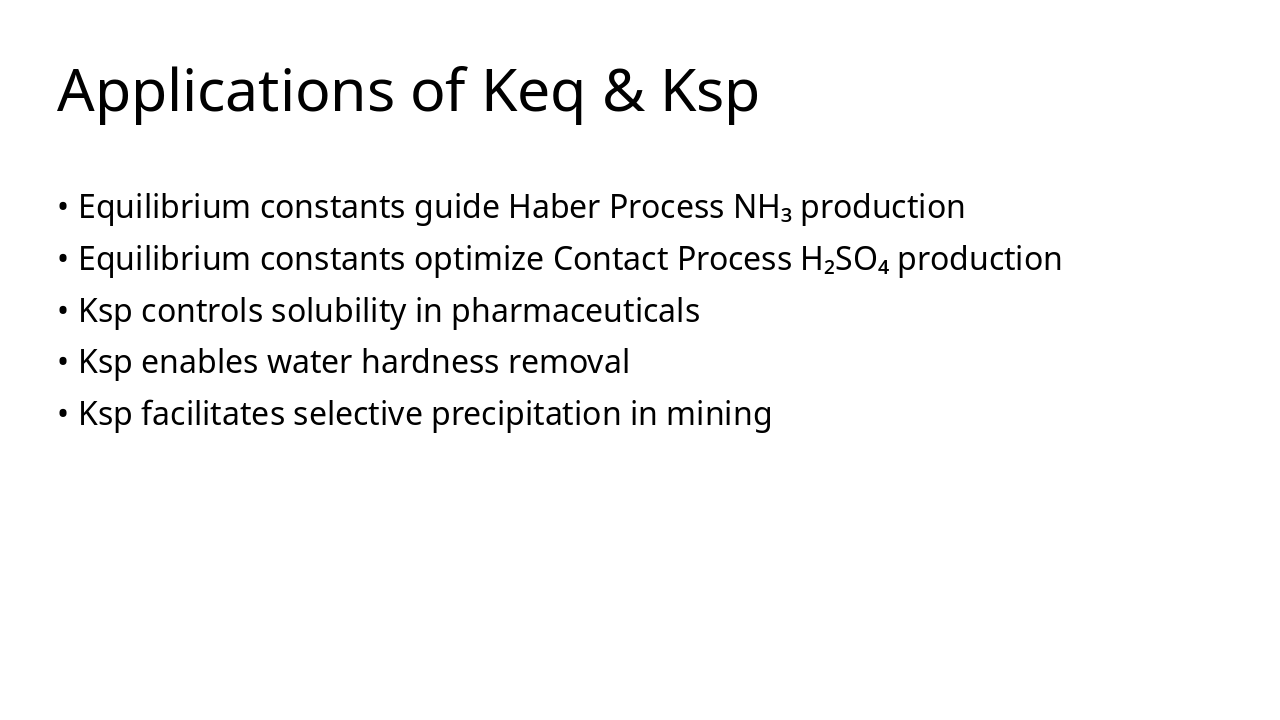
Slide 10 - Applications of Keq & Ksp

  • Equilibrium constants guide Haber Process NH₃ production
  • Equilibrium constants optimize Contact Process H₂SO₄ production
  • Ksp controls solubility in pharmaceuticals
  • Ksp enables water hardness removal
  • Ksp facilitates selective precipitation in mining
Slide 10 - Applications of Keq & Ksp
Slide 11 of 20

Slide 11 - Chemical Equilibrium & Constants (Keq & Ksp)

Chemical Equilibrium & Constants (Keq & Ksp)

HSC Chemistry – Module 5: Equilibrium and Acid Reactions
Slide 11 - Chemical Equilibrium & Constants (Keq & Ksp)
Slide 12 of 20

Slide 12 - Summary

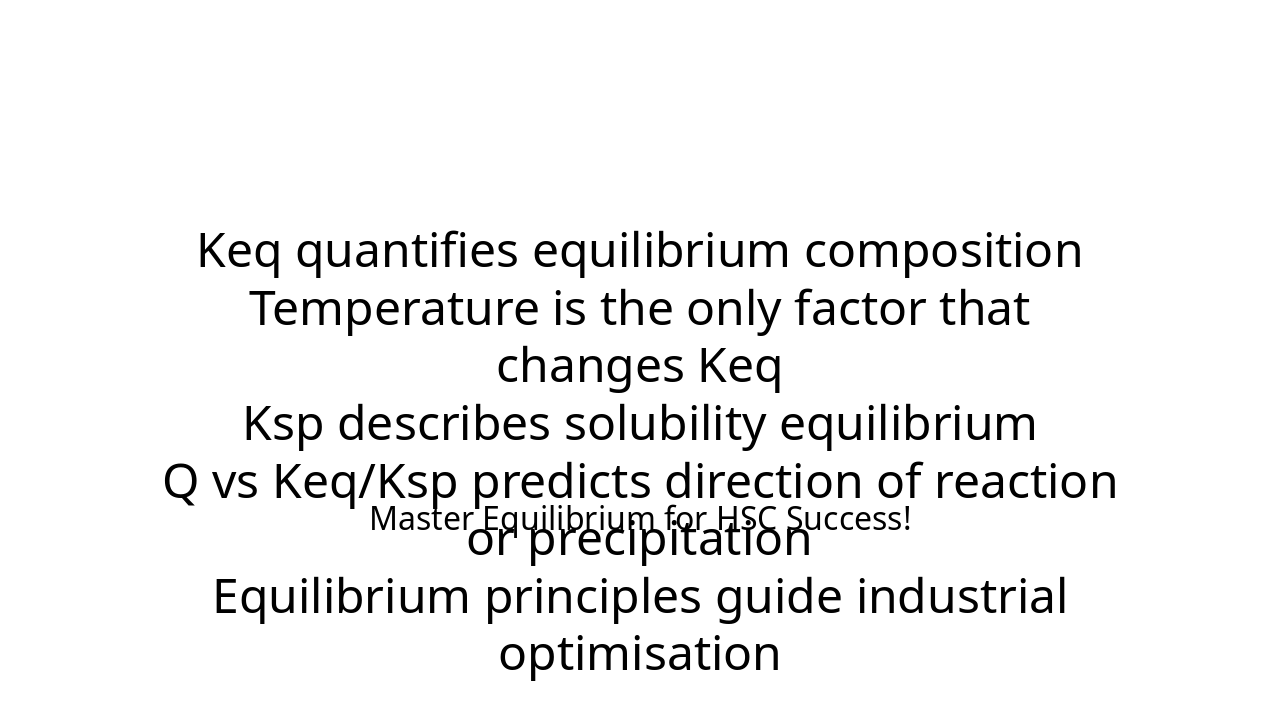
Keq quantifies equilibrium composition Temperature is the only factor that changes Keq Ksp describes solubility equilibrium Q vs Keq/Ksp predicts direction of reaction or precipitation Equilibrium principles guide industrial optimisation

Master Equilibrium for HSC Success!
Slide 12 - Summary
Slide 13 of 20

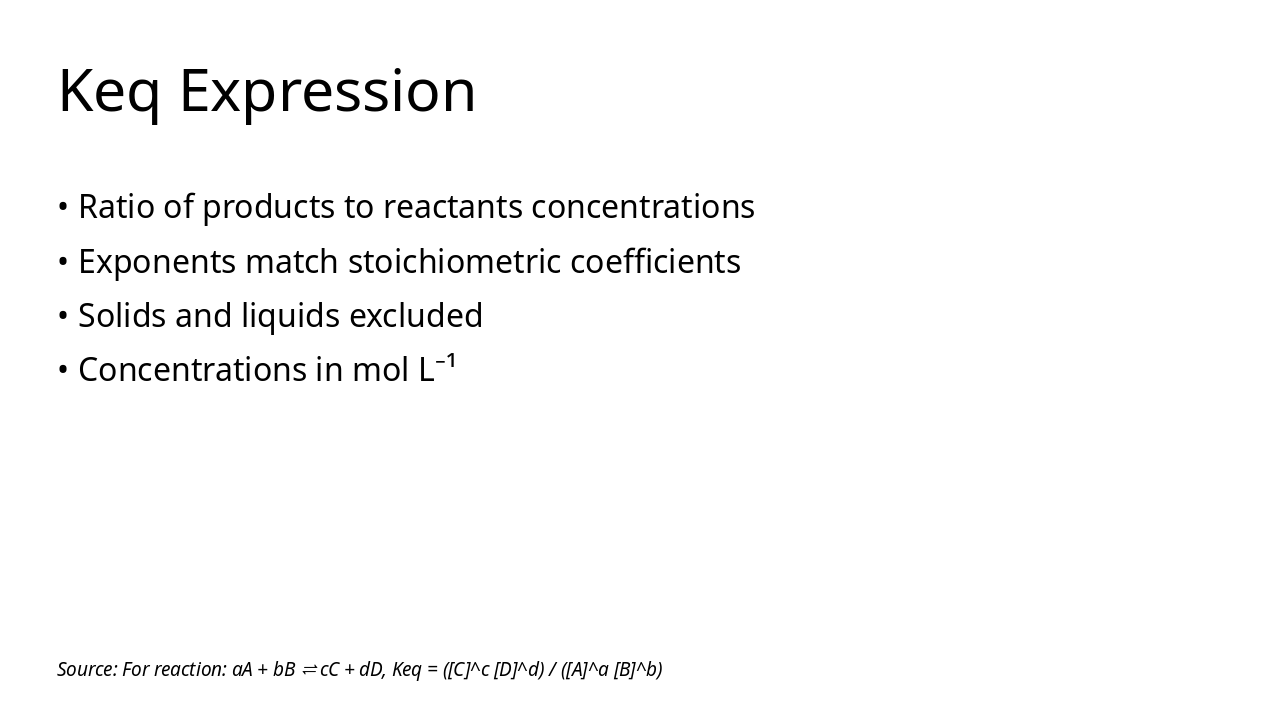
Slide 13 - Keq Expression

  • Ratio of products to reactants concentrations
  • Exponents match stoichiometric coefficients
  • Solids and liquids excluded
  • Concentrations in mol L⁻¹
Slide 13 - Keq Expression
Slide 14 of 20

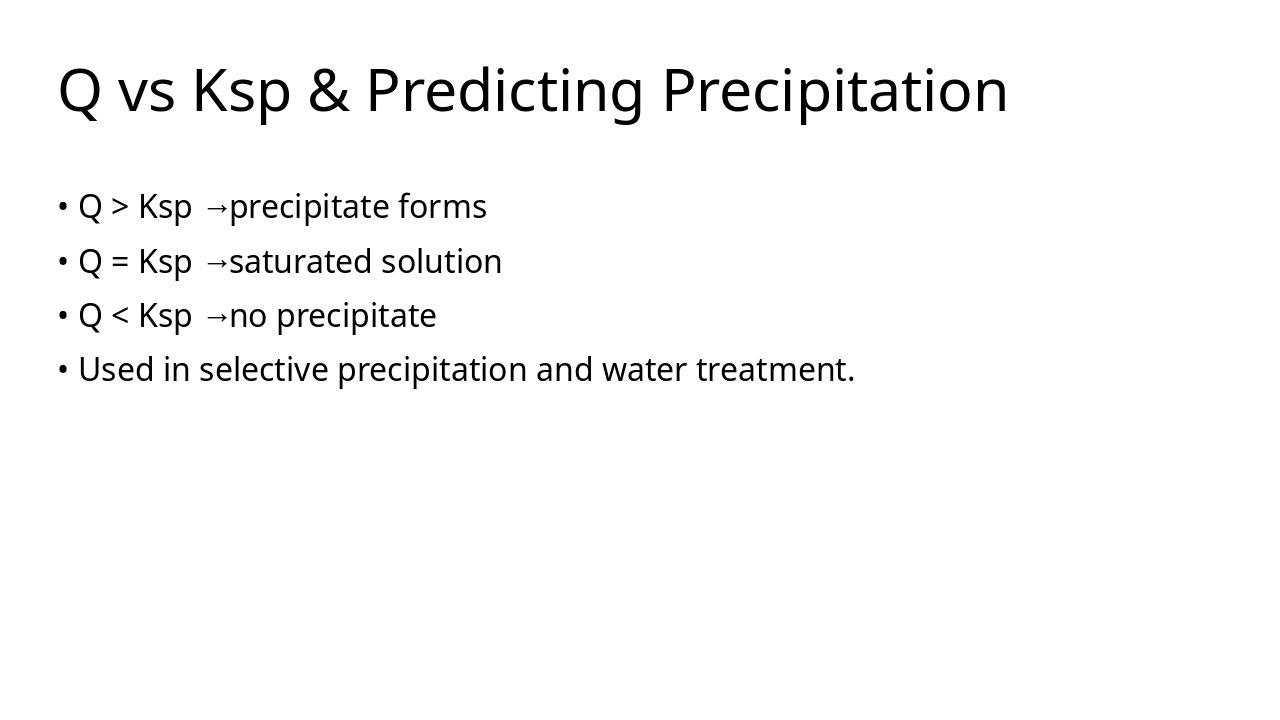
Slide 14 - Q vs Ksp & Predicting Precipitation

  • Q > Ksp → precipitate forms
  • Q = Ksp → saturated solution
  • Q < Ksp → no precipitate
  • Used in selective precipitation and water treatment.
Slide 14 - Q vs Ksp & Predicting Precipitation
Slide 15 of 20

Slide 15 - Le Chatelier’s Principle

  • A system at equilibrium will adjust to minimise the effect of a disturbance.
  • Key disturbances: Concentration, Temperature, Pressure/Volume (gases), Catalysts (no effect on position)
Slide 15 - Le Chatelier’s Principle
Slide 16 of 20

Slide 16 - ICE Tables

  • I: Initial concentrations of all species.
  • C: Changes based on stoichiometry (use x).
  • E: Equilibrium concentrations (I + C values).
  • Essential for setting up and solving Keq algebraically.
Slide 16 - ICE Tables
Slide 17 of 20

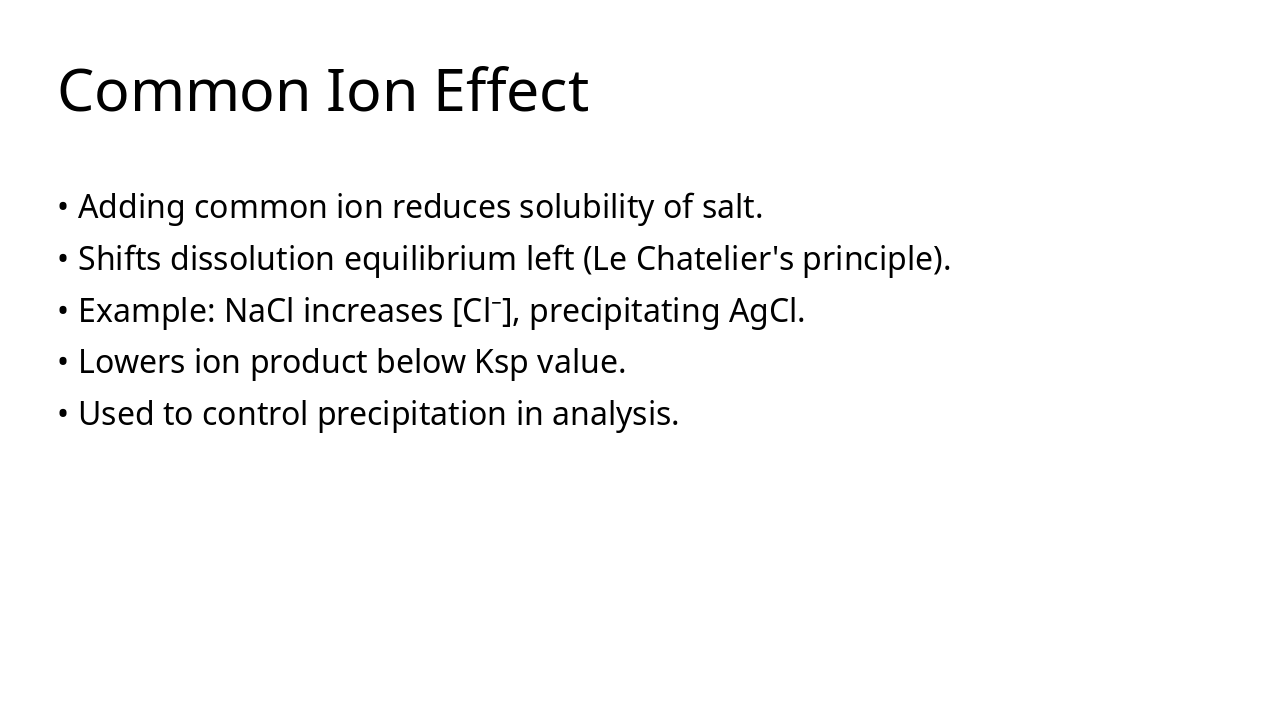
Slide 17 - Common Ion Effect

  • Adding common ion reduces solubility of salt.
  • Shifts dissolution equilibrium left (Le Chatelier's principle).
  • Example: NaCl increases [Cl⁻], precipitating AgCl.
  • Lowers ion product below Ksp value.
  • Used to control precipitation in analysis.
Slide 17 - Common Ion Effect
Slide 18 of 20

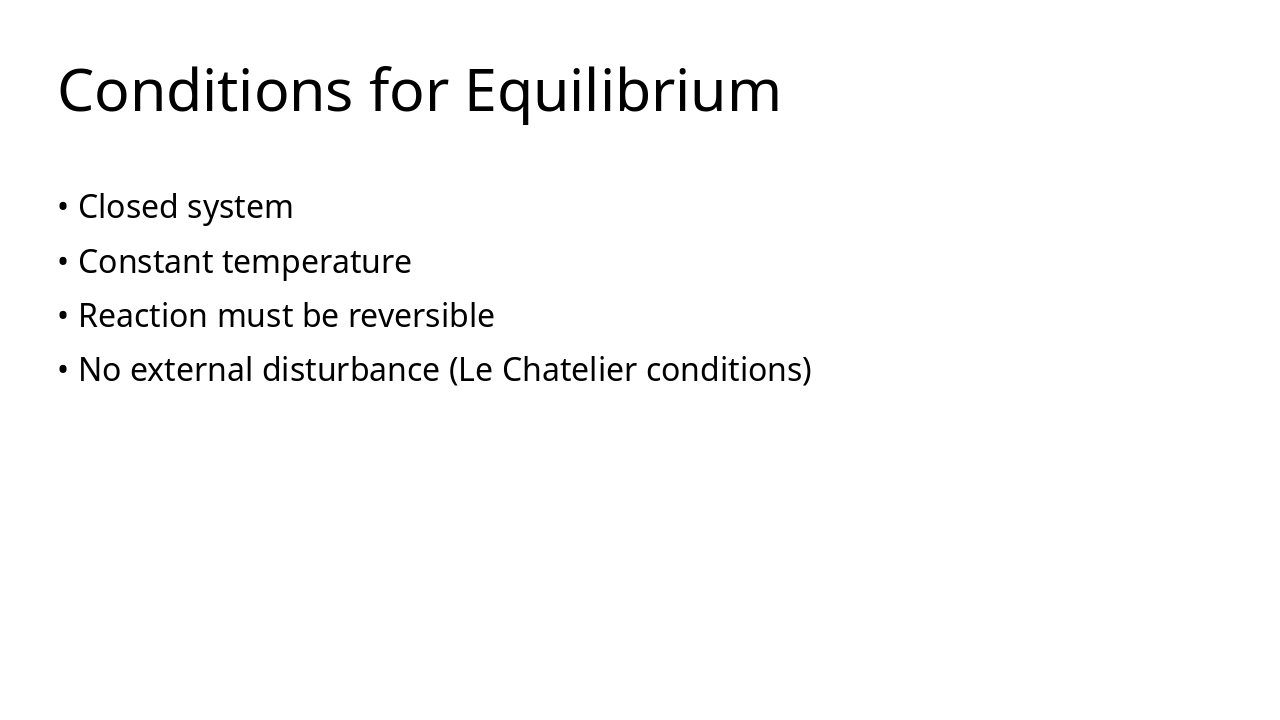
Slide 18 - Conditions for Equilibrium

  • Closed system
  • Constant temperature
  • Reaction must be reversible
  • No external disturbance (Le Chatelier conditions)
Slide 18 - Conditions for Equilibrium
Slide 19 of 20

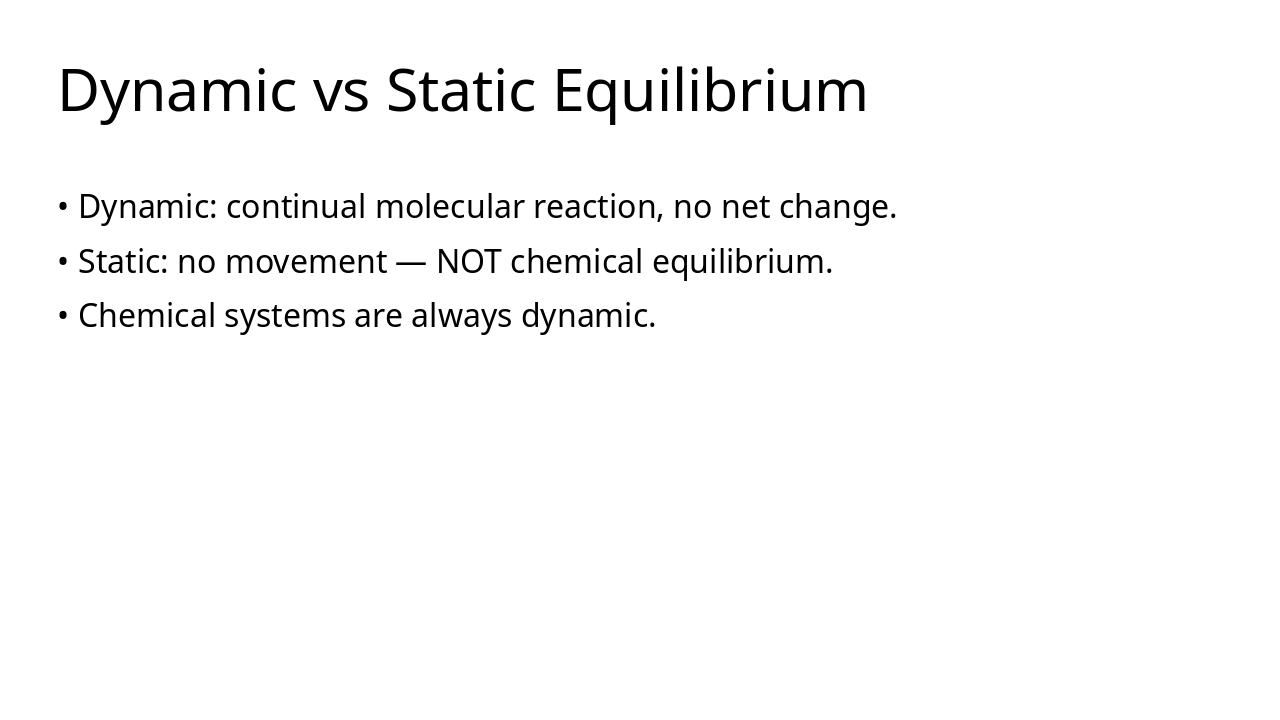
Slide 19 - Dynamic vs Static Equilibrium

  • Dynamic: continual molecular reaction, no net change.
  • Static: no movement — NOT chemical equilibrium.
  • Chemical systems are always dynamic.
Slide 19 - Dynamic vs Static Equilibrium
Slide 20 of 20

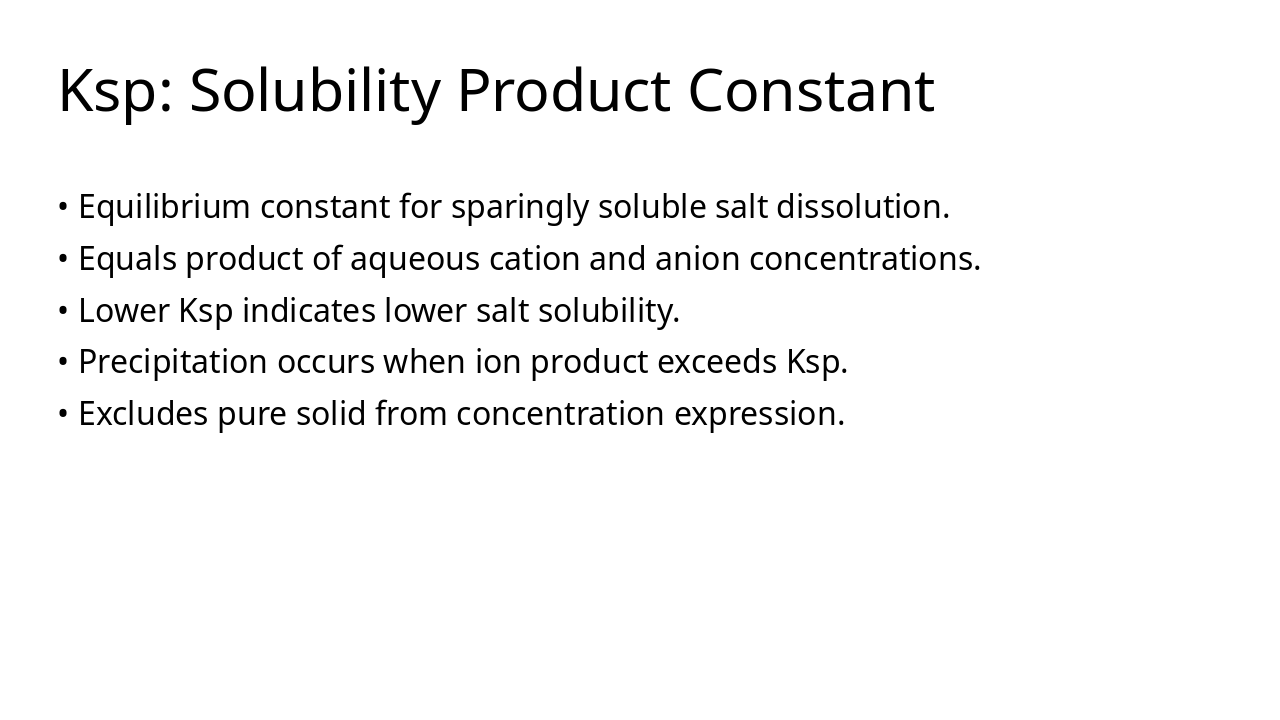
Slide 20 - Ksp: Solubility Product Constant

  • Equilibrium constant for sparingly soluble salt dissolution.
  • Equals product of aqueous cation and anion concentrations.
  • Lower Ksp indicates lower salt solubility.
  • Precipitation occurs when ion product exceeds Ksp.
  • Excludes pure solid from concentration expression.
Slide 20 - Ksp: Solubility Product Constant
Powered by AI

Create Your Own Presentation

Generate professional presentations in seconds with Karaf's AI. Customize this presentation or start from scratch.

Create New Presentation

Powered by Karaf.ai — AI-Powered Presentation Generator