Remote Work's Impact on Employee Health

Generated from prompt:

Create a professional presentation titled 'Impact of Post-Pandemic Remote Work on Employee Health and Well-Being'. Sections: 1. Introduction - Business problem: Shift to remote/hybrid work raised well-being concerns - Objectives: Analyze effects of work arrangements on burnout and health - Dataset: Survey of 3,157 employees from 2025 2. Data Cleaning & Preparation - Missing value treatment for mental/physical health - Data type validation - No duplicate records 3. Data Exploration - Descriptive statistics on hours, work-life balance, isolation - Burnout level distribution - Correlations and key visual findings 4. Modeling Analysis - Regression: Work hours & isolation negatively affect work-life balance - Classification: Predict burnout using Random Forest and logistic regression - Association Rules: Found links between work setup and burnout - Clustering: Identified 3 groups – High Burnout, Balanced, Isolated 5. Model Evaluation - Regression: Low R² - Classification: ~31% accuracy - Clustering: Silhouette score ~0.24 - Association rules had meaningful lift and confidence 6. Recommendations - Limit long work hours - Encourage hybrid models - Address isolation in remote settings - Use burnout models for early detection - Personalize support strategies 7. Conclusion - Data shows complex impact of remote/hybrid/onsite work - Hybrid offers balanced outcomes - Insights support evidence-based HR policies Design Style: - Clean, modern, with visual emphasis on data (charts/graphs/heatmaps) - Use icons and illustrations for burnout, work-life balance, remote work, etc.

Analyzes 2025 survey of 3,157 employees, revealing remote/hybrid work's effects on burnout, health, and balance via data exploration, modeling (RF, regression, clustering), and recommendations for hyb

February 10, 20268 slides
Slide 1 of 8

Slide 1 - Remote Work's Health Impact

This title slide is titled "Remote Work's Health Impact" and focuses on the "Impact of Post-Pandemic Remote Work on Employee Health and Well-Being." It features a subtitle providing a "Professional Analysis of Burnout, Health, and Well-Being from 2025 Survey Data."

Impact of Post-Pandemic Remote Work

on Employee Health and Well-Being

Professional Analysis of Burnout, Health, and Well-Being from 2025 Survey Data

Source: 2025 Employee Survey (n=3,157)

Speaker Notes
Introduce the post-pandemic shift to remote/hybrid work, key objectives, and dataset overview.
Slide 1 - Remote Work's Health Impact
Slide 2 of 8

Slide 2 - Presentation Agenda

This agenda slide outlines the structure of the presentation, starting with an Introduction and followed by Data Cleaning and Data Exploration. It continues with Modeling Analysis, Model Evaluation, Recommendations, and ends with a Conclusion.

Presentation Agenda

  1. 1. Introduction
  2. 2. Data Cleaning
  3. 3. Data Exploration
  4. 4. Modeling Analysis
  5. 5. Model Evaluation
  6. 6. Recommendations
  7. 7. Conclusion

Source: Impact of Post-Pandemic Remote Work on Employee Health and Well-Being

Speaker Notes
Outline the key sections of the presentation, highlighting the flow from problem introduction to actionable recommendations and insights.
Slide 2 - Presentation Agenda
Slide 3 of 8

Slide 3 - Impact of Post-Pandemic Remote Work on Employee Health and Well-Being

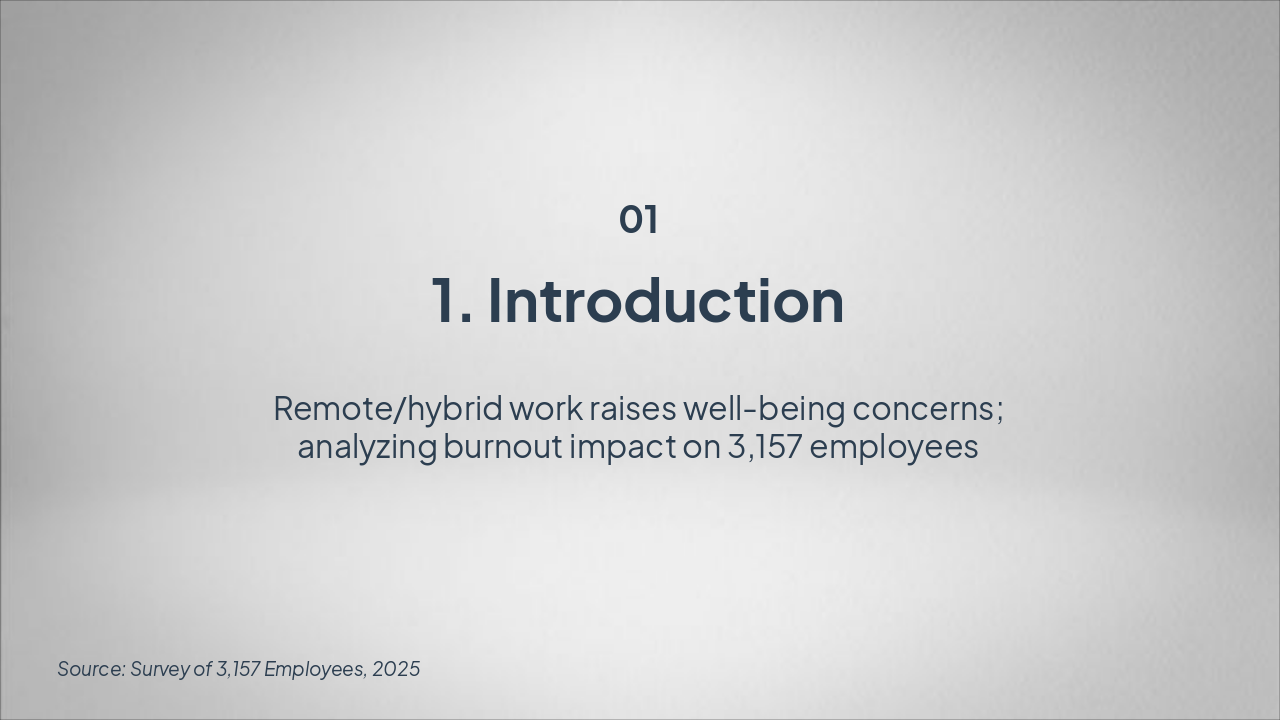
This section header slide introduces the topic of post-pandemic remote work's impact on employee health and well-being. It highlights concerns about remote/hybrid work, focusing on analyzing burnout effects among 3,157 employees.

Impact of Post-Pandemic Remote Work on Employee Health and Well-Being

01

1. Introduction

Remote/hybrid work raises well-being concerns; analyzing burnout impact on 3,157 employees

Source: Survey of 3,157 Employees, 2025

Speaker Notes
Highlight the business problem of remote/hybrid shift raising well-being concerns. State objectives: analyze work arrangements' effects on burnout and health. Mention dataset.
Slide 3 - Impact of Post-Pandemic Remote Work on Employee Health and Well-Being
Slide 4 of 8

Slide 4 - 2. Data Cleaning & Preparation

The slide outlines key steps in data cleaning and preparation, including treating missing values in mental and physical health data. It also covers validating data types for consistency and confirming the absence of duplicate records.

2. Data Cleaning & Preparation

  • Treated missing values in mental/physical health data
  • Validated all data types for consistency
  • Confirmed no duplicate records present

Source: Impact of Post-Pandemic Remote Work on Employee Health and Well-Being

Speaker Notes
Highlight the steps taken to ensure data quality: treated missing values in health metrics, validated data types, and confirmed no duplicates for reliable analysis.
Slide 4 - 2. Data Cleaning & Preparation
Slide 5 of 8

Slide 5 - 3. Data Exploration

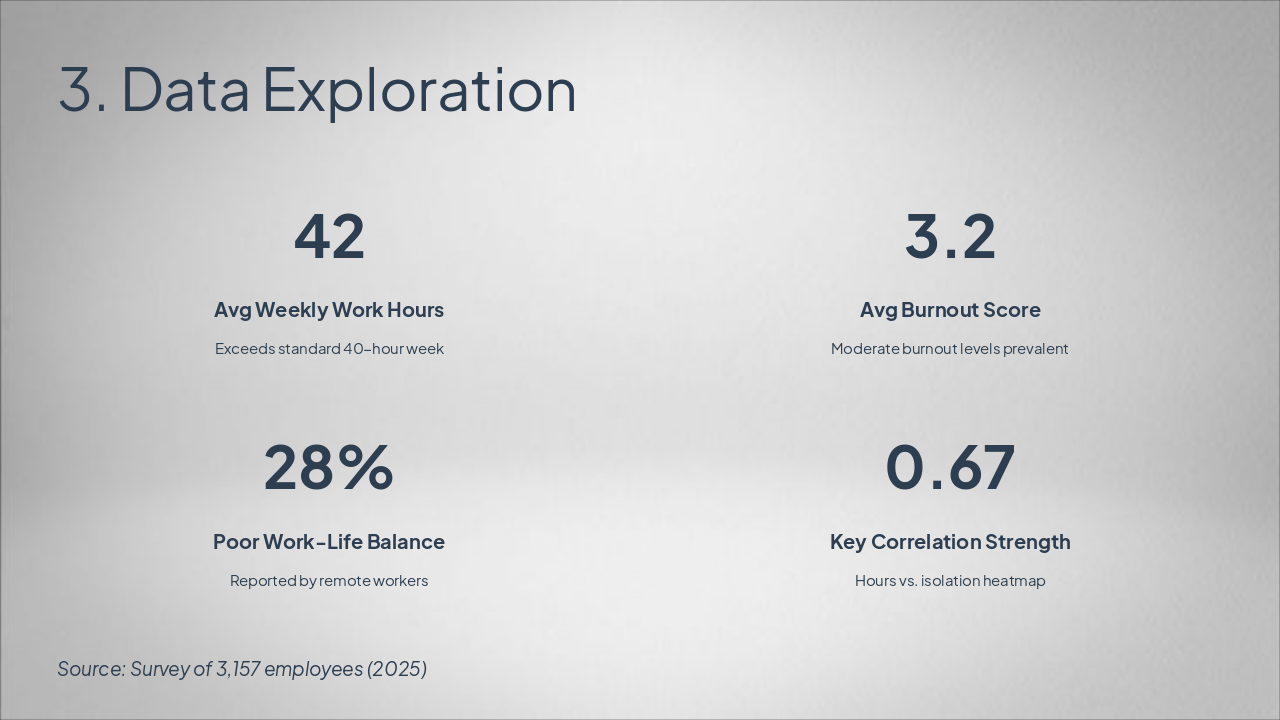
The slide on Data Exploration presents key stats: average weekly work hours at 42 (exceeding the standard 40-hour week), moderate burnout score of 3.2, 28% of remote workers reporting poor work-life balance, and a 0.67 correlation strength between hours and isolation. These metrics highlight prevalent issues like overwork and burnout among remote workers.

3. Data Exploration

  • 42: Avg Weekly Work Hours
  • Exceeds standard 40-hour week

  • 3.2: Avg Burnout Score
  • Moderate burnout levels prevalent

  • 28%: Poor Work-Life Balance
  • Reported by remote workers

  • 0.67: Key Correlation Strength

Hours vs. isolation heatmap Source: Survey of 3,157 employees (2025)

Slide 5 - 3. Data Exploration
Slide 6 of 8

Slide 6 - 4. Modeling Analysis

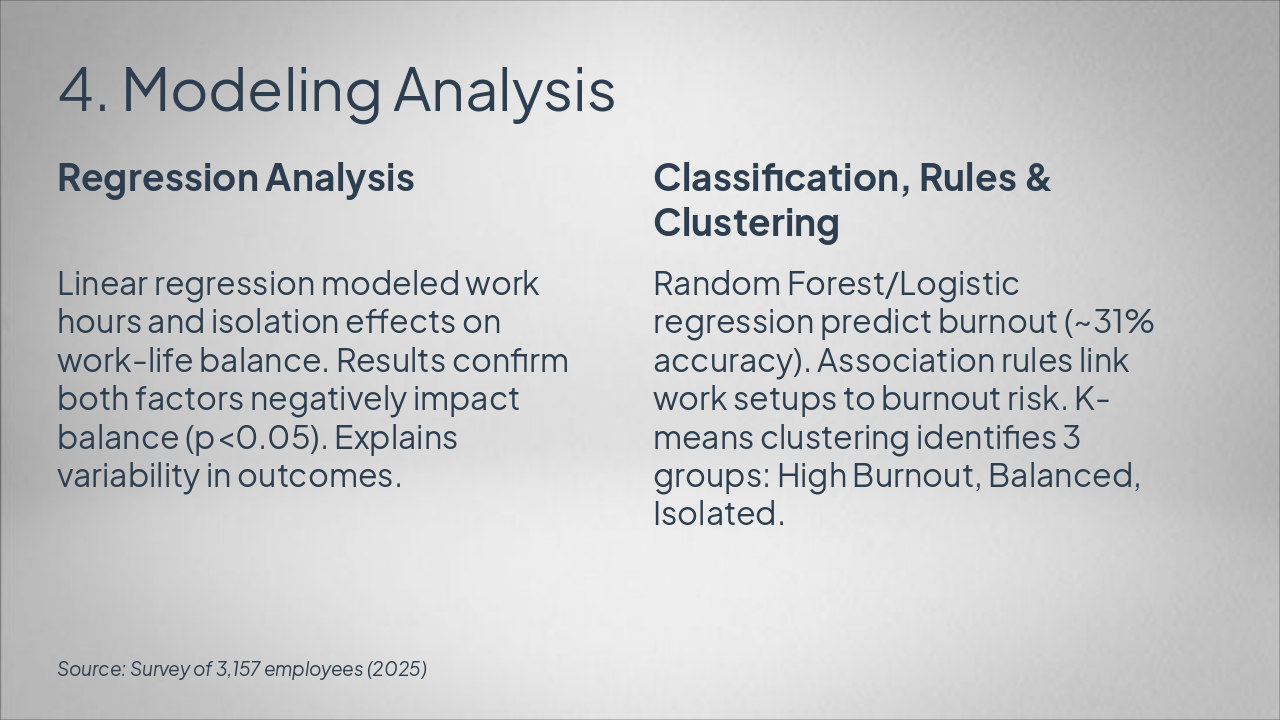
The slide presents a modeling analysis divided into regression and classification/clustering. Linear regression shows work hours and isolation negatively affect work-life balance (p<0.05), while Random Forest/Logistic regression predict burnout at ~31% accuracy, association rules link setups to risk, and K-means identifies three groups: High Burnout, Balanced, and Isolated.

4. Modeling Analysis

Regression AnalysisClassification, Rules & Clustering
Linear regression modeled work hours and isolation effects on work-life balance. Results confirm both factors negatively impact balance (p<0.05). Explains variability in outcomes.Random Forest/Logistic regression predict burnout (~31% accuracy). Association rules link work setups to burnout risk. K-means clustering identifies 3 groups: High Burnout, Balanced, Isolated.

Source: Survey of 3,157 employees (2025)

Speaker Notes
Highlight key models: regression shows negative impacts, RF/logistic predict burnout at ~31% accuracy, clustering reveals 3 distinct employee groups.
Slide 6 - 4. Modeling Analysis
Slide 7 of 8

Slide 7 - 5. Model Evaluation

The slide evaluates four ML models: Regression shows poor fit with low R², Classification has low accuracy at ~31%, and Clustering exhibits weak structure with a Silhouette score of ~0.24. Association Rules perform best, with strong Lift/Confidence indicating meaningful rules.

5. Model Evaluation

ModelMetricScoreAssessment
RegressionLowPoor fit
ClassificationAccuracy~31%Low performance
ClusteringSilhouette~0.24Weak structure
Association RulesLift/ConfidenceStrongMeaningful rules

Source: Survey Data Analysis

Slide 7 - 5. Model Evaluation
Slide 8 of 8

Slide 8 - Recommendations & Conclusion

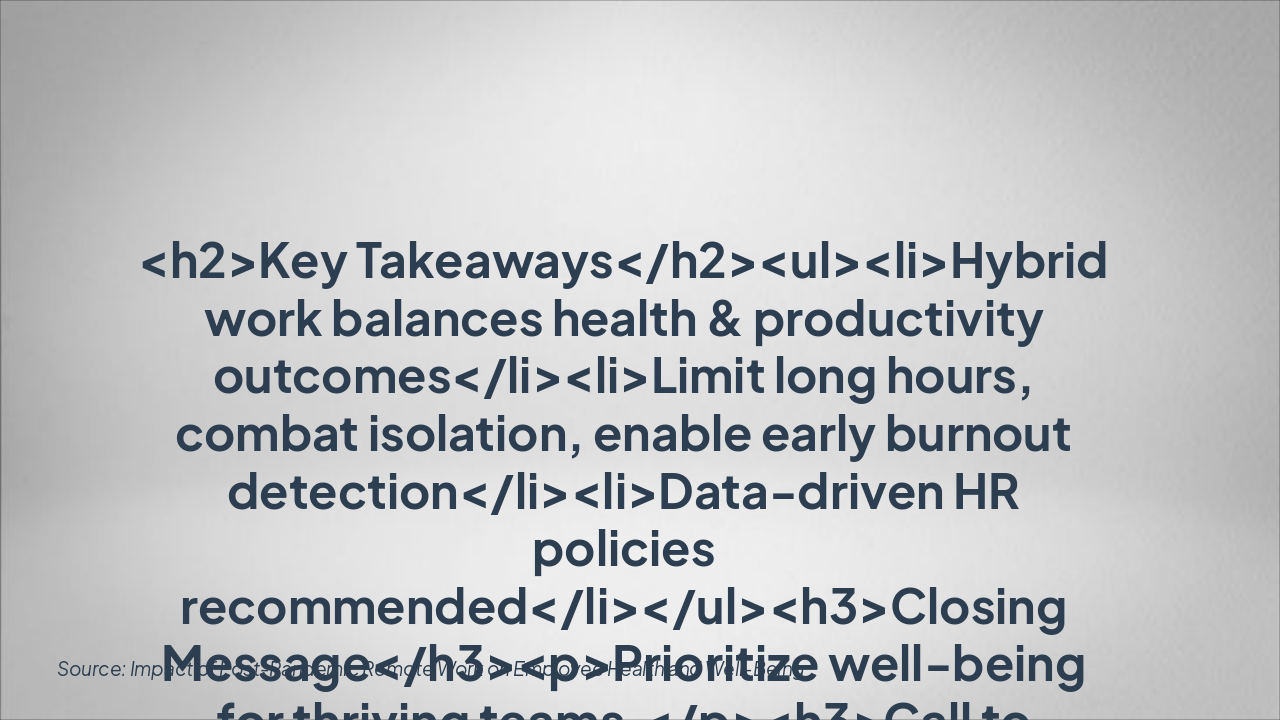
The slide's key takeaways highlight that hybrid work balances health and productivity, while recommending limits on long hours, combating isolation, early burnout detection, and data-driven HR policies. It closes with a message to prioritize well-being for thriving teams and a call to action to implement hybrid strategies and monitor burnout today.

Recommendations & Conclusion

<h2>Key Takeaways</h2><ul><li>Hybrid work balances health & productivity outcomes</li><li>Limit long hours, combat isolation, enable early burnout detection</li><li>Data-driven HR policies recommended</li></ul><h3>Closing Message</h3><p>Prioritize well-being for thriving teams.</p><h3>Call to Action</h3><p>Implement hybrid strategies and monitor burnout today.</p>

Source: Impact of Post-Pandemic Remote Work on Employee Health and Well-Being

Speaker Notes
Summarize key insights: hybrid balances outcomes; recommend data-driven HR policies for limiting hours, fighting isolation, and early detection.
Slide 8 - Recommendations & Conclusion

Discover More Presentations

Explore thousands of AI-generated presentations for inspiration

Browse Presentations
Powered by AI

Create Your Own Presentation

Generate professional presentations in seconds with Karaf's AI. Customize this presentation or start from scratch.

Create New Presentation

Powered by Karaf.ai — AI-Powered Presentation Generator