Milrinone in Cardiac Care Essentials

Generated from prompt:

Create a medical presentation about Milrinone, including its mechanism of action, clinical uses, dosing, adverse effects, and contraindications. Include visuals such as molecular mechanism diagrams and cardiac physiology illustrations.

This presentation explores Milrinone, a PDE3 inhibitor used in acute heart failure and post-surgery support. It covers its mechanism (increasing cAMP for enhanced contractility), dosing (50 mcg/kg loa

November 25, 202515 slides
Slide 1 of 15

Slide 1 - Milrinone Overview

The slide titled "Milrinone Overview" introduces a presentation on the use of Milrinone in cardiac care. It features the main text "An Overview of Milrinone in Cardiac Care" and a subtitle welcoming viewers to explore Milrinone as a key inotropic agent, covering its pharmacology and clinical applications.

An Overview of Milrinone in Cardiac Care

Welcome to this presentation on Milrinone, a key inotropic agent for cardiac care including pharmacology and clinical applications.

Slide 1 - Milrinone Overview
Slide 2 of 15

Slide 2 - Presentation Agenda

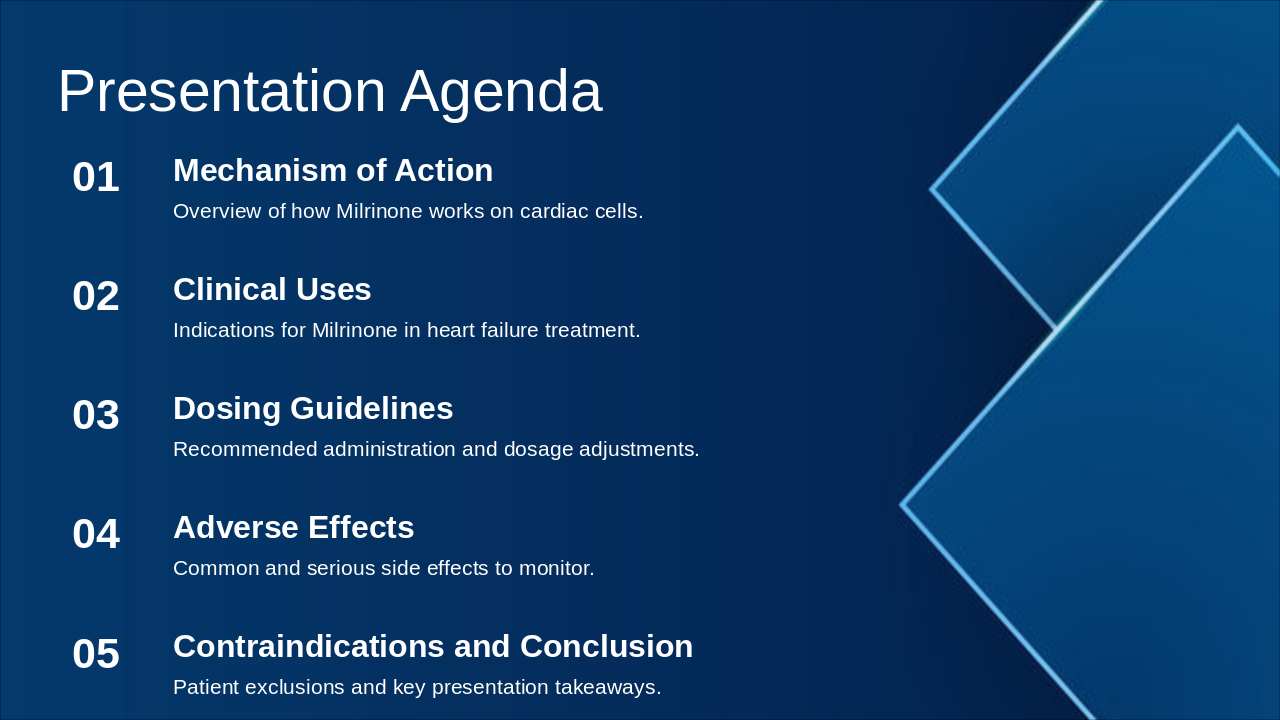
The presentation agenda outlines key topics on Milrinone, starting with its mechanism of action on cardiac cells and clinical uses in heart failure treatment. It continues with dosing guidelines, adverse effects to monitor, and concludes with contraindications and key takeaways.

Presentation Agenda

  1. Mechanism of Action
  2. Overview of how Milrinone works on cardiac cells.

  3. Clinical Uses
  4. Indications for Milrinone in heart failure treatment.

  5. Dosing Guidelines
  6. Recommended administration and dosage adjustments.

  7. Adverse Effects
  8. Common and serious side effects to monitor.

  9. Contraindications and Conclusion
  10. Patient exclusions and key presentation takeaways.

Slide 2 - Presentation Agenda
Slide 3 of 15

Slide 3 - Mechanism of Action

This slide introduces the "Mechanism of Action" section, numbered 02, focusing on Milrinone's role as a phosphodiesterase-3 inhibitor. It provides an overview of how the drug functions in this capacity.

Mechanism of Action

02

Mechanism of Action

Introduction to how Milrinone works as a phosphodiesterase-3 inhibitor.

Speaker Notes
Introduction to how Milrinone works as a phosphodiesterase-3 inhibitor. Include visuals such as molecular mechanism diagrams and cardiac physiology illustrations.
Slide 3 - Mechanism of Action
Slide 4 of 15

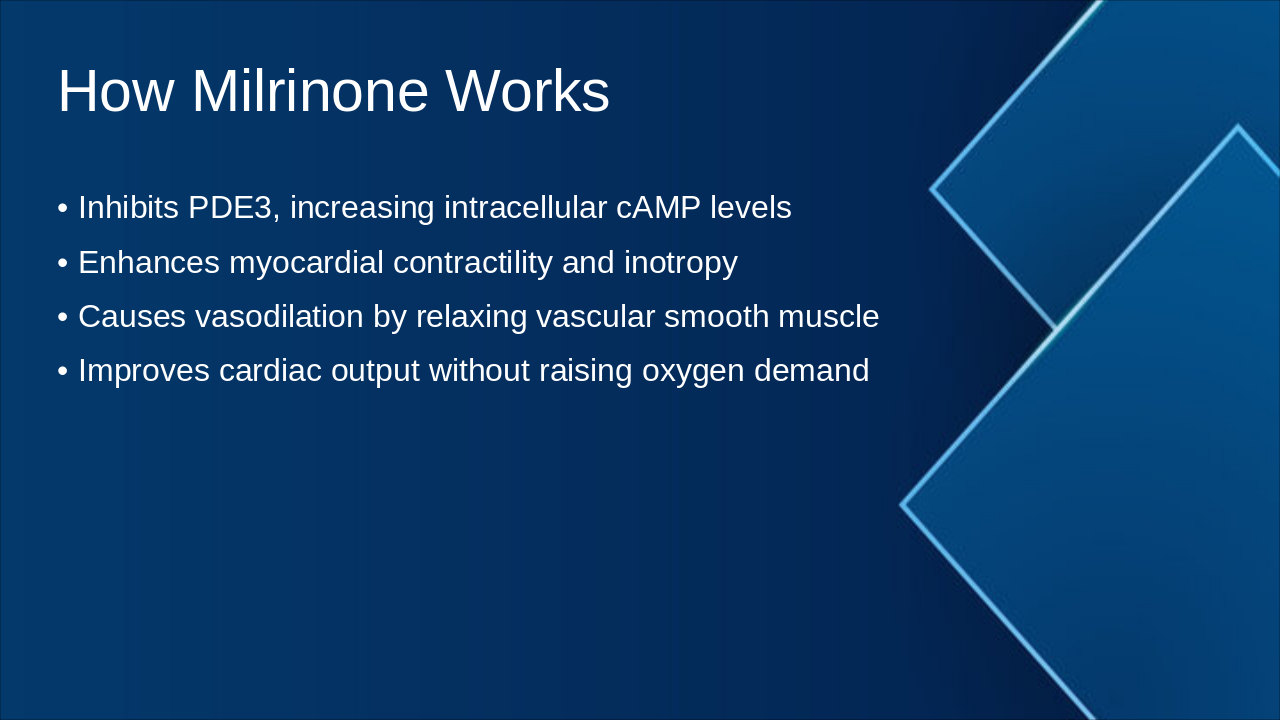
Slide 4 - How Milrinone Works

Milrinone works by inhibiting PDE3, which elevates intracellular cAMP levels to enhance myocardial contractility and inotropy. It also promotes vasodilation through relaxation of vascular smooth muscle, ultimately improving cardiac output without increasing oxygen demand.

How Milrinone Works

  • Inhibits PDE3, increasing intracellular cAMP levels
  • Enhances myocardial contractility and inotropy
  • Causes vasodilation by relaxing vascular smooth muscle
  • Improves cardiac output without raising oxygen demand
Slide 4 - How Milrinone Works
Slide 5 of 15

Slide 5 - Molecular Mechanism Diagram

This slide illustrates the molecular mechanism of PDE3 inhibition in cardiac cells, which prevents cAMP degradation and leads to elevated cAMP levels that activate PKA for enhanced contractility. It further explains how increased calcium sensitivity improves heart function while promoting vasodilation to reduce vascular resistance and preload.

Molecular Mechanism Diagram

!Image

  • PDE3 inhibition blocks cAMP degradation in cardiac cells.
  • Elevated cAMP activates PKA, enhancing contractility.
  • Increased calcium sensitivity improves heart function.
  • Vasodilation reduces vascular resistance and preload.

Source: Image from Wikipedia article "Milrinone"

Slide 5 - Molecular Mechanism Diagram
Slide 6 of 15

Slide 6 - Clinical Uses

This slide serves as a section header titled "Clinical Uses," marking it as the fifth section in the presentation. It includes a subtitle highlighting the primary medical indications for the drug Milrinone.

05

Clinical Uses

Primary indications for Milrinone in medical practice.

Slide 6 - Clinical Uses
Slide 7 of 15

Slide 7 - Indications

This slide outlines key indications for a medical intervention or therapy, focusing on critical cardiac conditions. It includes treatment of acute decompensated heart failure, hemodynamic support after cardiac surgery, short-term management of cardiogenic shock, and bridging patients to advanced options like transplant.

Indications

  • Acute decompensated heart failure treatment
  • Post-cardiac surgery hemodynamic support
  • Short-term cardiogenic shock management
  • Bridge to advanced therapies like transplant
Slide 7 - Indications
Slide 8 of 15

Slide 8 - Cardiac Physiology Illustration

This slide illustrates cardiac physiology, focusing on the drug milrinone, which boosts myocardial contractility by inhibiting PDE3. It highlights how milrinone significantly improves cardiac output and stroke volume while reducing vascular resistance to enhance overall hemodynamics.

Cardiac Physiology Illustration

!Image

  • Milrinone increases myocardial contractility via PDE3 inhibition.
  • Improves cardiac output and stroke volume significantly.
  • Enhances hemodynamics by reducing vascular resistance.

Source: milrinone effects on cardiac function

Speaker Notes
Diagram illustrating improved cardiac function and hemodynamics with Milrinone.
Slide 8 - Cardiac Physiology Illustration
Slide 9 of 15

Slide 9 - Dosing Guidelines

This section header slide introduces the topic of Dosing Guidelines. It highlights recommended administration protocols, dosing regimens, and key aspects of patient monitoring.

Dosing Guidelines

Recommended administration protocols, dosing regimens, and essential patient monitoring.

Slide 9 - Dosing Guidelines
Slide 10 of 15

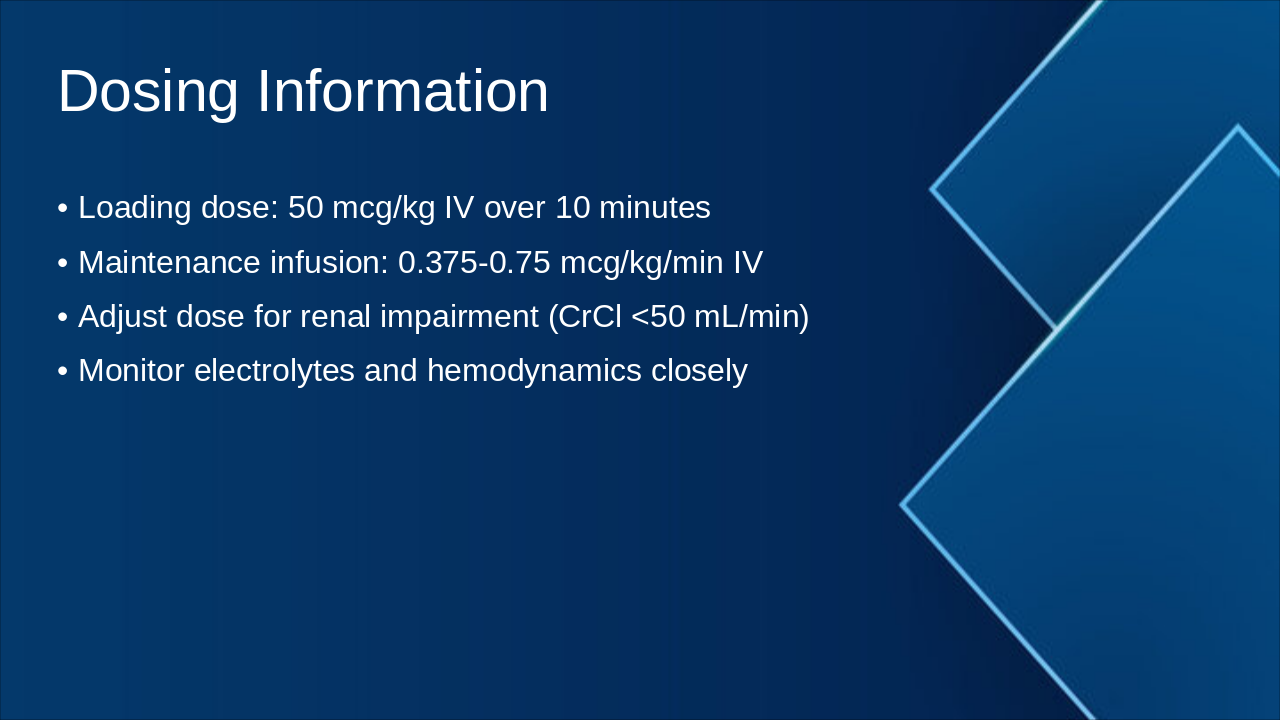
Slide 10 - Dosing Information

The slide outlines dosing for a medication, starting with a loading dose of 50 mcg/kg IV administered over 10 minutes, followed by a maintenance infusion of 0.375-0.75 mcg/kg/min IV. It also advises adjusting the dose for patients with renal impairment (CrCl <50 mL/min) and emphasizes close monitoring of electrolytes and hemodynamics.

Dosing Information

  • Loading dose: 50 mcg/kg IV over 10 minutes
  • Maintenance infusion: 0.375-0.75 mcg/kg/min IV
  • Adjust dose for renal impairment (CrCl <50 mL/min)
  • Monitor electrolytes and hemodynamics closely
Slide 10 - Dosing Information
Slide 11 of 15

Slide 11 - Adverse Effects

This slide serves as a section header titled "Adverse Effects," marking it as the fourth section in the presentation. It includes a subtitle highlighting common and serious side effects that require monitoring.

Adverse Effects

04

Adverse Effects

Common and serious side effects to watch for.

Source: Milrinone Medical Presentation

Speaker Notes
Common and serious side effects to watch for.
Slide 11 - Adverse Effects
Slide 12 of 15

Slide 12 - Side Effects

The slide on side effects lists common adverse reactions including ventricular arrhythmias, hypotension, headache and nausea, and hypokalemia. It also notes a rare occurrence of thrombocytopenia.

Side Effects

  • Ventricular arrhythmias
  • Hypotension
  • Headache and nausea
  • Hypokalemia
  • Rare thrombocytopenia
Slide 12 - Side Effects
Slide 13 of 15

Slide 13 - Contraindications

This slide serves as a section header titled "Milrinone Contraindications." It includes a subtitle explaining that these are situations where the use of Milrinone should be avoided.

Milrinone Contraindications

Situations where Milrinone should be avoided.

Slide 13 - Contraindications
Slide 14 of 15

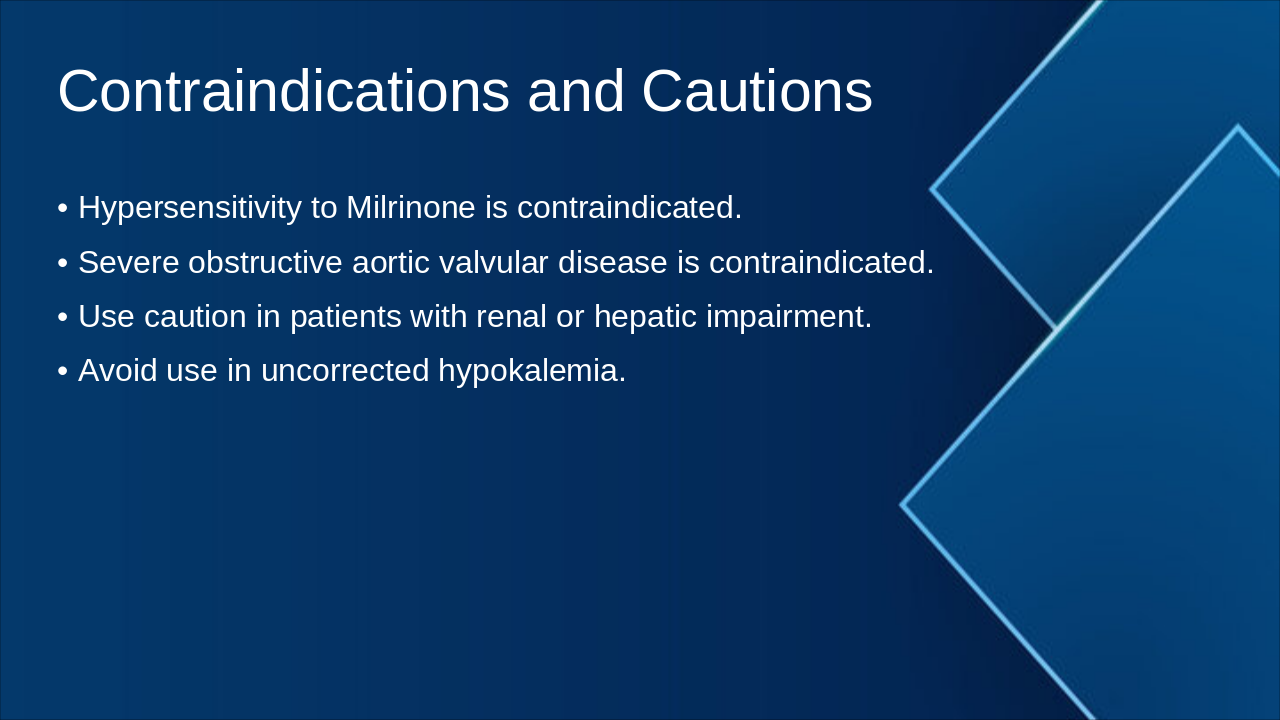
Slide 14 - Contraindications and Cautions

Milrinone is contraindicated in cases of hypersensitivity to the drug or severe obstructive aortic valvular disease. Caution is advised for patients with renal or hepatic impairment, and use should be avoided in those with uncorrected hypokalemia.

Contraindications and Cautions

  • Hypersensitivity to Milrinone is contraindicated.
  • Severe obstructive aortic valvular disease is contraindicated.
  • Use caution in patients with renal or hepatic impairment.
  • Avoid use in uncorrected hypokalemia.
Slide 14 - Contraindications and Cautions
Slide 15 of 15

Slide 15 - Summary and Key Takeaways

Milrinone proves effective in treating acute heart failure but requires vigilant monitoring to ensure safety. Care should be tailored to individual patients, adhering closely to established guidelines for optimal outcomes.

Summary and Key Takeaways

Milrinone: Effective for acute heart failure with vigilant monitoring. Tailor to patients and follow guidelines.

Optimize Care: Consult Guidelines and Monitor Closely

Speaker Notes
Milrinone is effective for acute heart failure but requires careful monitoring due to risks. Always tailor to patient needs and consult guidelines.
Slide 15 - Summary and Key Takeaways

Discover More Presentations

Explore thousands of AI-generated presentations for inspiration

Browse Presentations
Powered by AI

Create Your Own Presentation

Generate professional presentations in seconds with Karaf's AI. Customize this presentation or start from scratch.

Create New Presentation

Powered by Karaf.ai — AI-Powered Presentation Generator