Understanding How to Read Music Notes: A Beginner's Guide

Generated from prompt:

Understanding how to read music notes

This beginner-friendly presentation demystifies reading music notation. It covers the musical staff and clefs (treble and bass), mnemonic devices for notes on lines and spaces, ledger lines for extended pitches, note durations and rests in 4/4 time, accidentals (sharps, flats, naturals), and practical steps for reading simple melodies like nursery rhymes. Includes an agenda, examples, practice tips, and key takeaways to build foundational music reading skills.

May 9, 202616 slides
Slide 1 of 16

Slide 1 - Understanding How to Read Music Notes

Understanding How to Read Music Notes

A Beginner's Guide to Musical Notation

---

Photo by Miguel Alcântara on Unsplash
Slide 1 - Understanding How to Read Music Notes
Slide 2 of 16

Slide 2 - Presentation Agenda

  • The Musical Staff and Clefs
  • Notes on Lines and Spaces
  • Ledger Lines
  • Note Durations and Rests
  • Accidentals: Sharps, Flats, Naturals
  • Reading Simple Melodies
  • Practice Tips
  • Key Takeaways

---

Photo by Lucas Alexander on Unsplash
Slide 2 - Presentation Agenda
Slide 3 of 16

Slide 3 - The Musical Staff and Clefs

1

The Musical Staff and Clefs

The foundation of all sheet music

---

Photo by Liana S on Unsplash

Slide 3 - The Musical Staff and Clefs
Slide 4 of 16

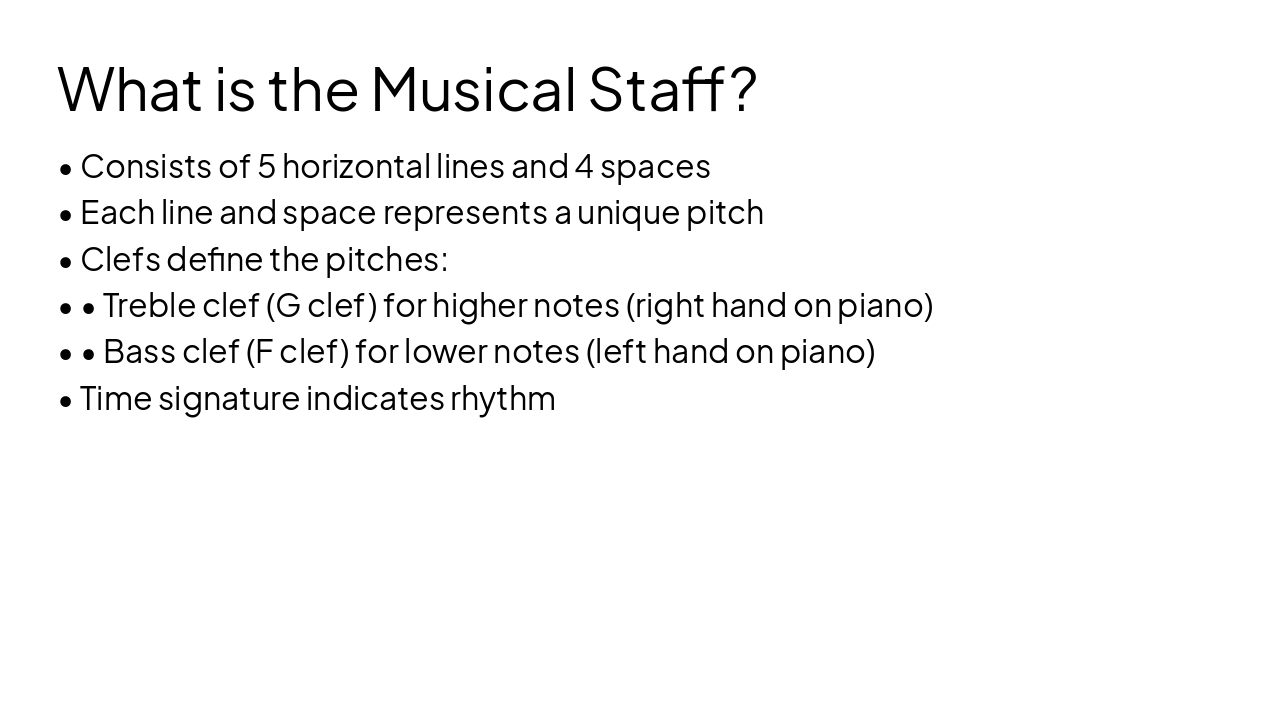
Slide 4 - What is the Musical Staff?

  • Consists of 5 horizontal lines and 4 spaces
  • Each line and space represents a unique pitch
  • Clefs define the pitches:
  • • Treble clef (G clef) for higher notes (right hand on piano)
  • • Bass clef (F clef) for lower notes (left hand on piano)
  • Time signature indicates rhythm
Slide 4 - What is the Musical Staff?
Slide 5 of 16

Slide 5 - Treble and Bass Clefs

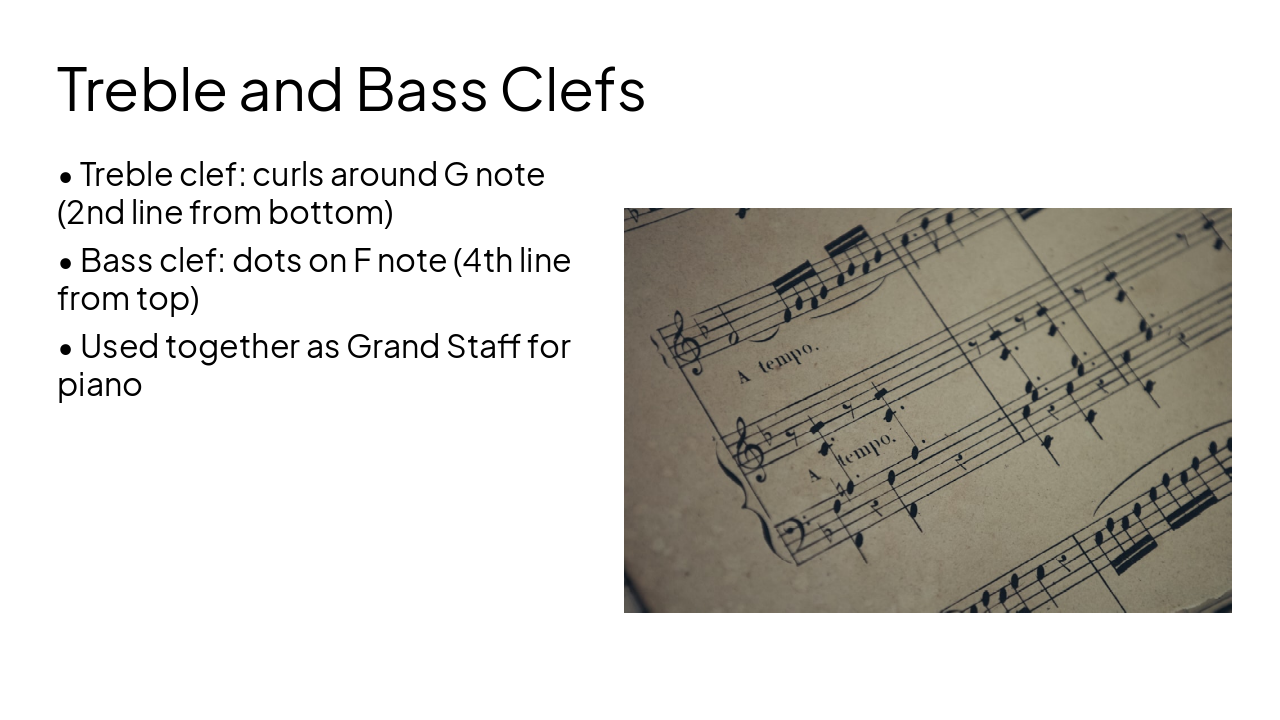
  • Treble clef: curls around G note (2nd line from bottom)
  • Bass clef: dots on F note (4th line from top)
  • Used together as Grand Staff for piano

---

Photo by Miguel Alcântara on Unsplash
Slide 5 - Treble and Bass Clefs
Slide 6 of 16

Slide 6 - Notes on Lines and Spaces

2

Notes on Lines and Spaces

Mnemonic devices to remember pitches

---

Photo by Gerda Pocepaviciute on Unsplash
Slide 6 - Notes on Lines and Spaces
Slide 7 of 16

Slide 7 - Treble Clef: Lines and Spaces

Lines (bottom to top) E - G - B - D - F (Every Good Boy Does Fine)

Spaces (bottom to top) F - A - C - E (FACE)
Slide 7 - Treble Clef: Lines and Spaces
Slide 8 of 16

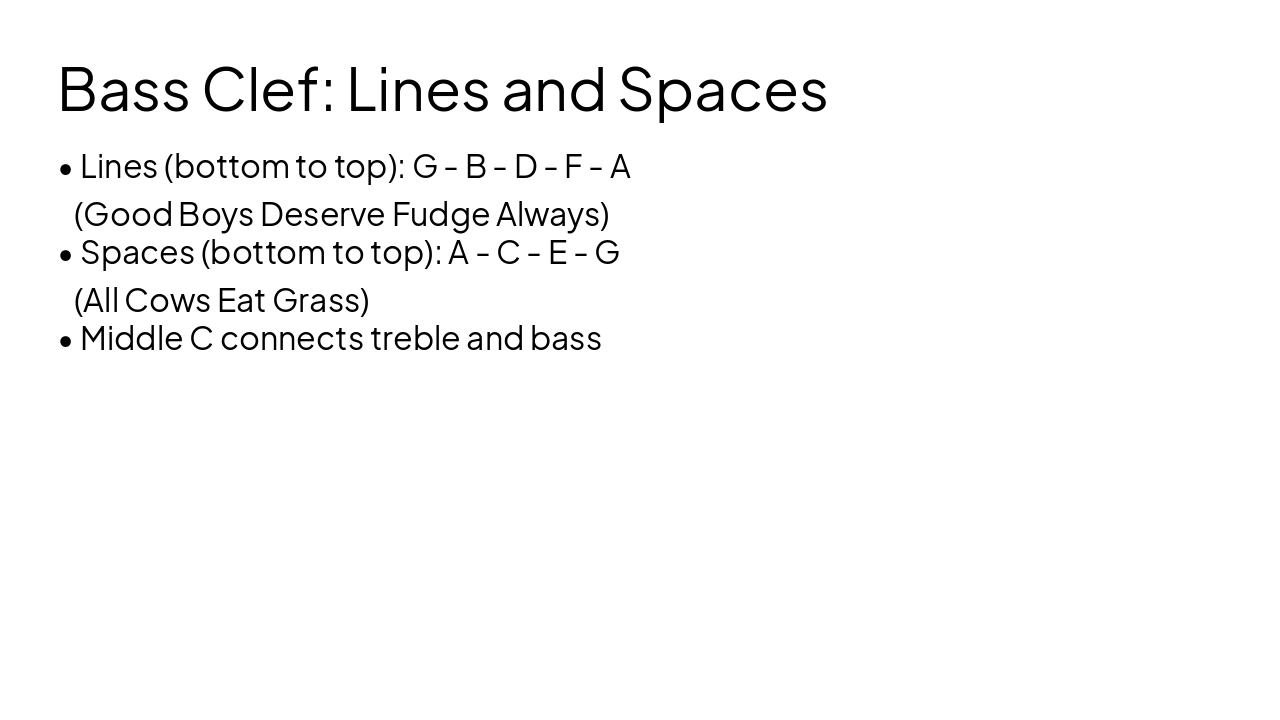
Slide 8 - Bass Clef: Lines and Spaces

  • Lines (bottom to top): G - B - D - F - A

(Good Boys Deserve Fudge Always)

  • Spaces (bottom to top): A - C - E - G

(All Cows Eat Grass)

  • Middle C connects treble and bass
Slide 8 - Bass Clef: Lines and Spaces
Slide 9 of 16

Slide 9 - Ledger Lines

3

Ledger Lines

For notes above or below the staff

---

Photo by weston m on Unsplash
Slide 9 - Ledger Lines
Slide 10 of 16

Slide 10 - Examples of Ledger Lines

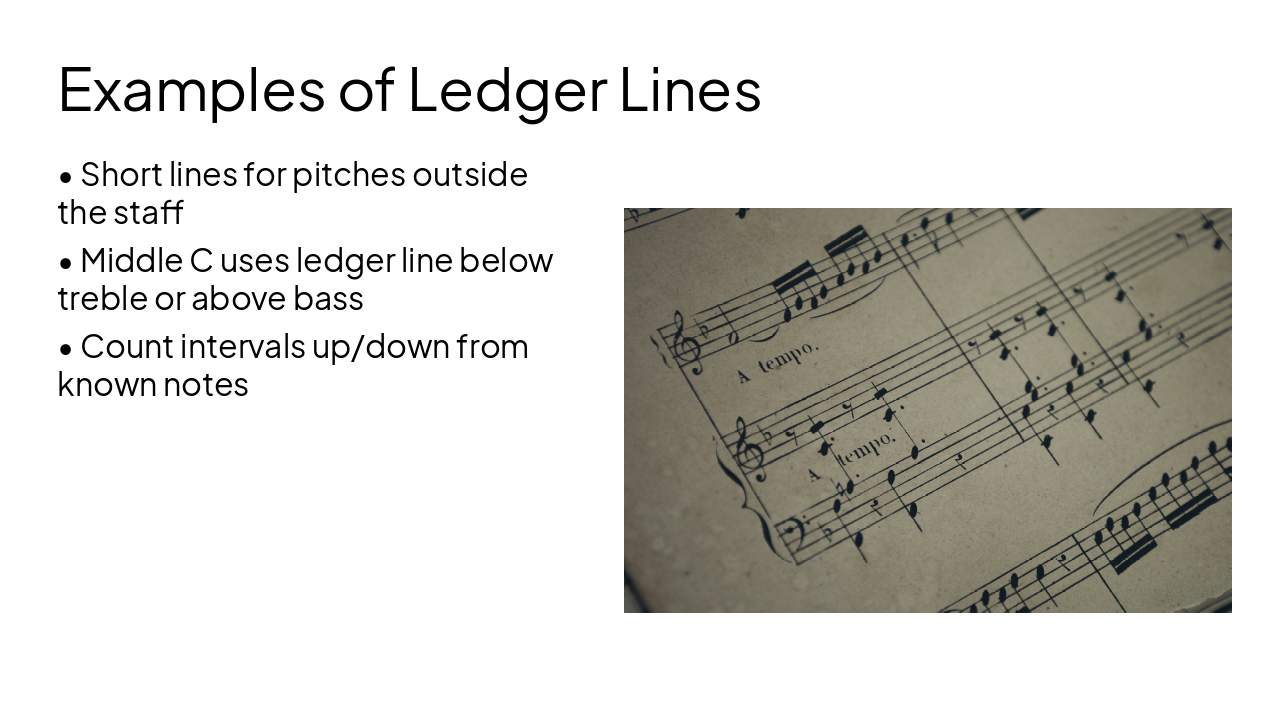
  • Short lines for pitches outside the staff
  • Middle C uses ledger line below treble or above bass
  • Count intervals up/down from known notes

---

Photo by Miguel Alcântara on Unsplash
Slide 10 - Examples of Ledger Lines
Slide 11 of 16

Slide 11 - Note Durations and Rests

4

Note Durations and Rests

Rhythm is as important as pitch

---

Photo by Олег Мороз on Unsplash
Slide 11 - Note Durations and Rests
Slide 12 of 16

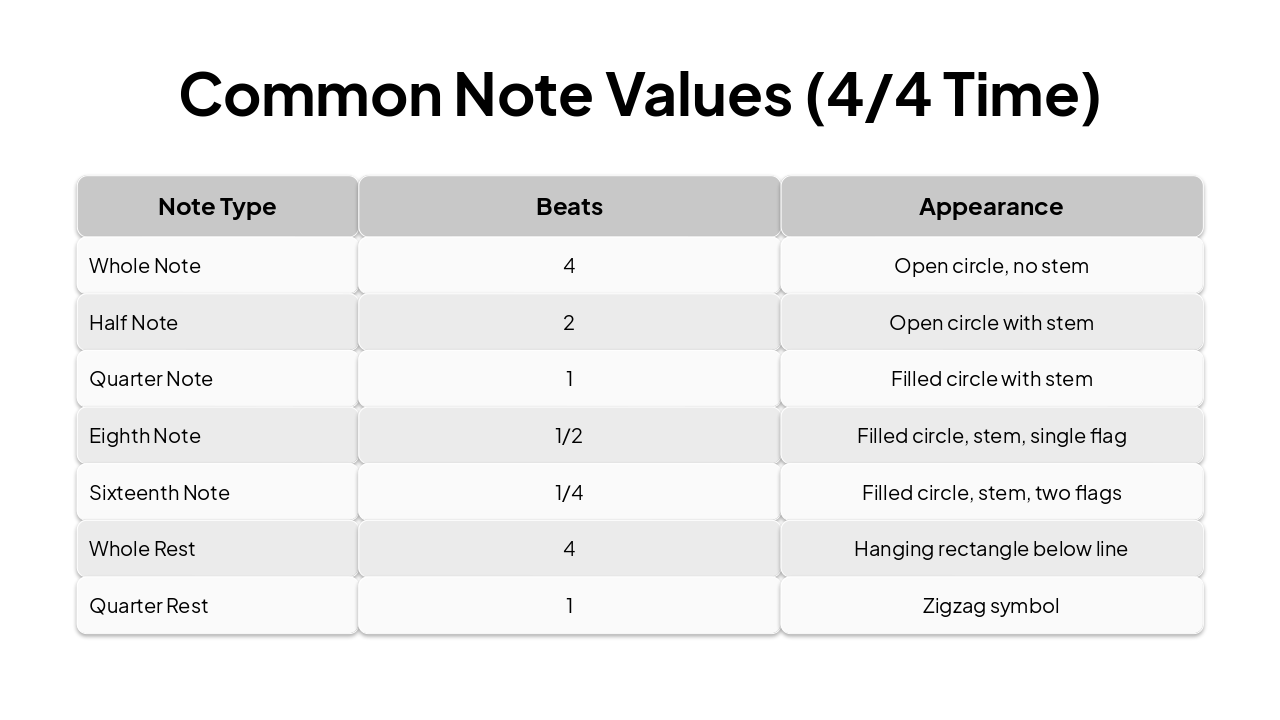
Slide 12 - Common Note Values (4/4 Time)

Note TypeBeatsAppearance
Whole Note4Open circle, no stem
Half Note2Open circle with stem
Quarter Note1Filled circle with stem
Eighth Note1/2Filled circle, stem, single flag
Sixteenth Note1/4Filled circle, stem, two flags
Whole Rest4Hanging rectangle below line
Quarter Rest1Zigzag symbol
Slide 12 - Common Note Values (4/4 Time)
Slide 13 of 16

Slide 13 - Accidentals

5

Accidentals

Sharps, Flats, and Naturals

---

Photo by Andrea Stuart on Unsplash

Slide 13 - Accidentals
Slide 14 of 16

Slide 14 - Sharps, Flats, and Naturals

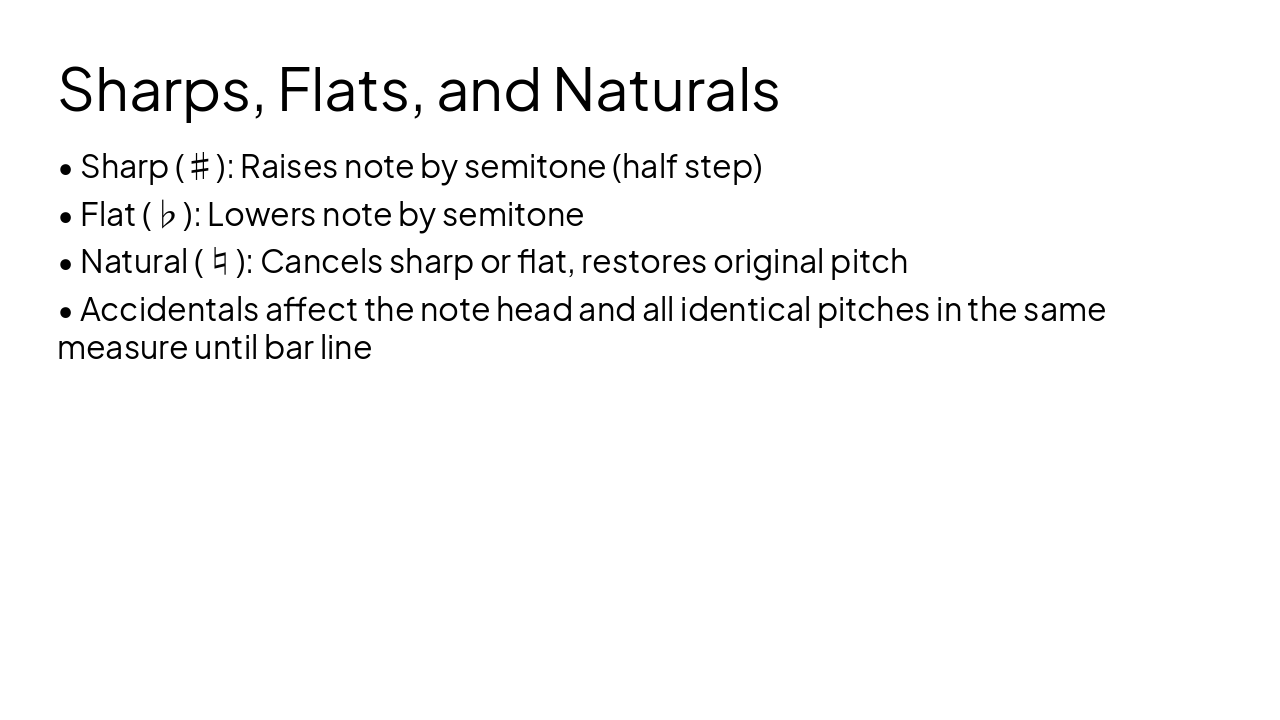
  • Sharp (♯): Raises note by semitone (half step)
  • Flat (♭): Lowers note by semitone
  • Natural (♮): Cancels sharp or flat, restores original pitch
  • Accidentals affect the note head and all identical pitches in the same measure until bar line
Slide 14 - Sharps, Flats, and Naturals
Slide 15 of 16

Slide 15 - Reading a Simple Melody

  • Identify pitch from line/space position
  • Match note value to rhythm
  • Practice with familiar tunes like nursery rhymes
  • Use flashcards or apps for reinforcement

---

Photo by Liana S on Unsplash

Slide 15 - Reading a Simple Melody
Slide 16 of 16

Slide 16 - Mastering Music Reading

Key Takeaways:

  • Staff + Clefs set the pitches
  • Lines/Spaces + Mnemonics for notes
  • Ledger lines extend range
  • Note shapes define rhythm
  • Accidentals alter pitches

Practice consistently!

Thank you! Questions?

---

Photo by Miguel Alcântara on Unsplash
Slide 16 - Mastering Music Reading

Discover More Presentations

Explore thousands of AI-generated presentations for inspiration

Browse Presentations
Powered by AI

Create Your Own Presentation

Generate professional presentations in seconds with Karaf's AI. Customize this presentation or start from scratch.

Create New Presentation

Powered by Karaf.ai — AI-Powered Presentation Generator