AI Overview: From Basics to Future

Generated from prompt:

Create a presentation about artificial intelligence

This presentation explores artificial intelligence, covering its definition, key components, historical timeline, everyday applications, benefits versus challenges, growth statistics, and a responsibl

November 9, 202511 slides
Slide 1 of 11

Slide 1 - Artificial Intelligence: An Overview

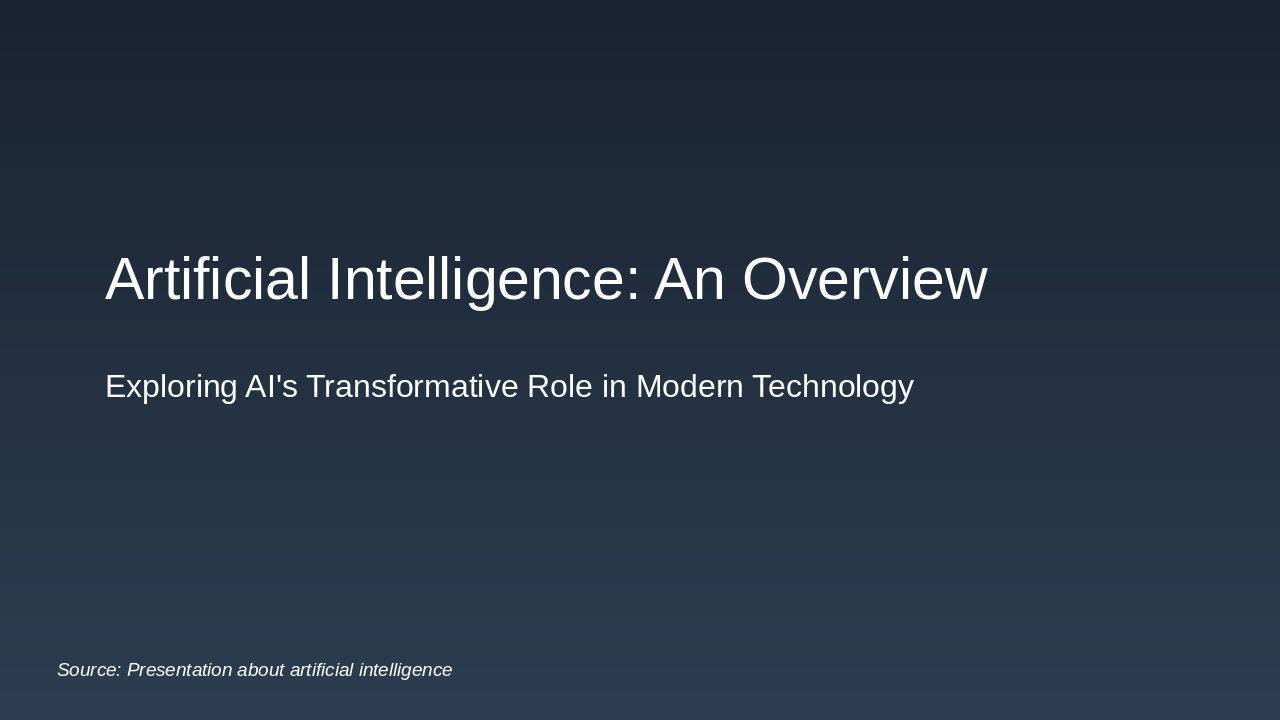
The slide features the main title "Artificial Intelligence: An Overview," presenting a high-level introduction to the field. Its subtitle, "Exploring AI's Transformative Role in Modern Technology," highlights AI's significant impact on contemporary innovations.

Artificial Intelligence: An Overview

Exploring AI's Transformative Role in Modern Technology

Source: Presentation about artificial intelligence

--- Speaker Notes: Welcome slide. Presenter: AI Expert. Date: Current.
Slide 1
Slide 2 of 11

Slide 2 - Presentation Agenda

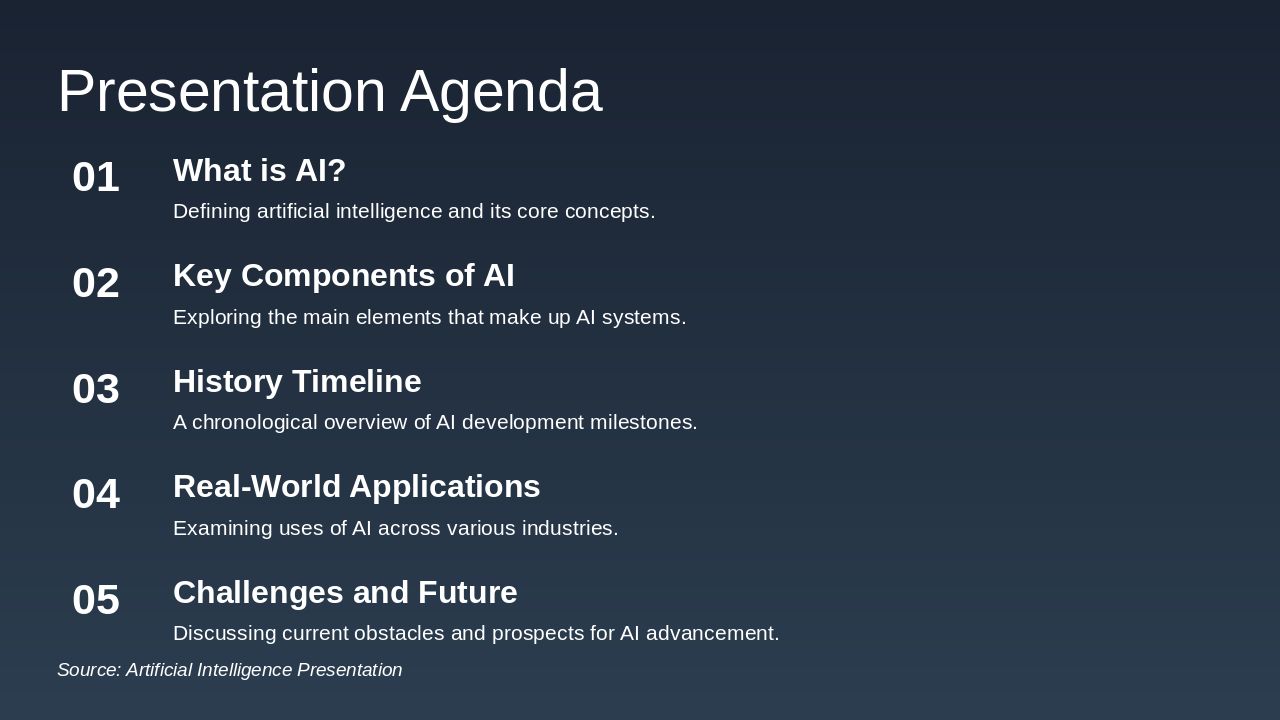
The presentation agenda outlines a structured exploration of artificial intelligence, starting with its definition and core concepts in "What is AI?" followed by the key components that form AI systems. It then covers a historical timeline of milestones, real-world applications across industries, and concludes with current challenges and future prospects for AI advancement.

Presentation Agenda

  1. What is AI?

Defining artificial intelligence and its core concepts.

  1. Key Components of AI

Exploring the main elements that make up AI systems.

  1. History Timeline

A chronological overview of AI development milestones.

  1. Real-World Applications

Examining uses of AI across various industries.

  1. Challenges and Future

Discussing current obstacles and prospects for AI advancement.

Source: Artificial Intelligence Presentation

Slide 2
Slide 3 of 11

Slide 3 - What is Artificial Intelligence?

This section header slide, titled "What is Artificial Intelligence?" and numbered as 01, introduces the core concept of AI. It features a subtitle defining AI as machines performing human-like tasks, such as learning and reasoning.

What is Artificial Intelligence?

01

What is Artificial Intelligence?

Machines performing human-like tasks such as learning and reasoning.

Slide 3
Slide 4 of 11

Slide 4 - Core Definition of AI

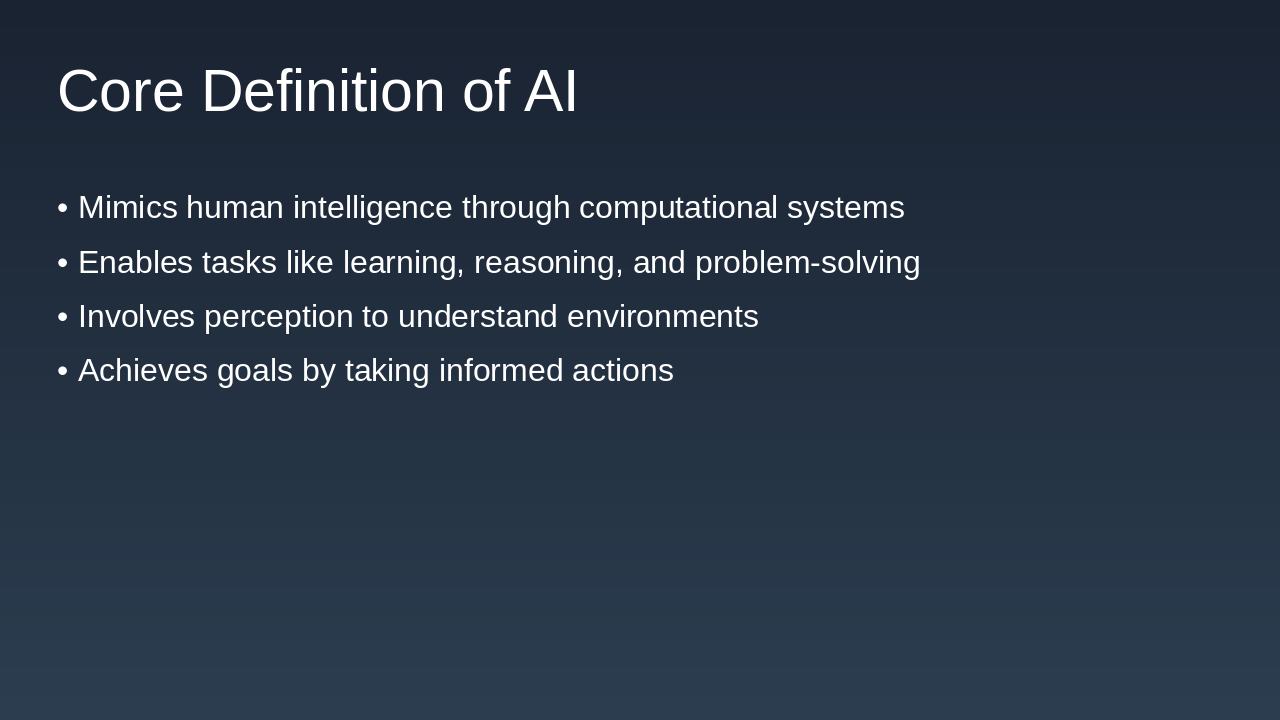
Artificial Intelligence (AI) is defined as computational systems that mimic human intelligence to perform tasks such as learning, reasoning, and problem-solving. It incorporates perception to understand environments and achieves goals through informed actions.

Core Definition of AI

  • Mimics human intelligence through computational systems
  • Enables tasks like learning, reasoning, and problem-solving
  • Involves perception to understand environments
  • Achieves goals by taking informed actions
Slide 4
Slide 5 of 11

Slide 5 - Key Components of AI

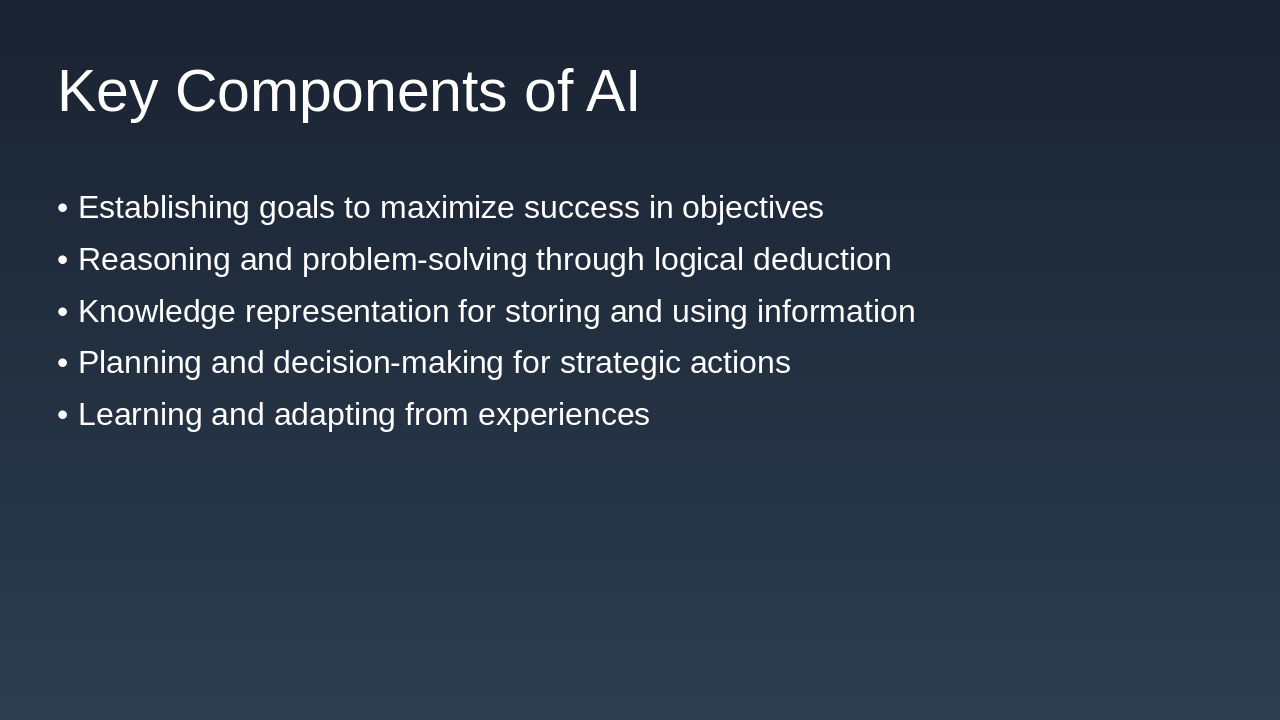
The slide outlines the key components of AI, starting with establishing goals to maximize success in objectives and incorporating reasoning and problem-solving via logical deduction. It further covers knowledge representation for storing and using information, planning and decision-making for strategic actions, and learning and adapting from experiences.

Key Components of AI

  • Establishing goals to maximize success in objectives
  • Reasoning and problem-solving through logical deduction
  • Knowledge representation for storing and using information
  • Planning and decision-making for strategic actions
  • Learning and adapting from experiences
Slide 5
Slide 6 of 11

Slide 6 - Brief History of AI

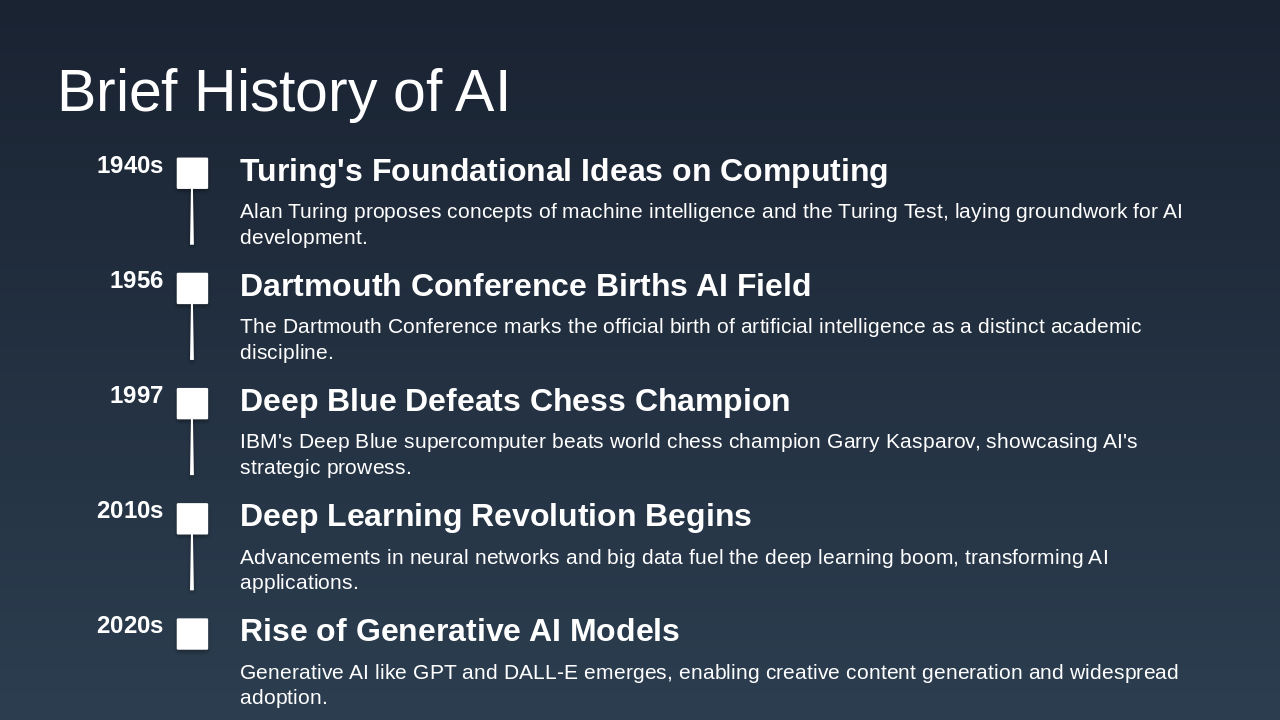
The timeline slide "Brief History of AI" traces key milestones from the 1940s, when Alan Turing proposed foundational ideas like the Turing Test, to the 1956 Dartmouth Conference that officially established AI as an academic field. It continues through IBM's Deep Blue defeating chess champion Garry Kasparov in 1997, the deep learning revolution of the 2010s driven by neural networks and big data, and the 2020s rise of generative AI models like GPT and DALL-E for creative content generation.

Brief History of AI

1940s: Turing's Foundational Ideas on Computing Alan Turing proposes concepts of machine intelligence and the Turing Test, laying groundwork for AI development. 1956: Dartmouth Conference Births AI Field The Dartmouth Conference marks the official birth of artificial intelligence as a distinct academic discipline. 1997: Deep Blue Defeats Chess Champion IBM's Deep Blue supercomputer beats world chess champion Garry Kasparov, showcasing AI's strategic prowess. 2010s: Deep Learning Revolution Begins Advancements in neural networks and big data fuel the deep learning boom, transforming AI applications. 2020s: Rise of Generative AI Models Generative AI like GPT and DALL-E emerges, enabling creative content generation and widespread adoption.

Slide 6
Slide 7 of 11

Slide 7 - AI Applications in Daily Life

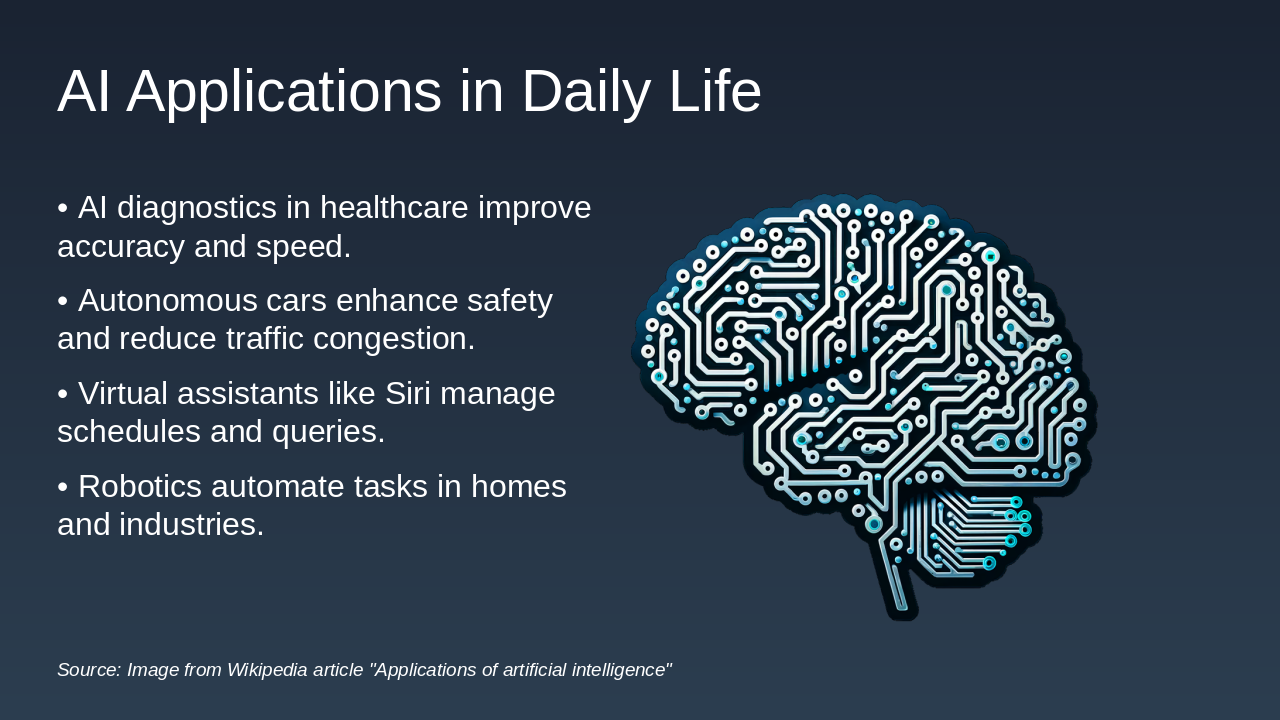
The slide titled "AI Applications in Daily Life" highlights practical uses of AI through an accompanying image. It lists key examples, including AI diagnostics for faster and more accurate healthcare, autonomous cars that boost safety and ease traffic, virtual assistants like Siri for managing schedules and queries, and robotics for automating home and industrial tasks.

AI Applications in Daily Life

!Image

  • AI diagnostics in healthcare improve accuracy and speed.
  • Autonomous cars enhance safety and reduce traffic congestion.
  • Virtual assistants like Siri manage schedules and queries.
  • Robotics automate tasks in homes and industries.

Source: Image from Wikipedia article "Applications of artificial intelligence"

Slide 7
Slide 8 of 11

Slide 8 - A Famous Quote on AI

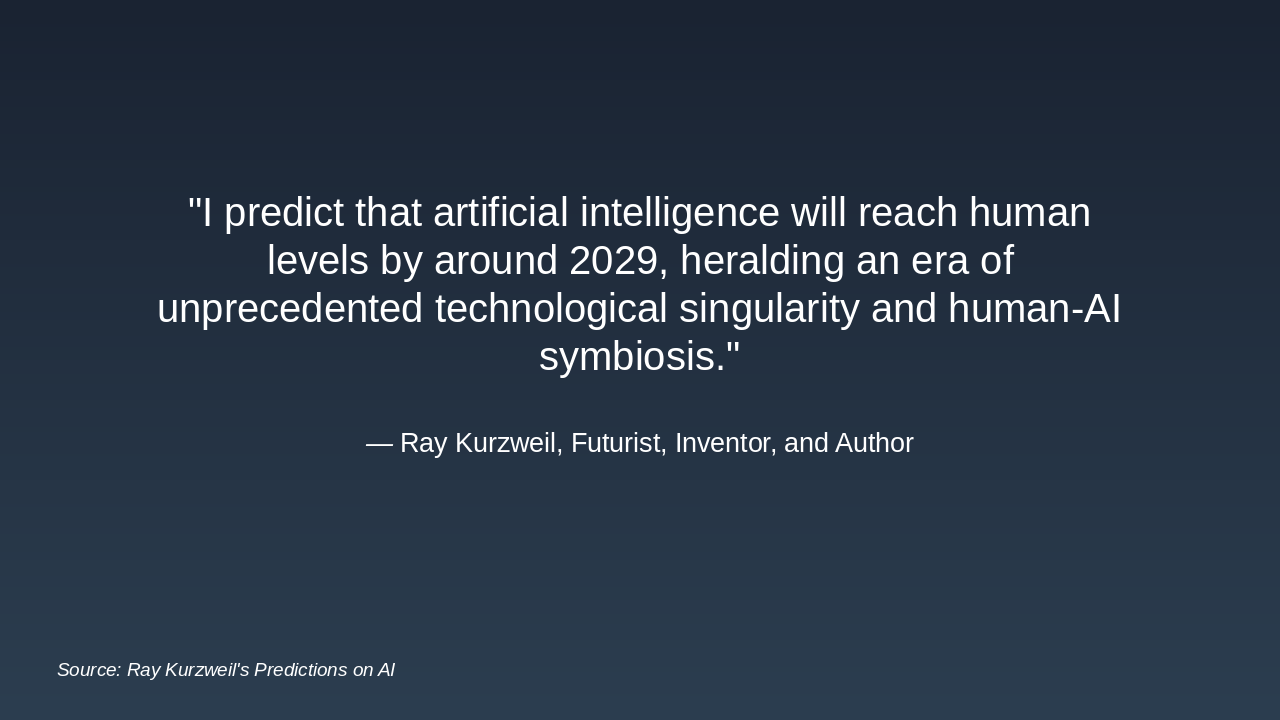
The slide features a famous quote on AI from Ray Kurzweil, a renowned futurist, inventor, and author. In it, he predicts that artificial intelligence will achieve human-level capabilities by around 2029, ushering in a technological singularity and a new era of human-AI symbiosis.

A Famous Quote on AI

> I predict that artificial intelligence will reach human levels by around 2029, heralding an era of unprecedented technological singularity and human-AI symbiosis.

— Ray Kurzweil, Futurist, Inventor, and Author

Source: Ray Kurzweil's Predictions on AI

--- Speaker Notes: Reflects optimistic views on AI's rapid advancement.

Slide 8
Slide 9 of 11

Slide 9 - Benefits vs. Challenges

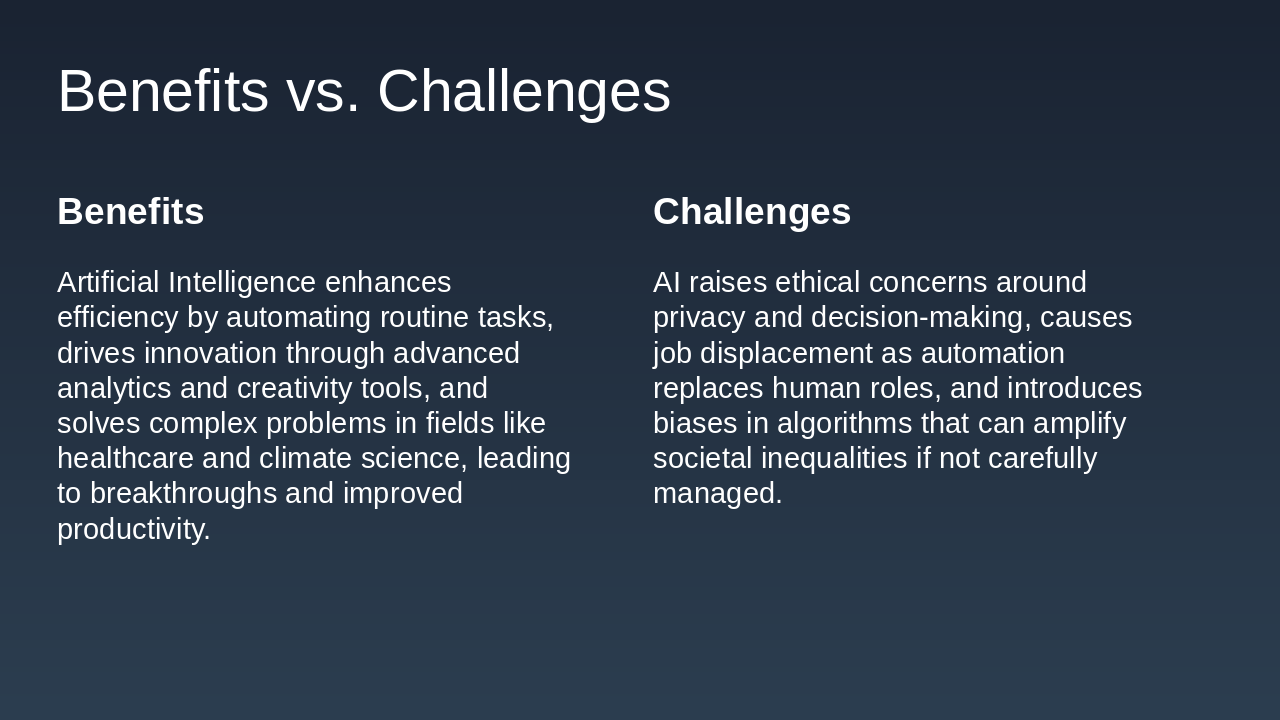
The slide contrasts the benefits of Artificial Intelligence, which include enhancing efficiency through task automation, driving innovation via advanced analytics and creativity tools, and solving complex problems in areas like healthcare and climate science to boost productivity and enable breakthroughs. On the challenges side, it highlights ethical issues related to privacy and decision-making, job displacement from automation replacing human roles, and algorithmic biases that can exacerbate societal inequalities if unmanaged.

Benefits vs. Challenges

BenefitsChallenges
Artificial Intelligence enhances efficiency by automating routine tasks, drives innovation through advanced analytics and creativity tools, and solves complex problems in fields like healthcare and climate science, leading to breakthroughs and improved productivity.AI raises ethical concerns around privacy and decision-making, causes job displacement as automation replaces human roles, and introduces biases in algorithms that can amplify societal inequalities if not carefully managed.
Slide 9
Slide 10 of 11

Slide 10 - AI Growth Statistics

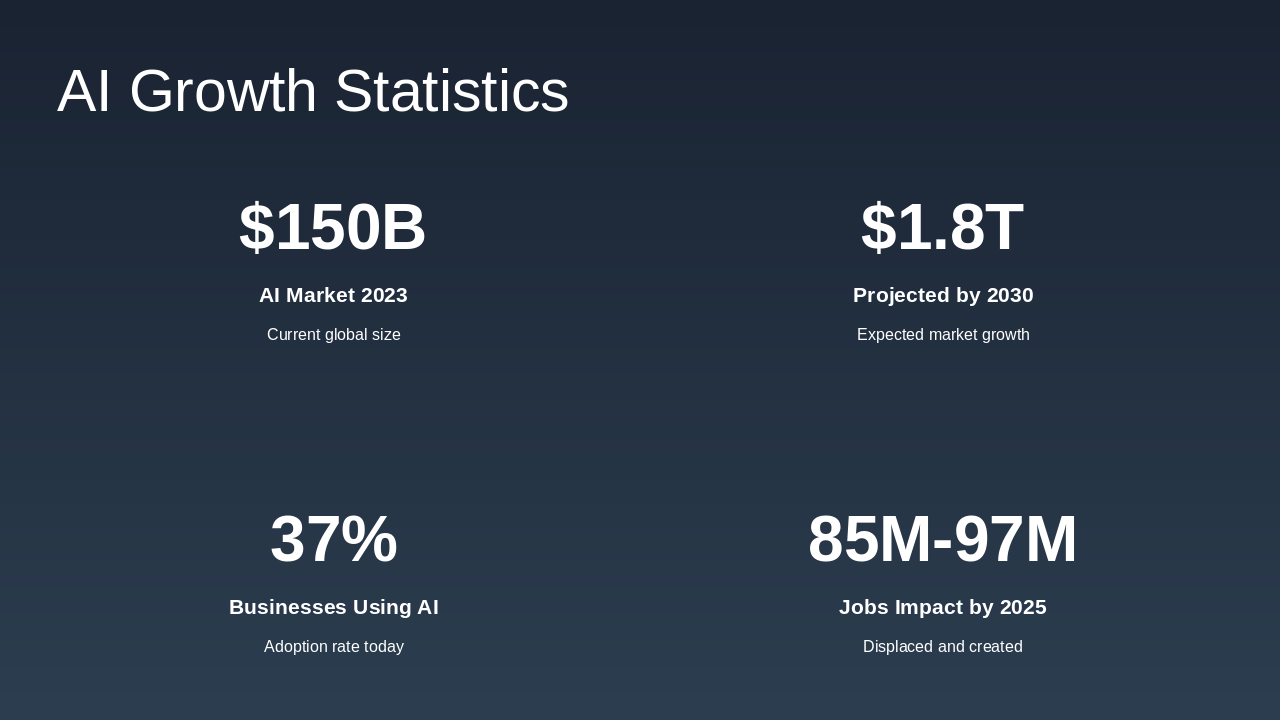
The AI market reached $150 billion globally in 2023 and is projected to grow to $1.8 trillion by 2030. Currently, 37% of businesses use AI, with 85-97 million jobs expected to be displaced or created by 2025.

AI Growth Statistics

  • $150B: AI Market 2023

Current global size

  • $1.8T: Projected by 2030

Expected market growth

  • 37%: Businesses Using AI

Adoption rate today

  • 85M-97M: Jobs Impact by 2025

Displaced and created

Slide 10
Slide 11 of 11

Slide 11 - Conclusion: The Future of AI

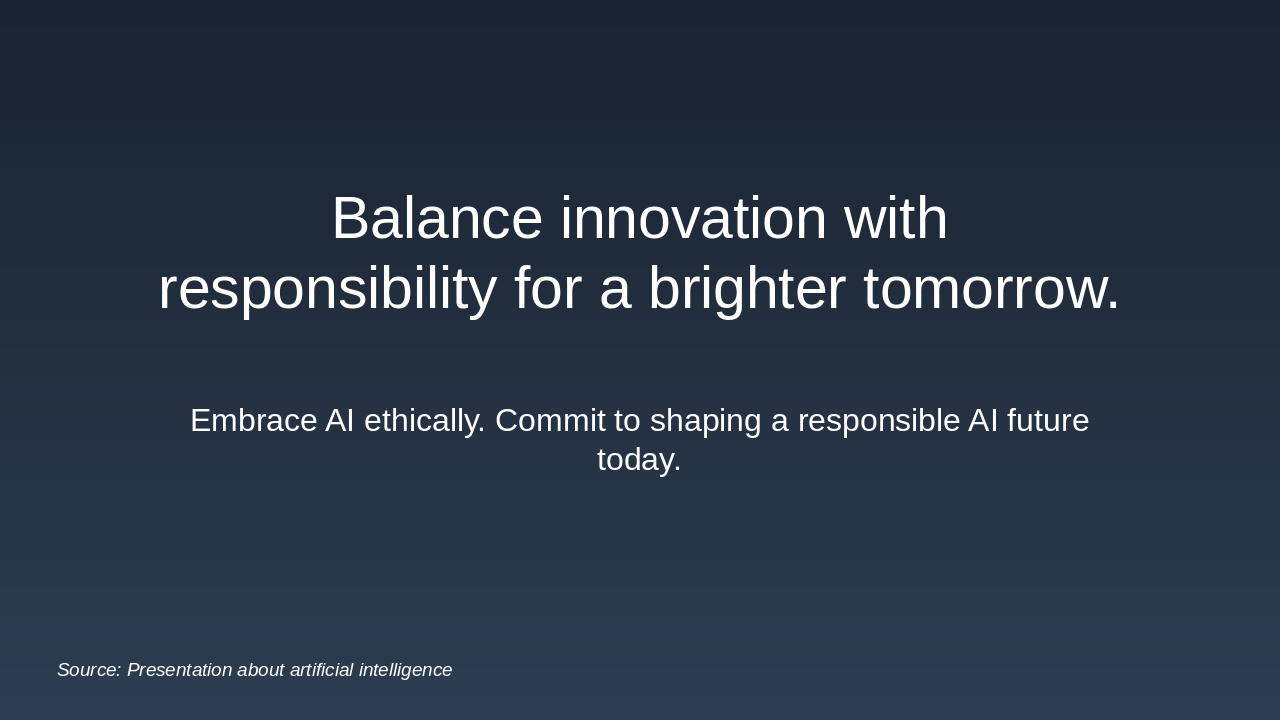
The conclusion slide, titled "The Future of AI," emphasizes balancing innovation with responsibility to create a brighter tomorrow. Its subtitle urges embracing AI ethically and committing to shape a responsible AI future today.

Conclusion: The Future of AI

Balance innovation with responsibility for a brighter tomorrow.

Embrace AI ethically. Commit to shaping a responsible AI future today.

Source: Presentation about artificial intelligence

--- Speaker Notes: AI transforms society; embrace ethical development. Key takeaway: Balance innovation with responsibility for a brighter tomorrow.

Slide 11
Powered by AI

Create Your Own Presentation

Generate professional presentations in seconds with Karaf's AI. Customize this presentation or start from scratch.

Create New Presentation

Powered by Karaf.ai — AI-Powered Presentation Generator