Vygotsky & Bronfenbrenner: Theories in Early Childhood

Generated from prompt:

Complete the remaining slides for a PowerPoint titled 'Understanding Child Behaviour through Learning Theories'. Keep existing slides unchanged. Continue style simple, humanized, no em dashes. Add sections for Vygotsky and Bronfenbrenner following same format as Piaget slides. Include: Slide: Vygotsky Theory and Scenario - Brief overview: social interaction, Zone of Proximal Development, scaffolding, role of language - Scenario: child upset at drop off Slide: Vygotsky Applying Theory and Educator Response - Explain behaviour using social support and separation anxiety context - Educator response: comforting, co regulation, gradual separation, communication with family - EYLF links Slide: Bronfenbrenner Theory and Scenario - Brief overview: ecological systems theory, microsystem, mesosystem, exosystem, macrosystem - Scenario: child being left out by peers Slide: Bronfenbrenner Applying Theory and Educator Response - Explain behaviour using environmental influences - Educator response: inclusive practices, support peer interactions, adjust environment - EYLF links Slide: Comparison of Theories - Key differences between Piaget, Vygotsky, Bronfenbrenner Slide: Conclusion - Summary of importance of using multiple theories in practice Keep tone simple and student friendly. Ensure slides are concise bullet points.

Explore Vygotsky's Sociocultural Theory and Bronfenbrenner's Ecological Systems Theory applied to childcare scenarios like separation anxiety and peer exclusion. Includes educator responses, EYLF links, theory comparisons, and holistic strategies for

March 25, 20268 slides
Slide 1 of 8

Slide 1

Vygotsky Sociocultural Theory

Social Interaction and Scaffolding in Development

---

Photo by CDC on Unsplash
Slide 1
Slide 2 of 8

Slide 2 - Vygotsky Theory and Scenario

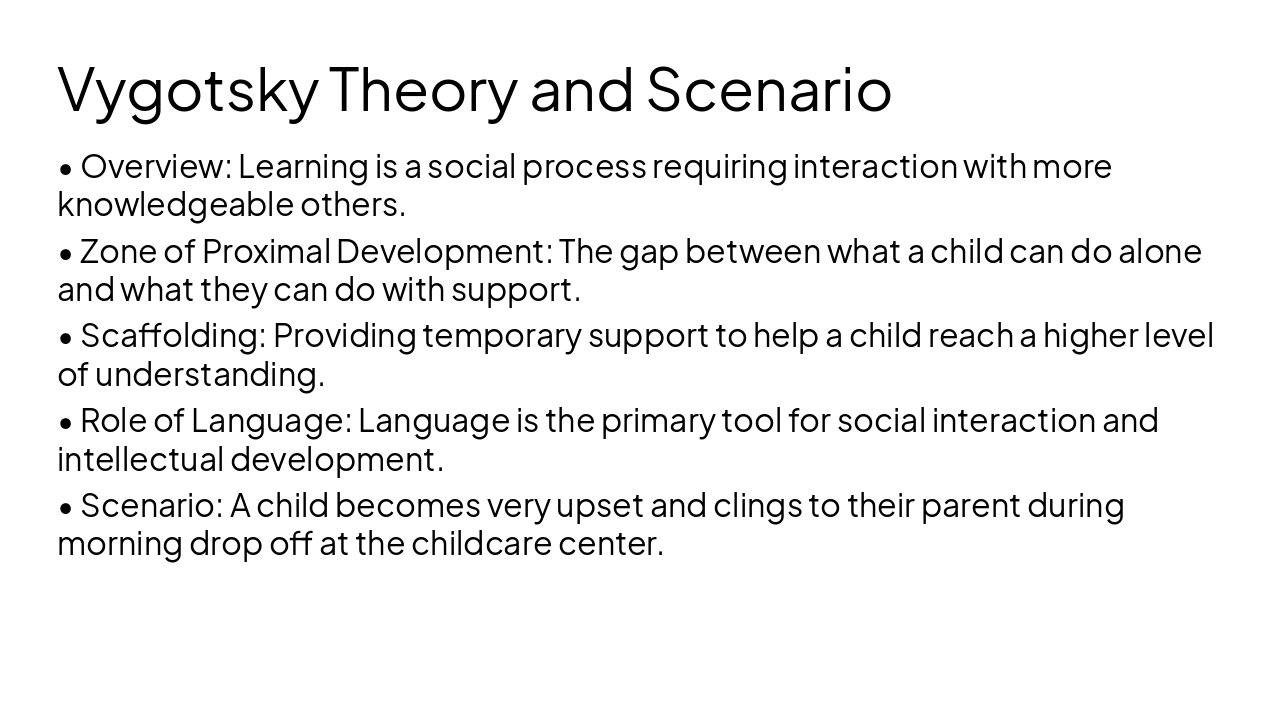
  • Overview: Learning is a social process requiring interaction with more knowledgeable others.
  • Zone of Proximal Development: The gap between what a child can do alone and what they can do with support.
  • Scaffolding: Providing temporary support to help a child reach a higher level of understanding.
  • Role of Language: Language is the primary tool for social interaction and intellectual development.
  • Scenario: A child becomes very upset and clings to their parent during morning drop off at the childcare center.
Slide 2 - Vygotsky Theory and Scenario
Slide 3 of 8

Slide 3 - Vygotsky Applying Theory and Educator Response

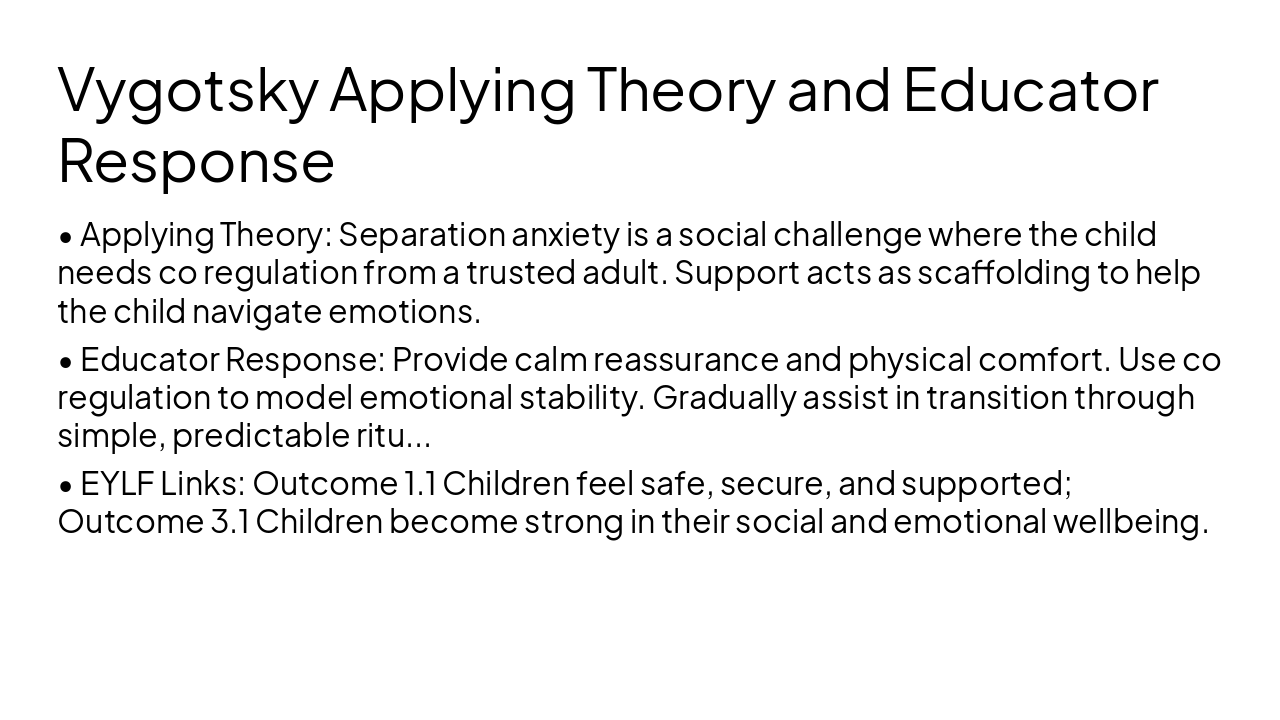
  • Applying Theory: Separation anxiety is a social challenge where the child needs co regulation from a trusted adult. Support acts as scaffolding to help the child navigate emotions.
  • Educator Response: Provide calm reassurance and physical comfort. Use co regulation to model emotional stability. Gradually assist in transition through simple, predictable rituals. Maintain open, supportive communication with the family to align approaches.
  • EYLF Links: Outcome 1.1 Children feel safe, secure, and supported; Outcome 3.1 Children become strong in their social and emotional wellbeing.
Slide 3 - Vygotsky Applying Theory and Educator Response
Slide 4 of 8

Slide 4 - Bronfenbrenner Theory Section

Bronfenbrenner Ecological Systems Theory

The Contextual Environment and Child Development

---

Photo by Robert Collins on Unsplash
Slide 4 - Bronfenbrenner Theory Section
Slide 5 of 8

Slide 5 - Bronfenbrenner Theory and Scenario

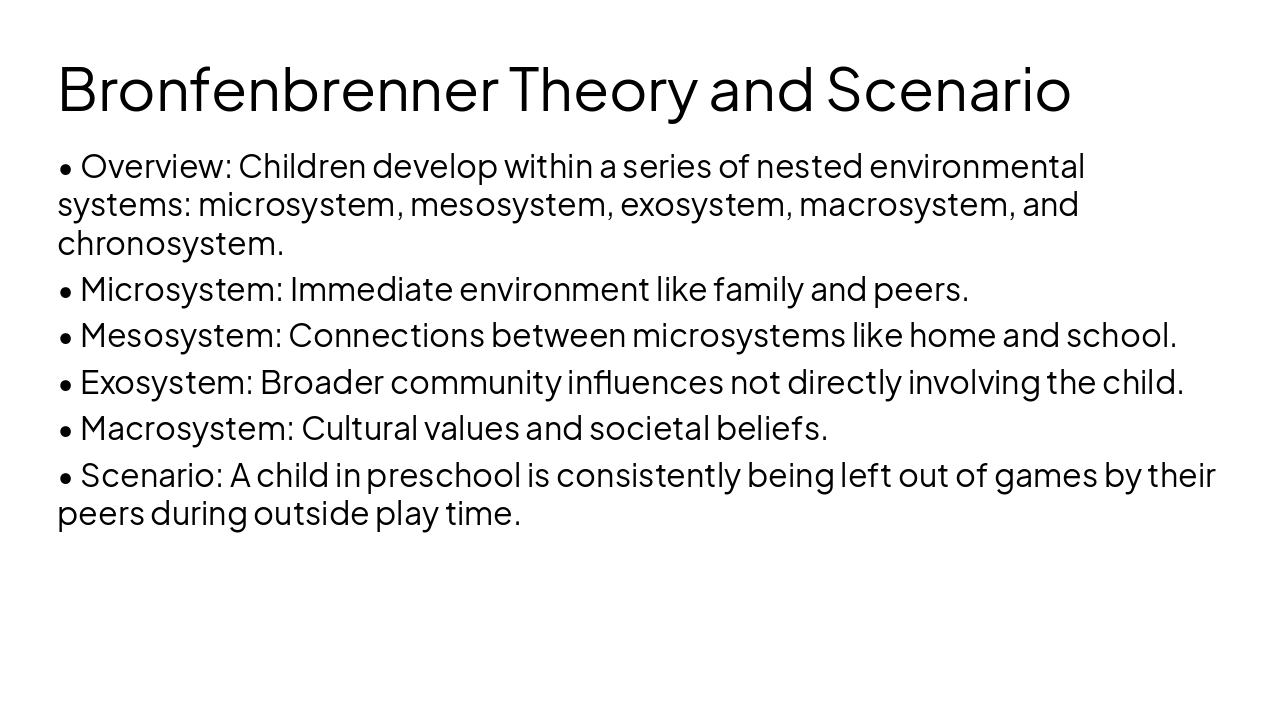
  • Overview: Children develop within a series of nested environmental systems: microsystem, mesosystem, exosystem, macrosystem, and chronosystem.
  • Microsystem: Immediate environment like family and peers.
  • Mesosystem: Connections between microsystems like home and school.
  • Exosystem: Broader community influences not directly involving the child.
  • Macrosystem: Cultural values and societal beliefs.
  • Scenario: A child in preschool is consistently being left out of games by their peers during outside play time.
Slide 5 - Bronfenbrenner Theory and Scenario
Slide 6 of 8

Slide 6 - Bronfenbrenner Applying Theory and Educator Response

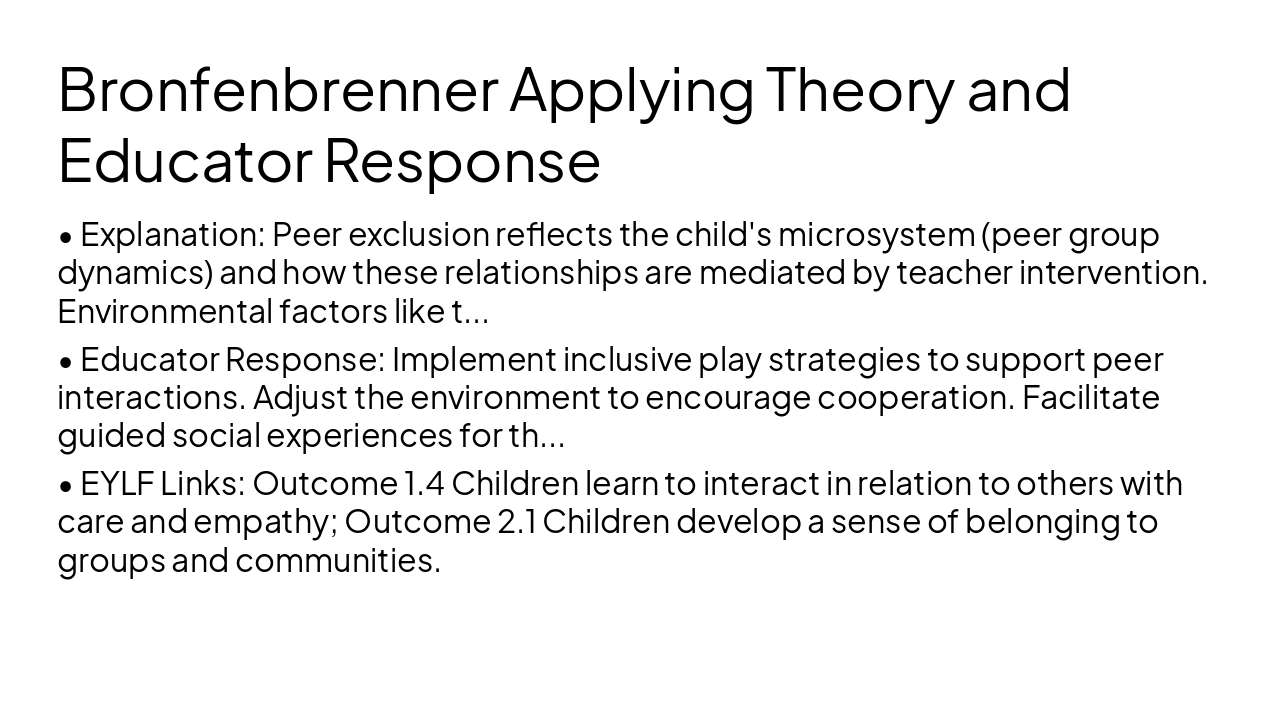
  • Explanation: Peer exclusion reflects the child's microsystem (peer group dynamics) and how these relationships are mediated by teacher intervention. Environmental factors like the play space design affect inclusion.
  • Educator Response: Implement inclusive play strategies to support peer interactions. Adjust the environment to encourage cooperation. Facilitate guided social experiences for the child and their peers. Partner with families to address home-based social support.
  • EYLF Links: Outcome 1.4 Children learn to interact in relation to others with care and empathy; Outcome 2.1 Children develop a sense of belonging to groups and communities.
Slide 6 - Bronfenbrenner Applying Theory and Educator Response
Slide 7 of 8

Slide 7 - Comparison of Theories

Theory Perspectives Piaget focuses on individual cognitive construction through biological maturation and play exploration. Vygotsky focuses on social interactions and language as tools for learning. Bronfenbrenner looks at the entire ecological context.

Application Focus Piaget looks at developmental stages. Vygotsky looks at the potential for social scaffolding and assistance. Bronfenbrenner examines how environmental systems interact to shape development.

---

Photo by Nick Brunner on Unsplash
Slide 7 - Comparison of Theories
Slide 8 of 8

Slide 8 - Conclusion

Applying multiple theories provides educators with a comprehensive, holistic toolkit to understand and respond to the complex needs of every child in their care.

Using diverse perspectives to better support children in early learning.

---

Photo by Ivan Aleksic on Unsplash
Slide 8 - Conclusion

Discover More Presentations

Explore thousands of AI-generated presentations for inspiration

Browse Presentations
Powered by AI

Create Your Own Presentation

Generate professional presentations in seconds with Karaf's AI. Customize this presentation or start from scratch.

Create New Presentation

Powered by Karaf.ai — AI-Powered Presentation Generator