Unlocking Code Reuse: Programming Libraries

Generated from prompt:

Create a 7-slide PowerPoint presentation on the topic 'Library – Collection of Reusable Code Functions (e.g., NumPy, jQuery)'. The presentation should cover: 1. Introduction to programming libraries, 2. Purpose and importance of libraries, 3. Structure and components of a library, 4. Examples of popular libraries (NumPy, jQuery, etc.), 5. How libraries improve coding efficiency, 6. How to use/import libraries in programming, 7. Summary and conclusion.

This 7-slide presentation explores programming libraries as reusable code collections, covering their introduction, purpose, structure, popular examples like NumPy and jQuery, efficiency gains, import

November 26, 20257 slides
Slide 1 of 7

Slide 1 - Introduction to Programming Libraries

Programming libraries are collections of pre-written code functions designed for reuse, allowing developers to efficiently build upon existing solutions in languages like Python and JavaScript. Examples include NumPy for mathematical operations and jQuery for web development.

Introduction to Programming Libraries

  • A library is a collection of pre-written code functions for reuse.
  • Enables developers to build on existing solutions efficiently.
  • Common in languages like Python and JavaScript.
  • Examples: NumPy for mathematical operations, jQuery for web development.
Slide 1 - Introduction to Programming Libraries
Slide 2 of 7

Slide 2 - Purpose and Importance of Libraries

Libraries serve to simplify complex programming tasks, promote code reuse across projects, and save development time and resources by providing pre-tested functions that reduce errors. They also standardize coding practices and foster collaboration within open-source communities.

Purpose and Importance of Libraries

  • Simplify complex programming tasks
  • Promote code reuse across projects
  • Save development time and resources
  • Reduce errors with tested functions
  • Standardize coding practices and conventions
  • Foster collaboration in open-source communities
Slide 2 - Purpose and Importance of Libraries
Slide 3 of 7

Slide 3 - Structure and Components of a Library

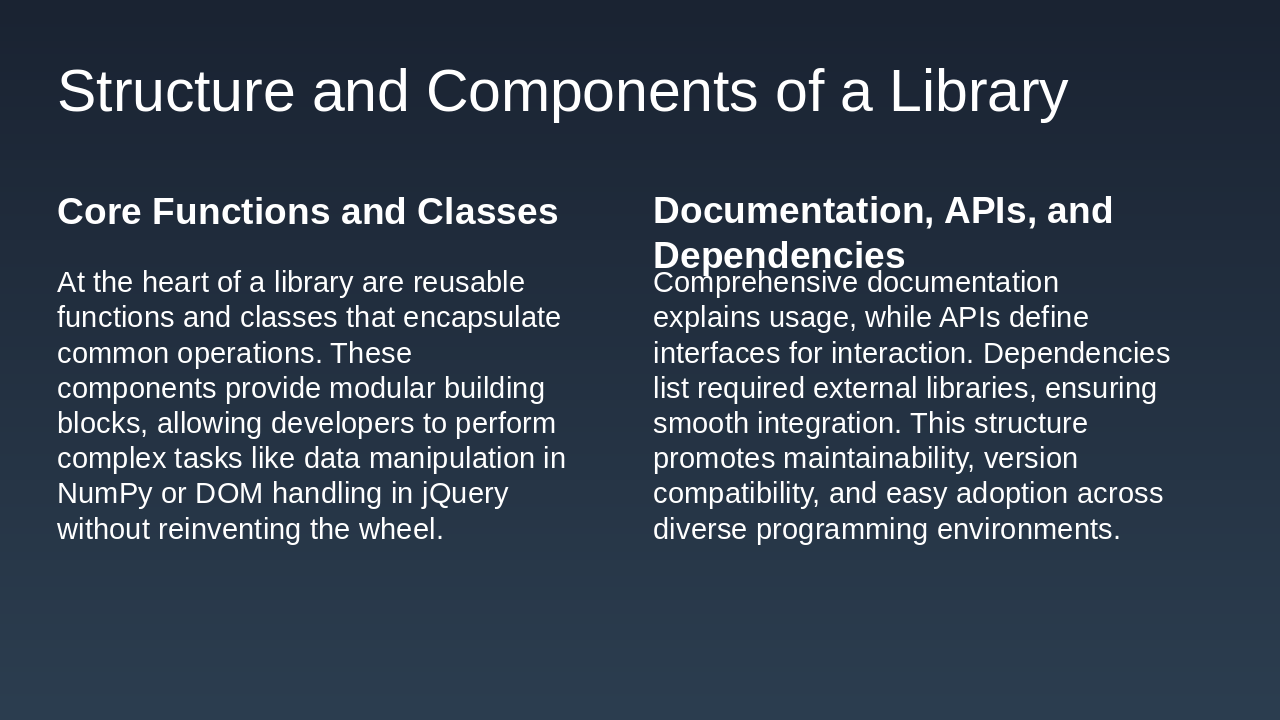
The slide outlines the core structure of a library, highlighting reusable functions and classes on the left that serve as modular building blocks for tasks like data manipulation in NumPy or DOM handling in jQuery, eliminating the need for developers to start from scratch. On the right, it emphasizes comprehensive documentation for usage, well-defined APIs for interaction, and listed dependencies to ensure maintainability, version compatibility, and seamless integration across programming environments.

Structure and Components of a Library

Core Functions and ClassesDocumentation, APIs, and Dependencies
At the heart of a library are reusable functions and classes that encapsulate common operations. These components provide modular building blocks, allowing developers to perform complex tasks like data manipulation in NumPy or DOM handling in jQuery without reinventing the wheel.Comprehensive documentation explains usage, while APIs define interfaces for interaction. Dependencies list required external libraries, ensuring smooth integration. This structure promotes maintainability, version compatibility, and easy adoption across diverse programming environments.
Speaker Notes
Highlight the modular design that enables easy integration and maintenance of the library in various projects.
Slide 3 - Structure and Components of a Library
Slide 4 of 7

Slide 4 - Examples of Popular Libraries

This slide presents examples of popular programming libraries, highlighting their primary uses. It includes NumPy for Python-based numerical computing and array operations, jQuery for JavaScript DOM manipulation and AJAX requests, React for building interactive user interfaces in JavaScript, and Pandas for Python data analysis and manipulation.

Examples of Popular Libraries

  • NumPy (Python): Numerical computing and array operations.
  • jQuery (JavaScript): DOM manipulation and AJAX requests.
  • React (JavaScript): Building interactive user interfaces.
  • Pandas (Python): Data analysis and manipulation.
Speaker Notes
NumPy for Python numerical computing and arrays; jQuery for JavaScript DOM manipulation and AJAX; React for UI development; Pandas for data analysis.
Slide 4 - Examples of Popular Libraries
Slide 5 of 7

Slide 5 - How Libraries Improve Coding Efficiency

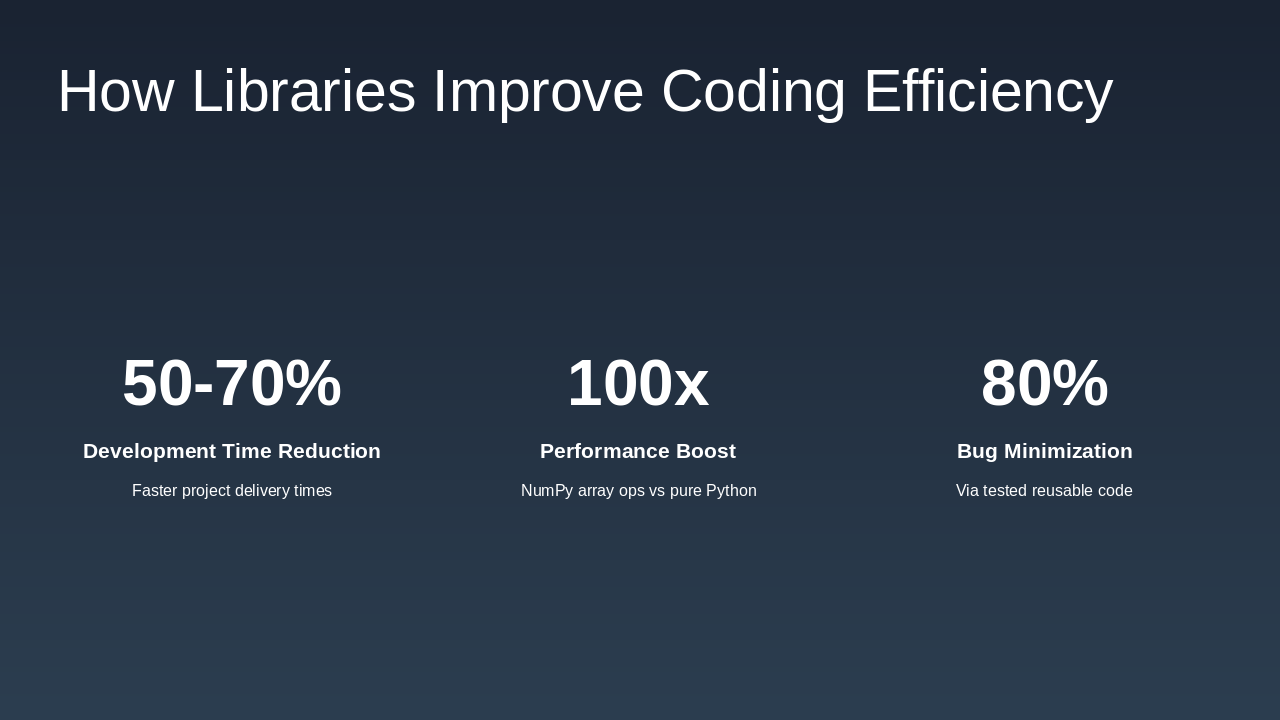
Libraries improve coding efficiency by reducing development time by 50-70%, enabling faster project delivery. They also provide a 100x performance boost for operations like NumPy array processing compared to pure Python, while minimizing bugs by up to 80% through tested, reusable code.

How Libraries Improve Coding Efficiency

  • 50-70%: Development Time Reduction
  • Faster project delivery times

  • 100x: Performance Boost
  • NumPy array ops vs pure Python

  • 80%: Bug Minimization
  • Via tested reusable code

Slide 5 - How Libraries Improve Coding Efficiency
Slide 6 of 7

Slide 6 - How to Use/Import Libraries in Programming

This slide explains how to import libraries in Python using the 'import' statement, such as 'import numpy as np', and in JavaScript by including via CDN or installing with npm. It also advises checking official documentation for instructions, managing library versions to prevent compatibility issues, and using virtual environments for dependency handling.

How to Use/Import Libraries in Programming

  • Python: Use 'import' statement, e.g., import numpy as np.
  • JavaScript: Include via CDN or install with npm.
  • Check official documentation for usage instructions.
  • Handle library versions to avoid compatibility issues.
  • Use virtual environments for dependency management.
Slide 6 - How to Use/Import Libraries in Programming
Slide 7 of 7

Slide 7 - Summary and Conclusion

The conclusion slide emphasizes that libraries are vital for efficient and reliable coding, empowering developers from tools like NumPy to jQuery. It includes a closing message on how libraries drive development success, with a call-to-action to integrate them immediately and streamline workflows.

Summary and Conclusion

- Libraries are essential for efficient, reliable coding.

  • From NumPy to jQuery, they empower developers.
  • Start using them to enhance your projects today!

Closing Message: Libraries Drive Development Success Call-to-Action: Integrate libraries now to streamline your coding workflow.

Slide 7 - Summary and Conclusion

Discover More Presentations

Explore thousands of AI-generated presentations for inspiration

Browse Presentations
Powered by AI

Create Your Own Presentation

Generate professional presentations in seconds with Karaf's AI. Customize this presentation or start from scratch.

Create New Presentation

Powered by Karaf.ai — AI-Powered Presentation Generator