Africa's Digital Divide: Challenges & Solutions (40 chars)

Generated from prompt:

Digital Access Inequalities: A Case Study – Africa | A professional, blue minimalist academic presentation. Structure: 1. Title Slide (Digital Access Inequalities: A Case Study – Africa, by Nada Abassi) 2. Introduction – Definition of the digital divide, its impact on Africa’s socio-economic development. 3. Definition & Key Concepts – access, usage, and mastery of ICT. 4. African Context – digital divide patterns across rural and urban regions. 5. Household Internet Access & Regional Disparities – key data and examples. 6. Digital Equipment Inequality – devices, computers, smartphones. 7. Impact of Education & Income Level – correlation with digital usage. 8. Major Challenges – infrastructure gaps, affordability, digital literacy, gender gap. 9. Opportunities & Solutions – investment in connectivity, education programs, public-private partnerships, mobile fintech solutions. 10. Conclusion – summary and call for inclusive digital growth. 11. Bibliography – main data sources and references.

This academic presentation examines digital access inequalities in Africa, covering definitions, regional disparities, equipment gaps, education/income impacts, challenges like infrastructure and affo

November 30, 202511 slides
Slide 1 of 11

Slide 1 - Digital Access Inequalities: A Case Study – Africa

The title slide introduces the topic "Digital Access Inequalities: A Case Study – Africa," focusing on disparities in digital access across the continent. It features an academic exploration of the digital divide authored by Nada Abassi.

Digital Access Inequalities: A Case Study – Africa

Academic Exploration of the Digital Divide by Nada Abassi
Slide 1 - Digital Access Inequalities: A Case Study – Africa
Slide 2 of 11

Slide 2 - Introduction

The slide introduces the digital divide as the unequal access to digital technologies, emphasizing its profound impacts on Africa's socio-economic development. It details how this divide hinders education by limiting resources and opportunities, restricts economic growth through barriers to business and innovation, and reduces social inclusion by exacerbating existing inequalities.

Introduction

  • Defines digital divide as unequal access to digital technologies.
  • Highlights impacts on Africa's socio-economic development.
  • Hinders education through limited learning resources and opportunities.
  • Restricts economic growth by constraining business and innovation.
  • Reduces social inclusion, widening existing inequalities across populations.
Slide 2 - Introduction
Slide 3 of 11

Slide 3 - Definition & Key Concepts

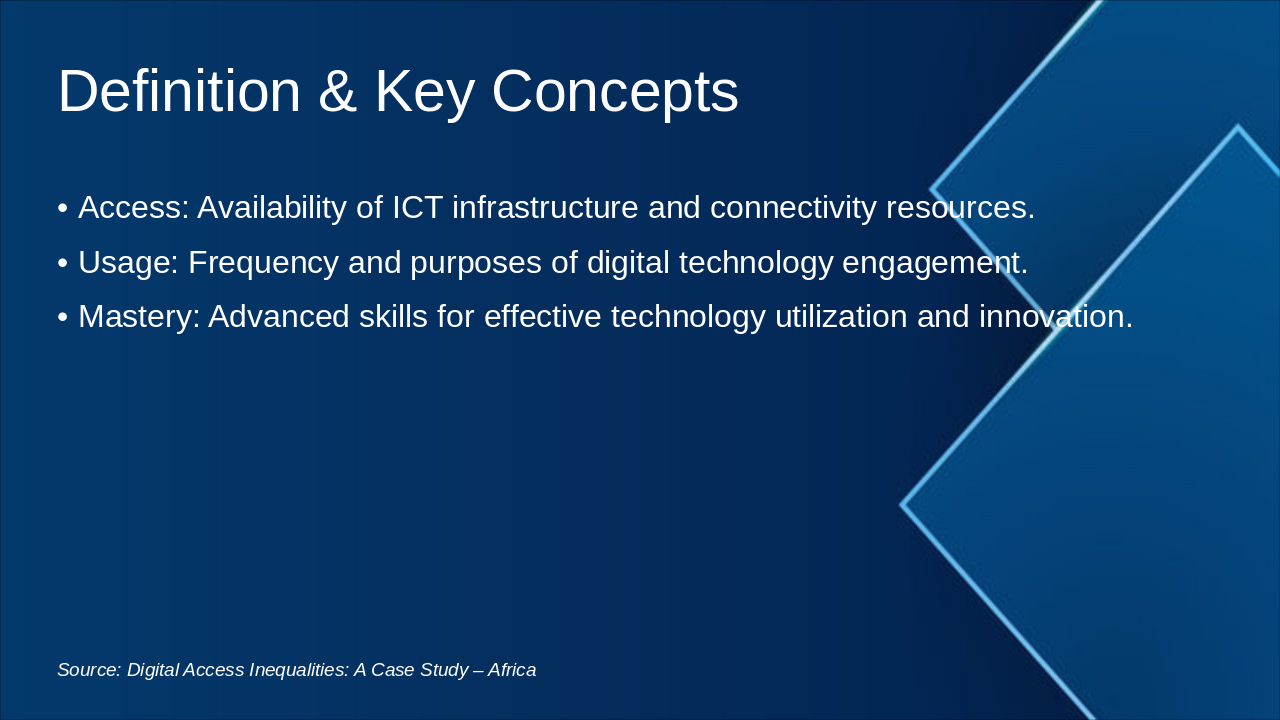
The slide defines key concepts in digital technology engagement under the title "Definition & Key Concepts." It outlines access as the availability of ICT infrastructure and connectivity, usage as the frequency and purposes of engaging with digital tools, and mastery as advanced skills for effective utilization and innovation.

Definition & Key Concepts

  • Access: Availability of ICT infrastructure and connectivity resources.
  • Usage: Frequency and purposes of digital technology engagement.
  • Mastery: Advanced skills for effective technology utilization and innovation.

Source: Digital Access Inequalities: A Case Study – Africa

Slide 3 - Definition & Key Concepts
Slide 4 of 11

Slide 4 - African Context

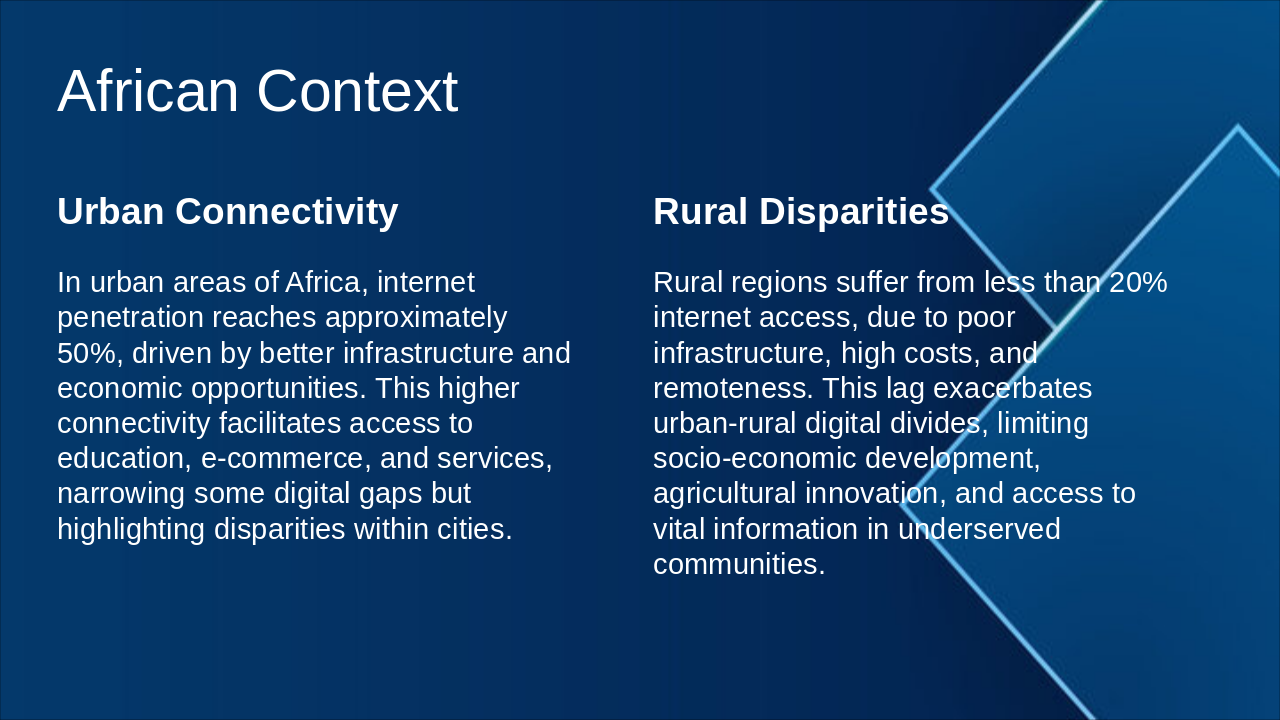
In urban areas of Africa, internet penetration stands at about 50%, fueled by improved infrastructure and economic opportunities that enhance access to education, e-commerce, and services while revealing intra-city disparities. In contrast, rural regions face less than 20% access due to inadequate infrastructure, high costs, and isolation, widening the urban-rural digital divide and hindering socio-economic growth, agricultural innovation, and information access for underserved communities.

African Context

Urban ConnectivityRural Disparities
In urban areas of Africa, internet penetration reaches approximately 50%, driven by better infrastructure and economic opportunities. This higher connectivity facilitates access to education, e-commerce, and services, narrowing some digital gaps but highlighting disparities within cities.Rural regions suffer from less than 20% internet access, due to poor infrastructure, high costs, and remoteness. This lag exacerbates urban-rural digital divides, limiting socio-economic development, agricultural innovation, and access to vital information in underserved communities.
Slide 4 - African Context
Slide 5 of 11

Slide 5 - Household Internet Access & Regional Disparities

Household internet access in Sub-Saharan Africa stands at 28%, highlighting significant regional disparities across the continent. In contrast, North Africa reports 70% access, South Africa 60%, and Ethiopia a notably low 15%.

Household Internet Access & Regional Disparities

  • 28%: Sub-Saharan Africa
  • household internet access

  • 70%: North Africa
  • household internet access

  • 60%: South Africa
  • household internet access

  • 15%: Ethiopia

household internet access Source: ITU 2023

Speaker Notes
Emphasize the stark North-South divide and examples of intra-continental disparities.
Slide 5 - Household Internet Access & Regional Disparities
Slide 6 of 11

Slide 6 - Digital Equipment Inequality

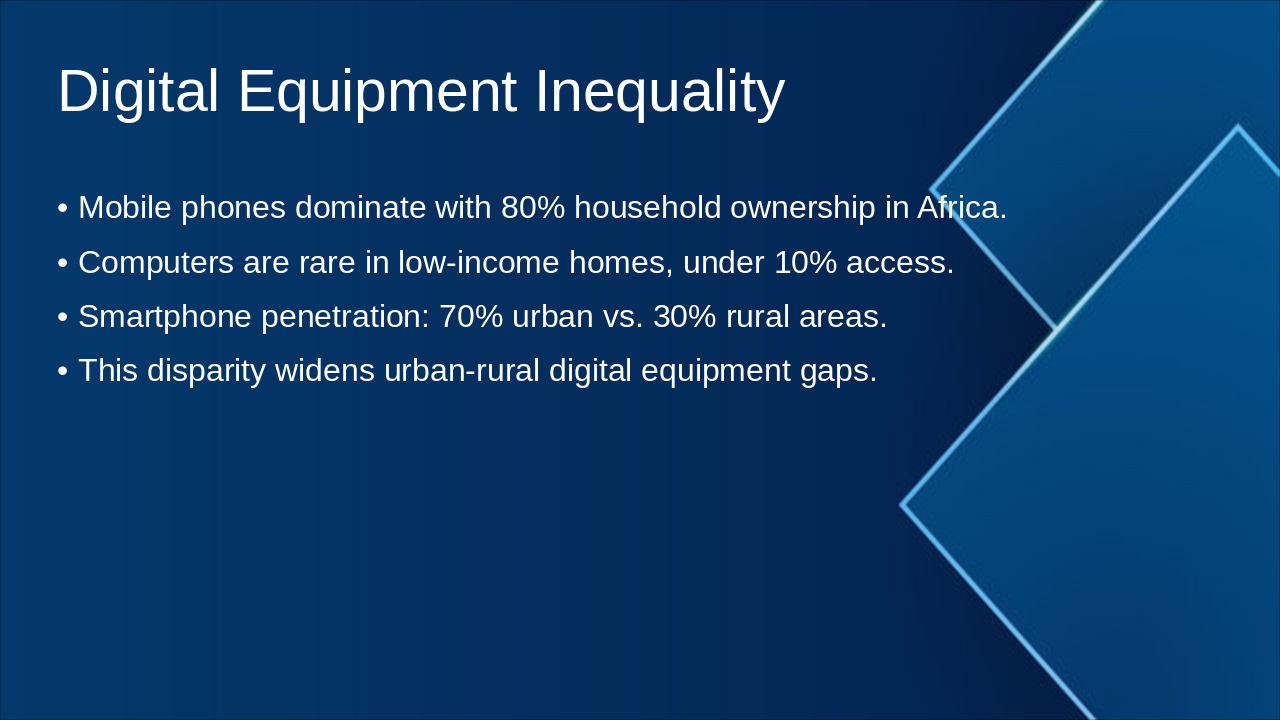
In Africa, mobile phones are highly prevalent with 80% of households owning them, while computers remain scarce in low-income homes with access below 10%. Smartphone penetration highlights urban-rural disparities, reaching 70% in urban areas compared to just 30% in rural ones, thereby widening the overall digital equipment gap.

Digital Equipment Inequality

  • Mobile phones dominate with 80% household ownership in Africa.
  • Computers are rare in low-income homes, under 10% access.
  • Smartphone penetration: 70% urban vs. 30% rural areas.
  • This disparity widens urban-rural digital equipment gaps.
Slide 6 - Digital Equipment Inequality
Slide 7 of 11

Slide 7 - Impact of Education & Income Level

The slide highlights disparities in digital engagement by education and income levels. Highly educated individuals show 60% digital usage, compared to just 20% for those with low education, while access reaches 50% for incomes over $100/month versus only 10% for those under $50/month.

Impact of Education & Income Level

  • 60%: High Education Usage
  • Digital usage among highly educated individuals

  • 20%: Low Education Usage
  • Digital usage among low education groups

  • 50%: High Income Access
  • Access for income over $100/month

  • 10%: Low Income Access

Access for income under $50/month Source: World Bank data

Speaker Notes
Emphasize how education and income significantly influence digital usage and access in Africa.
Slide 7 - Impact of Education & Income Level
Slide 8 of 11

Slide 8 - Major Challenges

The slide "Major Challenges" outlines key barriers to digital access, including infrastructure gaps in remote areas that hinder connectivity and high data costs representing 5-10% of income that limit affordability. It also highlights shortages in digital literacy that impede effective usage, along with a gender gap where women have 20% less access than men.

Major Challenges

  • Infrastructure gaps in remote areas hinder connectivity
  • High data costs (5-10% of income) limit affordability
  • Shortages in digital literacy impede effective usage
  • Gender gap: women face 20% less access than men
Slide 8 - Major Challenges
Slide 9 of 11

Slide 9 - Opportunities & Solutions

The slide titled "Opportunities & Solutions" outlines key strategies to address infrastructure and inclusion challenges, starting with investments in broadband connectivity and education programs for digital literacy. It further emphasizes fostering public-private partnerships for sustainable infrastructure and promoting mobile fintech solutions to enhance financial inclusion.

Opportunities & Solutions

  • Invest in broadband connectivity to bridge infrastructure gaps.
  • Launch education programs for digital literacy enhancement.
  • Foster public-private partnerships for sustainable infrastructure.
  • Promote mobile fintech solutions to boost financial inclusion.
Slide 9 - Opportunities & Solutions
Slide 10 of 11

Slide 10 - Conclusion

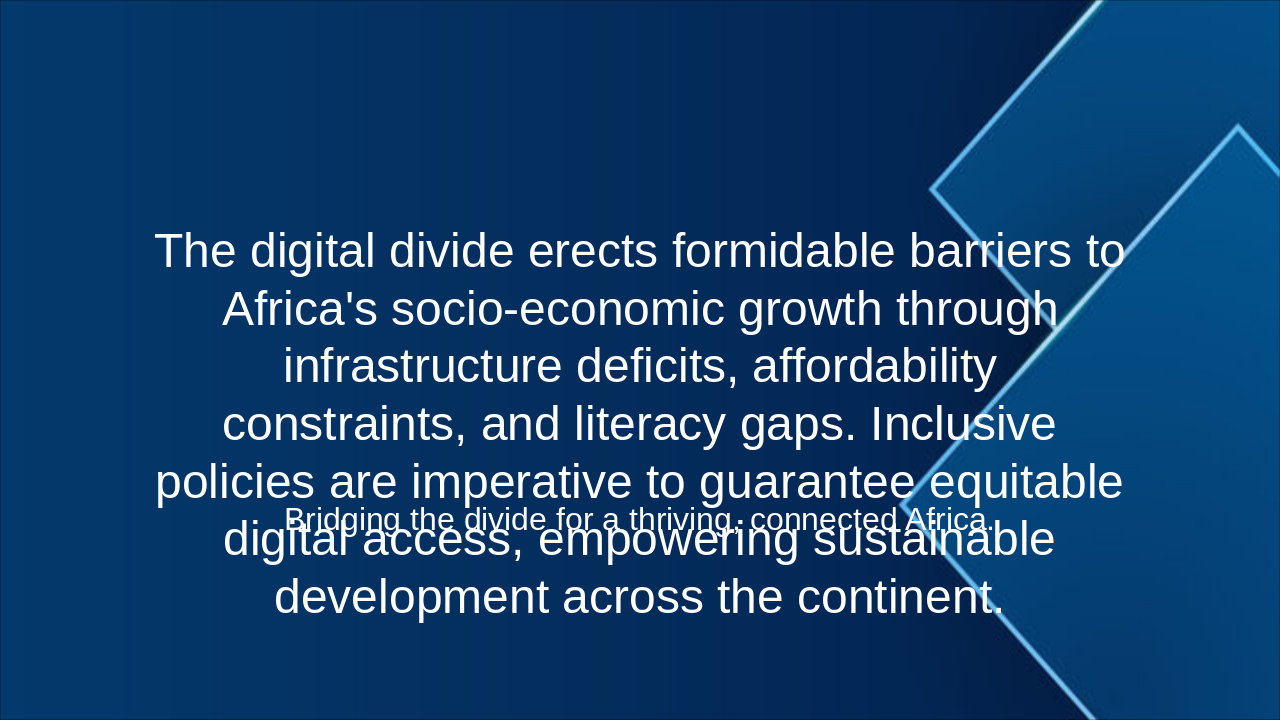
The digital divide poses significant barriers to Africa's socio-economic growth due to infrastructure shortages, high costs, and literacy challenges. Inclusive policies are essential to ensure equitable digital access and foster sustainable development across the continent, bridging the divide for a thriving, connected Africa.

Conclusion

The digital divide erects formidable barriers to Africa's socio-economic growth through infrastructure deficits, affordability constraints, and literacy gaps. Inclusive policies are imperative to guarantee equitable digital access, empowering sustainable development across the continent.

Bridging the divide for a thriving, connected Africa.

Speaker Notes
Emphasize the urgency of action; transition to Q&A or bibliography.
Slide 10 - Conclusion
Slide 11 of 11

Slide 11 - Bibliography

The Bibliography slide lists key sources on digital development and economy, including ITU's 2023 report on Measuring Digital Development and the World Bank's 2022 Digital Economy Report. It also references GSMA's 2023 Mobile Economy Africa report and various academic sources addressing the digital divide.

Bibliography

  • ITU (2023): Measuring Digital Development.
  • World Bank (2022): Digital Economy Report.
  • GSMA (2023): Mobile Economy Africa.
  • Academic sources on digital divide.
Slide 11 - Bibliography

Discover More Presentations

Explore thousands of AI-generated presentations for inspiration

Browse Presentations
Powered by AI

Create Your Own Presentation

Generate professional presentations in seconds with Karaf's AI. Customize this presentation or start from scratch.

Create New Presentation

Powered by Karaf.ai — AI-Powered Presentation Generator