Run Warm-Ups Boost Elementary Fitness (34 chars)

Generated from prompt:

Create a 14-slide PowerPoint presentation titled 'Activity-Based Interventions and Fitness Outcomes in Elementary Physical Education' for KINE 6301. Include Introduction, Review of Literature, Method, Findings, and References. Summarize key points from the user's uploaded drafts: the study explores effects of a structured one-mile run warm-up on fifth graders’ aerobic fitness using heart-rate monitoring and timed performance. Use concise bullet points and visuals like children running, PE class scenes, and heart-rate graphics. Match tone to an academic oral presentation, suitable for 8–10 minutes voice-over narration.

Examines daily 1-mile run warm-up's impact on fifth graders' aerobic fitness via HR monitoring & timed runs. Covers lit review, methods, findings showing gains, & PE implications. (148 chars)

December 13, 202515 slides
Slide 1 of 15

Slide 1 - Activity-Based Interventions and Fitness Outcomes in Elementary Physical Education

This title slide features the topic "Activity-Based Interventions and Fitness Outcomes in Elementary Physical Education." The subtitle lists the course KINE 6301, presenter [Your Name], and date [Insert Date].

Activity-Based Interventions and Fitness Outcomes in Elementary Physical Education

KINE 6301 | Presenter: [Your Name] | Date: [Insert Date]

Source: Children running in PE class

Speaker Notes
Good [morning/afternoon], everyone. Today, I'll present on activity-based interventions and their impact on fitness outcomes in elementary physical education for KINE 6301. This study examines a structured one-mile run warm-up's effects on fifth graders' aerobic fitness.
Slide 1 - Activity-Based Interventions and Fitness Outcomes in Elementary Physical Education
Slide 2 of 15

Slide 2 - Presentation Agenda

The slide, titled "Presentation Agenda," outlines the structure of the presentation. It lists five main sections: Introduction, Review of Literature, Method, Findings, and References.

Presentation Agenda

  1. Introduction
  2. Review of Literature
  3. Method
  4. Findings
  5. References

Source: KINE 6301: Activity-Based Interventions and Fitness Outcomes in Elementary Physical Education

Speaker Notes
Introduce the presentation structure using a timeline graphic of study phases: Introduction, Literature Review, Method, Findings, and References. Academic tone for 8-10 minute voice-over. Concise bullets with visuals like children running and heart-rate graphics.
Slide 2 - Presentation Agenda
Slide 3 of 15

Slide 3 - Activity-Based Interventions and Fitness Outcomes in Elementary Physical Education

This section header slide is titled "Activity-Based Interventions and Fitness Outcomes in Elementary Physical Education." It introduces Section 01: "Introduction to Activity-Based Interventions," with a subtitle exploring structured one-mile run warm-up effects on aerobic fitness in fifth graders.

Activity-Based Interventions and Fitness Outcomes in Elementary Physical Education

01

Introduction to Activity-Based Interventions

Exploring structured one-mile run warm-up effects on aerobic fitness in fifth graders

Source: KINE 6301

Speaker Notes
Welcome to this presentation on activity-based interventions in elementary PE. We focus on a structured one-mile run warm-up and its effects on aerobic fitness in fifth graders, using heart-rate monitoring and timed performance data.
Slide 3 - Activity-Based Interventions and Fitness Outcomes in Elementary Physical Education
Slide 4 of 15

Slide 4 - Background & Purpose

This slide addresses rising childhood obesity and the need for effective PE strategies. It describes a study on daily 1-mile runs' impact on fifth graders' aerobic capacity, measured via heart-rate monitoring and timed mile performance, to improve fitness outcomes.

Background & Purpose

  • Rising childhood obesity demands effective PE strategies
  • Study: daily 1-mile run impact on aerobic capacity
  • Measures: heart-rate monitoring and timed mile performance
  • Goal: improve fifth graders' fitness outcomes
Slide 4 - Background & Purpose
Slide 5 of 15

Slide 5 - PE Class Warm-Up Scene

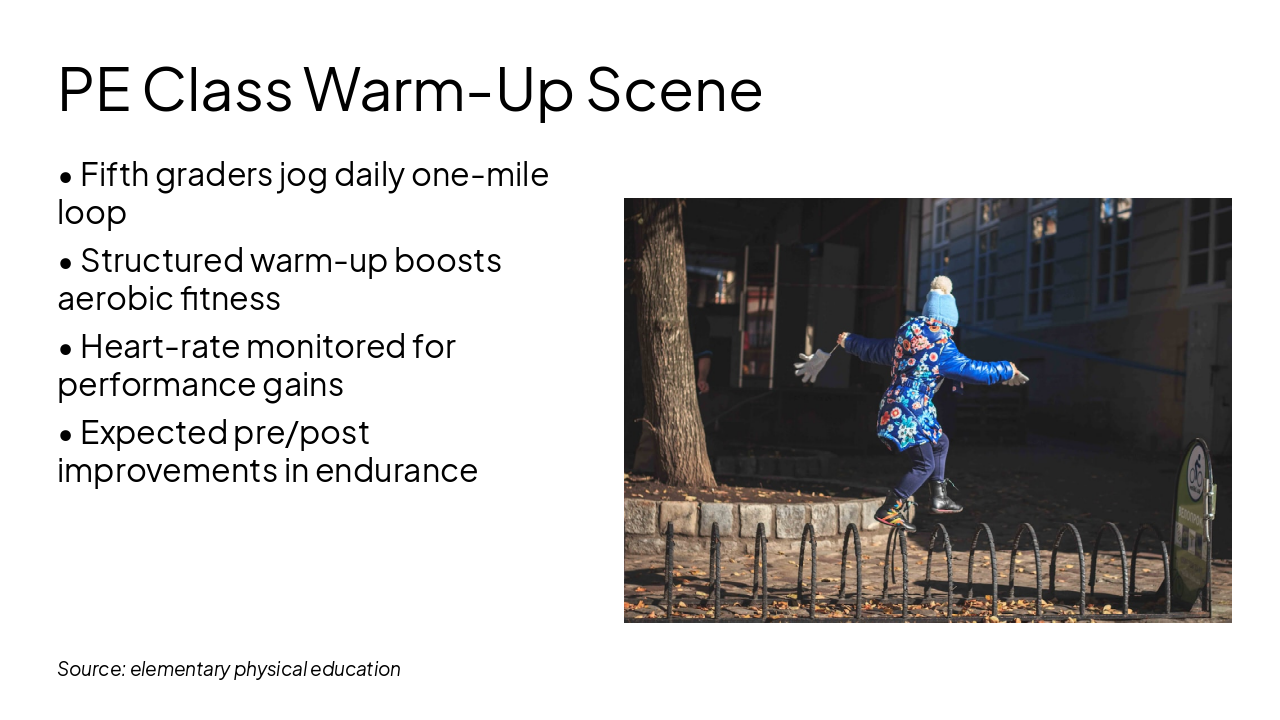
The slide shows fifth graders jogging a daily one-mile loop during PE class warm-up. It emphasizes boosted aerobic fitness through structured activity, heart-rate monitoring for gains, and expected endurance improvements.

PE Class Warm-Up Scene

!Image

  • Fifth graders jog daily one-mile loop
  • Structured warm-up boosts aerobic fitness
  • Heart-rate monitored for performance gains
  • Expected pre/post improvements in endurance

Source: elementary physical education

Speaker Notes
This slide illustrates the structured one-mile run intervention in action, with fifth graders jogging the school track loop. Key focus: aerobic fitness improvements via heart-rate data and timed runs, anticipating measurable pre/post gains for academic presentation.
Slide 5 - PE Class Warm-Up Scene
Slide 6 of 15

Slide 6 - Review of Literature

This slide serves as a section header for "Review of Literature," designated as section 05. Its subtitle highlights key studies on activity interventions and youth fitness.

Review of Literature

05

Review of Literature

Key studies on activity interventions & youth fitness

Source: Bookshelf or research icons

Speaker Notes
This section reviews key studies on activity-based interventions and their impact on youth fitness, particularly aerobic outcomes in elementary physical education settings. Highlight foundational research supporting structured warm-ups like one-mile runs.
Slide 6 - Review of Literature
Slide 7 of 15

Slide 7 - Relevant Research

The left column of the slide summarizes key studies, including Tomporowski (2003) on acute exercise boosting cognition and Strong et al. (2005) recommending 30-60 minutes of daily MVPA. The right column outlines CDC guidelines for aerobic fitness via structured activity and highlights gaps in warm-up-specific research in elementary PE.

Relevant Research

Key StudiesGuidelines & Gaps

| • Tomporowski (2003): Acute exercise boosts cognition

  • Strong et al. (2005): 30-60 min MVPA daily recommended | • CDC guidelines: Aerobic fitness via structured activity
  • Gaps: Limited warm-up specific studies in elem. PE |
Slide 7 - Relevant Research
Slide 8 of 15

Slide 8 - Key Quote from Literature

The slide, titled "Key Quote from Literature," features a quote on exercise benefits for children. It states: "Regular aerobic activity enhances cardiovascular endurance in children," cited from the American College of Sports Medicine (ACSM, 2018).

Key Quote from Literature

> Regular aerobic activity enhances cardiovascular endurance in children.

— American College of Sports Medicine (ACSM, 2018)

Source: Heart-rate graph background

Speaker Notes
This key insight from ACSM emphasizes the benefits of aerobic activity for children's cardiovascular health, aligning with our study's focus on structured run warm-ups to improve fifth graders' endurance. (Pause for emphasis during narration.)
Slide 8 - Key Quote from Literature
Slide 9 of 15

Slide 9 - Method

This section header slide introduces the "Method" section. Its subtitle specifies "Study design & procedures."

Method

Study design & procedures

Slide 9 - Method
Slide 10 of 15

Slide 10 - Study Workflow

The study workflow recruits 50 fifth graders before a Week 1 baseline of timed 1-mile runs with HR monitoring. It then features an 8-week intervention of daily 1-mile run warm-ups, ending with a Week 10 post-test repeating the baseline.

Study Workflow

{ "headers": [ "Phase", "Procedure", "Duration" ], "rows": [ [ "Recruitment", "Recruit 50 fifth graders", "Pre-study" ], [ "Baseline", "Timed 1-mile run + HR monitoring", "Week 1" ], [ "Intervention", "Daily 1-mile run warm-up", "8 weeks" ], [ "Post-test", "Repeat timed 1-mile + HR monitoring", "Week 10" ] ] }

Source: KINE 6301 Presentation: Activity-Based Interventions

Speaker Notes
Narrate: 'Our study followed a structured workflow: recruiting 50 fifth graders, establishing baseline fitness with timed miles and HR monitoring, implementing an 8-week daily 1-mile run intervention, and post-testing to measure improvements in aerobic fitness.' Suitable for 30-45 sec.
Slide 10 - Study Workflow
Slide 11 of 15

Slide 11 - Participant Demographics

The "Participant Demographics" slide features a table comparing two groups: Control (average age 10.5 years, n=25) and Intervention (average age 10.4 years, n=25). Both groups have nearly identical average ages and sample sizes.

Participant Demographics

{ "headers": [ "Group", "Age", "n" ], "rows": [ [ "Control", "10.5", "25" ], [ "Intervention", "10.4", "25" ] ] }

Slide 11 - Participant Demographics
Slide 12 of 15

Slide 12 - Findings

This slide serves as the section header for "Findings" (section 04). Its subtitle introduces "Results from the Structured One-Mile Run Intervention."

Findings

04

Findings

Results from the Structured One-Mile Run Intervention

Source: Bar charts teaser

Speaker Notes
Presenting key results from the structured one-mile run intervention on fifth graders' aerobic fitness, using heart-rate data and timed performance metrics.
Slide 12 - Findings
Slide 13 of 15

Slide 13 - Aerobic Fitness Improvements

The Aerobic Fitness Improvements slide reports a statistically significant 45-second reduction in average timed mile (p<0.01). It also shows a 15% gain in peak HR efficiency and a 12% increase in estimated VO2 Max.

Aerobic Fitness Improvements

  • -45 sec: Timed Mile Avg
  • p<0.01 significance

  • +15%: Peak HR Efficiency
  • Performance gain

  • +12%: VO2 Max Est.
  • Improvement

Slide 13 - Aerobic Fitness Improvements
Slide 14 of 15

Slide 14 - Key Outcomes & Implications

The slide outlines key outcomes and implications, emphasizing significant fitness gains from run warm-ups that are practical for elementary PE curricula. It recommends integrating heart rate feedback to optimize benefits.

Key Outcomes & Implications

  • Significant fitness gains from run warm-up
  • Practical for elementary PE curricula
  • Recommend integration with HR feedback
Slide 14 - Key Outcomes & Implications
Slide 15 of 15

Slide 15 - Conclusion & References

The conclusion slide states that activity-based warm-ups enhance fitness outcomes and calls for future longitudinal studies. It lists references from Tomporowski et al. (2003), Strong et al. (2005), and ACSM (2018), with a "Thank you! Q&A" closing and subtitle "Enhance fitness today!"

Conclusion & References

• Activity-based warm-ups enhance fitness outcomes.

  • Next: Longitudinal studies.

References:

  • Tomporowski et al. (2003)
  • Strong et al. (2005)
  • ACSM (2018)

Thank you! Q&A

Enhance fitness today!

Source: Group high-five

Speaker Notes
In conclusion, activity-based warm-ups significantly enhance fitness outcomes in elementary PE. Future research should include longitudinal studies. Key references listed. Thank you! Open for Q&A.
Slide 15 - Conclusion & References

Discover More Presentations

Explore thousands of AI-generated presentations for inspiration

Browse Presentations
Powered by AI

Create Your Own Presentation

Generate professional presentations in seconds with Karaf's AI. Customize this presentation or start from scratch.

Create New Presentation

Powered by Karaf.ai — AI-Powered Presentation Generator