Slide 1 of 8
Slide 1 - The Industrial Revolution
The Industrial Revolution
A Transformation That Shaped the Modern World
---
Photo by Ludek Pytloun on Unsplash
Generated from prompt:
Create a professional World History presentation about the Industrial Revolution for a high school WHAP class. The slideshow should be visually engaging, historically accurate, and easy to present in 5–10 minutes. Use a modern academic style with large readable text, strong visuals, minimal wording per slide, and clear organization. Include historical photos, paintings, factory illustrations, maps, steam engines, and industrial cities. Use dark backgrounds with white or gold text for a polished look. The presentation should contain 8 slides: 1. Title Slide * Title: “The Industrial Revolution” * Include images of factories, steam engines, smoke stacks, and industrial cities * Add subtitle explaining it transformed the modern world 2. Introduction / What Was the Industrial Revolution? * Explain that it began in Britain in the late 1700s * Describe the shift from hand production to machine manufacturing * Mention factories, mechanization, and economic change * Include timeline visuals or before-and-after comparisons 3. Major Inventions and Innovators * Cover the steam engine, Spinning Jenny, power loom, and cotton gin * Mention inventors like James Watt and Eli Whitney * Show diagrams or illustrations of inventions 4. Factory System and Working Conditions * Explain factory labor, long hours, low wages, unsafe conditions, and child labor * Include emotional historical images of workers and factories * Use a serious tone 5. Urbanization and City Growth * Explain migration from farms to cities * Discuss overcrowding, pollution, and poor sanitation * Include visuals of crowded industrial cities like London 6. Global Impact and Imperialism * Explain how industrialized nations became more powerful * Discuss railroads, steamships, global trade, and imperial expansion * Include world maps and transportation images 7. Positive vs Negative Effects * Create a comparison slide with two sections * Positives: economic growth, inventions, transportation, mass production * Negatives: pollution, exploitation, child labor, poor living conditions 8. Conclusion * Summarize how the Industrial Revolution permanently changed society, economies, and technology * End with a comparison between industrial-era technology and modern technology * Include a powerful final image Additional requirements: * Use minimal text and more visuals * Every slide should include at least one image * Use smooth transitions and clean layouts * Make the presentation easy for a student to memorize and present naturally * Tone should be educational, polished, and visually impressive rather than childish
This presentation provides a comprehensive overview of the Industrial Revolution, starting from its origins in Britain in the 1760s, key inventions like the steam engine and Spinning Jenny, the rise of the factory system with harsh working conditions and child labor, rapid urbanization and city growth, global impacts including imperialism and trade, as well as the positive effects like economic growth and negatives such as pollution and exploitation, concluding with its enduring influence on modern society and technology.
The Industrial Revolution
A Transformation That Shaped the Modern World
---
Photo by Ludek Pytloun on Unsplash
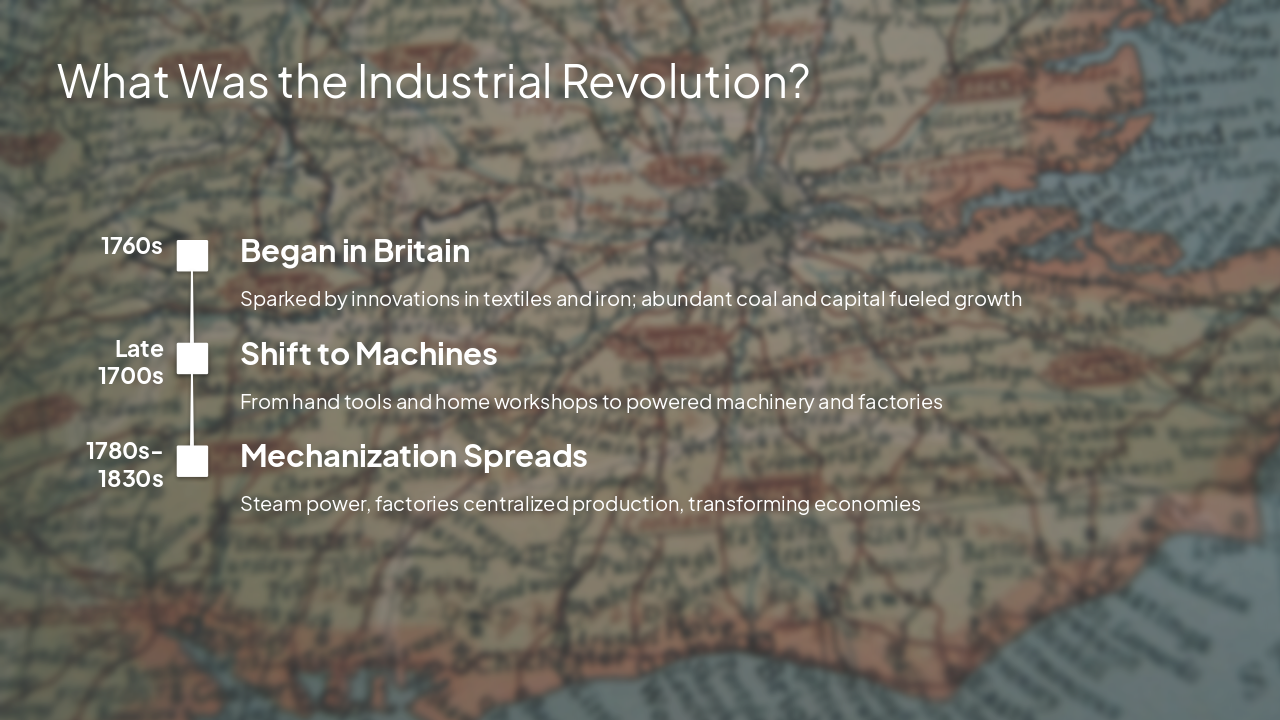
1760s: Began in Britain Sparked by innovations in textiles and iron; abundant coal and capital fueled growth Late 1700s: Shift to Machines From hand tools and home workshops to powered machinery and factories 1780s-1830s: Mechanization Spreads Steam power, factories centralized production, transforming economies
---
Photo by Danil Ahmetşah on Unsplash
---
Photo by British Library on Unsplash
---
Photo by Michael Lloyd on Unsplash
---
Photo by Otakar Hyps on Unsplash
---
Photo by Joshua Olsen on Unsplash
Positives
Negatives
---
Photo by Patrick Hendry on Unsplash
Permanently transformed society, economies, and technology
Industrial era machines paved way for today's digital revolution
---
Photo by Ruoyu Li on Unsplash

Explore thousands of AI-generated presentations for inspiration
Generate professional presentations in seconds with Karaf's AI. Customize this presentation or start from scratch.