Slide 1 of 8
Slide 1 - Santiago Calatrava
Generated from prompt:
Create an 8-slide architecture-focused presentation on Santiago Calatrava. Style: elegant, modern, white background with blue and gray accents, highly visual with architectural sketches, plans, elevations, and iconic project photography. Include concise professional content suitable for architecture students. Slide 1: Title Slide - Title: Santiago Calatrava - Subtitle: Life, Vision, and Architectural Philosophy - Include portrait and iconic works montage. Slide 2: Early Life & Biography - Birth in Valencia, Spain (1951) - Education in architecture and civil engineering - Influence of art, sculpture, and engineering - Timeline of major life milestones Slide 3: Vision & Design Philosophy - Organic forms inspired by nature and movement - Integration of engineering and sculpture - Concepts of light, motion, structure, and fluidity - Include sketches and conceptual diagrams Slide 4: Thought Process & Architectural Approach - Design methodology from sketches to structure - Use of geometry, biomechanics, and structural expressionism - Discussion of materials: steel, concrete, glass - Show process sketches and structural concepts Slide 5: Major Works & Achievements - Milwaukee Art Museum - Turning Torso - World Trade Center Transportation Hub - City of Arts and Sciences - Awards and international recognition Slide 6: Plans, Elevations & Architectural Analysis - Include architectural plans and elevations from key projects - Explain spatial organization, circulation, and structural systems - Comparative architectural diagrams Slide 7: Iconic Projects Discussion - Deep discussion of 3 projects: 1. City of Arts and Sciences 2. Turning Torso 3. Oculus Transportation Hub - Architectural significance and public impact - Include renderings and analytical notes Slide 8: Legacy & Conclusion - Influence on contemporary architecture - Criticism and controversies balanced with innovation - Lasting contribution to architecture and engineering - Closing quote or philosophy statement Make the presentation visually rich, professional, and architecture-oriented with diagrams, elevations, plans, and minimal but impactful text.
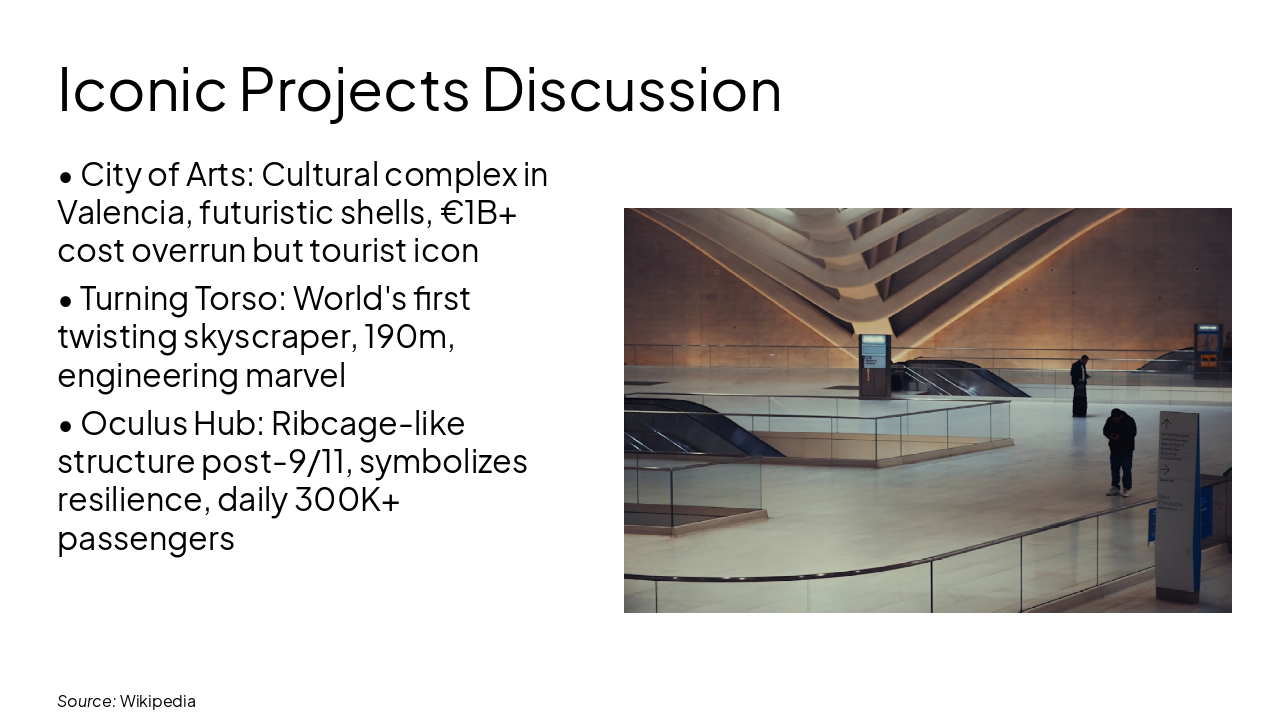
This presentation chronicles the life, creative vision, and architectural philosophy of Santiago Calatrava, the Spanish architect and engineer known for organic, sculptural designs. It covers his early biography from Valencia to ETH Zurich, design principles inspired by nature and motion, creative workflow, major works like Milwaukee Art Museum, Turning Torso, WTC Oculus, and City of Arts and Sciences, structural analyses, and enduring legacy despite controversies.
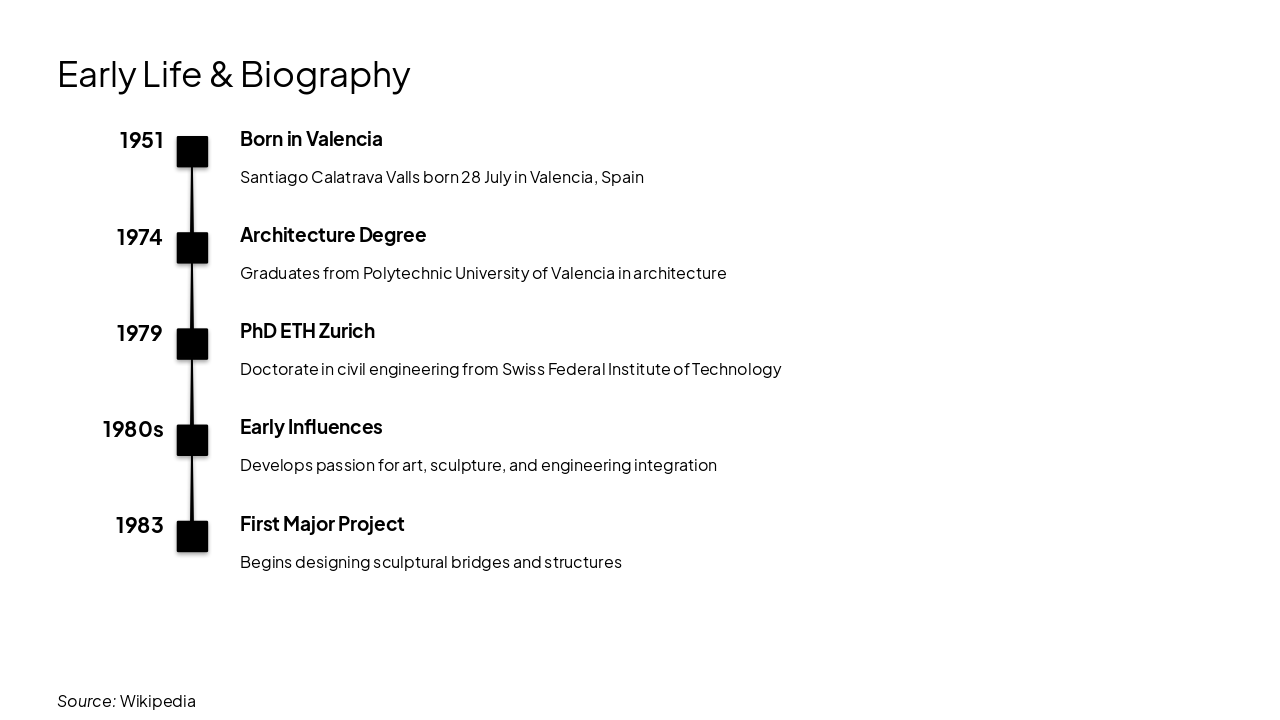
1951: Born in Valencia Santiago Calatrava Valls born 28 July in Valencia, Spain 1974: Architecture Degree Graduates from Polytechnic University of Valencia in architecture 1979: PhD ETH Zurich Doctorate in civil engineering from Swiss Federal Institute of Technology 1980s: Early Influences Develops passion for art, sculpture, and engineering integration 1983: First Major Project Begins designing sculptural bridges and structures
Source: Wikipedia
---
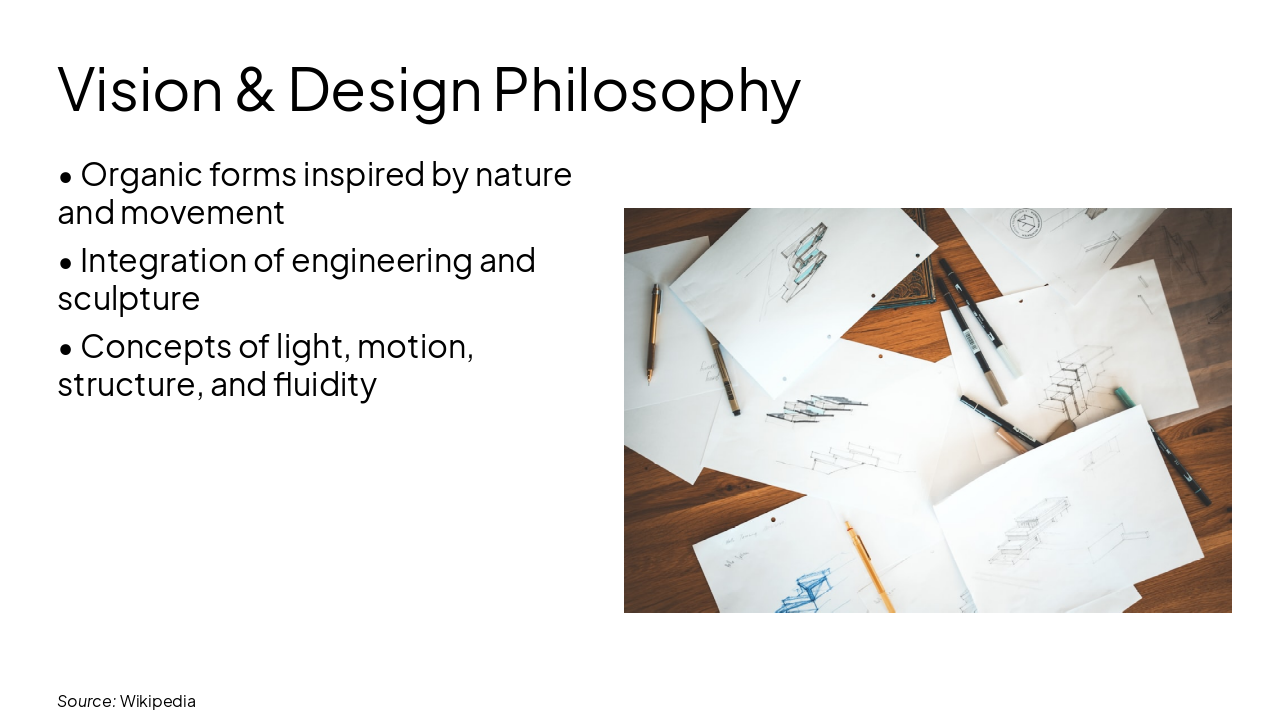
Photo by Marvin Meyer on Unsplash
Source: Wikipedia
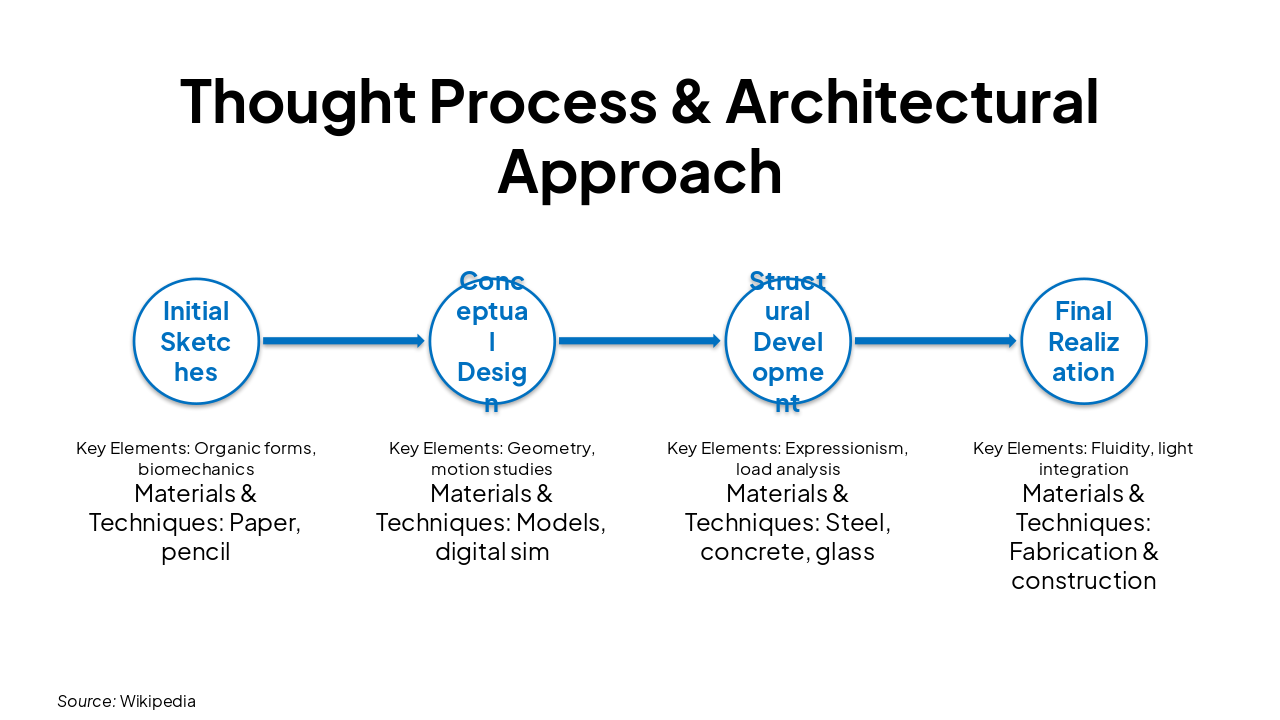
| Stage | Key Elements | Materials & Techniques |
|---|---|---|
| Initial Sketches | Organic forms, biomechanics | Paper, pencil |
| Conceptual Design | Geometry, motion studies | Models, digital sim |
| Structural Development | Expressionism, load analysis | Steel, concrete, glass |
| Final Realization | Fluidity, light integration | Fabrication & construction |
Source: Wikipedia
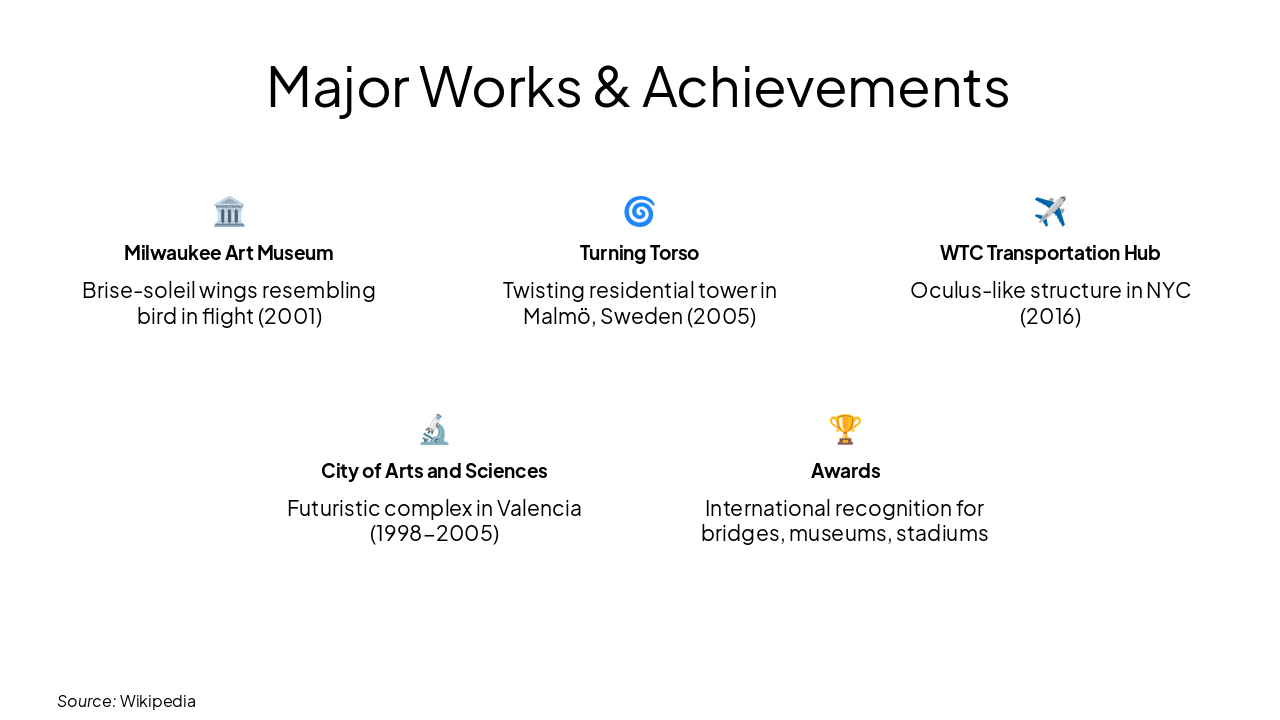
🏛️ Milwaukee Art Museum Brise-soleil wings resembling bird in flight (2001)
🌀 Turning Torso Twisting residential tower in Malmö, Sweden (2005)
✈️ WTC Transportation Hub Oculus-like structure in NYC (2016)
🔬 City of Arts and Sciences Futuristic complex in Valencia (1998-2005)
🏆 Awards International recognition for bridges, museums, stadiums
Source: Wikipedia
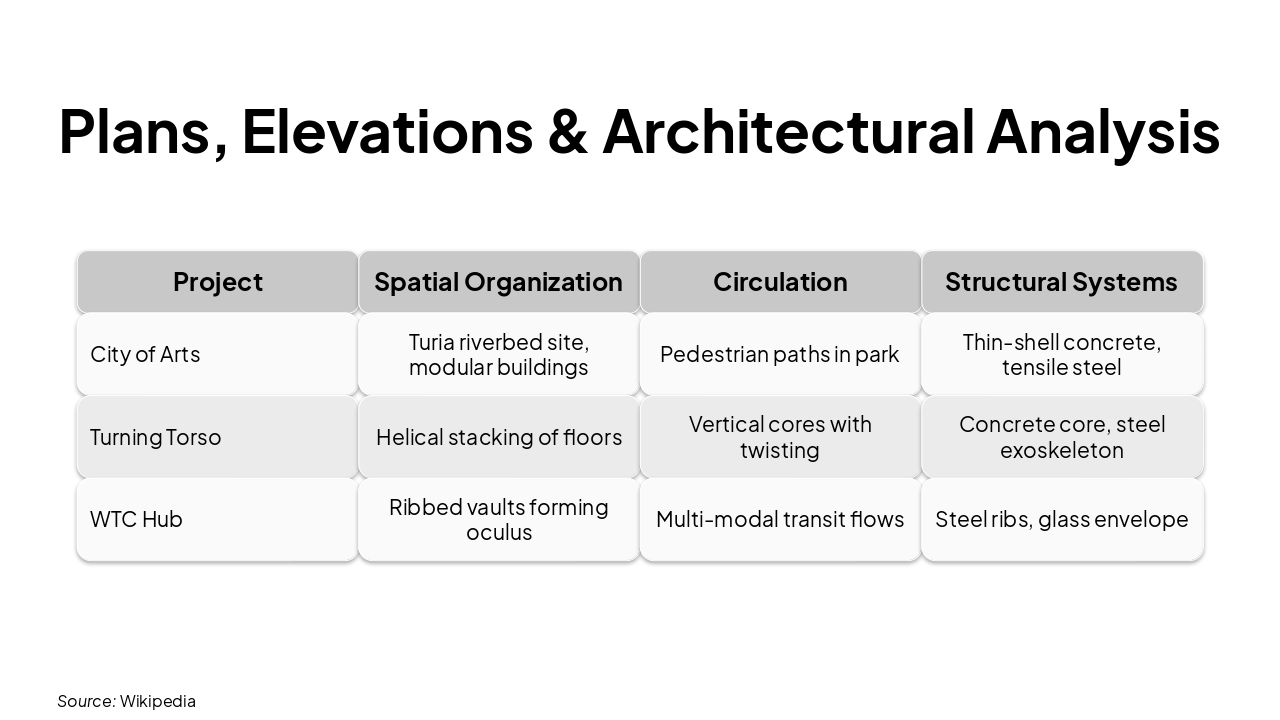
| Project | Spatial Organization | Circulation | Structural Systems |
|---|---|---|---|
| City of Arts | Turia riverbed site, modular buildings | Pedestrian paths in park | Thin-shell concrete, tensile steel |
| Turning Torso | Helical stacking of floors | Vertical cores with twisting | Concrete core, steel exoskeleton |
| WTC Hub | Ribbed vaults forming oculus | Multi-modal transit flows | Steel ribs, glass envelope |
Source: Wikipedia
---
Photo by Tomasz Brengos on Unsplash
Source: Wikipedia
Calatrava's organic, kinetic forms redefine architecture-engineering fusion Influence on neo-futurism Balanced by cost controversies, enduring innovation
'I try to make buildings that invite their users to touch them, to relate to them.' – Santiago Calatrava
---
Photo by Zulfugar Karimov on Unsplash
Source: Wikipedia
Explore thousands of AI-generated presentations for inspiration
Generate professional presentations in seconds with Karaf's AI. Customize this presentation or start from scratch.