Aberrations in Optical Images: Chromatic and Spherical Imperfections

Generated from prompt:

Aberration in images - bsc hons physics

This BSc Honours Physics presentation introduces optical aberrations, which cause blurring and distortion in images. It covers fundamentals, chromatic aberration due to wavelength dispersion, spherical aberration in lenses and mirrors, visualization through ray diagrams, and correction techniques using achromatic doublets, aspheric surfaces, and aperture stops. Concludes with the importance for high-quality optical instruments.

May 12, 202613 slides
Slide 1 of 13

Slide 1 - Aberrations in Optical Images
Aberrations in Optical Images

BSc Hons Physics Presentation

---

Photo by David Clode on Unsplash

Slide 1 - Aberrations in Optical Images
Slide 2 of 13

Slide 2 - Presentation Outline

  • Introduction to Aberrations
  • Chromatic Aberration
  • Spherical Aberration
  • Correction in Optical Systems
  • Conclusion

---

Photo by Philippe BONTEMPS on Unsplash
Slide 2 - Presentation Outline
Slide 3 of 13

Slide 3 - Section 1: Fundamentals

1

Introduction to Aberrations

Understanding image distortions in optical systems

---

Photo by Anastassia Anufrieva on Unsplash
Slide 3 - Section 1: Fundamentals
Slide 4 of 13

Slide 4 - What is Optical Aberration?

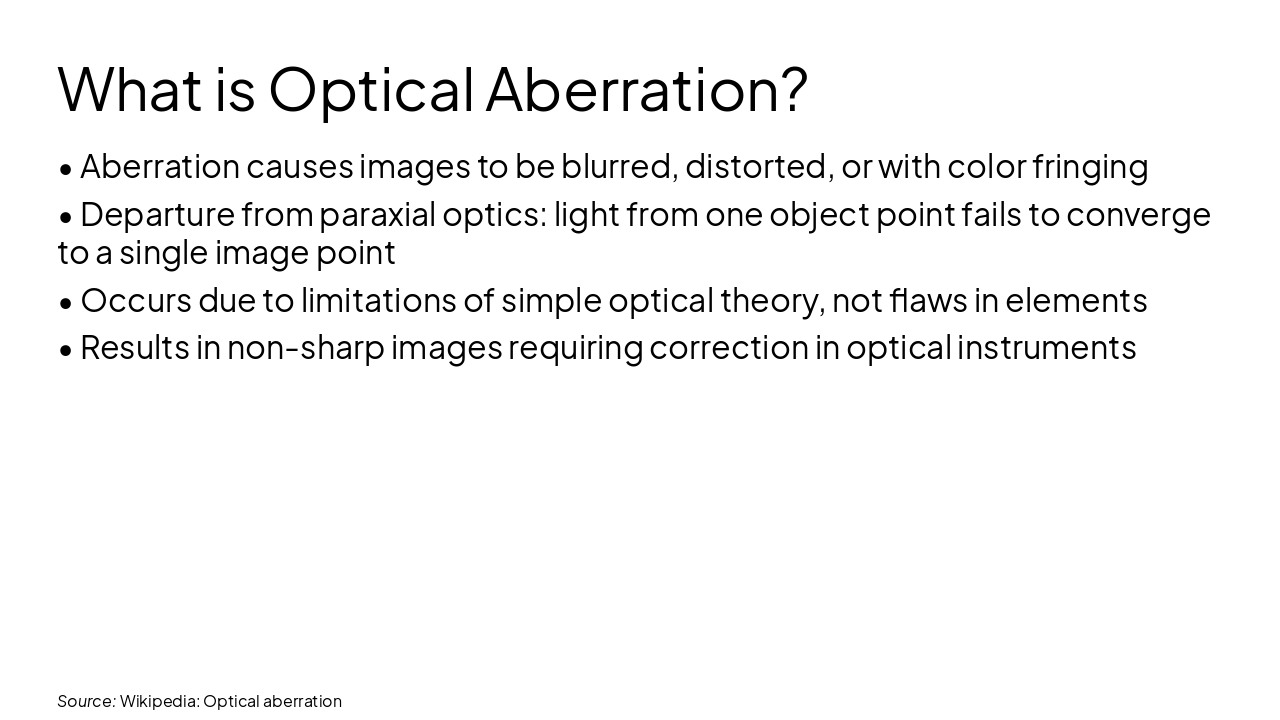
  • Aberration causes images to be blurred, distorted, or with color fringing
  • Departure from paraxial optics: light from one object point fails to converge to a single image point
  • Occurs due to limitations of simple optical theory, not flaws in elements
  • Results in non-sharp images requiring correction in optical instruments

Source: Wikipedia: Optical aberration
Slide 4 - What is Optical Aberration?
Slide 5 of 13

Slide 5 - Visualizing Aberrations

  • Ideal paraxial rays focus sharply
  • Aberrated rays spread out causing blur
  • Analyzed using geometrical optics

---

Photo by Adrien on Unsplash

Source: Wikipedia: Optical aberration

Slide 5 - Visualizing Aberrations
Slide 6 of 13

Slide 6 - Chromatic Aberration

2

Chromatic Aberration

Failure to focus all colors to the same point

---

Photo by Aubree Herrick on Unsplash
Slide 6 - Chromatic Aberration
Slide 7 of 13

Slide 7 - Chromatic Aberration Explained

  • Lens fails to focus all wavelengths to the same point
  • Due to dispersion: refractive index decreases with increasing wavelength
  • Focal length varies by color, causing different focus distances or magnifications
  • Appears as color fringes or purple fringing at high-contrast edges

Source: Wikipedia: Chromatic aberration
Slide 7 - Chromatic Aberration Explained
Slide 8 of 13

Slide 8 - Chromatic Aberration Visualization

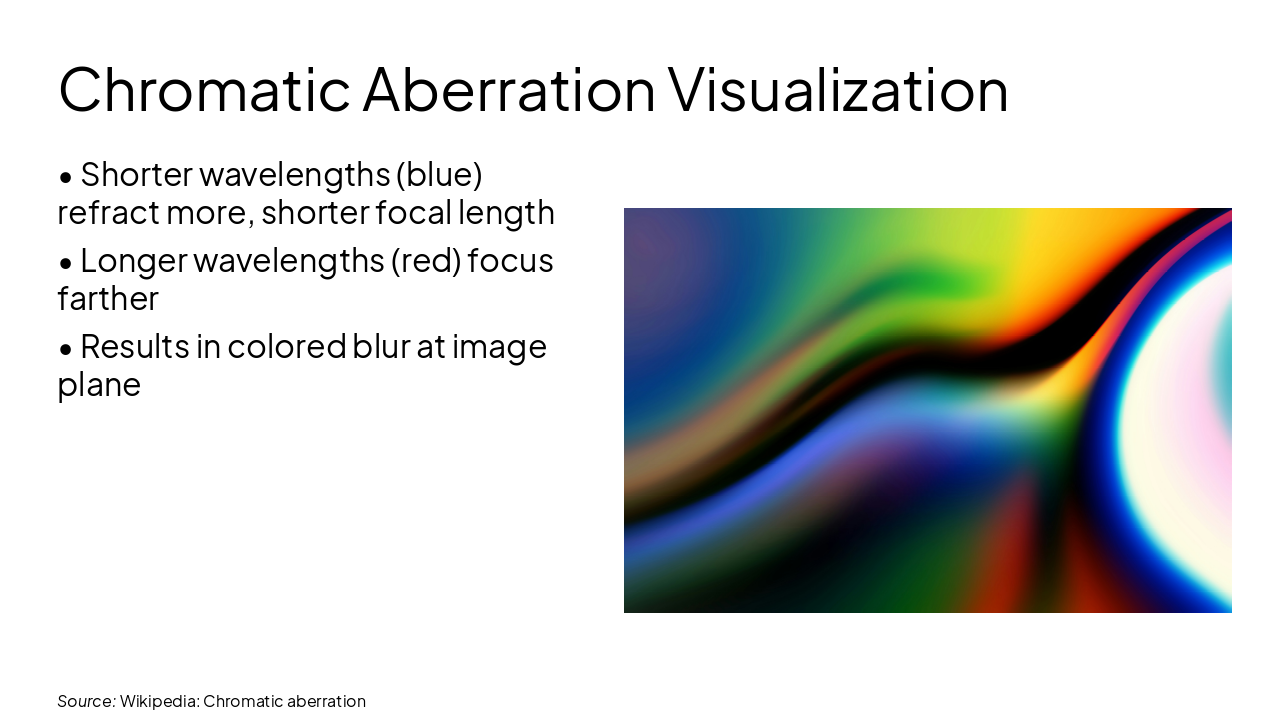
  • Shorter wavelengths (blue) refract more, shorter focal length
  • Longer wavelengths (red) focus farther
  • Results in colored blur at image plane

---

Photo by vackground.com on Unsplash

Source: Wikipedia: Chromatic aberration
Slide 8 - Chromatic Aberration Visualization
Slide 9 of 13

Slide 9 - Spherical Aberration

3

Spherical Aberration

Imperfections in spherical lenses and mirrors

---

Photo by Yaron Cohen on Unsplash
Slide 9 - Spherical Aberration
Slide 10 of 13

Slide 10 - Spherical Aberration Explained

  • Common in spherical lenses and curved mirrors due to manufacturing ease
  • Peripheral rays refract/reflect more than central rays
  • Reduces image quality; first noted by Ibn al-Haytham (11th century) in Kitāb al-Manāẓir
  • Leads to blurred images as rays don't converge at one point

Source: Wikipedia: Spherical aberration
Slide 10 - Spherical Aberration Explained
Slide 11 of 13

Slide 11 - Spherical Aberration Ray Diagram

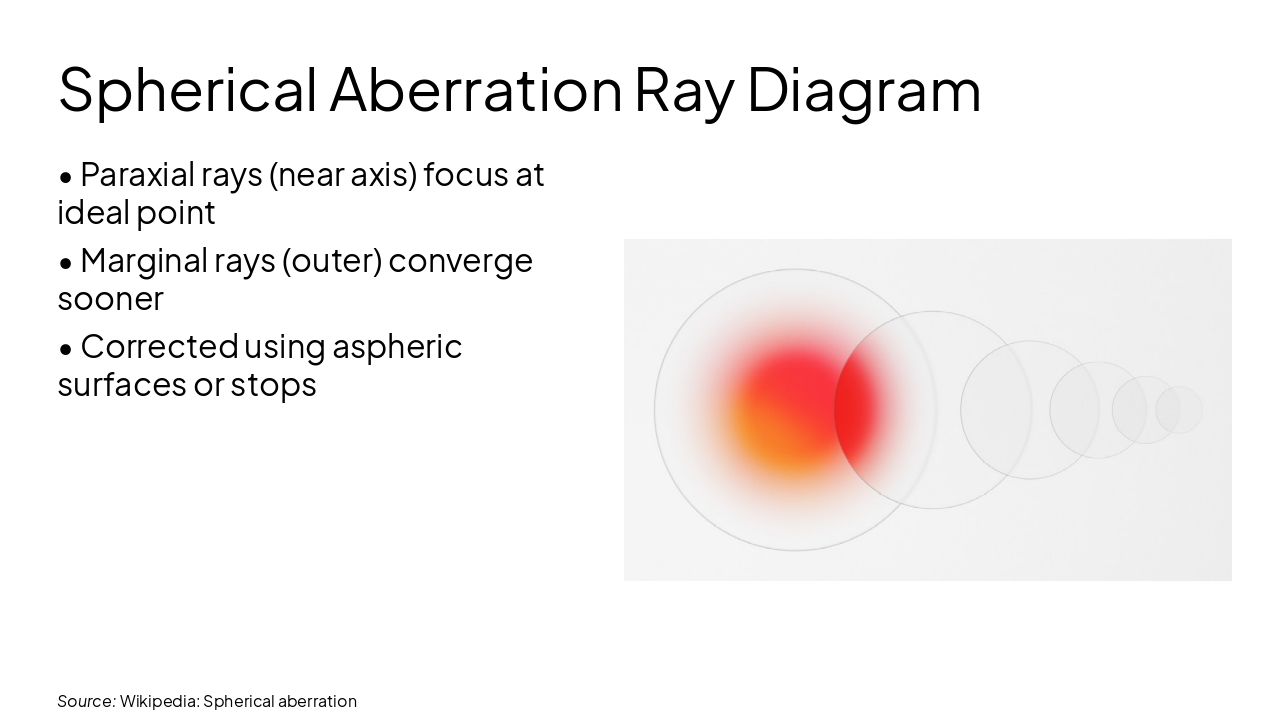
  • Paraxial rays (near axis) focus at ideal point
  • Marginal rays (outer) converge sooner
  • Corrected using aspheric surfaces or stops

---

Photo by Shubham Dhage on Unsplash

Source: Wikipedia: Spherical aberration
Slide 11 - Spherical Aberration Ray Diagram
Slide 12 of 13

Slide 12 - Correcting Aberrations

  • Use achromatic doublets (crown + flint glass) to minimize chromatic aberration
  • Aspheric surfaces or parabolic mirrors reduce spherical aberration
  • Aperture stops limit off-axis rays
  • Geometrical optics and ray-tracing for design optimization
  • Essential for high-quality imaging systems

Source: Wikipedia: Optical aberration
Slide 12 - Correcting Aberrations
Slide 13 of 13

Slide 13 - Conclusion

Optical aberrations blur and distort images but can be corrected using advanced lens designs and materials. Essential knowledge for physics and optics.

Thank you! Questions?

---

Photo by Monique Van Dijk on Unsplash
Slide 13 - Conclusion

Discover More Presentations

Explore thousands of AI-generated presentations for inspiration

Browse Presentations
Powered by AI

Create Your Own Presentation

Generate professional presentations in seconds with Karaf's AI. Customize this presentation or start from scratch.

Create New Presentation

Powered by Karaf.ai — AI-Powered Presentation Generator