Healthcare AI: Engineering Medicine's Future

Generated from prompt:

Create a presentation about healthcare AI

This presentation explores AI engineering in healthcare, covering its definition, key components, historical evolution, practical applications like diagnostics and predictive analytics, statistical im

November 19, 202512 slides
Slide 1 of 12

Slide 1 - Healthcare AI: Engineering the Future of Medicine

The slide's main title is "Healthcare AI: Engineering the Future of Medicine," highlighting the role of artificial intelligence in transforming medical practices. Its subtitle, "Building Scalable AI Solutions for Medical Advancements," emphasizes the development of robust, expandable technologies to drive progress in healthcare.

Healthcare AI: Engineering the Future of Medicine

Building Scalable AI Solutions for Medical Advancements
Slide 1
Slide 2 of 12

Slide 2 - Presentation Agenda

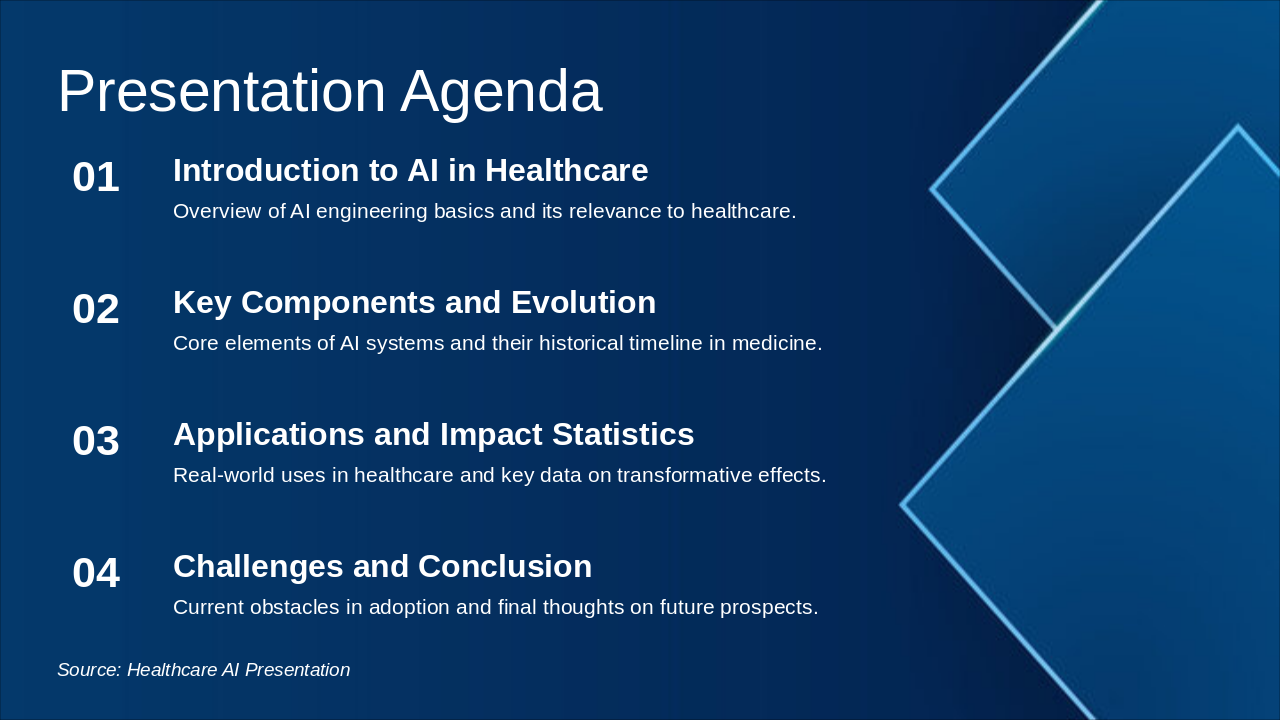
The presentation agenda outlines the structure of a talk on AI in healthcare, starting with an introduction to AI engineering basics and its relevance to the field. It then covers key components and their evolution in medicine, real-world applications with impact statistics, and concludes with challenges in adoption plus future prospects.

Presentation Agenda

  1. Introduction to AI in Healthcare

Overview of AI engineering basics and its relevance to healthcare.

  1. Key Components and Evolution

Core elements of AI systems and their historical timeline in medicine.

  1. Applications and Impact Statistics

Real-world uses in healthcare and key data on transformative effects.

  1. Challenges and Conclusion

Current obstacles in adoption and final thoughts on future prospects.

Source: Healthcare AI Presentation

Slide 2
Slide 3 of 12

Slide 3 - Introduction to AI in Healthcare

This section header slide introduces the topic of AI in Healthcare as the first section (01). It features a subtitle emphasizing the design, development, and deployment of AI systems to create reliable healthcare solutions.

Introduction to AI in Healthcare

01

Introduction to AI in Healthcare

Designing, developing, and deploying AI systems for reliable healthcare solutions.

Source: Healthcare AI Presentation

--- Speaker Notes: Overview of AI engineering: Designing, developing, and deploying AI systems that merge data and software engineering for reliable healthcare solutions.

Slide 3
Slide 4 of 12

Slide 4 - What is Healthcare AI Engineering?

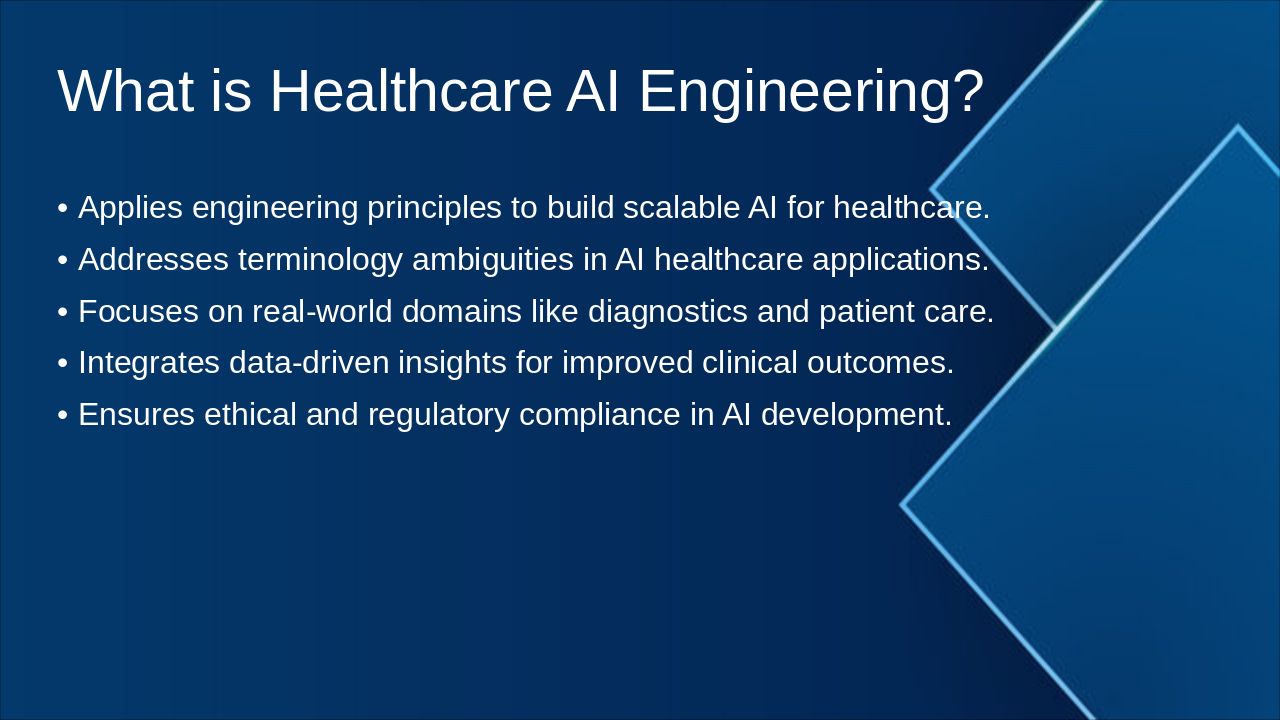
Healthcare AI Engineering applies engineering principles to develop scalable AI systems for healthcare, tackling terminology ambiguities and emphasizing real-world applications like diagnostics and patient care. It integrates data-driven insights to enhance clinical outcomes while ensuring ethical and regulatory compliance in AI development.

What is Healthcare AI Engineering?

  • Applies engineering principles to build scalable AI for healthcare.
  • Addresses terminology ambiguities in AI healthcare applications.
  • Focuses on real-world domains like diagnostics and patient care.
  • Integrates data-driven insights for improved clinical outcomes.
  • Ensures ethical and regulatory compliance in AI development.
Slide 4
Slide 5 of 12

Slide 5 - Key Components of AI Engineering

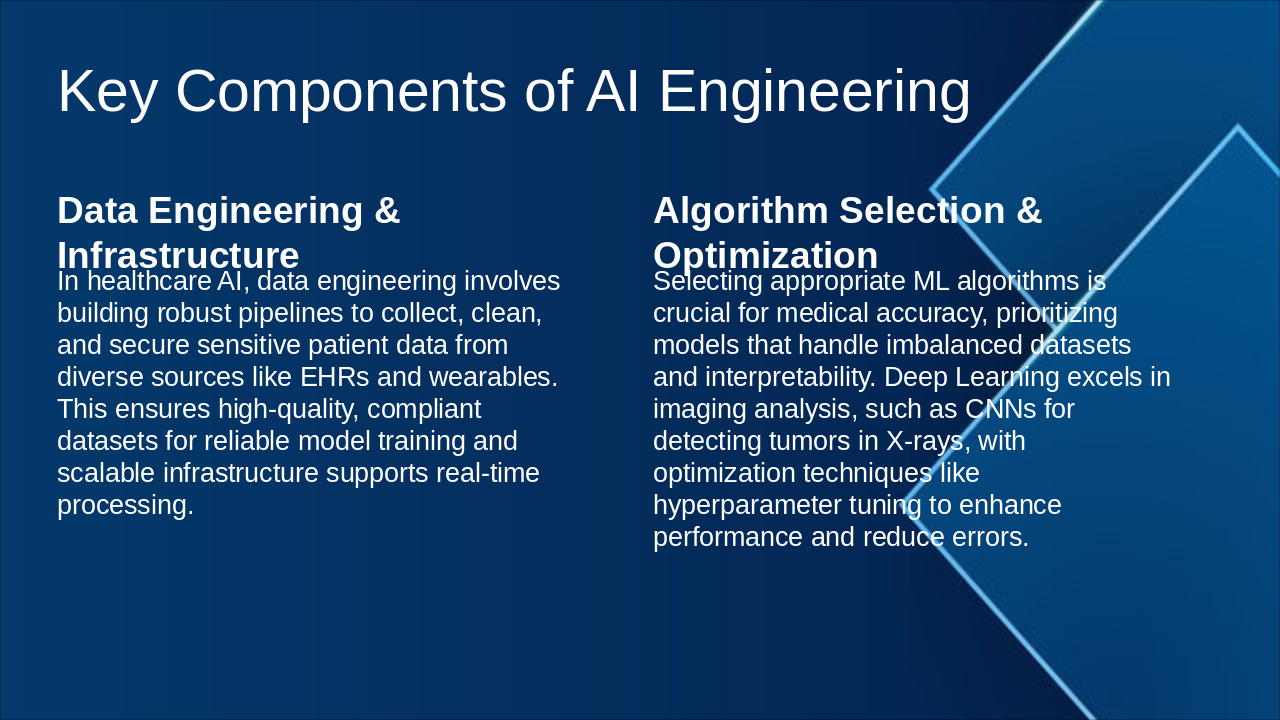
In the left column of the slide, "Data Engineering & Infrastructure" highlights building robust pipelines to collect, clean, and secure sensitive patient data from sources like EHRs and wearables, ensuring compliant, high-quality datasets for model training and real-time processing. The right column, "Algorithm Selection & Optimization," emphasizes choosing ML algorithms suited for medical accuracy, such as interpretable models for imbalanced data and CNNs for imaging tasks like tumor detection in X-rays, enhanced through hyperparameter tuning to boost performance and minimize errors.

Key Components of AI Engineering

Data Engineering & InfrastructureAlgorithm Selection & Optimization
In healthcare AI, data engineering involves building robust pipelines to collect, clean, and secure sensitive patient data from diverse sources like EHRs and wearables. This ensures high-quality, compliant datasets for reliable model training and scalable infrastructure supports real-time processing.Selecting appropriate ML algorithms is crucial for medical accuracy, prioritizing models that handle imbalanced datasets and interpretability. Deep Learning excels in imaging analysis, such as CNNs for detecting tumors in X-rays, with optimization techniques like hyperparameter tuning to enhance performance and reduce errors.
Slide 5
Slide 6 of 12

Slide 6 - Evolution of AI in Healthcare

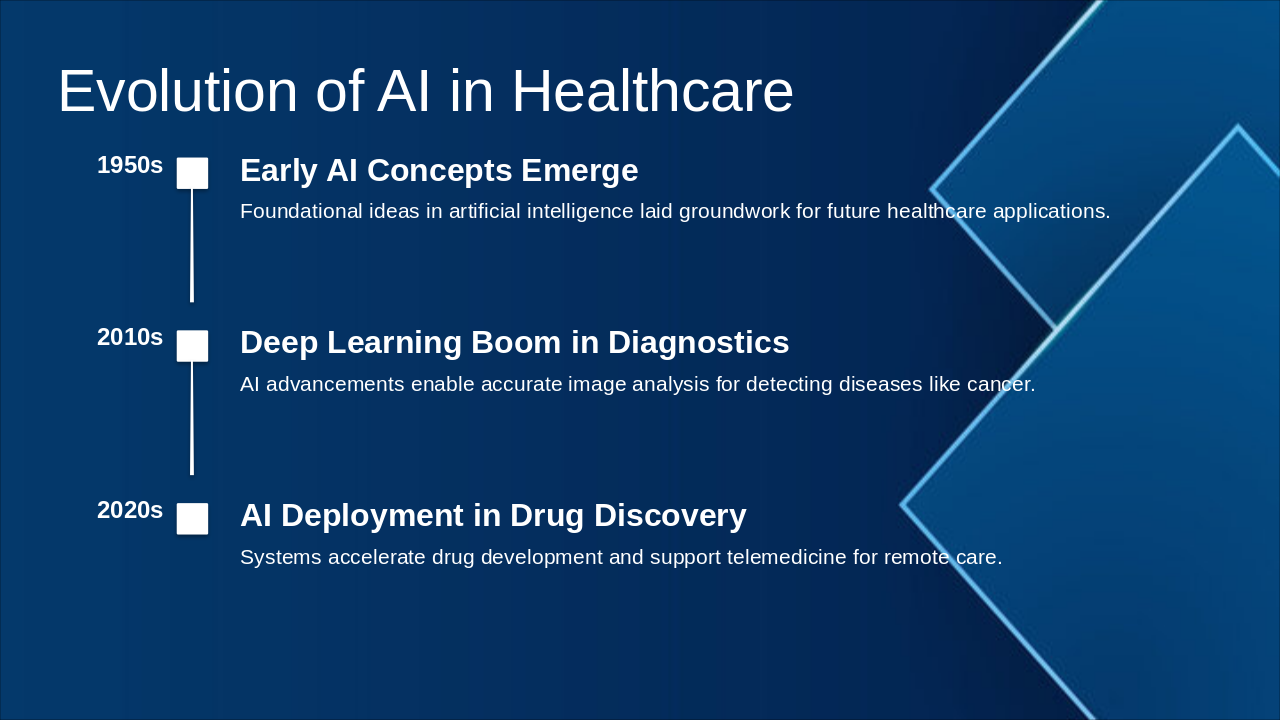
The timeline slide traces the evolution of AI in healthcare, starting in the 1950s when foundational AI concepts emerged to lay the groundwork for future medical applications. It then highlights the 2010s deep learning boom for accurate disease diagnostics like cancer detection via image analysis, and the 2020s focus on AI deployment in drug discovery and telemedicine for accelerated development and remote care.

Evolution of AI in Healthcare

1950s: Early AI Concepts Emerge Foundational ideas in artificial intelligence laid groundwork for future healthcare applications. 2010s: Deep Learning Boom in Diagnostics AI advancements enable accurate image analysis for detecting diseases like cancer. 2020s: AI Deployment in Drug Discovery Systems accelerate drug development and support telemedicine for remote care.

Slide 6
Slide 7 of 12

Slide 7 - Applications in Healthcare

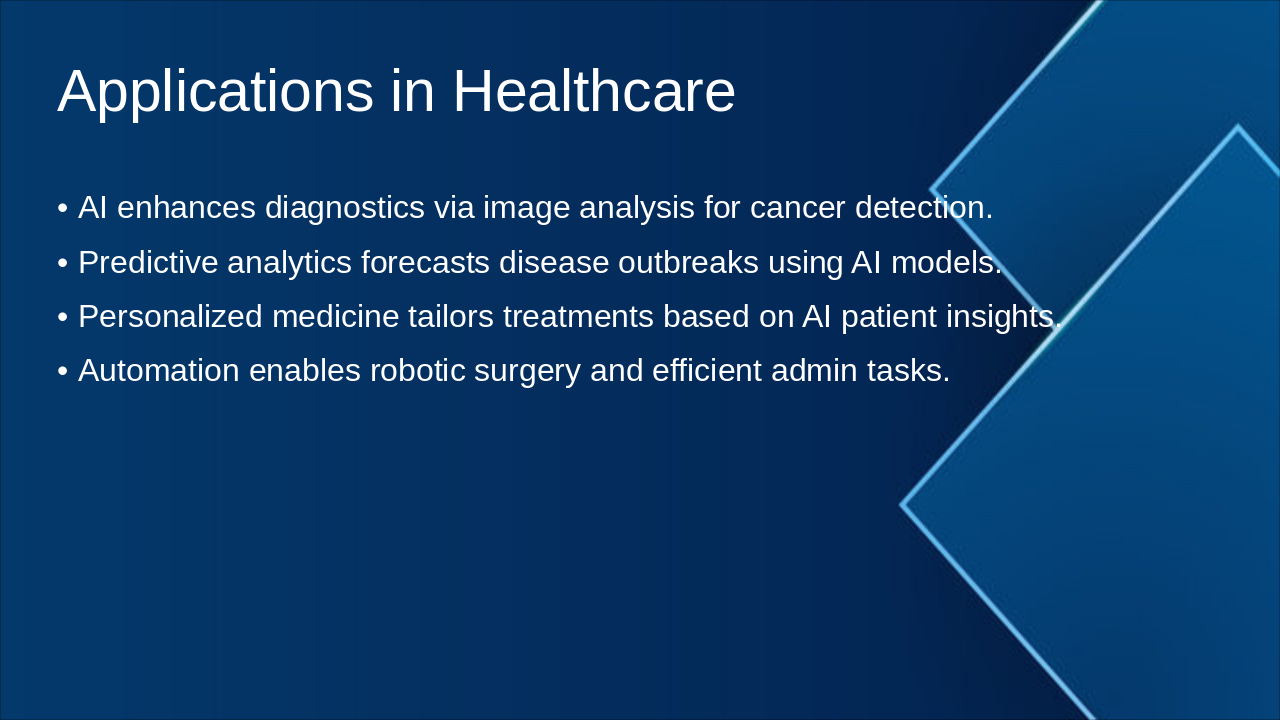
AI applications in healthcare improve diagnostics through image analysis for cancer detection and enable predictive analytics to forecast disease outbreaks. They also support personalized medicine by tailoring treatments to individual patient insights and automate processes like robotic surgery and administrative tasks.

Applications in Healthcare

  • AI enhances diagnostics via image analysis for cancer detection.
  • Predictive analytics forecasts disease outbreaks using AI models.
  • Personalized medicine tailors treatments based on AI patient insights.
  • Automation enables robotic surgery and efficient admin tasks.
Slide 7
Slide 8 of 12

Slide 8 - Impact and Statistics

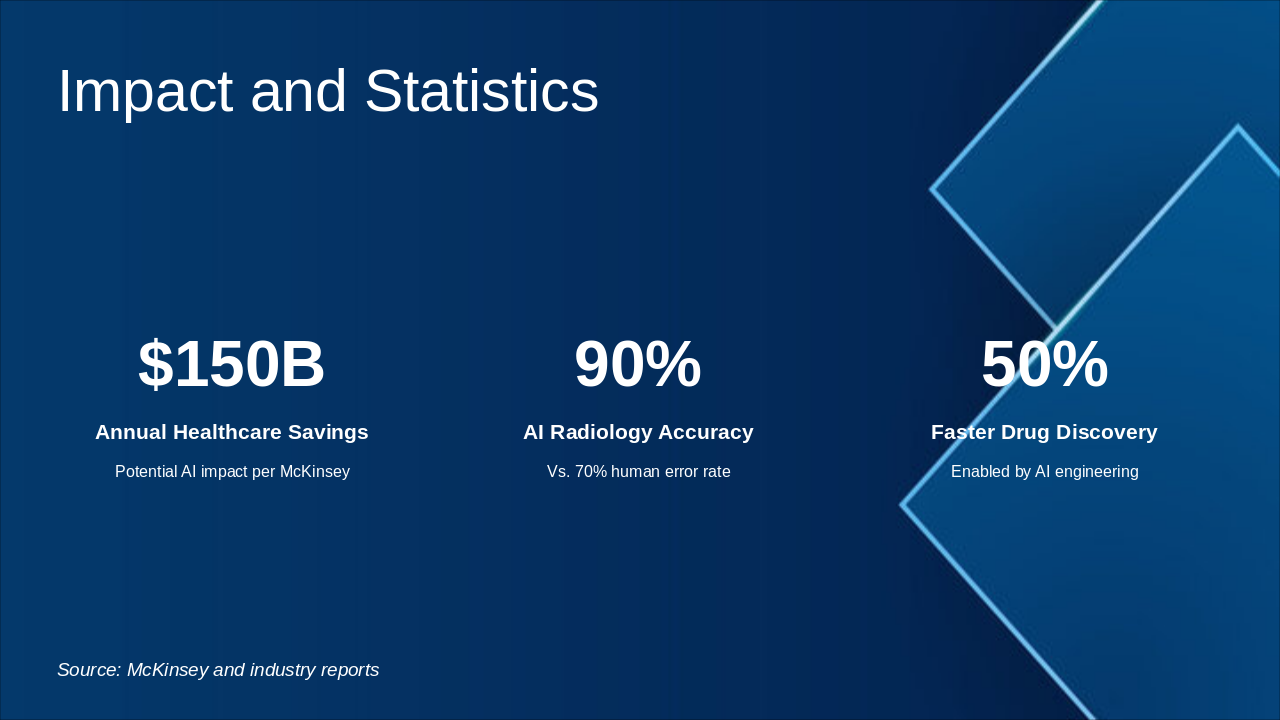
AI could generate $150 billion in annual healthcare savings, according to McKinsey estimates. It also achieves 90% accuracy in radiology compared to humans' 70% error rate and accelerates drug discovery by 50%.

Impact and Statistics

  • $150B: Annual Healthcare Savings

Potential AI impact per McKinsey

  • 90%: AI Radiology Accuracy

Vs. 70% human error rate

  • 50%: Faster Drug Discovery

Enabled by AI engineering

Source: McKinsey and industry reports

Slide 8
Slide 9 of 12

Slide 9 - AI in Action: Example

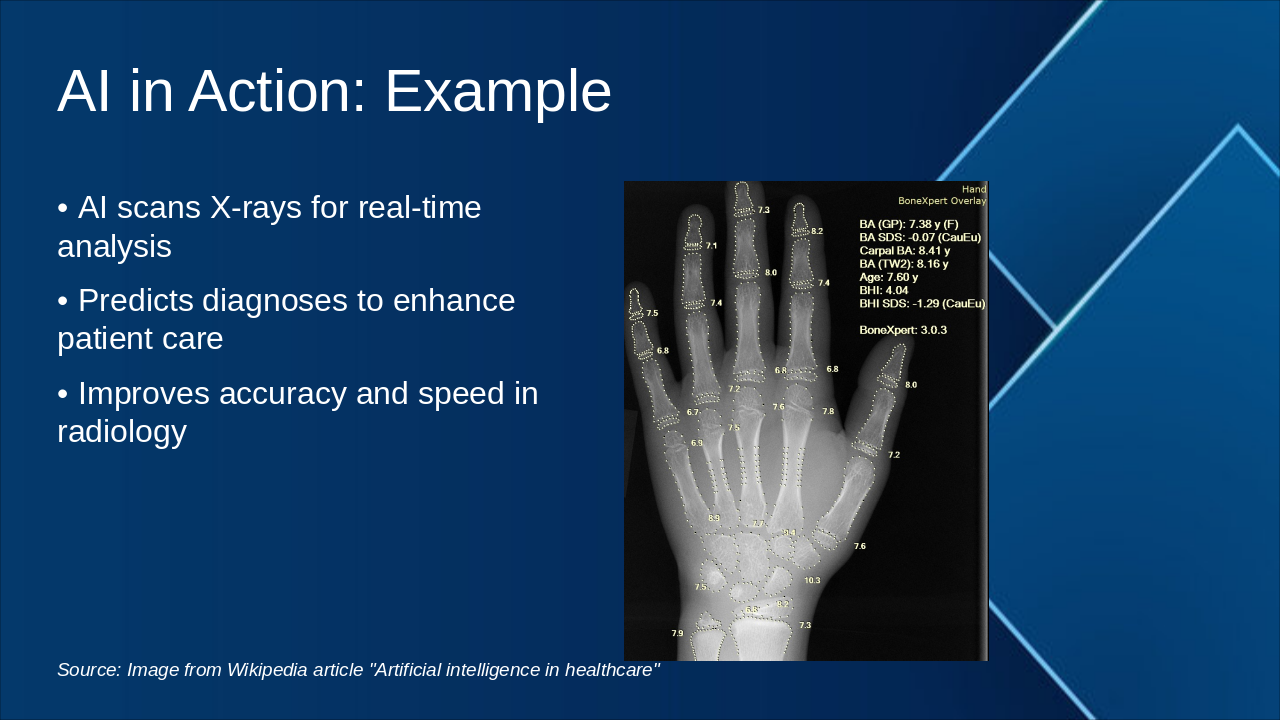
This slide illustrates an example of AI in action, featuring an image that demonstrates AI scanning X-rays for real-time analysis in radiology. It highlights key benefits, including predicting diagnoses to enhance patient care and improving accuracy and speed in the process.

AI in Action: Example

!Image

  • AI scans X-rays for real-time analysis
  • Predicts diagnoses to enhance patient care
  • Improves accuracy and speed in radiology

Source: Image from Wikipedia article "Artificial intelligence in healthcare"

Slide 9
Slide 10 of 12

Slide 10 - Expert Insights

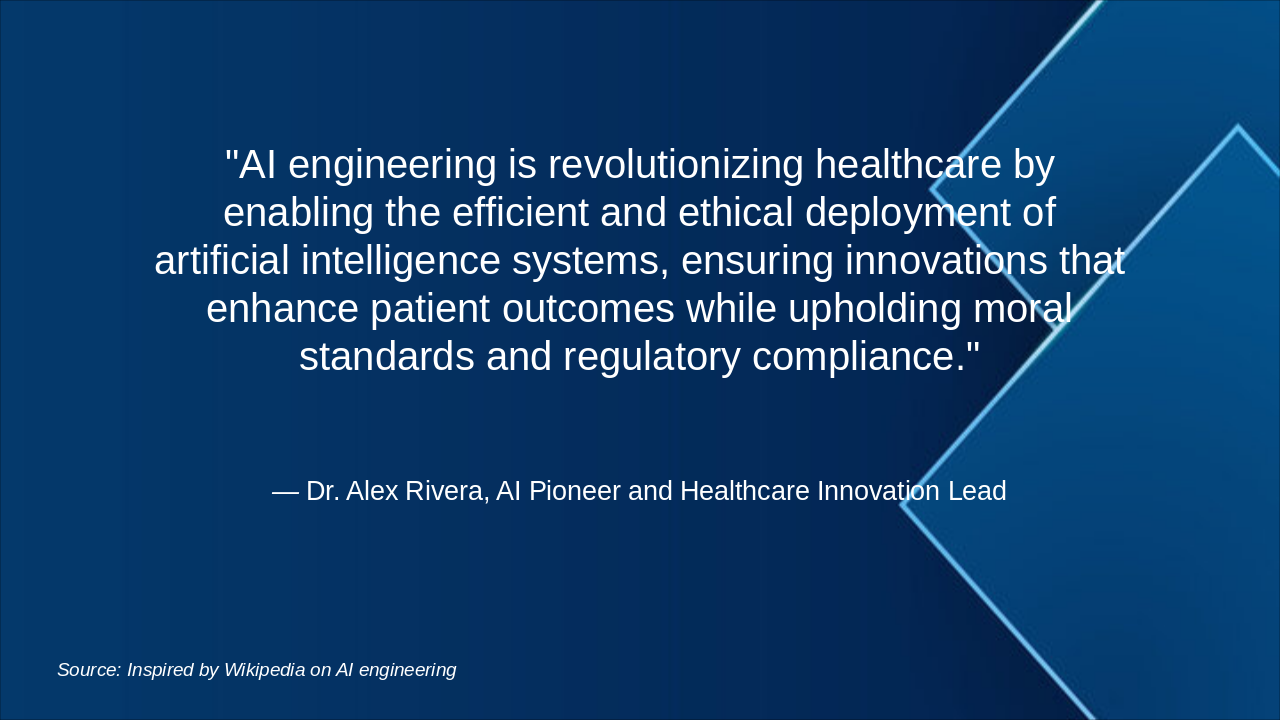
The slide, titled "Expert Insights," features a quote from Dr. Alex Rivera, an AI Pioneer and Healthcare Innovation Lead. In it, she explains how AI engineering is transforming healthcare through efficient and ethical AI system deployment, boosting patient outcomes while maintaining moral standards and regulatory compliance.

Expert Insights

> AI engineering is revolutionizing healthcare by enabling the efficient and ethical deployment of artificial intelligence systems, ensuring innovations that enhance patient outcomes while upholding moral standards and regulatory compliance.

— Dr. Alex Rivera, AI Pioneer and Healthcare Innovation Lead

Source: Inspired by Wikipedia on AI engineering

--- Speaker Notes: Context: Create a presentation about healthcare AI

Slide 10
Slide 11 of 12

Slide 11 - Challenges and Future

This section header slide introduces the topic of "Challenges and Future" in healthcare AI. It focuses on discussing ethical issues, data privacy concerns, and the essential need for robust AI infrastructure.

Challenges and Future

Discussing ethical issues, data privacy, and the need for robust AI infrastructure in healthcare.

Slide 11
Slide 12 of 12

Slide 12 - Conclusion: Embracing AI in Healthcare

AI engineering in healthcare transforms diagnostics, personalizes treatments, and boosts efficiency, resulting in better patient outcomes and innovative breakthroughs. The slide urges investing in ethical AI development now to shape a superior healthcare future, under the subtitle "Embrace AI: Transform Healthcare Now."

Conclusion: Embracing AI in Healthcare

AI engineering in healthcare revolutionizes diagnostics, personalizes treatments, and enhances efficiency, leading to superior patient outcomes and groundbreaking innovations.

Call to Action: Invest in ethical AI development today to drive better healthcare tomorrow.

Embrace AI: Transform Healthcare Now.

Slide 12
Powered by AI

Create Your Own Presentation

Generate professional presentations in seconds with Karaf's AI. Customize this presentation or start from scratch.

Create New Presentation

Powered by Karaf.ai — AI-Powered Presentation Generator