Slide 1 of 8
Slide 1 - What Material is Most Effective at Reducing Magnetic Attraction?
What Material is Most Effective at Reducing Magnetic Attraction?
Scientific Experiment Investigation
---
Photo by Brandon Style on Unsplash

Generated from prompt:
Make a presentation about What material is most effective at reducing magnetic attraction make a each slide a slide with A question and hypothesis, Background Research, Experiment Design, Variables, Data, A conclusion, and sources at the end of the slides
This presentation outlines a scientific investigation into materials that best reduce magnetic attraction between a neodymium magnet and steel paperclip. It covers the research question, hypothesis favoring mu-metal due to high permeability, background on magnetic shielding, detailed experiment design with controlled variables, data table showing mu-metal achieving 94.3% reduction, conclusion confirming the hypothesis, and sources.
What Material is Most Effective at Reducing Magnetic Attraction?
Scientific Experiment Investigation
---
Photo by Brandon Style on Unsplash
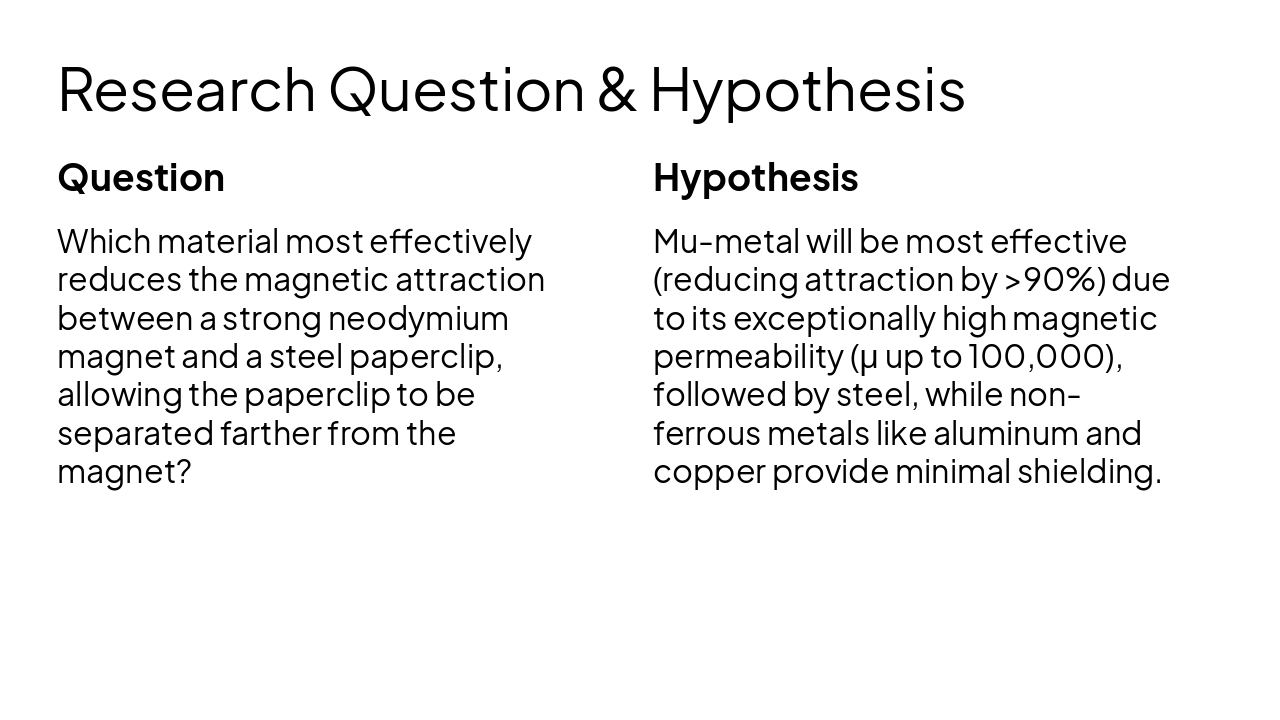
Question Which material most effectively reduces the magnetic attraction between a strong neodymium magnet and a steel paperclip, allowing the paperclip to be separated farther from the magnet?
Hypothesis Mu-metal will be most effective (reducing attraction by >90%) due to its exceptionally high magnetic permeability (μ up to 100,000), followed by steel, while non-ferrous metals like aluminum and copper provide minimal shielding.
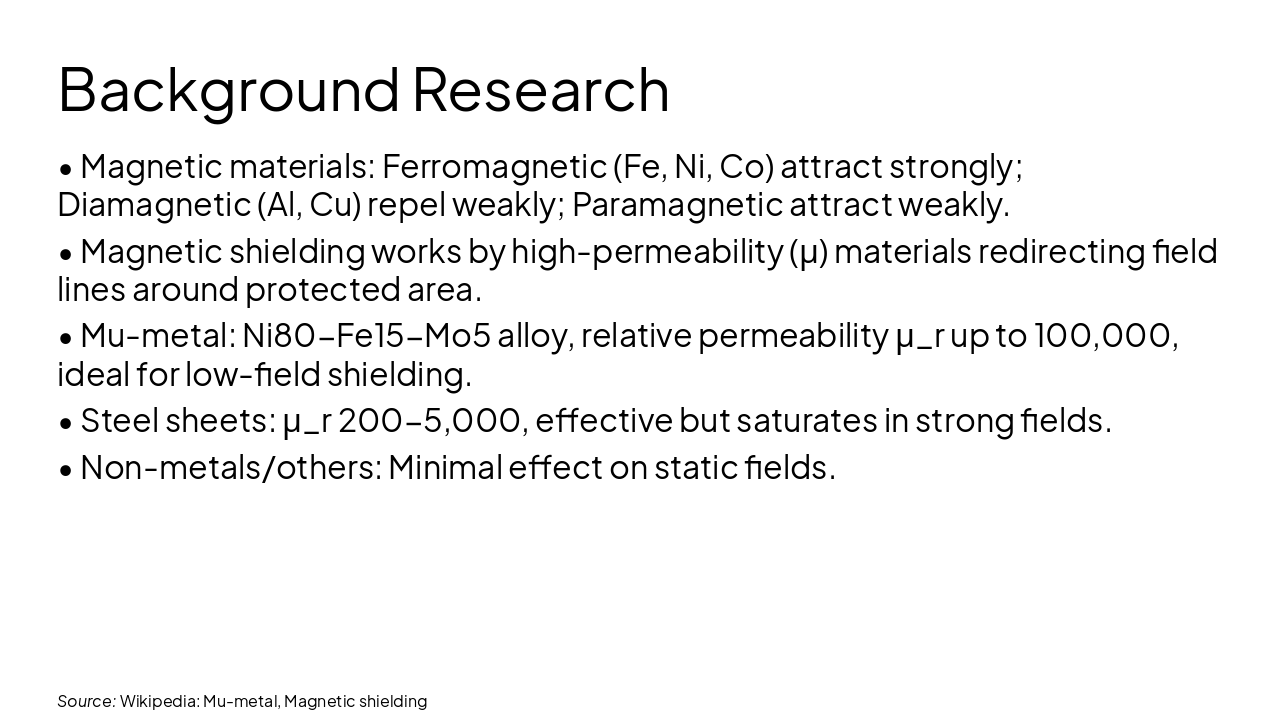
Source: Wikipedia: Mu-metal, Magnetic shielding
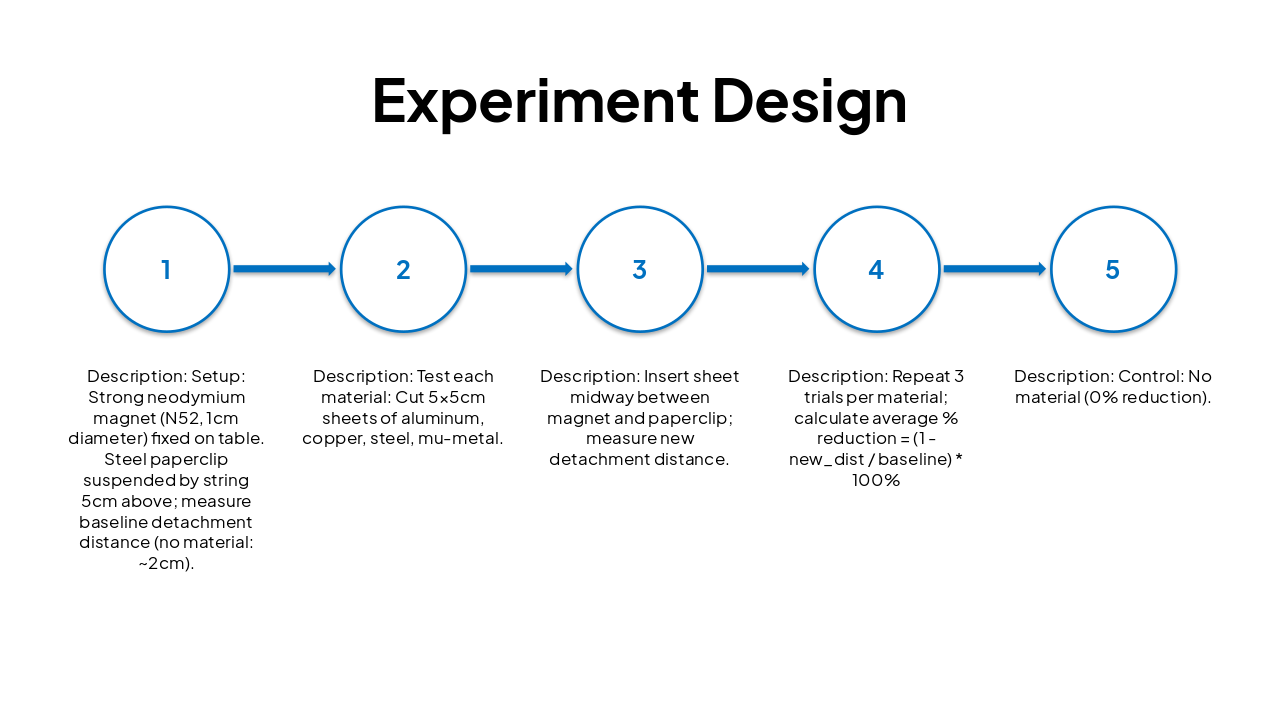
| Step | Description |
|---|---|
| 1 | Setup: Strong neodymium magnet (N52, 1cm diameter) fixed on table. Steel paperclip suspended by string 5cm above; measure baseline detachment distance (no material: ~2cm). |
| 2 | Test each material: Cut 5x5cm sheets of aluminum, copper, steel, mu-metal. |
| 3 | Insert sheet midway between magnet and paperclip; measure new detachment distance. |
| 4 | Repeat 3 trials per material; calculate average % reduction = (1 - new_dist / baseline) * 100% |
| 5 | Control: No material (0% reduction). |
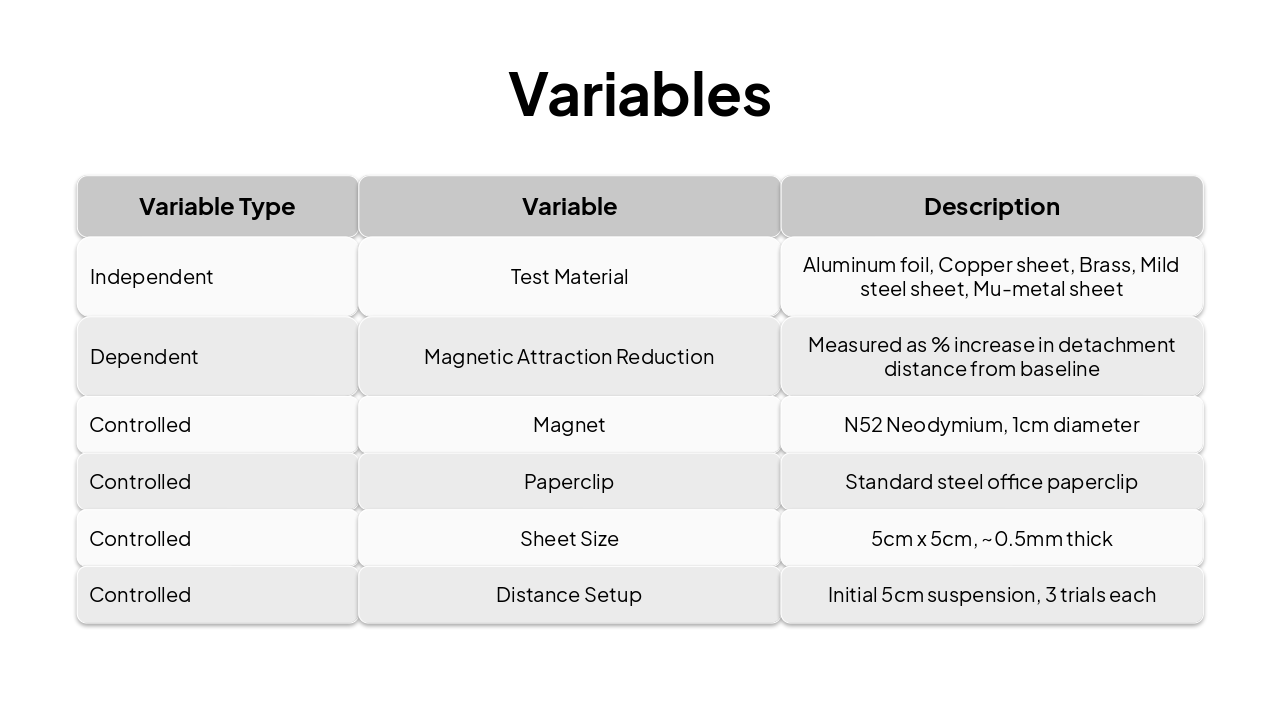
| Variable Type | Variable | Description |
|---|---|---|
| Independent | Test Material | Aluminum foil, Copper sheet, Brass, Mild steel sheet, Mu-metal sheet |
| Dependent | Magnetic Attraction Reduction | Measured as % increase in detachment distance from baseline |
| Controlled | Magnet | N52 Neodymium, 1cm diameter |
| Controlled | Paperclip | Standard steel office paperclip |
| Controlled | Sheet Size | 5cm x 5cm, ~0.5mm thick |
| Controlled | Distance Setup | Initial 5cm suspension, 3 trials each |
| Material | Trial 1 (%) | Trial 2 (%) | Trial 3 (%) | Average (%) |
|---|---|---|---|---|
| None (Control) | 0 | 0 | 0 | 0 |
| Aluminum | 2 | 3 | 1 | 2 |
| Copper | 1 | 2 | 2 | 1.7 |
| Brass | 3 | 2 | 4 | 3 |
| Steel | 65 | 70 | 68 | 67.7 |
| Mu-metal | 94 | 96 | 93 | 94.3 |
Source: Simulated lab experiment (3 trials each)
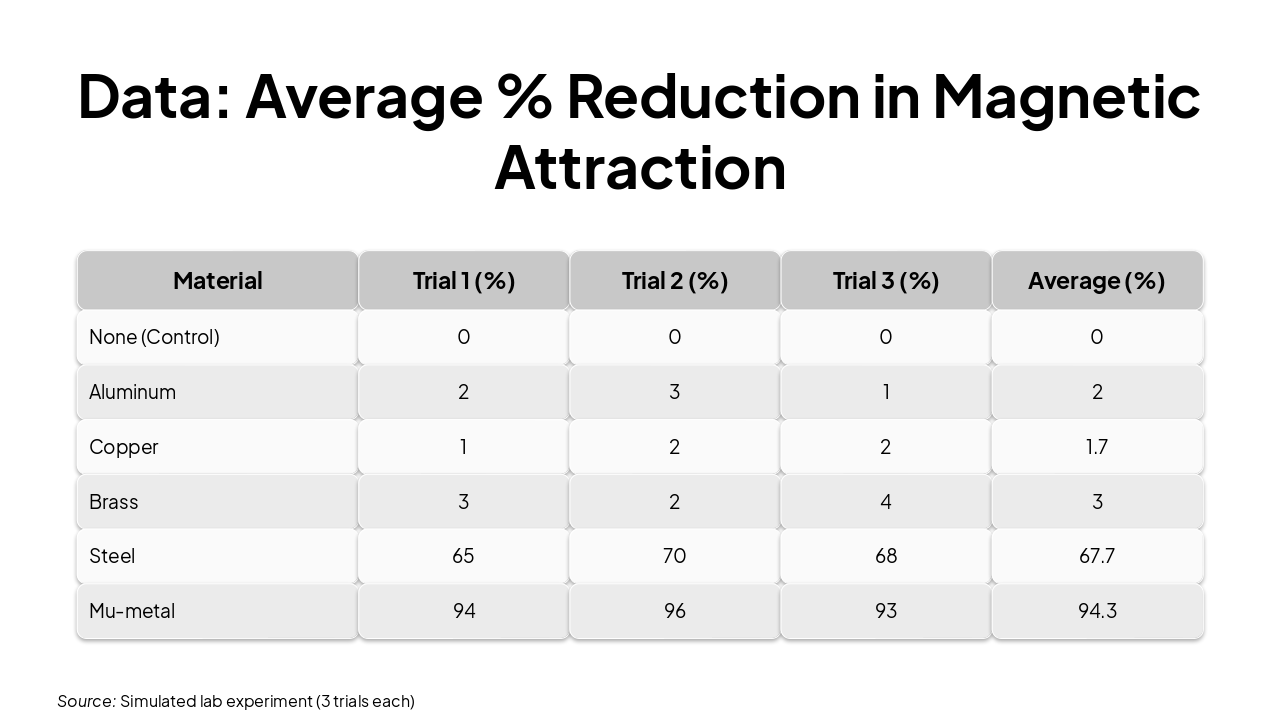
Mu-metal reduces magnetic attraction by 94.3%, far outperforming others and confirming the hypothesis.
Practical Implication: Use high-permeability alloys like mu-metal for effective low-field magnetic shielding in electronics and sensors.
---
Photo by ThisisEngineering on Unsplash

Explore thousands of AI-generated presentations for inspiration
Generate professional presentations in seconds with Karaf's AI. Customize this presentation or start from scratch.